TS-E for dummy

tpatana said:
If that were completely true, the focal plane is always horizontal no matter what, since that chart covers basically every tilt angle. It'd be just question of how high from ground the plane is, or how much below ground.

So what I'm saying, there's some missing piece on the puzzle that I haven't figured out yet.

I'm not quite sure what you mean by that, I may have misunderstood what exactly it is that you're missing (or I'm missing something myself; also very possible).

I would reformulate what you wrote to say :

"The focal plane can always be set to a horizontal position (at a certain, specific focus distance), for any tilt angle, it's just a question of how high from the ground the plane is, or how much below ground".

I believe that statement is true (ignoring petty constraints such as limited tilt angles, close focusing ability of the lens or the existence of 100 meter high tripods).

But remember, once your tilt value is set, if you move your focus ring, your plane of focus tilts, and therefore does not remain horizontal. For a given tilt value, the plane of focus can only be horizontal at one specific focus distance. Consequently, at a given tilt value, you can only have a horizontal plane of focus at one specific height above or below ground.

Hence, if you want it to be horizontal AND on the ground (so at a given vertical distance from your camera), you need a specific tilt value, so that once you find the focus distance that gives you a horizontal plane, it happens to fall on the ground. At any other tilt value this wouldn't work. You could still create a horizontal plane of focus, but it would fall above or below ground level.

Hopefully I'm making things a bit clearer, apologies if I'm just confusing things even further ;)
 
Upvote 0
NorbR said:
tpatana said:
If that were completely true, the focal plane is always horizontal no matter what, since that chart covers basically every tilt angle. It'd be just question of how high from ground the plane is, or how much below ground.

So what I'm saying, there's some missing piece on the puzzle that I haven't figured out yet.

I'm not quite sure what you mean by that, I may have misunderstood what exactly it is that you're missing (or I'm missing something myself; also very possible).

I would reformulate what you wrote to say :

"The focal plane can always be set to a horizontal position (at a certain, specific focus distance), for any tilt angle, it's just a question of how high from the ground the plane is, or how much below ground".

I believe that statement is true (ignoring petty constraints such as limited tilt angles, close focusing ability of the lens or the existence of 100 meter high tripods).

But remember, once your tilt value is set, if you move your focus ring, your plane of focus tilts, and therefore does not remain horizontal. For a given tilt value, the plane of focus can only be horizontal at one specific focus distance. Consequently, at a given tilt value, you can only have a horizontal plane of focus at one specific height above or below ground.

Hence, if you want it to be horizontal AND on the ground (so at a given vertical distance from your camera), you need a specific tilt value, so that once you find the focus distance that gives you a horizontal plane, it happens to fall on the ground. At any other tilt value this wouldn't work. You could still create a horizontal plane of focus, but it would fall above or below ground level.

Hopefully I'm making things a bit clearer, apologies if I'm just confusing things even further ;)

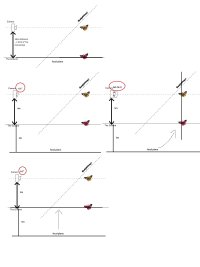
This starts to make sense, to some degree. There's just some interesting items, see my graph below (original picture stolen from Northlight, plus added some of my mad paint skills to it)

So top picture. You're at 10m from ground. Based on the chart, you set the focus at 0.1°.

Second picture, you move down 5m without changing anything else. Now you're 5m from ground, and your focal plane just went 5m underground. From this, if you tilt 0.2° more (bottom picture), the focal plane moves up by 5m. If you tilt 0.1° less (to make it no tilt, picture on right), it suddenly flips to vertical.

The tilt movement either flips it up, or moves it up, depending on which direction you tilt. In my mind, tilt change effect should be always same, regardless of which direction you tilt.
 

Attachments

  • tse_thinking.jpg
    tse_thinking.jpg
    132.5 KB · Views: 203
Upvote 0
tpatana said:
NorbR said:
tpatana said:
So say I have camera at height X, and tilt Y degrees to make the focal plane horizontal. Now if I move the camera 30cm straight up, why would the focal plane not still be horizontal? Shouldn't it just be 30cm higher than it used to be?

Yes, in that scenario, the focal plane will still be horizontal, and 30cm higher than it used to be. If that's what you want, great, but often it's not what you would be looking for. Assuming that the focal plane was at ground level in the first place, and that you want to put it back on the ground after raising your camera 30cm, that's where you'll have to adjust tilt. You can't just move the focus ring, because your plane of focus will not remain horizontal. You'll have to adjust focus AND tilt (in your example, lower the amount of tilt).

If that were completely true, the focal plane is always horizontal no matter what, since that chart covers basically every tilt angle. It'd be just question of how high from ground the plane is, or how much below ground.

So what I'm saying, there's some missing piece on the puzzle that I haven't figured out yet.

Being a physicist myself, I understand both your need to fully understand the physics and the issue at hand. The image cube is not rectilinear. While left/right and up/down (on a non-fisheye lens) are reasonably rectilinear, the mapping of source distance to focal plane distance is not. Just review the equation for image and focal distances for a simple thin lens and you will see the strong 1/r like non-linearity. What the tilt-shift lens allows is for the sensor plane to slice through the "image cube" at arbitrary orientations. If all 3 coordinates were rectilinear, then you would be right and height would not make a difference. However, given the curvature in the focus coordinate, for a fixed tilt the image plane effectively rotates as the focal distance is changed (e.g., the camera height is changed). Changing focus moves you to a different place on the curved focal plane coordinate and it has a different local slope there.

Joe
 
Upvote 0
Re: TS-E for physicist

OK - I see the problem (I originally read astrophysics at uni and worked as an engineer amongst many other things )

What you want is all the stuff I work so hard to leave out of my articles!
What I've written is for photographers ;-)

The details I suspect you want are the sort of things that would drive off 96% of photographers (and 96% is being generous ;-)

Read Harold Merklinger's book

http://www.trenholm.org/hmmerk/index.html#FVC

Then you will see why I leave so much out and make some approximations to explain the use of tilted lenses ;-)
 
Upvote 0
I have the ts 90 and use it for pano's - not the way you think. I really like the sharpness and DOF(f) control.

The number one thing I suggest all who get a T/S is to..... TAKE A MOVIE.

Of your backyard, living room, or something where you can move through all the adjustements and talk your way through. Slowly - slower than you think and you will see how each adjustment changes the DOF(f).

Even some of the experienced T/S folks tell me they have an "aha" moment.

So put on a tripod, start with the max aperture, something close, mid distance, etc.

Watch the leading edge of focus, trailing, the leading edge of the image (shifting) and trailing.

Helped me ALOT.

Cause I am a dummy.
 
Upvote 0
Re: TS-E for physicist

keithcooper said:
OK - I see the problem (I originally read astrophysics at uni and worked as an engineer amongst many other things )

What you want is all the stuff I work so hard to leave out of my articles!
What I've written is for photographers ;-)

The details I suspect you want are the sort of things that would drive off 96% of photographers (and 96% is being generous ;-)

Read Harold Merklinger's book

http://www.trenholm.org/hmmerk/index.html#FVC

Then you will see why I leave so much out and make some approximations to explain the use of tilted lenses ;-)

Lol, yes. First I do want to just use the lens, but I also want to understand how/why things go like they do. Especially that figure I posted, such huge movement from such tiny tilt angle sounds strange, so that makes me want to learn it even more.

Thanks for the link, have to read more on the lens.
 
Upvote 0
Dear tpatana,

I had the same issues that you presently have, I needed to understand the principles before feeling comfortable when using the lens. Like yourself I have an inquiring mind and spent most of my adult life flying high performance aircraft and teaching others how to do so. In this world of mine we had to understand the principles absolutely in order to react instantaneously when we needed to. Operating a TS lens is perhaps less dramatic and the consequences less dire in case something does not work out. Also in this world we had to digest high volumes of diverse information and in the end had to put it all together in a harmonious fashion, only now we could then simplify.

Let's simplify the little tilt thing and in the end enjoy its use and the magnificent results that can be obtained.

The main issue for me was to understand exactly how the Depth of Field reacts when tilting, all the way from no tilt to max tilt. How does the DoF change from that of an un-tilted lens to a wedge? This resulted in reading a lot of theory and finally writing an Xcel macro which graphically illustrates all this. The best literature I could find was twelve different documents by Harold Merklinger. So what did I learn?

The basic adjustments on the lens are:
Focus Distance - This places the Focal Plane at a particular distance perpendicular to the camera sensor.
Lens Tilt - This determines the "Hinge Line" or axis around which the "Wedge" of acceptable focus will rotate.
Camera Body Tilt - Nobody tells you about this - Simply tilting the camera body forward and backwards.
Aperture - Increases or decreases the DoF and thus also the angular width of the "Wedge" of acceptable focus.

Coming back to the DoF behavior from being un-tilted to any amount of tilt:

The un-tilted plane of sharpest focus is naturally at the Focus Distance which you set on the lens and is on a line straight through the centre of the lens and perpendicular to the sensor plane. The "Hinge Line" or axis of rotation of the "Wedge" is then at infinity and parallel to the Focus Distance Plane.

When we start to tilt the lens, the plane of sharpest focus remains at the Focus Distance where it intersects the un-tilted line of sight. The "Hinge Line" is now no longer parallel to the "Focus Distance Plane" and starts to intersect it, albeit very far away. As lens tilt is increased the "Hinge Line" will move closer to the lens.

What this all tells us is that the Sharpest Plane of Focus will always be at an angle to the lens line of sight. Now the only way to place the Plane of Sharpest focus onto a horizontal surface is to use Camera Body Tilt by the same amount as the angle between the Focus Distance Plane and the Sharpest Plane of Focus.

Most people seem to just rely on the fact that the Plane of Sharpest Focus and the Plane of Far Acceptable Focus covers the horizontal surface that you need to capture.

This is perhaps the most compact version I could explain this, should you need more knowledge about it please let me know, will be glad to assist. I tried to use the terms found in Merlinger's literature.
 
Upvote 0
While it is good to get the physics, do bear in mind that the physics is for perfect optics. No field curvature, no changes with tilt and shift etc..

Certainly for the TS-E 17mm this is not the case. Understanding the theory only tells you what direction you should theoretically move (or how to get an approximate starting point), not what will actually get you the shot you want.

For instance, do you actually want the focal plane 'flat' on the ground? You may say for a particular shot, well obviously, yes. Then you do everything right and find you have very soft near corners, or something else not quite as you expected.

Then, assuming you are prepared to 'bend' the theory you will find the best focus distance and tilt for the shot you want. Maybe you care about the corners, or maybe you don't, maybe you are OK with a slightly softer infinity for sharper near-field corners, or maybe not. This involves a lot of experimentation and a methodology to setting up a shot and getting the tilt and focus where you want it (maybe the shift too) for the shot at hand and the particular lens. Knowing the lens is 1/2 the equation IME and you only get that with taking a lot of shots.

When you get to fine adjustments the fact you are actually moving the lens, rather than the camera doesn't help either.
 
Upvote 0
I did couple test shots on Monday at a basketball arena, and just tried the next door church (w/ 6 stop ND). Both have basic LR adjustments, church needed 0.5 degree tilt, tripod was almost level but not exactly.

What amazes me with the church picture is the lack of CA. There's some, but that kind of shot is brutal for many lenses. Also noticed that there's couple small specks in the sky, so time to get my cleaning kit out soon. I've seen way worse, but it only takes couple minutes to clean so might as well start the new year with clean sensor :)
 

Attachments

  • T1D_8756.jpg
    T1D_8756.jpg
    1.1 MB · Views: 201
  • T1D_0734.jpg
    T1D_0734.jpg
    1.2 MB · Views: 205
Upvote 0
tpatana said:
Ok, time to educate a dummy. For some time I've been looking for the TS-E lens(es), and reading quite a bit about them too. Problem is that without one in hand, the instructions can be complicated. Now I finally snatched one from the Canon refurb deals, 24 Mark II :) Waiting for the shipment to arrive...

I'm sure I'll learn plenty by just playing with the knobs, but to start with, can someone give dummy-proof setting how they usually use in certain situations. Dummy-proof as in how is the tilt (including direction), shift (including direction), rotation and focus, for following scenarios:

1: Typical landscape

2: Typical tall building when standing relatively close

3: The "mandatory" miniature shot


For 1), I was reading one recommendation about rotating 30 degrees, and then shifting each end, rotate 30 to another side and again shift. Then stitch the 4 shots.

For bonus points: Seems tripod is recommended usually. Anyone use handheld?

And should I get ND and/or CPL?

You can use the TS-E lenses as precision instruments for straightening converging lines, making perfect panoramas, and yes you can calculate the exact tilt angle required to have the ground from your feet to infinity in focus, but you're missing out on a lot fun if you only shoot that way.
To me, the real paydirt comes from getting up close and personal with the tilt. Tripod or handheld - find some cool stuff to put in the foreground, then tilt so you have some of the background in focus. Its a classic shot, but endlessly fun and challenging. Shoot with the blood!
This first picture was shot handheld, near Coyhaique, Chile. This is a perfect example of when to use tilt. It was extremely windy as it always is in Patagonia, so I needed a fast shutter speed. I wanted the flowers as the main focus of the picture with the mountains in the background, so I needed a huge depth of field. Typically fast shutter and huge depth of field are contradictory, but TILT to the rescue! I threw the lens into maximum tilt towards the ground, leaned over the flowers, composed, focused, and took the picture.
I know the whole image isn't in focus, but that's the point! I find it hard to believe, but there are so many photographers who don't get selective focus.
Photo info: 6D, TS-E 24II, 1/500sec, f/8, ISO 400
 

Attachments

  • IMG_6483.jpg
    IMG_6483.jpg
    1.4 MB · Views: 208
Upvote 0
More fun with tilt:
My friend decided he needed a Maori tattoo. I was there to catch his priceless expression:
Photo Info: 60D, TS-E 24I, 1/250sec, f/3.5, ISO 1250 with enough tilt for his face and hand to be in focus.
 

Attachments

  • IMG_8276.jpg
    IMG_8276.jpg
    1.6 MB · Views: 176
Upvote 0
I've taken shot now and then, slowly learning how it works. Fun experimenting.

Took some amount this week travelling.

First one 4 photo stitch (shift diagonally, rotate and shift again).

Second one 30" exposure with 6 stop ND.

Third one with tilt&shift.
 

Attachments

  • T1D_4847-Pano.jpg
    T1D_4847-Pano.jpg
    1.5 MB · Views: 140
  • T1D_4979.jpg
    T1D_4979.jpg
    1.2 MB · Views: 161
  • T1D_5016.jpg
    T1D_5016.jpg
    921.1 KB · Views: 161
Upvote 0