What’s Coming Next from Canon?

I think what people get confused by (as I was myself until I did some reading up about the physics of it) is the difference in the effect on noise of total light and that of light per unit area. Good explanation (the one that finally made it click for me) from Richard Butler on this DPreview thread, with the bit that I think people get led astray by in bold:


I know that's what you've been saying but it puts it in a slightly different way that I personally found easier.
That's fair enough, and this subject not particularly intuitive; but the bigger problem (on this forum and in the world generally) is when people who don't understand things cling doggedly to their ignorance in the face of any and all evidence and explanations. A little humility goes a long way - nobody knows everything, and all of us had to learn each thing for the first time once upon a time. But those people don't have that attitude, they start from a position of absolute self confidence (and even if they do finally concede, an apology is rarely forthcoming).
 
Upvote 0
In my opinion, you are mixing apples and pears. The comparison with rain and area is wrong. The same amount of water falls on the area. That's the principle of the rain gauge, gentlemen 😀

I really don't know what you're talking about here. I know the R7 takes nice pictures of animals. And that's why I bought it.


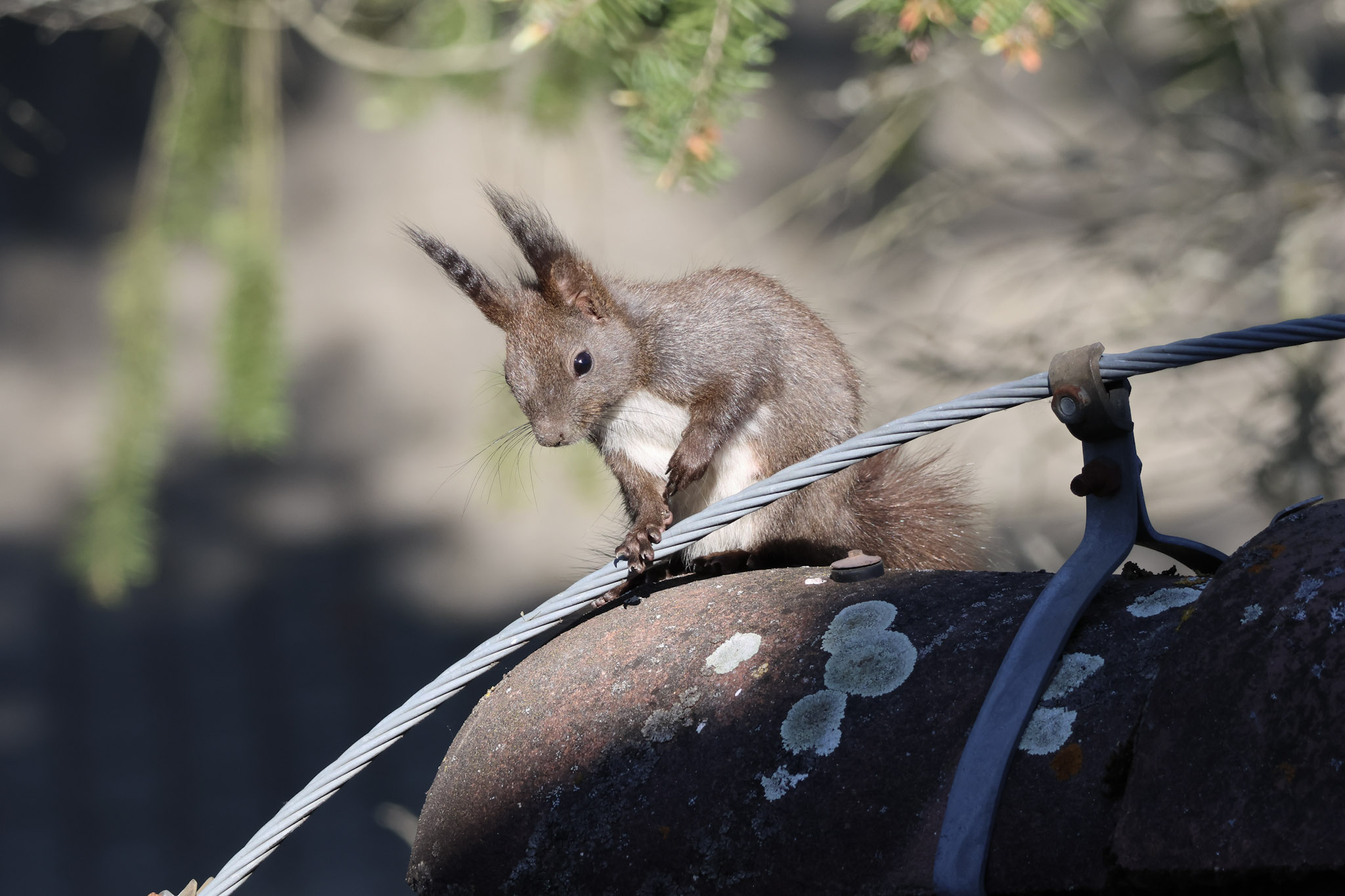
Here you have a squirrel, for example.

Do you see her fine whiskers? Are those the buckets of water?

Don't sweat, you'd be hard pressed to find any difference between APS-C and FF under proper lighting.
Full frame merely raises the ceiling of what you can theoretically achieve in terms of image quality by giving you a bit more flexibility, that's it. I take much better pictures with my R7 + RF 100-500L than the R5 Mark II + 200-800 I was lent. Possibly because I know my setup much better and know how to go around its weaknesses, but also because I simply have a superior lens.

Depth of field is a much more compelling argument in favor of FF for portrait photographers than dynamic range is for birders.
 
Upvote 0
Don't sweat, you'd be hard pressed to find any difference between APS-C and FF under proper lighting.
Full frame merely raises the ceiling of what you can theoretically achieve in terms of image quality by giving you a bit more flexibility, that's it. I take much better pictures with my R7 + RF 100-500L than the R5 Mark II + 200-800 I was lent. Possibly because I know my setup much better and know how to go around its weaknesses, but also because I simply have a superior lens.

Depth of field is a much more compelling argument in favor of FF for portrait photographers than dynamic range is for birders.
RF 100-500L is on my wish list... is it worth more than 200-800 for R7?
 
Upvote 0
RF 100-500L is on my wish list... is it worth more than 200-800 for R7?
It's $1000 / 1000€ more expensive new, but you can have it second hand for about 2500€ so not much more than the 200-800.

If you're talking about performance, you get an equivalent 160-800 with dual USM AF, great stabilization, three stabilizer modes, one dedicated to panning/birds in flight. All in a much lighter, smaller and more robust lens body.
The 200-800 is heavy, bulky, hard to balance when zoomed out and all around inferior. 800mm is quite soft on it so you're better off cropping from 700. On the R7 I can only imagine this being worse.
1280mm FF equivalent is far too much anyway, atmospheric disturbances will ruin the vast majority of your images.

The R7 paired with the 100-500 is already a bargain compared to FF equivalent kits and can absolutely produce award winning images. In fact, many people have won photography awards with this exact kit.
 
Upvote 0
Don't sweat, you'd be hard pressed to find any difference between APS-C and FF under proper lighting.
One other difference is that given the same sensor resolution you lose about one f/stop before diffraction becomes a problem because the photo site in an APS-C sensor of the same sensor resolution is that much smaller. Going in the other direction, keeping the photo sites the same size and not hitting diffraction losses earlier is going to cut overall sensor resolution.

Note I didn't say where diffraction becomes a problem since that depends on what the photographer considers acceptable loss of sharpness but given the same photographer, you lose about one stop by going APS-C. If diffraction bothers you at f/16 on full frame then you'll find it bothers you at f/11 on APS-C. If diffraction bothers you at f/8 on full frame then you'll find it bothers you at f/5.6 on APS-C.
 
Last edited:
Upvote 0
One other difference is that given the same sensor resolution you lose about one f/stop before diffraction becomes a problem because the photo site in an APS-C sensor of the same sensor resolution is that much smaller. Going in the other direction, keeping the photo sites the same size and not hitting diffraction losses earlier is going to cut overall sensor resolution.

Note I didn't say where diffraction becomes a problem since that depends on what the photographer considers acceptable loss of sharpness but given the same photographer, you lose about one stop by going APS-C. If diffraction bothers you at f/11 on full frame then you'll find it bothers you at f/8 on APS-C.
With higher resolution sensors, this difference between FF and APS-C is getting slimer with each new generation of camera and in a few years we probably won't compare FF and APS-C on diffraction.

The DLA of the R7 is around f/5.0, on the A7RVI it's f/5.6.
 
Upvote 0
Don't sweat, you'd be hard pressed to find any difference between APS-C and FF under proper lighting.
Depth of field is a much more compelling argument in favor of FF for portrait photographers than dynamic range is for birders.
In this context, dynamic range is really a surrogate for image noise.

Perhaps you usually shoot in 'proper lighting' (by which I think you mean lots of it). I shoot in the light I have, and it's often not very bright, either due to the fast shutter speeds needed for flying birds, or because I need to stop motion at indoor events.

I shoot a lot of birds in flight, and that requires a fast shutter. You mention your preference for the R7 and the 100-500L combo, and for my birding shots with that relatively slow lens, my most commonly used ISOs are at or over 12800.

100-500L by ISO.png

Personally, I would not shoot with an APS-C camera at those high ISOs. YMMV.

The story for me is similar for indoor events – I am usually shooting those with the 24-105/2.8 and 100-300/2.8, and almost all my shots are at ISO 6400 or higher. Here are the ISOs from my 100-300/2.8 shots, for example.

100-300L by ISO.png

If 'proper light' means, for example, in the ISO 100-1600 range, then for me that's a small minority of my images in some use cases.

And once again, the point is not about one sensor size being 'better' than another, but to be aware of the capabilities and limitations so an informed choice can be made based on an individual's needs.
 
Upvote 0