What is the best lens for astrophotography - 35mm or wider?

Matthew Saville said:
meywd said:
....
are you sure about the 24mm f/1.4? it is the recommended lens for astrophotography and always the reviews say its the one with least coma.

Rokinon 24mm f/1.4 ED AS UMC Review
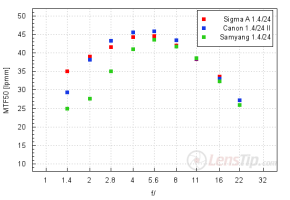
Samyang 24 mm f/1.4 ED AS UMC LensTip review
Prime Time! - Lenses for Night Photography

I was gonna say, how is the Rokinon 24 1.4 not at the top of everyone's list for astro work? It kills the Canon and Nikon, and the Sigma unfortunately did not match / beat it for coma and just barely surpassed it for vignetting, IIRC.

The one drawback about Roki-Bow-Yang lenses is, of course, their longevity and QC. You can indeed get a lemon. And you can expect a good copy of the lens to have a 50-50 chance of "rattling soft" if you spend too much time driving on nasty washboard roads to get to those nice desert places that astro-landscape shooters love to visit so much.

Considering the cost of the lens, and the cost of any of its competition, I consider it a fair trade. Buy three, keep only the sharpest one, return the others. Then in 2-3 years, sell it on Ebay, and repeat. Still way cheaper than a Canon L...

Compared to the Sigma 35mm, the Samyang 24mm does not appeal to me because:

1. Coma is inferior
2. Not sharp wide open
3. Distortion is high
4. Vignetting is high
5. No AF

3. and 4. can be corrected, but I dislike post-processing if it can be avoided because of increased noise. As East Wind Photography points out, AF increases the usefulness.
 
Upvote 0
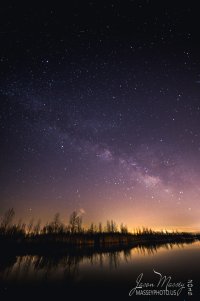
I know you have already made your choice but I just recently picked up the Rokinon 14mm f/2.8 and have found it to be a decent lens. I do see some coma but nothing I can't live with. The attached image was taken in an area with a lot of light pollution and was my first real attempt at Milky Way shots. I'm fairly happy with the result but hope to do better.

Anyway, I think it is a great, cheap choice for astrophotographers on a budget.
 

Attachments

  • IMG_2760.jpg
    IMG_2760.jpg
    1.6 MB · Views: 375
Upvote 0
chrysoberyl said:
Compared to the Sigma 35mm, the Samyang 24mm does not appeal to me because:

1. Coma is inferior
2. Not sharp wide open
3. Distortion is high
4. Vignetting is high
5. No AF

3. and 4. can be corrected, but I dislike post-processing if it can be avoided because of increased noise. As East Wind Photography points out, AF increases the usefulness.

Okay, if you compare the Sigma 35 to the Rokinon 24, its fair to say the Sigma is better, but that's mainly becaues it's 35mm, not 24mm. The Sigma 24mm doesn't beat the Rokinon 24 for much other than sharpness, and even then the Rokinon bests it in the extreme corners.

Considering that this is for astrophotography, I figured AF was completely out of the question.

For the record, though, as someone who doesn't just shoot astro, I do own the Sigma 35 as well, and love it. I just don't use it for astro nearly as much as I use my wider lenses. The Rokinon 14 and 24 are simply the go-to lenses, when you need such focal lengths without breaking the bank.
 
Upvote 0
I'll jump in here...

You guys please correct me if I'm wrong, but I thought one of the main reasons the Samyang 24 f/1.4 appears to have coma that is so uniquely better-controled is because its sharpness is so piss-poor! Its the Samyang's lack of resolution (at the ultra-wide apertures required of wide-field astrophotography) that goes a long way towards obscuring the the "gull wings" of problematic coma common to other manufacture's similarly fast 24mm lenses.

http://www.the-digital-picture.com/Reviews/ISO-12233-Sample-Crops.aspx?Lens=821&Camera=453&Sample=0&FLI=0&API=0&LensComp=985&CameraComp=0&FLIComp=0&APIComp=0
 

Attachments

  • 4239_roz2.png
    4239_roz2.png
    818.2 KB · Views: 1,302
Upvote 0
JustMeOregon said:
I'll jump in here...

You guys please correct me if I'm wrong, but I thought one of the main reasons the Samyang 24 f/1.4 appears to have coma that is so uniquely better-controled is because its sharpness is so piss-poor! Its the Samyang's lack of resolution (at the ultra-wide apertures required of wide-field astrophotography) that goes a long way towards obscuring the the "gull wings" of problematic coma common to other manufacture's similarly fast 24mm lenses.

http://www.the-digital-picture.com/Reviews/ISO-12233-Sample-Crops.aspx?Lens=821&Camera=453&Sample=0&FLI=0&API=0&LensComp=985&CameraComp=0&FLIComp=0&APIComp=0

Thank you, JustMeOregon! Sharpness partly molded my decision to go with the Sigma 35mm. Why have f/1.4 if it's not sharp? And the Sigma 35mm is even sharper wide open than any of these.

And distortion - I won't be critical of other's photo's (that's a matter of taste, budget, etc.), but for my photo's, I want a natural appearance with minimal correction that causes noise.
 
Upvote 0
BeenThere said:
As a prime, the Sigma 24 Art shot at f/2.8 gives pretty good results, including coma. But I still like the new Tamron SP 15-30mm best for its focal length flexibility plus good coma performance.

The Tamron is indeed another fine lens, but I have a Tokina 16-28 f/2.8 and nothing between that and 70mm, so 35mm made sense. Also, the flare is not good (I also do sunsets), the edges are bit weak and it is slower than the Sigma. But what great vignetting and coma! And VC!
 
Upvote 0
JustMeOregon said:
I'll jump in here...

You guys please correct me if I'm wrong, but I thought one of the main reasons the Samyang 24 f/1.4 appears to have coma that is so uniquely better-controled is because its sharpness is so piss-poor! Its the Samyang's lack of resolution (at the ultra-wide apertures required of wide-field astrophotography) that goes a long way towards obscuring the the "gull wings" of problematic coma common to other manufacture's similarly fast 24mm lenses.

http://www.the-digital-picture.com/Reviews/ISO-12233-Sample-Crops.aspx?Lens=821&Camera=453&Sample=0&FLI=0&API=0&LensComp=985&CameraComp=0&FLIComp=0&APIComp=0

For astrophotography, I find that field curvature, coma, and vignetting trump a slight difference in sharpness. I certainly wouldn't call the Rokinon piss-poor at 1.4, it's more than enough for a 4K timelapse, and can be used for star exposures while you drop your ISO and hit f/2.8 or f/4 for your foreground exposure.

Oppositely, Canon fast wides are notorious for practically turning into tilt-shift lenses when elements are misaligned, despite all that L build quality. Not so much the 24 L, but especially the 16-35 and 35 L's...

All in all, I certainly wouldn't hold it against someone for buying the Sigma 24. A bit more coma never hurt your timelapse, or even your still frame, as long as the photo itself is impressive. And sharpness helps you print impressive photos, bigger, much more than low coma does.

So what I'd say is, if you're mainly an astro shooter and already own the Rokinon, think twice before "upgrading" to the Sigma. However if you're a more well-rounded shooter, and find AF / central sharpness useful, then by all means, consider the Sigma. Thirdly, though, if you own the Canon 24 L, well, IMO it's time to sell it. ;-)
 
Upvote 0
Ok, NancyP and Matthew, I am a beginner in astro, and I don't know how to hack into the Hubble feed, as Jrista obviously has (all, please note that this is a joke, so don't flame me!). So here is my question - stacking? How does that work with astro? Macro stacking I understand, but for astro, don't you get star movement?

Regarding the 24 L, yes, selling is my exact intention! Terrible coma. I sold my Sigma 85mm for the same reason, and also because of the stunningly inconsistent AF.
 
Upvote 0
chrysoberyl said:
Ok, NancyP and Matthew, I am a beginner in astro, and I don't know how to hack into the Hubble feed, as Jrista obviously has (all, please note that this is a joke, so don't flame me!). So here is my question - stacking? How does that work with astro? Macro stacking I understand, but for astro, don't you get star movement?

Regarding the 24 L, yes, selling is my exact intention! Terrible coma. I sold my Sigma 85mm for the same reason, and also because of the stunningly inconsistent AF.

Astro stacking software will perform an automated star alignment....or in the case of comets, can align on the comet. The rest is processing through complex mathematical algorithms to enhance faint detail and reduce background noise.

See Deep Sky Stacker to get started for free.
 
Upvote 0
Thank you, East Wind Photography, I will look into Deep Sky Stacker. It sounds perfect for shots taken with a sharp lens. Unfortunately, I live in the SE US where we rarely have clear air. But I will be camping on Mt. Mitchell at around 6400' in elevation in a few weeks, and I hope to get in a few shots.

What setup do you use for astro?
 
Upvote 0
I personally prefer the Zeiss 21mm f2.8 for astro wide angle. No coma wide open and a hard infinity stop, meaning, no fiddling around in the dark for perfect focus. The Zeiss 15mm is also a good one, for that wider view and the reasons mentioned above. While I have the Canon 24mm f1.4, I don't use it for astro, mainly for the issues of coma. Coma can be reduced by stopping down, but not eliminated. On the other hand, the 24mm is a great lens, when not used in astro work :)
 
Upvote 0
Crosswind said:
Matthew Saville said:
For astrophotography, I find that field curvature, coma, and vignetting trump a slight difference in sharpness. *snip*

+1

Absolutely. But it's not always about the technical quality. Esthetic, feelings and creative composition trumps everything else.

Edit; ...and patience.

Absolutely true, and we should never lose sight of that. In fact I've seen plenty of gorgeous timelapse montages that took my breath away, which were shot in a horribly mis-aligned Canon 16-35, so bad that you could see the de-focus even in a 1080p file. While I lament those folks' elitism that has led them to never consider another option, or to at least get their precious L glass serviced and brought to factory sharpness, I'm still glad they produced the beautiful content.

Give me an alarm clock, Sun Surveyor etc. on my phone, and a solid tripod, ...and any camera / lens in my hand will do.
 
Upvote 0
Crosswind said:
Mr Bean said:
I personally prefer the Zeiss 21mm f2.8 for astro wide angle. No coma wide open and a hard infinity stop, meaning, no fiddling around in the dark for perfect focus. *snip*

That's something really helpful when out in the dark, but sometimes it can be very cold (esp. at high altitude) and I fear that's the reason why so many lenses do not feature a hard infinity stop... y'know cause of material expansion caused by temperature difference. What do you think?

Edit: ...meaning that issue can indeed make a difference in terms of focus precision. If it's a really bad case and you have a lens with hard infinity stop, you may get problems by not being able to focus at infinity because the material of the lens internals slightly deformed. Although esp. Zeiss is using high-grade materials... but still...

I've thought about this too. However, I've used a couple of lenses with hard-infinity stops in sub-freezing temperatures, and they always seem to still pull off perfect star sharpness.

It probably has more to do with the mechanical and optical engineering of the lens. A prime that consists mostly of metal and closely aligned elements might simply be good to go in extremely cold / hot weather without losing infinity focus, while a cheaper, more plastic-y lens (especially a complex zoom) might not be afforded such a luxury, mechanically speaking.

All I know is, my freaking Nikon G lenses are extremely difficult to focus on stars. I don't know if any folks here have adapted the Nikon 14-24 to their Canon, like some of my friends have, but seriously focusing on the stars sharply is literally a fraction of a milimeter on both the scale and the focus ring. Comparatively, all you have to do with a Rokinon is rack focus once and then come to a halt near whatever marking is right for the ambient temp, and you're good to go.
 
Upvote 0
This is something I've been humming and hawing over for a long time. My first pick was the Samyang 14mm 2.8 and then I was fancying the Tamron 15-30mm 2.8, particularly after reading Dustin Abbott's review.

My hesitation is that the Samyang or the Tamron would pretty much be a dedicated astro lens. I do mainly landscape shooting and live and die by my GND filters (I currently use the 17-40mm f/4 but am looking to go with the 16-35 f/4 by New Year). I've already got a Lee filter set and the Samyang filter holder and the filters themselves are WAY too big and clunky for me. The same would hold true for any Tamron filter rig. My hesitation with the Tamron is that it's an awful lot of money for a niche lens, but I hesitate to go with the Samyang due to the QC issues. The Samyang QC issues are of particular concern since I do a lot of hiking and cycling, so I need my equipment to be able to take a beating.

I'd never considered a 24 1.4 or a 35 1.4, but after doing the math, both would give an additional 1.33 and 0.67 stops respectively when shooting wide open (shutter speed adjusted to prevent star trails). I still fancy ultra-wide, though.
 
Upvote 0