What lens would you buy.. if You....

Extenders add a lot of focal length without much extra weight. A monopod would help support whatever you choose without being too bulky or getting in the way as much as a tripod. And as already said, working on fieldcraft is pretty useful - although no good for a lot of situations.
 
Upvote 0
How about the Sigma 150-600 Contemporary? It's light, sharp, and affordable. Great for hand holding from what they say. Nearly at sharp as the Sport model but much lighter. Somebody said at f8 its nearly as sharp as his 600mm f4 II......
 
Upvote 0
For me the ultimate combo would be the 200-400L plus a 5DIII. Love the Bandoleer idea Eldar, you've inspired me to devise my own now, I have a standard belt with a neoprene single lens pouch are lying at home unused at present, guess what that's being transformed in to!!
 
Upvote 0
A hunter's blind and a tripod with gimbal mount and your existing lenses.
That allows you to set up in comfort. You can move around (quietly) inside the blind. Birds see you when you have camo on and are outside the blind - they aren't fooled, they have better eyes than we do. The trick is to get them to believe that you aren't a threat. Just sitting there in full sight, minding your own business, and moving forward an inch at a time every few minutes while looking the other way - not a threat, usually.
 
Upvote 0
bod said:
Mt Spokane Photography said:
I had the 400mm f/5.6, and the 300mm f/4 as well, but they have too many drawbacks so I sold them. Now I use a 5D MK III and the 100-400mm MK II

Would you mind expanding on the drawbacks compared to the zoom? I have been comparing these three lenses as regards getting the 400 or the 100-400 for bird photography and would value your feedback. Thanks.

The 400mm f/5.6 has three features I found that made it difficult to use for my photography.

1. A long MFD means low magnification, you can't get close to small birds or animals to fill the frame.

2. No IS. This means using a high shutter speed to capture static objects or a extremely stable platform, tripod and head. That high shutter speed usually relegates you to bright sunlight or excessively high ISO settings. For moving subjects at a distance, the 400 f/5.6 is fine.

3. A long lens and will not fit in ordinary camera bags like the 100-400 or 300mm f/4.


The 300mm f/4 makes a loud clunk when IS engages, but has a nice short MFD. It fits in a case as well. I'd take it over the 400mm L.

1. Poor IS, but better than none.

2. Generally not a long enough focal length for birds, so a TC is needed.

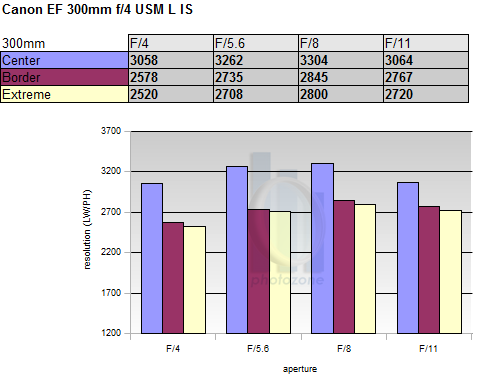
3. I was not impressed by the sharpness of my copy, its good if you stop it down, but wide open, its lacking and a TC will make it worse Testing seems to bear this out.

http://www.photozone.de/canon_eos_ff/611-canon300f4ff?start=1

mtf.png


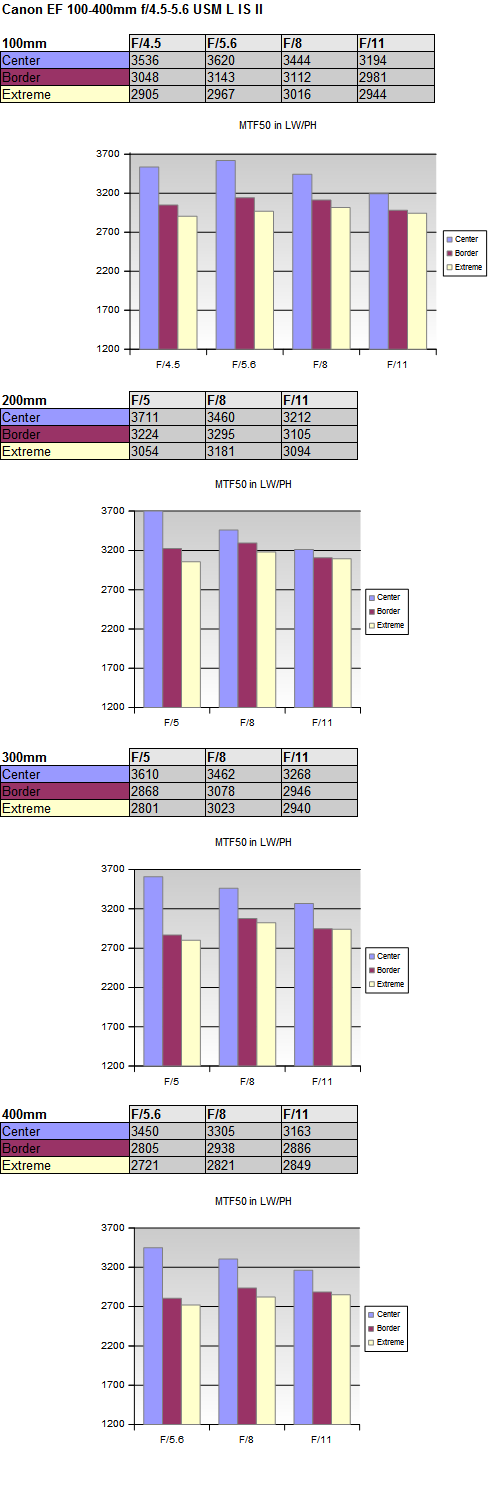
Although Zooms are a compromise, the 100-400mm L MK II is pretty good.

mtf.png
 
Upvote 0
Invest in a sherpa, not another lens.

Ok ok, in all seriousness. My only question is: do you even need a new lens? Sounds like you have a more-than-awesome kit as it is.

The only thing I can think of is the 400mm 2.8, and only if you need that extra stop of light.
 
Upvote 0
monkey44 said:
Then, learn to shoot the photos you CAN, and forget the ones you CAN'T. Too many photographers try to get shots that are near impossible given the physical capacity of humans. A photographer can try for the impossible or unlikely shots and miss ones that are truly remarkable, but closer. Think INSIDE the box ... or as was also suggested - get yourself inside the box.

I'm not suggesting all distant shots are impossible or worthless, or no one should challenge his/her skills in that realm. But, we can get caught up in distance and ignore what's right beside us.

Great advice! My longest lens is the Canon EF 400mm f/5.6. Until recently, I've been disappointed in most of the photos I've taken with it. Same thing with my 70-200 mkII. The reason I was disappointed is that I was having a lot of trouble getting clear shot of birds because I was never near enough and then had to massively crop the photos. The problem wasn't the lenses. The problem was my technique and trying to do the impossible. I've since learned patience and to attract the birds to get them closer. Wait for better opportunities. I'm a fairly new hobbyist, but learning. I don't waste thousands of senseless shutter clicks anymore either. Used to go out for an hour and come home with hundreds of useless photos. Now I go out and come home with less than 20. Enjoyed your post. What you wrote is spot on!
 
Upvote 0
Dholai said:
.. Shoot wildlife and birds


...already have 200-400 F4L
....600 mmF4L MKII
... 70-200 2.8L MK II

... to be used with

..1Dx
..7D MK II
..5DsR

And...
You can not handhold a camera with most lenses due to physical condition but want a lighter lens to try without compromising image quality ???

I don't own either one, but if you are looking for a wildlife lens that is light, sticking with canon, I believe your only options are the 300 and 400L's. I left off the 100-400 as you listed the 70-200 in the list as a potential weight problem. I hear good and bad on the 300, but the 400 gets praises for cost/weight if you can live without is and with f5.6.
 
Upvote 0
wsmith96 said:
I don't own either one, but if you are looking for a wildlife lens that is light, sticking with canon, I believe your only options are the 300 and 400L's. I left off the 100-400 as you listed the 70-200 in the list as a potential weight problem. I hear good and bad on the 300, but the 400 gets praises for cost/weight if you can live without is and with f5.6.

300L II and 400L II are way hevier than the 70-200L IS II.
The lightest and most flexible combo, from what you said, would be the new 100-400L II + 7D2. This combo is very hanholdable and with good technique you'll amazing results.
 
Upvote 0
Hjalmarg1 said:
wsmith96 said:
I don't own either one, but if you are looking for a wildlife lens that is light, sticking with canon, I believe your only options are the 300 and 400L's. I left off the 100-400 as you listed the 70-200 in the list as a potential weight problem. I hear good and bad on the 300, but the 400 gets praises for cost/weight if you can live without is and with f5.6.

300L II and 400L II are way hevier than the 70-200L IS II.
The lightest and most flexible combo, from what you said, would be the new 100-400L II + 7D2. This combo is very hanholdable and with good technique you'll amazing results.

The person you quoted was not referring to the VII f/2,8 lenses if you check the last sentence.
 
Upvote 0