Why are DSLRs so Big?

i agree with what most has been said here, i bought a 70d and its great but its too small, its okay with smaller lenses but with a big telephoto like the sigma 120-300 it sucks. your fingers pinch between the grip and the lens and the buttons are too small and close together. i like the size of the 40d, i suppose the 7dii will be bigger and would buy it just for that.

i bought an sl1 as a gift, its a great camera but its like typing on a blackberry, you feel like you have to use your fingertips to do anything
 
Upvote 0
unfocused said:
I admit to a bit of bias here, as I have serious doubts that mirrorless will ever supplant DSLRS. I don't really buy into the idea that the smaller size of a mirrorless makes it that much more desirable for many photographers.

Small size clearly seems to matter to some, though (but, given the poor sales history of M43 cameras, not *that* much). This is hardly a representative sampling, of course, but all the friends I have who have sought my advice re buying a (better) camera in the last few years, especially women, want something small enough to fit in a largeish handbag; and some of them consider cameras/lenses which strike me as light to be heavy, including such a lightweight combination as a Nikon D3200/Rebel + a couple of kit lenses. (I persuaded a colleague to get at least one of the smaller M43s, but she was unwilling to buy a Panasonic/Leica 25mm for it because it was "much heavier" than the other M43 lenses of similar focal length - we're talking a difference of a couple of ounces here; she stated it in grams to make it sound more dramatic...).

For my part, if the lenses can be kept small, I'll take a small body; and small systems are nicer to carry around all day on vacation, etc. But I would rather handle a larger camera; my fondness for the OM-D EM5 is mainly because of how well it works (and because I like how it looks). Big lenses on a small body is a combination that doesn't appeal to me at all.

 
Upvote 0
Canon-EOS-M-70_200_01.jpg

Good luck using something like this for a day long shoot ;D
 
Upvote 0
This is a great, relevant question. I recently got an SL1 http://www.dpreview.com/reviews/canon-eos-100d-rebel-sl1 as a light travel camera. This thing is TINY. Next to a de-gripped 7D it's hard to believe they are both APS-C bodies.

Next to the 1D MkIV and 5D3 it looks like a pocket camera. I needed a third body on a corporate job last week and hooked the SL1 onto my 300 f/2.8is. It looked hilarious, but the 1600 iso files were as good as gold.

I was pretty surprised when I got my gripped 5D3...it is heavier, taller, thicker and wider than my 1D MkIV. And the 1DX is slightly bigger in every dimension than the 1D MkIV. Let's hope that the current 1-Series and 5 Series bodies represent the peak in size and weight for Canon DSLR's.

-pw
 
Upvote 0
sdsr said:
unfocused said:
I admit to a bit of bias here, as I have serious doubts that mirrorless will ever supplant DSLRS. I don't really buy into the idea that the smaller size of a mirrorless makes it that much more desirable for many photographers.

Small size clearly seems to matter to some, though (but, given the poor sales history of M43 cameras, not *that* much). This is hardly a representative sampling, of course, but all the friends I have who have sought my advice re buying a (better) camera in the last few years, especially women, want something small enough to fit in a largeish handbag; and some of them consider cameras/lenses which strike me as light to be heavy, including such a lightweight combination as a Nikon D3200/Rebel + a couple of kit lenses. (I persuaded a colleague to get at least one of the smaller M43s, but she was unwilling to buy a Panasonic/Leica 25mm for it because it was "much heavier" than the other M43 lenses of similar focal length - we're talking a difference of a couple of ounces here; she stated it in grams to make it sound more dramatic...).

For my part, if the lenses can be kept small, I'll take a small body; and small systems are nicer to carry around all day on vacation, etc. But I would rather handle a larger camera; my fondness for the OM-D EM5 is mainly because of how well it works (and because I like how it looks). Big lenses on a small body is a combination that doesn't appeal to me at all.

For me this hits it right on the head. I want small(ish) lenses on a small camera. Unfortunately, with physics that kinda means a FF is pretty well out (for a compact mirrorless), especially for a fast lens, because you need all that glass. I actually wish they could have made the 22mm on the EOS-M just a tad bit thinner, because it doesn't fit quite as nice as I would like into my pocket. Just a bit too thick.
 
Upvote 0
I have taken apart a variety of digital cameras to convert them to infrared, both compact and DSLR size. There's no wasted space in there (not that anyone is saying that). There is almost always a balance between the mechanical and electrical design and layout that happens during product development. Each developer's "piece" of the puzzle has to work in harmony: Human factors, ESD and EMC radiation and susceptibility, thermal, mechanical, performance, etc. Certainly there are obvious size adders on the 1D series bodies, such as bottom battery placement, vertical and horizontal grip controls ,etc. But I am always amazed at how much technology gets squeezed in there.

I have small hands, but I absolutely love the feel of the 1D series in my hands. It just fits and works. I actually hope the size of the flagship models don't shrink too much even if technology allows. I use a 5D (infrared) and 5D Mark II on occasion and I always prefer the feel of the 1D cameras better. Having said that, there are times when it would be nice to have an SL1 in the bag :)
 
Upvote 0
The size and shape of canon's DSLRs are a consequence of the 35mm SLRs. Early DSLRs still had the motors and gears for advancing film.

They have to be as thick as they are to allow for the amount of distance between the sensor and the lens mount. Plus there is a mirror/prisim and a grid of focus sensors. Because of these limitations there was no miniaturization.

NOW that there is fast dual cmos focusing, that paves the way for a smaller mirrorless autofocus interchangeable lens camera that could be on par with canon's flagship cameras (5dm3/1DX).
 
Upvote 0
Speaking personally and professionally, I'll say that ergonomics play a huge roll(no pun intended). You get to a point when miniaturizing things that they get too small to effectively be able to interact with them. I live in the TV world and if you look at a one piece Betacam from the 90's with it's tape transport in the body vs. a solid state camera today(with 20 years of technological advancements), the bodies are still pretty much the same size, same weight and same layout of key switches and buttons(even among different manufacturers). If I go in my office and pick up my first Sony Betacam from 1997 and then pick up my Panasonic P2 Varicam from today, the power switch, black balance/white balance switch, filter wheel, record button, white balance memory switch, etc. are all in the same places. The cameras sit on my shoulder and balance similarly. My point is, especially in the professional world, the way something feels and the way you are able to interact with it are more important than "lets make it small just because we can".
 
Upvote 0
Dylan777 said:
Some even think that is one "sexy combo" :-\

Sorry, but I just don't see it and will never get it ::)

I actually tried it with my EOS m and 70-200 II and it was mildly usable for the short time period i was messing around with it. I pretty much was supporting the entire weight with my left hand on the lens and just kinda aimed and pressed the shutter with my right.

The most awkward part for me tbh was having to hold the combination in front of you to see the LCD instead of up to your face.
 
Upvote 0
DSLRs are big (well compared to what exactly?) because when DSLRs came into market the idea of the camera manufacturers were to put the available technology inside the body (or a similar body) of the existing film cameras - the form factor remained the same. For canon that form factor probably drew on T90; for Nikon it was probably something like the body of Nikon F401 or F4. At that time there was a technological limitation on the miniaturization of the digital components. And photographers have grown accustomed with the form factor so much that there have never really been any revolutionary change in that form (What can Lytro lightfield form factor do is yet to be seen). In future the size is bound to go down a bit... with further miniaturization of the digital and electronic components. For example with the new AF technology of 70D I can foresee that the AF sensor at the base of the camera (the are located at the base of the camera right?) will surely be eliminated - so will the secondary mirror. As SL1 has shown the sensor mount mechanism can also be made smaller - in near future that will go to full frame as well, but making full frame cameras smaller may not be in the primary goal list of camera manufactureres.


OP is forgetting that the DSLRs need space for several motherboards, chips and much more wiring than the film/analogue cameras. Roger cicala of Lens Rentals stripped down the 5D III long back,.... it is worthwhile to have a look at what it has inside

http://www.lensrentals.com/blog/2012/04/5d-iii-strip-tease
 
Upvote 0
RunAndGun said:
Speaking personally and professionally, I'll say that ergonomics play a huge role (no pun intended). You get to a point when miniaturizing things that they get too small to effectively be able to interact with them.

My point is, especially in the professional world, the way something feels and the way you are able to interact with it are more important than "lets make it small just because we can".

++1
My tiny SL1 is ideal as an ultra-lightweight travel body, but compared to a 1-Series body the ergonomics are separated by orders of magnitude. And it's not just about size. The seamless, close to perfect ergonomics of 1-Series bodies on a busy, demanding project tangibly deliver better outcomes for the client and with less mental fatigue for the photographer. While my gripped 5D3 is pretty darn good in the ergonomics department, it's still a long way short of the almost exquisite, highly evolved handling of just about every 1-Series since the original 1D which launched way back in November 2001.

-pw
 
Upvote 0
RunAndGun said:
Speaking personally and professionally, I'll say that ergonomics play a huge roll(no pun intended). You get to a point when miniaturizing things that they get too small to effectively be able to interact with them. I live in the TV world and if you look at a one piece Betacam from the 90's with it's tape transport in the body vs. a solid state camera today(with 20 years of technological advancements), the bodies are still pretty much the same size, same weight and same layout of key switches and buttons(even among different manufacturers). If I go in my office and pick up my first Sony Betacam from 1997 and then pick up my Panasonic P2 Varicam from today, the power switch, black balance/white balance switch, filter wheel, record button, white balance memory switch, etc. are all in the same places. The cameras sit on my shoulder and balance similarly. My point is, especially in the professional world, the way something feels and the way you are able to interact with it are more important than "lets make it small just because we can".

The point that I think some people are missing is that you can operate a DSLR "without looking" - i.e. while the viewfinder is up against your eye, you can change most or all of the important settings - shutter speed, aperture, controlling the AF system (not only focusing, but also selecting things like the AF points to use), ISO etc. all without lowering the camera to look at it. - Smaller form factors sacrifice that ability.
 
Upvote 0
unfocused said:
I've been reading with interest the many comments here about the desirability of a mirrorless system, with small size being one of the desired traits.

Well, recently I took a look at my old Canon F1 (which is on semi-permanent loan to my daughter as a decorating accessory in her apartment). I had forgotten how tiny it is compared to a 7D or a 5DIII. And, that got me wondering why are DSLRs so big?

The F1 used a reflex mirror, so we can't blame the size on the mirror housing alone. It was a "full frame" camera, so it's not the sensor. Perhaps the electronics require more space. But, then again, the F1 had to have two cavities, one for the film cassette and one for the exposed film. That was wasted space that DSLRs don't need. Yes, the DSLR battery is much larger than the little dime-sized battery that powered the F1 for decades. But, a DSLR doesn't require any of the mechanics needed by a film camera for advancing the film.

The new SL1 shows that Canon can pack most of these electronics into a smaller body.

So, I'm just wondering how we ended up with these supersized DSLRs. Is it just a styling convention – people expect a bigger camera for the price? Maybe it makes people feel more like a "pro" if they have a big camera body?

Will we see DSLRs start to shrink in the coming years? I wonder if Nikon's new retro camera will be the same size as their old SLRs.

Just some random thoughts and questions thrown out there for discussion.

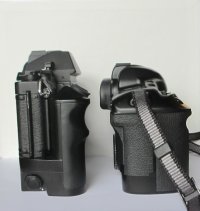
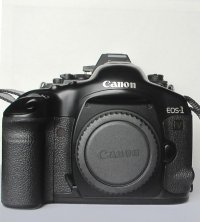
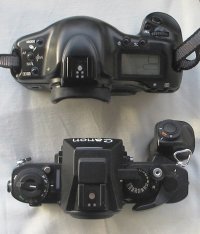
Top series dSLR body shape evolved out of SLR. Check the F1N (1981) size as compared to the 1V (2000) latest film pro body which is the base for today's dSLRs. It's fair to compare the F1N with power winder attached as this became incorporated in the 1V. As it shows, the F1N is overall larger than the 1V. Plan view shows the curvier design of the 1V for resisting to rain.

If you want to compare F1/1Ds MkIII you would have to attach the AE motor drive FN w/battery pack which is double size to the winder, result probably favours the 1Ds MkIII (1Dx only slightly larger).

Now, if you were to compare just the bare F1N body take a dSLR, strip LCD screens, change battery type and you get the idea of a Nik@n retro style DF.
 

Attachments

  • 01.JPG
    01.JPG
    195.2 KB · Views: 652
  • 02.JPG
    02.JPG
    231.5 KB · Views: 638
  • 03.jpg
    03.jpg
    159.8 KB · Views: 641
Upvote 0
gmrza said:
Smaller form factors sacrifice that ability.

Yes, *small*, but not necessarily smallER. Just because something isn't as large as a 1dx doesn't mean you cannot cleverly design it so you still have button access to all crucuial settings unless you try to operate it with thick gloves.

My observation is that next to there's a good deal of marketing involved. With the old film slrs like the EOS RT/620 I had back then you could exchange the grip with a bigger one, but currently spending less money means getting a cramp in the hand which is a striking incentive to "upgrade" from a Rebel. Also "bigger" means "sturdier" and "pro" and "I'm the photog, step aside people" - non of this is a necessity.

With the introduction of the 6d this might change a bit, it's not "pro" and crippled alright, but still not an embarrassing Rebel so it now seems to be more acceptable to like or wish for a smaller and lighter camera - the same seems to be happening with lenses looking at the latest Canon releases like the 24-70L2.
 
Upvote 0