Why can't there be IS/OS in all lenses?

Dec 16, 2013
216
0
6,456
I mean, they put it in their cheapest possible lens, the 18-55, which go for about 75 bucks in a kit. But they don't put it in various higher end lenses, like the 24-70/2.8 or 16-35. Sigma just announced a new 50 1.4 but with no OS. Why not? What am I missing? Why not make the price of a premium L lens like $1875 instead of a mere $1800 and add the IS?

(An aside, when I was with Pentax or Sony, I couldn't understand on the other hand why they didn't put hypersonic motors in all their new lenses. So many remained screw driven.)
 
IS affects the optical formula of the lens, it's not as simple as spalling a moving element and a pair of gyros in the barrel. Apparently, Canon tested IS versions of the 24-70/2.8 and weren't satisfied with the results.

RE your aside, screw driven motors are cheaper to produce - that's the same reason Canon doesn't include USM motors in all their lenses, the cheaper ones are generally micromotor AF.
 
Upvote 0
mackguyver said:
To follow up - why can't they make an extender with IS? I've wondered that for years, and I'm betting they could but don't want to cannibalize their sales of IS lenses. I'd be curious to see if anyone holds a (protective) patent for this. A quick search of Google patents doesn't come up with anything.

Tamron patented one about three years ago.

http://www.canonrumors.com/2011/02/cool-tamron-patent/

Nikon also has a patent for a front-mounted (i.e. like a screw-in filter) VC unit.
 
Upvote 0
neuroanatomist said:
mackguyver said:
To follow up - why can't they make an extender with IS? I've wondered that for years, and I'm betting they could but don't want to cannibalize their sales of IS lenses. I'd be curious to see if anyone holds a (protective) patent for this. A quick search of Google patents doesn't come up with anything.

Tamron patented one about three years ago.

http://www.canonrumors.com/2011/02/cool-tamron-patent/

Nikon also has a patent for a front-mounted (i.e. like a screw-in filter) VC unit.
Neuro, thanks for the link & info - would be interesting if this actually came to market.
 
Upvote 0
neuroanatomist said:
IS affects the optical formula of the lens, it's not as simple as spalling a moving element and a pair of gyros in the barrel. Apparently, Canon tested IS versions of the 24-70/2.8 and weren't satisfied with the results.

Yet Tamron seemed satisfied with theirs. I guess they have better engineers?
 
Upvote 0
Mr_Canuck said:
neuroanatomist said:
IS affects the optical formula of the lens, it's not as simple as spalling a moving element and a pair of gyros in the barrel. Apparently, Canon tested IS versions of the 24-70/2.8 and weren't satisfied with the results.

Yet Tamron seemed satisfied with theirs. I guess they have better engineers?

Or they were focusing on pretty darn good instead of ZOMGAMAZING sharpness like Canon was. Or they just started from different optical formulas and went from there. Lots of possible reasons, and unless we have the engineers from both in the same room talking about it (which we probably wouldn't understand a word of), it's just pure speculation on our part.

Also, I imagine that adding IS on the higher quality & faster lenses also involves more expensive IS due to the larger optical elements that are generally involved, which translates into heavier & more sensitive to positioning.
 
Upvote 0
Mr_Canuck said:
neuroanatomist said:
IS affects the optical formula of the lens, it's not as simple as spalling a moving element and a pair of gyros in the barrel. Apparently, Canon tested IS versions of the 24-70/2.8 and weren't satisfied with the results.
Yet Tamron seemed satisfied with theirs. I guess they have better engineers?

Or lower standards for image quality.
 
Upvote 0
neuroanatomist said:
Mr_Canuck said:
neuroanatomist said:
IS affects the optical formula of the lens, it's not as simple as spalling a moving element and a pair of gyros in the barrel. Apparently, Canon tested IS versions of the 24-70/2.8 and weren't satisfied with the results.
Yet Tamron seemed satisfied with theirs. I guess they have better engineers?

Or lower standards for image quality.

Well that doesn't explain the 70-200 "L" II with IS. Almost everyone agrees the image quality is at least as good as the non-IS 70-200 and even as good as the f2.8 L prime. So, while that's a clever remark, it doesn't seem all that valid.
 
Upvote 0
unfocused said:
neuroanatomist said:
Mr_Canuck said:
neuroanatomist said:
IS affects the optical formula of the lens, it's not as simple as spalling a moving element and a pair of gyros in the barrel. Apparently, Canon tested IS versions of the 24-70/2.8 and weren't satisfied with the results.
Yet Tamron seemed satisfied with theirs. I guess they have better engineers?

Or lower standards for image quality.

Well that doesn't explain the 70-200 "L" II with IS. Almost everyone agrees the image quality is at least as good as the non-IS 70-200 and even as good as the f2.8 L prime. So, while that's a clever remark, it doesn't seem all that valid.

Sure it does. Canon managed to get the quality they wanted with IS, so they released it. Tamron was happy with their 24-70 f/2.8 with IS, and they were happy with the IQ that it has. Almost everyone agrees that the Canon 24-70v2 is optically a good bit superior to the Tamron 24-70 f/2.8 VC. Maybe it's just that Tamron had a goal of outperforming the Canon 24-70v1, which they did by a decent bit. But either way, they found that a _lesser_ image quality was acceptable, thus lower standards. Undoubtedly with good engineers. You don't get what they have without them. But they still chose to release it.
 
Upvote 0
Mr_Canuck said:
I mean, they put it in their cheapest possible lens, the 18-55, which go for about 75 bucks in a kit. But they don't put it in various higher end lenses, like the 24-70/2.8 or 16-35. Sigma just announced a new 50 1.4 but with no OS. Why not? What am I missing? Why not make the price of a premium L lens like $1875 instead of a mere $1800 and add the IS?

(An aside, when I was with Pentax or Sony, I couldn't understand on the other hand why they didn't put hypersonic motors in all their new lenses. So many remained screw driven.)

It would probably be possible to redesign every lens to put IS in it. Being a practical thing is yet another matter. Generally, IS benefits longer focal lengths more, which is why you see it used there. However, if buyers want it and are willing to pay even if its not very useful, then it will come.

You do see IS in most crop lenses, they are aimed at beginning photographers who might not have yet developed a understanding of how to adjust shutter speed in the TV mode to get sharp images. This has had the likely unintended consequence of having those photographers expecting it when they move up to professional cameras where the photographer should know more about how to overcome camera movement. I expect to see it in all f/2.8 lenses as time goes on, and probably in new f/2 and f/1.8 lenses as well. Its one of those things like built-in light metering and autofocus. Buyers demand those things, so they have been added to virtually all cameras in recent times. Before we had those features, photographers managed quite well, many great action shots that were in focus and properly exposed. Those photographers had developed a skill, and did not welcome new technology, but it arrived anyway. Having lived in the all manual era, I find the improvements quite welcome.
 
Upvote 0
unfocused said:
neuroanatomist said:
Mr_Canuck said:
neuroanatomist said:
IS affects the optical formula of the lens, it's not as simple as spalling a moving element and a pair of gyros in the barrel. Apparently, Canon tested IS versions of the 24-70/2.8 and weren't satisfied with the results.
Yet Tamron seemed satisfied with theirs. I guess they have better engineers?
Or lower standards for image quality.
Well that doesn't explain the 70-200 "L" II with IS. Almost everyone agrees the image quality is at least as good as the non-IS 70-200 and even as good as the f2.8 L prime. So, while that's a clever remark, it doesn't seem all that valid.

Two points:

First, as Drizzt321 points out, the Canon 24-70/2.8L II image quality exceeds that of the Tamron 24-70/2.8 VC - that was my point about Tamron having lower standards for IQ (perhaps different standards for acceptable IQ at a given price point would be a better way to phrase that - the Tamron lens does seem quite good).

Second, I think you may have missed my point above (which I now see has a glaring spelling error, or more specifically, a glaring mumble as I was dictating to my iPhone). It's not always as simple as dropping an IS unit into the optical forumla. For the 70-200 lenses, it actually is that simple - there's a gap at the right place in the optical design of the lenses. The optical deisgn of the 24-70/2.8L II is quite packed with elements, so it appears that an IS version of that lens would require a substantially different – and larger – design for the lens. Could it be done? As Mt. Spokane suggests, almost certainly yes. But can it be done cost-effectively without compromising the other desired design parameters of the lens?

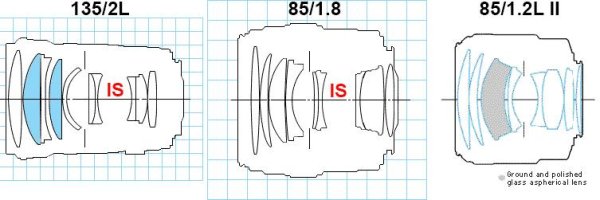
For example, people have discussed a desire for IS versions of the 85L and 135L, and given the release patterns of the new non-L IS primes, 50mm and 85mm versions seem likely. Looking below, you can see an obvious location to incorporate an IS group into the 135L and 85/1.8 lenses, but where would you put it in the current 85L design? Worth noting that the 50/1.2L and 50/1.4 both have a double-Gauss design that looks quite similar to the 85L, meaning a 50mm prime with IS would need a different design (also worth noting that Sigma's new 50/1.4 apparently does have a different design that the typical double-Gauss, although it lacks OS).
 

Attachments

  • IS elements.jpg
    IS elements.jpg
    37 KB · Views: 1,341
Upvote 0
I really am no engineer, but just observe that – for example – the 70-200 f/4 and the 70-200 f/4 IS are practically physical twins. Where did they squeeze all that IS into the IS version if IS requires so much difference in design and optical formula?
 
Upvote 0
Mr_Canuck said:
I really am no engineer, but just observe that – for example – the 70-200 f/4 and the 70-200 f/4 IS are practically physical twins. Where did they squeeze all that IS into the IS version if IS requires so much difference in design and optical formula?

That's my point - some non-IS lenses 'have space' (like the 70-200 zooms), whereas others (like the 85L and 24-70/2.8L II) don't.

In the case of the 70-200/4, you can see the space...

70-200mm f/4L (non-IS)
ef_70~200_4l_usm_bd.gif


...and you can see they basically just put the IS group in that space:

70-200mm f/4L IS
2006_ef_70-200_f4l_is_usm_bd.gif


But that's not so apparently feasible in the 24-70/2.8L II:

ef_24~70_28l_ii_usm_bd.gif
 
Upvote 0
Mr_Canuck said:
I mean, they put it in their cheapest possible lens, the 18-55, which go for about 75 bucks in a kit. But they don't put it in various higher end lenses, like the 24-70/2.8 or 16-35. Sigma just announced a new 50 1.4 but with no OS. Why not? What am I missing? Why not make the price of a premium L lens like $1875 instead of a mere $1800 and add the IS?

(An aside, when I was with Pentax or Sony, I couldn't understand on the other hand why they didn't put hypersonic motors in all their new lenses. So many remained screw driven.)

You make some good points. Here are some answers:

First of all, it is worth stating that the perfect lens does not exist. Every lens design has a tradeoff somewhere else. This includes image stabilization, which mainly involves tradeoff in weight and an extra element for the signal to pass through. Some also do not like the very brief delay that IS takes to engage which can result in a blurred photo if a picture is snapped at this point. Add one thing and something else might suffer.

Second, it is worth noting that all image stabilization really allows you to do for photos is to use a slower shutter speed. If you are using an appropriate shutter speed (reciprocal of focal length on full frame, reciprocal of focal length*1.6 on crop) then IS basically does nothing. So, to give an example, if you are using a 50mm lens, a shutter speed of about 1/50 or faster will result in no camera shake and no benefit from image stabilization. Your camera in general intelligently will shoot for the shutter speed not to drop below the reciprocal rule. With an 85mm lens, generally you'd want no slower than 1/80. But, if you are taking pictures of people, you will probably want your shutter speed a minimum of 1/100-1/125 to avoid motion blur; thus, if shooting people IS would not be useful in most cases unless focal length is greater than 100-125mm on full frame (crop is a totally different ballgame).

Again, the slower your shutter speed the more moving objects blur, which IS cannot counteract. And, with my own testing I further noticed that once you start to get real slow shutter speeds handheld everything starts to look mushy even when it is within the range of IS to correct. What this basically means is that the wider the lens, not only is IS less necessary, it is also less effective!

When do you need a slower shutter speed? When you don't get enough light. One thing that prevents you from getting enough light is slow aperture (f/stop). One way to allow for increased shutter speed is opening the aperture to a greater value like f/2.8. But not all lenses can do that. You can also increase ISO, but crop cameras look very noisy very fast when you do this.

So, with that in mind, lets look at your examples.

18-55mm, the cheap lens with IS and is slow (up to f/5.6). This is an EF-S crop lens. Therefore, in terms of the reciprocal rule, the shutter speed needs to be no slower than "1/88" when at 55mm. Yes, this lens requires a higher shutter speed than a 24-70mm on a full frame camera due to the crop factor. And on top of this, it can will be f/5.6 at 55mm. So combine those elements - "1/88" shutter speed requirement at 55mm, can't open beyond f/5.6 so not much light can get in, and crop looks pretty bad if iso is increased. So what can do you do so the picture isn't hopelessly dark? Decrease shutter speed past the reciprocal rule and use image stabilization to make up for it.

NOW, take 24-70 f/2.8 on full frame. At max only needs 1/70 at 70mm. Aperture at 70mm is f/2.8 instead of f/5.6. MUCH more light, shutter speed can be much faster. And as icing on the cake, f/2.8 still isn't good enough or can't be used, ISO can be bumped up MUCH higher than crop on full frame with little ill effects. So, with all this in mind, IS on this focal length is not that useful for photos. Still useful for taking videos, but not really photos. So if IS is integrated into this lens, you will be adding an extra glass element which could adversely impact IQ, increasing weight, increasing size, increasing price, and many might argue all of that for something that will go unused by photographers 99% of the time. The only time it would be useful is perhaps when you want to shoot inanimate objects in the dark at very low ISOs, a rather niche application.

Same applies to Sigma 50mm f/1.4. Only even less needed than the 24-70 2.8 because the aperture is able to be wider allowing more light in, and focal length is shorter requiring slower shutter speed of 1/50 per reciprocal rule to avoid shake.


So where is the cutoff really that you need IS? On crop, almost every lens could benefit from it unless they are very wide or very fast. On full frame, I would say you'd probably start to really benefit from IS at 100mm f/2.8 and longer lenses. So, this is why you see IS really being employed in modern full frame fast lens designs at 100mm and over, as 1/100 is probably the lowest you'd want to get a sharp image by avoiding motion blur (in addition to camera shake) - plus it lets a good amount of light in at f/2.8 or wider.

On the other hand, IS can be useful to videographers at all focal lengths and might be a good argument to make some of these lenses available for IS (though it may require redesign, greater cost, lesser optical qualities to do so - but videographers would likely take all of these tradeoffs for IS).

Hopefully that was a helpful insight.
 
Upvote 0
Ruined said:
If you are using an appropriate shutter speed (reciprocal of focal length on full frame, reciprocal of focal length*1.6 on crop) then IS basically does nothing. So, to give an example, if you are using a 50mm lens, a shutter speed of about 1/50 or faster will result in no camera shake and no benefit from image stabilization.

I disagree, for two reasons:

First, the 1/FL 'rule' is a legacy from film days. The resolution of current digital sensors exceeds the practical resolution of film (plus, you can view pixels at 100% on a large monitor, but you can't normally view film grains at 100%). The higher resolution means the effect (blur) of a given amount of angular motion is more easily visible (similar to how your hand shake is much more visible when pointing a laser pointer at the wall compared to a broad beam flashlight). That is part of the reason why 40D owners who upgraded to the 7D initially complained of soft images – their shutter speeds weren't high enough; the same was true for Nikon D700 users who moved to the D800. With current high pixel density sensors, shutter speeds of 1/ 2xFL, 1/ 3xFL, or even faster are often required (before adjusting for the crop factor).

Second, you are implying that 1/FL is some sort of hard and fast guarantee of, "no camera shake and no benefit from image stabilization." It's just a rule of thumb – a guideline for a shutter speed that gives you a reasonable chance of eliminating the effect of camera shake when handholding a 35mm film camera. It depends on physical ability, and even more so on technique. If you're holding the camera an inch away from your face with your elbows sticking out to the sides, after drinking 6 cups of coffee, I can guarantee you will have camera shake even at 1/FL on a film camera. I think this is one reason image stabilization is used (and has essentially become a requirement) for 'consumer' lenses (i.e., EF-S) – it helps compensate for the poor handholding technique often employed by novice photographers.

Ruined said:
So where is the cutoff really that you need IS? On crop, almost every lens could benefit from it unless they are very wide or very fast. On full frame, I would say you'd probably start to really benefit from IS at 100mm f/2.8 and longer lenses. So, this is why you see IS really being employed in modern full frame fast lens designs at 100mm and over...

Perhaps you missed the introduction of the Nikon 16-35/4 VR, the Canon 24-70/4L IS, or the Tamron 24-70/2.8 VC zoom lenses, and the Canon 24/2.8 IS, 28/2.8 IS and 35/2 IS primes. While you could argue that the first two are not 'fast' lenses, I would say that with the ISO capabilities of modern cameras, f/4 is not that much of a limitation anymore (and the 5DIII and 1D X have 20 f/4 cross-type AF points). The f/2.8 and f/2 lenses are certainly 'fast', and all of the above lenses are 'modern, full frame designs' (unless 4 years makes the 16-35 VR 'dated'; the other five lenses are all quite recent).
 
Upvote 0
neuroanatomist said:
...I think you may have missed my point above...It's not always as simple as dropping an IS unit into the optical forumla.

Thanks for the explanation. You are correct. Whereas you wrote "IS affects the optical formula of the lens" I think I misread that to mean the optical "quality" of the lens. And, of course, it would be hard to argue that IS negatively impacts the optical quality of the 70-200 II. But, looking at your illustrations, I can see what you were referencing and how challenging it might be to include IS in some lenses without significantly changing the design.

It will be interesting to see if the rumored 24-70 2.8 IS ever materializes and if so, how Canon solves the design challenge.
 
Upvote 0
Jackson_Bill said:
I must be missing something - why not put the IS in the camera instead of putting it in each of the lenses?

Sony, Olympus, and several others do just that. It has the advantage of working with any lens, in theory. In practice, in-body stabilization is much less effective with longer lenses (the sensor can only be shifted so far and so fast), doesn't stabilize the optical VF, and doesn't help with AF since the AF sensor isn't stabilized. I suppose Canon and Nikon would also consider not being able to charge more for IS in each lens as a disadvantage. ;)

Speaking of missing something, despite Sony being big proponents of sensor-shift IS, that feature is missing from their new FF mirrorless a7 and a7R.
 
Upvote 0
Ruined said:
(1)If you are using an appropriate shutter speed (reciprocal of focal length on full frame, reciprocal of focal length*1.6 on crop) then IS basically does nothing. So, to give an example, if you are using a 50mm lens, a shutter speed of about 1/50 or faster will result in no camera shake and no benefit from image stabilization.
(2)Again, the slower your shutter speed the more moving objects blur, which IS cannot counteract. And, with my own testing I further noticed that once you start to get real slow shutter speeds handheld everything starts to look mushy even when it is within the range of IS to correct.
(3)When do you need a slower shutter speed? When you don't get enough light.

1. The "reciprocal rule" is a rule of thumb. If after the "best we can do", sometimes a rule of gnat's a## is preferable, if available.

Consider this challenge - mount a 50mm lens, in plenty of light, shoot at 1/50, and see if you can shake the camera as you press the button enough to create a less sharp than desired image.

if you agree that this can be done, then we are talking about the degree of shake applied at the camera. if you think that it will not exceed the arbitrary standard-shake which the "rule" will cover, I imagine you to be free of any of the tremor that, in varying degree, effects many an older photographer, and that you do not hurry up inclines or across distance to change position relative to moving subjects(wildlife), and therefore are not ever shooting winded or tired (or old) enough to be shaky.

2. If the subject is immobile, the focus is correct,and the photo is still mushy, then the camera shake is patently NOT "within the range of IS to correct". The amount of correction available is finite, and can be inadequate if more is required than available.

3. I have plenty of light. I WANT the moving-object blur (which the IS "cannot correct"), and I want surrounding subject area Pin-sharp (which IS can help provide). The subject is a waterfall. Other situations could be imagined.

The amazing difference in what can be "seen" with binoculars, and what can be "studied" in detail with stabilized binoculars provides a clear example at human viewing speeds (vs a split second shutter ) of how helpful IS can be in countering human-induced camera(or binocular) shake.

I have posted a number of times elsewhere a link to a German photographer (name escapes my aging grasp ;-) ...Polking?) who has tested IS and "sharpness" extensively. His (and my) conclusions - If you are after the absolute best you can get, use every technique and piece of equipment available to steady the lens/camera when the shot is taken ( Tripod, weights, lens AND camera supported, IS (if tripod compatible), wind-shield, remote release (preferably wireless) etc.

Unless you have a granite tripod, an absolutely steady, smooth touch on the button, no wind, etc., SOME degree of quality in the image is likely to be lost when compared to what might-have-been.

This is , of course, perfectionist territory, and to whatever degree one is satisfied with less, the above considerations can be ignored, and "rues of thumb" substituted.

But they can hardly be considered "plenty good enough" for one and all. They are often as much gossip as gospel. ;-)

 
Upvote 0
Link to "sharpness" discussion referred-to in my last post.

Larry said:
I have posted a number of times elsewhere a link to a German photographer (name escapes my aging grasp ;-) ...Polking?) who has tested IS and "sharpness" extensively. His (and my) conclusions - If you are after the absolute best you can get, use every technique and piece of equipment available to steady the lens/camera when the shot is taken ….

Here is a link to (the late)Fritz Polking's work. Go to site, > Workshop1 >Sharpness

http://www.poelking.com/index_e.htm

MLU is also discussed.
 
Upvote 0