
You are using an out of date browser. It may not display this or other websites correctly.
You should upgrade or use an alternative browser.
You should upgrade or use an alternative browser.
Wrong Photography Ethics?
- Thread starter sanj
- Start date
In my humble opinion (which is often wrong - not the humble part), unless you are taking photos to go into a newspaper or photos that are intended to prove a point (i.e. polar bears swimming and drowning in iceless water etc. - no need to debate the example I chose) there is no such thing as ethics.
Any line that anyone choses to stand on is simply aesthetics and preference. There is no absolute. Photography and art are supposed to be interpretations of reality. Now, if you tell me your photo is pure reality and it isn’t that’d be cheating. If you just ask me if I like it, the fact that it is a composite is not relevant.
The idea that great photos are created in the camera is a myth. True, some great photos are created in the camera alone. I won’t argue that. However, Adams was notorious for spending hours in the darkroom in order to push his negatives and prints to replicate what he saw, his interpretation of reality. Take a look at how dark half-dome is in some of his most well-known photos. Take a look at the cemetery stones glowing in moon rise. Then watch a few documentaries or read a few books about him (not by him) and see what people say about the time he spent in the darkroom on those photos alone. The idea that beauty is created when the shutter is pressed isn’t fair, nor is it reality.
Reflecting reality the way you see it is just that, reflecting reality. It isn’t reality in and of itself. We don’t have to get into a philosophical debate and start citing Kant. But art is, I assume, wildly recognized as reflecting. You can choose to reflect it anyway you want. Some may think that it is bad art, but it is still art.
I’m often reminded of one of my favorite long-running best-friend adversarial relationships. Wordsworth and Coleridge. Wordsworth represented that his poetry was written on the fly, that something struck him and this beautiful complicated language rolled out of his head and on to his page. He even started to name poems in a way to imply this “Lines composed a few miles above Tinturn Abbey”. Excuse my butchering of his title. Coleridge, suffering from addiction and a raft of other social problems tried so hard to replicate Wordsworth’s easy-going technique. He suffered so much trying to let the words just flow. Instead he suffered, he wrote for hours on end, locked himself away for months to get the right rhyme or pattern. He did write some of the best Romantic poetry ever written – Ancient Mariner, Kubla Kahn. But he suffered. Funny thing is Wordsworth was having him on. He worked just as hard. The poetry didn’t spill out of him, he agonized over it, just like Coleridge. Difference is he never let on.
Long way to say, I think that this type of mentality, that beauty just spills out, particularly when there are dozens of tools in photography, and there always has been, to manipulate the raw negative, is way-of-base.
If Adams, Man Ray and their buddies can manipulate an image to reflect the reality they wanted, then so be it. It’s their art. It’s still a photo.
I do think that photos will suffer when pushed to far. I do like your image, but if you look at the fur, it just doesn’t look at good in the manipulated version. It suffers from the electronic manipulation. Noise, degradation. That doesn’t mean that it can’t be art though.
Any line that anyone choses to stand on is simply aesthetics and preference. There is no absolute. Photography and art are supposed to be interpretations of reality. Now, if you tell me your photo is pure reality and it isn’t that’d be cheating. If you just ask me if I like it, the fact that it is a composite is not relevant.
The idea that great photos are created in the camera is a myth. True, some great photos are created in the camera alone. I won’t argue that. However, Adams was notorious for spending hours in the darkroom in order to push his negatives and prints to replicate what he saw, his interpretation of reality. Take a look at how dark half-dome is in some of his most well-known photos. Take a look at the cemetery stones glowing in moon rise. Then watch a few documentaries or read a few books about him (not by him) and see what people say about the time he spent in the darkroom on those photos alone. The idea that beauty is created when the shutter is pressed isn’t fair, nor is it reality.
Reflecting reality the way you see it is just that, reflecting reality. It isn’t reality in and of itself. We don’t have to get into a philosophical debate and start citing Kant. But art is, I assume, wildly recognized as reflecting. You can choose to reflect it anyway you want. Some may think that it is bad art, but it is still art.
I’m often reminded of one of my favorite long-running best-friend adversarial relationships. Wordsworth and Coleridge. Wordsworth represented that his poetry was written on the fly, that something struck him and this beautiful complicated language rolled out of his head and on to his page. He even started to name poems in a way to imply this “Lines composed a few miles above Tinturn Abbey”. Excuse my butchering of his title. Coleridge, suffering from addiction and a raft of other social problems tried so hard to replicate Wordsworth’s easy-going technique. He suffered so much trying to let the words just flow. Instead he suffered, he wrote for hours on end, locked himself away for months to get the right rhyme or pattern. He did write some of the best Romantic poetry ever written – Ancient Mariner, Kubla Kahn. But he suffered. Funny thing is Wordsworth was having him on. He worked just as hard. The poetry didn’t spill out of him, he agonized over it, just like Coleridge. Difference is he never let on.
Long way to say, I think that this type of mentality, that beauty just spills out, particularly when there are dozens of tools in photography, and there always has been, to manipulate the raw negative, is way-of-base.
If Adams, Man Ray and their buddies can manipulate an image to reflect the reality they wanted, then so be it. It’s their art. It’s still a photo.
I do think that photos will suffer when pushed to far. I do like your image, but if you look at the fur, it just doesn’t look at good in the manipulated version. It suffers from the electronic manipulation. Noise, degradation. That doesn’t mean that it can’t be art though.
Upvote
0
RLPhoto said:All that is done before the shutter is closed, thus is taken as photography.
So it's okay to change the background before the shutter is pressed ("Please step over hear for a better background to this shot") but not after? What is so magic about closing the shutter?
Don't get me wrong or take me as too antagonistic--I get what you're saying, I'm just challenging the idea that there is something magical about pushing the button to capture an image. If you're shooting a portrait in front of the Eiffel tower, you can buy plane tickets and fly over there and do it "for real" or use an Eiffel tower backdrop or green screen and composite it. The only difference in the net result (if well done) is the cost of flying to Paris. It's hard to get past the emotional push of the "true" or "pure" photograph, but again, if there is no discernible difference in the resulting photo, what is the justification for the hassle and expense?
Upvote
0
unfocused
Photos/Photo Book Reviews: www.thecuriouseye.com
Krob78 said:I hope this was okay I just wanted to see the difference if adjustments were made as suggested. I only took about 4 or 5 minutes so I just copied the original and tried adding some global adjustments as suggested, just for giggles...
Cooled the sky added some exposure, subtracted some exposure, saturation and sharpening, leveled the horizon... it's not that terrible but is still the original composition... Idk... Sky may be a little overdone yet but it seems like good suggestions and doesn't feel like cheating as much as correcting... I hope it was okay to do this, I wasn't trying to offend anyone.
Everyone must find and follow their own ethics, but Krob78's changes sort of summarize mine. I have no problem pulling details out of different layers from the same image, adjusting colors, exposure, etc. To me, that is really just a more sophisticated version of what we used to do in the darkroom with burning and dodging. It's already there in the negative/raw file so it existed when the picture was taken.
Personally, I'm not all that uncomfortable with some removal of extraneous objects, depending on the image and its use. I'm less comfortable with adding things that were never there or moving objects around.
Upvote
0
gferdinandsen
was mich nicht umbringt, macht mich stärker
If I can do it in the wet darkroom (cropping, dodging, burning, filtering) then it's completely legal; adding to or subtracting from the photo I feel are iffy, they take away from the art of photography...that's certainly not to say that I have not photoshopped hundreds of contrails out of beautiful blue sky...but adding objects that do not exist is a no-no in my mind.
Upvote
0
Wrong ethics? That would depend on the purpose or usage of the photo. As some have pointed out if entered into a competition that clearly stated only crop, colour balance and some sharpening are allowed then of course you couldn't enter the 'enhanced' version.
This would also hold true if you wanted to submit as part of a news or reportage story.
Otherwise anything goes.
I myself do not hold to the belief that once a photo enters Photoshop it's no longer photography as most of these so-called fantastic edits were being done long before Photoshop ever existed. Photoshop like any camera, or lens filter or artificial light is but a tool, use them as you see fit to get the image you want.
This would also hold true if you wanted to submit as part of a news or reportage story.
Otherwise anything goes.
I myself do not hold to the belief that once a photo enters Photoshop it's no longer photography as most of these so-called fantastic edits were being done long before Photoshop ever existed. Photoshop like any camera, or lens filter or artificial light is but a tool, use them as you see fit to get the image you want.
Upvote
0
To me, if it was not there at the time of capture, then it's unethical.
You can argue about composition, putting stuff into the photo, choosing angle, etc... All of those are FINE as long as you do it at the time of capture. At least, it will show that you have some vision. But you don't have to tell anyone what you did with the photo; however, you cannot fool yourself.
You can argue about composition, putting stuff into the photo, choosing angle, etc... All of those are FINE as long as you do it at the time of capture. At least, it will show that you have some vision. But you don't have to tell anyone what you did with the photo; however, you cannot fool yourself.
Upvote
0
hsbn said:To me, if it was not there at the time of capture, then it's unethical.
You can argue about composition, putting stuff into the photo, choosing angle, etc... All of those are FINE as long as you do it at the time of capture. At least, it will show that you have some vision. But you don't have to tell anyone what you did with the photo; however, you cannot fool yourself.
Can I use an imaged backdrop? The backdrop is really there at the time of capture, but the image on the backdrop isn't. If no, then what are ethical backdrops and which aren't? If yes, then I can simply make a backdrop of whatever I want composited and then it's okay in your view?
Upvote
0

Well said and agreed. It would be like saying that if in someone else's opinion you take it too far, then perhaps we should ban digital photography all together and simply shoot film. Although as you aptly put, those of us that worked with film, pushed the processing in film as well...
Is there a line which creates a dichotomy between photographer and artist? Perhaps some are "Artographers". If so, perhaps it is all subject to the Artographer's vision?
I'm not offended or dismayed by anyone's vision of what they did with their photos. It's "theirs" not mine, whether I like it or not... :
Is there a line which creates a dichotomy between photographer and artist? Perhaps some are "Artographers". If so, perhaps it is all subject to the Artographer's vision?
I'm not offended or dismayed by anyone's vision of what they did with their photos. It's "theirs" not mine, whether I like it or not... :
mm said:In my humble opinion (which is often wrong - not the humble part), unless you are taking photos to go into a newspaper or photos that are intended to prove a point (i.e. polar bears swimming and drowning in iceless water etc. - no need to debate the example I chose) there is no such thing as ethics.
Any line that anyone choses to stand on is simply aesthetics and preference. There is no absolute. Photography and art are supposed to be interpretations of reality. Now, if you tell me your photo is pure reality and it isn’t that’d be cheating. If you just ask me if I like it, the fact that it is a composite is not relevant.
The idea that great photos are created in the camera is a myth. True, some great photos are created in the camera alone. I won’t argue that. However, Adams was notorious for spending hours in the darkroom in order to push his negatives and prints to replicate what he saw, his interpretation of reality. Take a look at how dark half-dome is in some of his most well-known photos. Take a look at the cemetery stones glowing in moon rise. Then watch a few documentaries or read a few books about him (not by him) and see what people say about the time he spent in the darkroom on those photos alone. The idea that beauty is created when the shutter is pressed isn’t fair, nor is it reality.
Reflecting reality the way you see it is just that, reflecting reality. It isn’t reality in and of itself. We don’t have to get into a philosophical debate and start citing Kant. But art is, I assume, wildly recognized as reflecting. You can choose to reflect it anyway you want. Some may think that it is bad art, but it is still art.
I’m often reminded of one of my favorite long-running best-friend adversarial relationships. Wordsworth and Coleridge. Wordsworth represented that his poetry was written on the fly, that something struck him and this beautiful complicated language rolled out of his head and on to his page. He even started to name poems in a way to imply this “Lines composed a few miles above Tinturn Abbey”. Excuse my butchering of his title. Coleridge, suffering from addiction and a raft of other social problems tried so hard to replicate Wordsworth’s easy-going technique. He suffered so much trying to let the words just flow. Instead he suffered, he wrote for hours on end, locked himself away for months to get the right rhyme or pattern. He did write some of the best Romantic poetry ever written – Ancient Mariner, Kubla Kahn. But he suffered. Funny thing is Wordsworth was having him on. He worked just as hard. The poetry didn’t spill out of him, he agonized over it, just like Coleridge. Difference is he never let on.
Long way to say, I think that this type of mentality, that beauty just spills out, particularly when there are dozens of tools in photography, and there always has been, to manipulate the raw negative, is way-of-base.
If Adams, Man Ray and their buddies can manipulate an image to reflect the reality they wanted, then so be it. It’s their art. It’s still a photo.
I do think that photos will suffer when pushed to far. I do like your image, but if you look at the fur, it just doesn’t look at good in the manipulated version. It suffers from the electronic manipulation. Noise, degradation. That doesn’t mean that it can’t be art though.
Upvote
0

RLPhoto
Gear doesn't matter, Just a Matter of Convenience.
thepancakeman said:RLPhoto said:All that is done before the shutter is closed, thus is taken as photography.
So it's okay to change the background before the shutter is pressed ("Please step over hear for a better background to this shot") but not after? What is so magic about closing the shutter?
Don't get me wrong or take me as too antagonistic--I get what you're saying, I'm just challenging the idea that there is something magical about pushing the button to capture an image. If you're shooting a portrait in front of the Eiffel tower, you can buy plane tickets and fly over there and do it "for real" or use an Eiffel tower backdrop or green screen and composite it. The only difference in the net result (if well done) is the cost of flying to Paris. It's hard to get past the emotional push of the "true" or "pure" photograph, but again, if there is no discernible difference in the resulting photo, what is the justification for the hassle and expense?
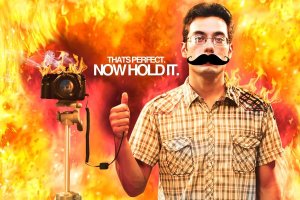
The camera captured the image as it was through the lens, That is Photography. Editing and tweaking is allowed, but adding element that were not there invalidates that.
Compositing Images into a new image is Digital Art. It just as valid and can be more awe-inspiring but it's not photography.
IE: This image is Digital art, Not Photography.
Attachments
Upvote
0
I'll buy that, so it combines both genres, is it Artography?RLPhoto said:thepancakeman said:RLPhoto said:All that is done before the shutter is closed, thus is taken as photography.
So it's okay to change the background before the shutter is pressed ("Please step over hear for a better background to this shot") but not after? What is so magic about closing the shutter?
Don't get me wrong or take me as too antagonistic--I get what you're saying, I'm just challenging the idea that there is something magical about pushing the button to capture an image. If you're shooting a portrait in front of the Eiffel tower, you can buy plane tickets and fly over there and do it "for real" or use an Eiffel tower backdrop or green screen and composite it. The only difference in the net result (if well done) is the cost of flying to Paris. It's hard to get past the emotional push of the "true" or "pure" photograph, but again, if there is no discernible difference in the resulting photo, what is the justification for the hassle and expense?
The camera captured the image as it was through the lens, That is Photography. Editing and tweaking is allowed, but adding element that were not there invalidates that.
Compositing Images into a new image is Digital Art. It just as valid and can be more awe-inspiring but it's not photography.
IE: This image is Digital art, Not Photography.
Upvote
0

sanj said:I found the sky boring and added clouds to make it more interesting.
Do you think this is cheating? I really want to know.
Am very confused. I have made changes but not altered nature. Have I done something wrong?
Thx
Yes you did alter nature - the sky is part of nature.
Did you do anything wrong? What are you claiming? If you are claiming that is the image you took, yes you are being dishonest. If you present the picture as "art" and you can sleep at night, then you did nothing wrong.
Bottom line - two thing IMO are important. Are you being honest about the image (if you don't claim it was as shown in the 2nd print you are fine) - but you decide where to draw the line? And can you sleep at night?
Upvote
0

As long as the photographer is not entering a competition and not breaking its rules, to me it doesn't matter what the photographer does with the image, it is his image, his vision ...as far as I'm concerned he can remove/add whatever he wants. Those who are capable of making awesome changes/modifications will continue to do so while those who are incapable will continue to crib that it is unethical.
Upvote
0

sanj said:I found the sky boring and added clouds to make it more interesting.
Do you think this is cheating? I really want to know.
Am very confused. I have made changes but not altered nature. Have I done something wrong?
Thx
That's an interesting question.
The way I see it, photography is cheating. By its own definition. It's about offering a fragment of reality from a perspective that you choose, carrying a visual message that you choose. It's not different from fiction, theatre, music, dance etc. If someone expect a pic to be a faithful reproduction of reality it's his problem, because it's like watching Harry Potter and thinking that Hogwarts actually exists.
Retouching is retouching. Making a composite, IMHO, is not ethically different from smoothening someone's skin, removing blemishes, saturating colors, etc.
You are either a purist that doesn't touch his RAW files (and who would want that?), or when you start compromising and editing then the acceptable limit of that is debatable. It actually becomes a mere matter of making sensible, tasteful retouches.
Upvote
0
I much prefer the altered image. I'm not sure the clouds were *needed*, but I like them and all the other changes, including the removal of those ugly, distracting, scruffy bushes/trees. Cheating? Sure, if the sole point of taking a photograph is to show what you were able to make of the scene in front of you using nothing but your ability to interact with a particular lens/camera combination.
Part of me wants to say that displaying skill/technique is part of the point of the exercise, and that adding interesting subjects and removing boring/ugly ones is as "wrong" as a recording where a pianist who hits 97 wrong notes is able to "fix" it by splicing in correct ones, or where a famous soprano's (Flagstad) high Cs were in fact sung by someone else (Schwarzkopf) and dubbed in.
Another part of me, though, wants to say that photography is different. Leaving aside honest/accurate reporting, photography is inherently deceptive/manipulative - if you can't "improve" on reality, why bother photographing it in the first place? The real thing looks better than any attempt at providing a neutral report of it. For many photographers, the best lenses are those which allow the shallowest depth of field. Why do we want them? So we can distort reality and make it appear that the subject is surrounded, not by distracting or ugly details, but by smears of light and colour. The same is true of wide angle lenses and long telephoto lenses - we want the distortions they provide. Compared to what all these lenses do, removing a few ugly bushes after the fact seems rather trivial.
Part of me wants to say that displaying skill/technique is part of the point of the exercise, and that adding interesting subjects and removing boring/ugly ones is as "wrong" as a recording where a pianist who hits 97 wrong notes is able to "fix" it by splicing in correct ones, or where a famous soprano's (Flagstad) high Cs were in fact sung by someone else (Schwarzkopf) and dubbed in.
Another part of me, though, wants to say that photography is different. Leaving aside honest/accurate reporting, photography is inherently deceptive/manipulative - if you can't "improve" on reality, why bother photographing it in the first place? The real thing looks better than any attempt at providing a neutral report of it. For many photographers, the best lenses are those which allow the shallowest depth of field. Why do we want them? So we can distort reality and make it appear that the subject is surrounded, not by distracting or ugly details, but by smears of light and colour. The same is true of wide angle lenses and long telephoto lenses - we want the distortions they provide. Compared to what all these lenses do, removing a few ugly bushes after the fact seems rather trivial.
Upvote
0
L
Loswr
Guest
I heard something on the radio yesterday - along the lines of techno electro pop fusion. It was created de novo on a computer, no instruments were used at all. The DJ called it a song. I bet if I'd Shazam'd it, I'd have found it on iTunes. Was it music? Is the person who produced it a musician or a programmer? Does it matter?
Upvote
0
RLPhoto said:Once you composite images, Its no longer Photography to me.
He didn't ask whether the results of his manipulations met some definition of "photograph" but whether the manipulations he performed were unethical. Are you saying that he can manipulate all he wants so long as he doesn't call the results "photographs"?
Upvote
0
RLPhoto
Gear doesn't matter, Just a Matter of Convenience.
sdsr said:RLPhoto said:Once you composite images, Its no longer Photography to me.
He didn't ask whether the results of his manipulations met some definition of "photograph" but whether the manipulations he performed were unethical. Are you saying that he can manipulate all he wants so long as he doesn't call the results "photographs"?
Their nice artwork to me, but I couldn't consider them photographs anymore. That's just my take on this subject...
Upvote
0
RLPhoto said:The camera captured the image as it was through the lens, That is Photography. Editing and tweaking is allowed, but adding element that were not there invalidates that.
IE: This image is Digital art, Not Photography.
Okay, I think I've got it. When I take a picture of a model in a bikini in front of a beech backdrop with an industrial fan blowing her hair and her head slightly turned to hide the hideous birthmark on her face and holding in her slightly out of shape gut, that's photography (and therefore honest/true) because it came thru the lens, right?
As a side note, the world has always been in color, which has always passed thru the lens, so by this definition black and white photography has never been actual photography.
Upvote
0
Similar threads

- Replies
- 4
- Views
- 1K
- Replies
- 8
- Views
- 1K