Your Go To Portrait Lens?

  • Thread starter Thread starter whaleofatime
  • Start date Start date
Status
Not open for further replies.
mjbehnke said:
OK, This might be a little off topic..... I see some of the posts saying that a 2.8 is really a stop slower on a 1.6 crop camera? I'm not sure how you figure that? Doesn't it still let the same amount of light go to the APS-C Sensor as it would a FF Sensor? ...And no, I really am not that smart!! And this is my next question.... Does the EF-S 17-55 F2.8 suffer the same thing as the EF lenses on an APS-C even though it's made only for the smaller sensor?

Thanks in Advance.
Matthew
neuro can probably explain it better but in simplest terms if you get a lens that works on both FF and crop let say a 17-40 f4L then fit it to each and frame the shot exactly the same so that both images filled each cameras view to the same extents. You would be standing closer to the subject using the FF and further away using the crop. Because you are closer to the subject you will have a shallower depth of field than the same lens taking the same shot on the crop since using the crop you are further away.

does that make sense?

since the EF-S 17-55 f2.8 only works on a crop body it behaves more like the 24-70 f2.8L so they are compared more to each other. So the 17-55 f2.8 doesnt suffer from anything
 
Upvote 0
Well.... This is one:

[/quote]
So...just as the 'crop factor' affects the effective focal length, it also affects the DoF - by the same 1.6x. That means that for the same framing you'd get on FF, an f/4 lens on APS-C is equivalent to f/6.4 on FF. That means very poor background blur unless you are very close to your subject and the background is well-separated. Not that it can't be done...it's just not ideal.
[/quote]

If I am understanding it right, F4 on a Full Frame is about F6.4 on a APS-C? So, to truly get down to F2.8, I should go FF? And the other part was, the EF-s 17-55 F2.8, is it like F4 on an APS-c, or is it trult F2.8?

Maybe I need to get to a website that explains this better.....
 
Upvote 0
wickidwombat said:
mjbehnke said:
OK, This might be a little off topic..... I see some of the posts saying that a 2.8 is really a stop slower on a 1.6 crop camera? I'm not sure how you figure that? Doesn't it still let the same amount of light go to the APS-C Sensor as it would a FF Sensor? ...And no, I really am not that smart!! And this is my next question.... Does the EF-S 17-55 F2.8 suffer the same thing as the EF lenses on an APS-C even though it's made only for the smaller sensor?

Thanks in Advance.
Matthew
neuro can probably explain it better but in simplest terms if you get a lens that works on both FF and crop let say a 17-40 f4L then fit it to each and frame the shot exactly the same so that both images filled each cameras view to the same extents. You would be standing closer to the subject using the FF and further away using the crop. Because you are closer to the subject you will have a shallower depth of field than the same lens taking the same shot on the crop since using the crop you are further away.

does that make sense?

since the EF-S 17-55 f2.8 only works on a crop body it behaves more like the 24-70 f2.8L so they are compared more to each other. So the 17-55 f2.8 doesnt suffer from anything


OK, That makes sense, since the 1.6 crop factor "brings things in closer" than shooting with a full frame......

Thanks very much for the Simple Terms!
 
Upvote 0
Unless you are going to focus/recompose the set AF mode to Servo to hold focus that way. That way you can move as well as the subject.

Makes it easier when using a prime to get the framing right by the manual zoom (one step back and forward)

The 70-200 f/2.8 II makes a good lens for shooting those candids on both ff and 1.6
 
Upvote 0
neuroanatomist said:
koolman said:
rocketdesigner said:
pwp said:
Hands down, the 70-200 f/2.8is II or the 70-200 f/2.8is II or the 70-200 f/2.8is II. No contest.

A well known blogger Jem Schofiled had a rather interesting response to this question in an on line interview:

http://bit.ly/thoNoq

He claims that the 70-200 L II F4 is his choice over the 70-200 L II f 2.8 because it "holds focus" better.

Since I just sold my f4 to get the f2.8, was I wrong ... is he technically correct?

I know lens choice is subjective, but he seems to make a fairly bold statement.

If you listen to Jem Schofiled's video - he is discussing his choice of lens for shooting VIDEO INTERVIEWS with a FF 5d2. The reason for using the 70-200 f/4 is that when he shoots the interview - he wants the subject to be able to move around and retain focus - hence he is forced to shoot at at least f/5 - to avoid a situation where if the subject for example leaned forward - they would appear blurred in the video. (thats what he means by "holds focus")

A 70-200mm f/2.8L IS II can be set to f/5 just like a 70-200mm f/4L IS, and I bet it would 'hold focus' just as well. Imagine that.

Of course you can stop down any lens. He was saying that there was no advantage to the larger heavier 2.8 - hence he chose the smaller lighter f/4
 
Upvote 0
A shallow depth of field is a function of a few factors:

1) The ACTUAL lens focal length - a telephoto lens produces a much more shallow DOF. Imagine shooting a 300mm lens focused on a tree, or a 50mm lens as such.

2) The distance between the camera and the subject

3) The distance between the background and the subject

4) The f stop of the lens. The larger the f/stop opening (the smaller the number) the more shallow DOF.

On Crops as apposed to FF:

The ACTUAL focal length of the lens is MUCH smaller to achieve the equivalent perspective of a FF. So if you are using a 50mm 1.4 lens on a 1.6 crop to receive a FF 80 mm perspective - because of the actual focal length - you are getting the DOF multiplied by 1.6 = 2.24.

If you use an identical 85mm 1.8 lens on a crop - compared to the same 85mm 1.8 lens on a FF - your DOF would increase for a different reason - you would need to stand further away - hence once again 1.8 = 2.8.

Additionally - if you place the 85mm 1.8 on the crop - and stand further away - you would have trouble shooting at f/1.8 - it is harder to nail focus wide open from a distance - and you might be forced to stop down !

The crop factor on the other hand has NOTHING to do with EXPOSURE which is a function of the ACTUAL aperture size of the lens.

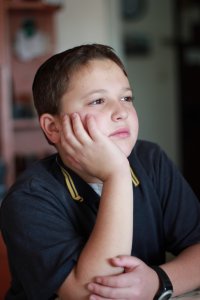
Portrait canon 50mm 1.4 rebel t2i


Attachments

  • MeirPortrait1.JPG
    MeirPortrait1.JPG
    132.2 KB · Views: 949
Upvote 0
Thanks for that explanation, but:

koolman said:
Additionally - if you place the 85mm 1.8 on the crop - and stand further away - you would have trouble shooting at f/1.8 - it is harder to nail focus wide open from a distance - and you might be forced to stop down !

Is that correct? Can anyone explain why, if so?
 
Upvote 0
I've never used a FF camera but can speak for the crop since I own one. I'd say either the 85L or 135L for the prime (85L over the 135L). And the zoom lens would be the 70-200mm 2.8 IS II (since I own it and I've taken some portraiture photos and it's not that bad, pretty good actually.) Never used it either but I hear great things about the 24-70L.
 
Upvote 0
bainsybike said:
Thanks for that explanation, but:

koolman said:
Additionally - if you place the 85mm 1.8 on the crop - and stand further away - you would have trouble shooting at f/1.8 - it is harder to nail focus wide open from a distance - and you might be forced to stop down !

Is that correct? Can anyone explain why, if so?

You COULD have trouble nailing sharp focus - as since you are shooting wide open - and AF needs good contrast to nail focus - since you are further away - the persons eyes for example are further away etc. so the AF might not be able to nail tack on.

You can try this yourself. Take a fast prime wide open, and focus standing closer and farther. Afterwords, compare the sharpness in both pics, especially of portraits, where eye sharpness is important.
 
Upvote 0
bainsybike said:
Thanks for that explanation, but:

koolman said:
Additionally - if you place the 85mm 1.8 on the crop - and stand further away - you would have trouble shooting at f/1.8 - it is harder to nail focus wide open from a distance - and you might be forced to stop down !

Is that correct? Can anyone explain why, if so?

In the context of depth of field that is being discussed, that is not correct. Depth of Field is larger for a larger subject distance. Whether the camera might not achieve focus as easily from a greater distance is unlikely but perhaps it might be harder for the photographer to hold the focus point steady on a particular spot such as an eye, but again the larger DoF would make that less critical.
 
Upvote 0
koolman said:
You COULD have trouble nailing sharp focus - as since you are shooting wide open - and AF needs good contrast to nail focus - since you are further away - the persons eyes for example are further away etc. so the AF might not be able to nail tack on.

Not sure about this - if you frame the subject the same way, won't the camera see the same thing (I'm not talking about the background) whatever the focal length of the lens? So why would it be more difficult to achieve focus with, say, an 85mm lens than with a 50mm lens for an identically framed subject and with the same aperture?
 
Upvote 0
mjbehnke said:
Well.... This is one:

"
So...just as the 'crop factor' affects the effective focal length, it also affects the DoF - by the same 1.6x. That means that for the same framing you'd get on FF, an f/4 lens on APS-C is equivalent to f/6.4 on FF. That means very poor background blur unless you are very close to your subject and the background is well-separated. Not that it can't be done...it's just not ideal.
"

If I am understanding it right, F4 on a Full Frame is about F6.4 on a APS-C? So, to truly get down to F2.8, I should go FF? And the other part was, the EF-s 17-55 F2.8, is it like F4 on an APS-c, or is it trult F2.8?

Maybe I need to get to a website that explains this better.....

That comment is referring to depth of field. When using an APS-C sensor, to achieve the same framing as FF you must stand 1.6x further away and if you also want the same DoF as a FF your aperture would have to also be wider by 1.6x (I believe this is an approximation that holds for typical subject distances, maybe neuro knows for sure? The calculation is different for the near and far field portions of the DoF).

So say you are composing a shot on a FF body with a 100mm lens and you are standing 5m from the subject and using f/6.4, the DoF will be 0.94m To get the same framing with an APS-C body you would stand at 8m from the subject but if you still use f/6.4 your DoF will be 1.54m. Change your aperture to f/4 and your DoF is now 0.96m so you now have the same framing and DoF.
 
Upvote 0
mjbehnke said:
Well.... This is one:
So...just as the 'crop factor' affects the effective focal length, it also affects the DoF - by the same 1.6x. That means that for the same framing you'd get on FF, an f/4 lens on APS-C is equivalent to f/6.4 on FF. That means very poor background blur unless you are very close to your subject and the background is well-separated. Not that it can't be done...it's just not ideal.
[/quote]

If I am understanding it right, F4 on a Full Frame is about F6.4 on a APS-C? So, to truly get down to F2.8, I should go FF? And the other part was, the EF-s 17-55 F2.8, is it like F4 on an APS-c, or is it trult F2.8?
[/quote]

Yep, that was me, and wickidwombat's explanation was spot on. Because the crop factor affects angle of view, for a given focal length you need to be further away to get the same framing on an APS-C camera, and that extra distance means a shallower DoF - by a factor of 1.6x (=1.3 stops).

koolman said:
A shallow depth of field is a function of a few factors:
3) The distance between the background and the subject

On Crops as apposed to FF:

The ACTUAL focal length of the lens is MUCH smaller to achieve the equivalent perspective of a FF.

The crop factor on the other hand has NOTHING to do with EXPOSURE

These statements have a few inaccuracies. Subject to background distance affects the OOF blur, but not the depth of field.

Perspective is solely a function of camera to subject distance. You mean equivalent field of view.

It depends on how you define exposure. If you mean shutter speed and f/number, it's true that the crop factor has no effect. But if you mean the exposure triangle, which includes ISO, the FF sensor enables you to bump the ISO up by 1.3 stops and keep the same noise in your image.

koolman said:
You COULD have trouble nailing sharp focus - as since you are shooting wide open - and AF needs good contrast to nail focus - since you are further away - the persons eyes for example are further away etc. so the AF might not be able to nail tack on.

Makes no sense. As Meh states, from a greater distance with the same focal length, DoF is deeper, meaning more of the subject should be in sharp focus. If the framing is the same, the extra distance doesn't matter to the camera's AF system, the subject will cover the same portion of the AF sensor. If you're even further away, even less problem. The place focus errors manifest is with close subjects and long focal lengths, where DoF is thinnest.
 
Upvote 0
As someone who considers himself pretty good at visualizing geometry problems in his head, this particular problem is still very difficult to keep straight.

I never really *actually* understood what was going on until I went and experienced it for myself. I have all the tools -- if I remember I'll get an example posted here soon.
 
Upvote 0
branden said:
As someone who considers himself pretty good at visualizing geometry problems in his head, this particular problem is still very difficult to keep straight.

I never really *actually* understood what was going on until I went and experienced it for myself. I have all the tools -- if I remember I'll get an example posted here soon.

+1 excellent point... it's difficult for anyone to visualize because where DoF is concerned there is more than one variable and the relationship/math is not simple. Angle of view is easier to visualize because it's a simple change in the angle and is the type of thing that is experienced in day to day life.
 
Upvote 0
Ok, here's my attempt at a comparison picture. Although, the lower image quality of the lens on the crop camera makes the results a little difficult to see, there is noticeably more depth of field in the image on the right, and additionally the background objects are not blurred to the same extent.

31mm x 1.6 crop factor =~ 50mm.

depth-of-field-compare.jpg


From this, you can conclude that to fully mimic the full frame camera, a narrower aperture is needed on the 1.6x crop camera if the framing and field of view is otherwise identical.
 
Upvote 0
Here is another test. Unfortunately, my truck full of hot models and attractive backgrounds was stuck in traffic, so Bender's head in my backyard had to stand in instead.

This test shows two identically-framed loose "head and shoulders" portraits -- one on a full frame camera at 135mm f/5.6, and the other at 85mm f/5.6 on a crop camera. The 1.6x crop factor means the 85mm and the 135mm focal lengths should have very similar fields of view.

background-blur-compare.jpg


You can see considerably more detail in the background in the crop frame shot, showing the relationship between framing, background blur, and frame size. For the 85mm crop frame photo to achieve a similar level of background blur to the full frame 135mm photo, an aperture 1.6x wider would be needed.
 
Upvote 0
whaleofatime said:
If you had to choose both one zoom and one fixed lens as your go to portrait lens. What would they be?

Back to the OP...

These are easy questions to answer.

Zoom? The 70-200 f/2.8isII is my default portrait lens. This is THE wow lens of the entire Canon range. No photographer should be without one.

Prime? Right now it's the Sigma 50 f/1.4. My Christmas present to myself will be the 135 f/2L so definately that lens will get plenty of prime time too.

Paul Wright
 
Upvote 0
Status
Not open for further replies.