
Possible Canon RF 45mm f/1.2 STM Patent Published

Richard Cox
4 Min Read

When you purchase through links on our site, we may earn an affiliate commission. Here’s how it works.

In this patent application (2025-149754) we see some interesting primes that Canon is applying for a patent. Now while it’s unusual to see a patent application before the lens is released, it does happen. As well, with this year being a hot mess in terms of planning it could be that alot of things were waiting until after August so that Canon and also it’s suppliers know what is up in terms of the supply chains.

Since we have heard that a Canon RF 45mm F1.2 STM is coming out soon, and there’s one in this patent application, there’s a high degree of certainty that if this isn’t the actual patent application, it was one of the competing ones.

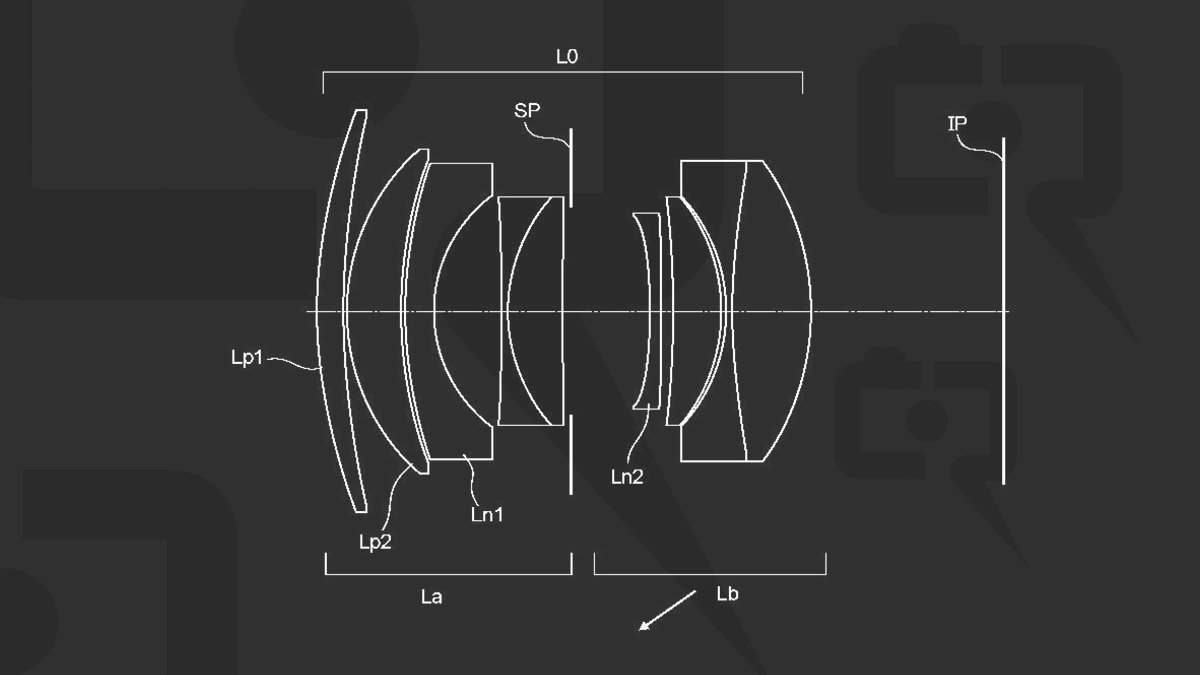
Canon RF 45mm F1.2

Yes, I know that the patent actually states 48mm, but it would not be the first time that Canon has been a little fast and loose with focal lengths.

This lens is quite bulky in terms of its glass; there appears to be a lot that needs to move for focus. If this is an STM lens, I don’t think it will be a quick-to-focus lens, but if it’s a USM or VCM lens, it should be just fine. It’s also very small for a f/1.2 – around 65mm in lens length.
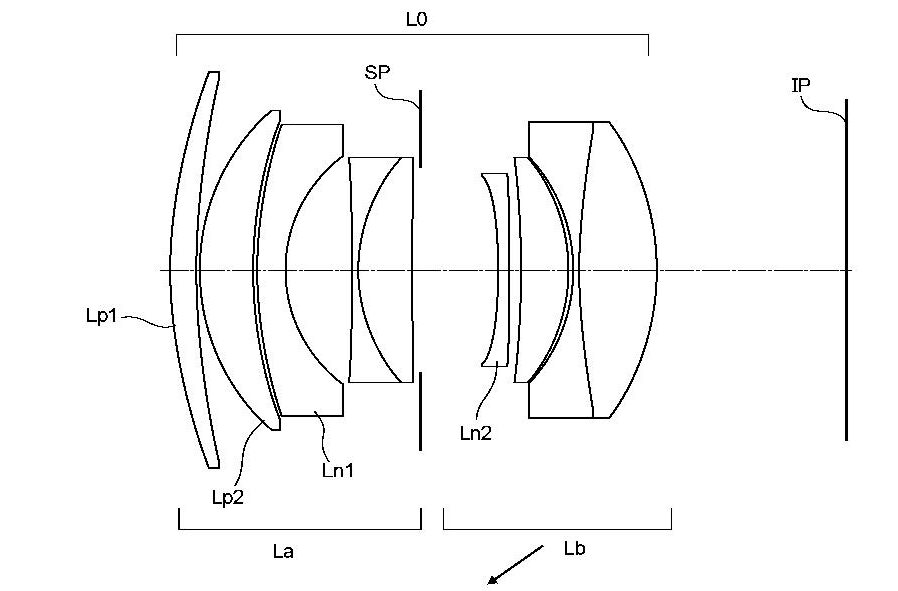
Focal length48.60
F-number1.24
Half angle of view24.00
Image height21.64
Total lens length85.76
Back focus distance24.00

Canon RF 35mm F1.8

This is another interesting design. But with Canon already having a Canon RF 35mm F1.8 IS STM Macro I doubt this lens will see the light of day. But if Canon wanted to make a “true” Canon RF 35mm F1.8, which would be a lot smaller, then this would be the way to go about it. This lens could be especially useful if Canon wants to make good “dual use” lenses for APS-C and full frame, as this would be a decent lens for APS-C (56mm) and also still useable on full frame as a 35mm prime.
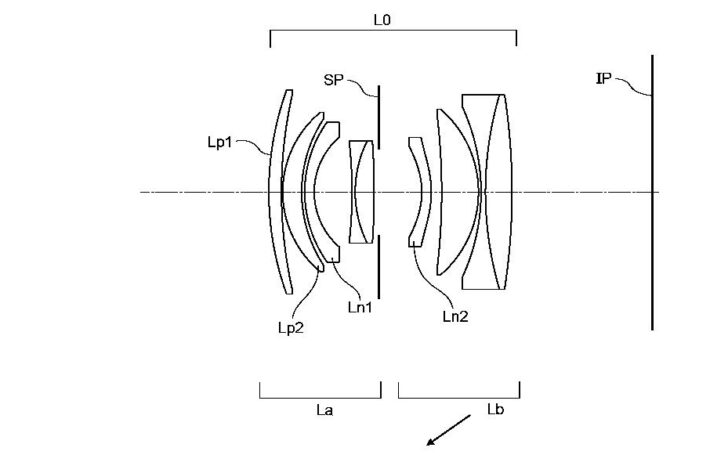
Focal length35.00
F-number1.84
Half angle of view31.72
Image height21.64
Total lens length60.67
Back focus distance22.20

Canon RF 70mm F1.8

Canon has never done a 70mm prime lens before but there has at least been a 70mm F2.8 Macro before, so it’s not uncommon. Of course, this on an APS-C camera would end up having a crop factor taking it to around 110mm, which is a common potraiture focal length. This lens isn’t as small as the 35mm, however that stands to reason as it doubles the focal length.
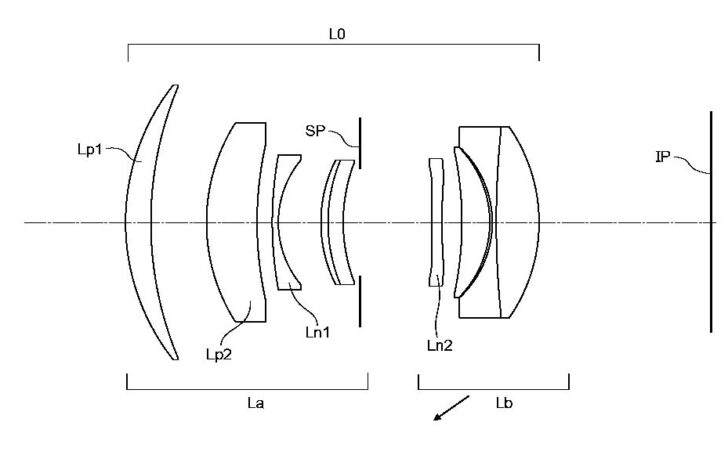
Focal length68.78
F-number1.85
Half angle of view17.46
Image height21.64
Total lens length115.82
Back focus distance34.05

Closing Thoughts

Many of these embodiments would be interesting, but as with anything, it’s the devil in the details and how Canon would market such lenses would determine if they are released or not.

Just a Reminder!

With all patents and patent applications, I have to stress constantly – this is simply a look into Canon’s research; the only thing we can quantify accurately is that Canon is researching this. A patent application doesn’t mean they are going to release this in the next month, or even year, or even at all.


Go to discussion...

Share This Article
Follow:
Richard has been using Canon cameras since the 1990s, with his first being the now legendary EOS-3. Since then, Richard has continued to use Canon cameras and now focuses mostly on the genre of infrared photography.

22 comments

  1. The graphics look pretty much like classical Double-Gauss design.
    So I wouldn't expect magical resolution numbers from them.
    But we know the magic such lenses might have...

    I hope that the AF motor is fast enough... 🤔

    And, @Richard CR, don't you think that 48.6 mm is closer to 50 mm than to 45?
    Could also be named 50/1.2, couldn't it? (apart from the rumored name)
  2. And, @Richard CR, don't you think that 48.6 mm is closer to 50 mm than to 45?
    If I'm not mistaken, the RF 50mm f/1.8 STM is a 48.5mm as well

    By the way, could these be plastic moulded elements? Such material would certainly be a lot lighter
  3. If I'm not mistaken, the RF 50mm f/1.8 STM is a 48.5mm as well

    By the way, could these be plastic moulded elements? Those would certainly be a lot lighter

    Canon can go on either side of a reported focal length.

    If this design is a related patent to the final product, there could be a technical reason that they market it as 45mm. I could see confusion simply having a 50 1.2 and 1.4 already in the lineup for much more money than this will cost.
  4. Canon can go on either side of a reported focal length.

    If this design is a related patent to the final product, there could be a technical reason that they market it as 45mm. I could see confusion simply having a 50 1.2 and 1.4 already in the lineup for much more money than this will cost.
    Fully understand. I had the same thought but was to lazy to add it to my post.
  5. The graphics look pretty much like classical Double-Gauss design.
    So I wouldn't expect magical resolution numbers from them.
    But we know the magic such lenses might have...

    I hope that the AF motor is fast enough... 🤔

    And, @Richard CR, don't you think that 48.6 mm is closer to 50 mm than to 45?
    Could also be named 50/1.2, couldn't it? (apart from the rumored name)
    Indeed, it does. Reminiscent of the EF 50/1.2 or the 50/1.4. I would imagine performance closer to the 1.2, but who knows. A very lightweight 50/1.2, even if not optically stellar like the current RF 50/1.2L, would be a welcome lens to many. And there is 'some' magic in that slightly less than perfect old 50/1.2. It has character.
  6. The 9-element lens design looks much simpler than that of the L series, but it’s obviously not something you can buy for just a few hundred dollars.How many elements in 50F1.4 Vcm?
  7. Back in the NFD days they had both a 50 1.2 L and non-L for sale at the same time, prior to that they had the FD 55 1.2 SSC and 55 1.2 SSC Aspherical so it isn't like it has never been done before.
  8. It's a modern short backfocus double gauss derived design just as I anticipated in the other thread. Checked the patent and looks like they are using some really high abbe number glass. Another improvement is it's rear group focus instead of full group focus, so a lot less moving mass.
    As for abberation correction with this few elements, they definitely would have to make tradeoffs. Just as I predicted, it lean toward a little residual SA, which can be desirable for bokeh and oof background. Distortion is sacrificed, CA is lower than the EF but still present. Overall I think they made good choices
    It would sell like hot cakes if they price it right.
  9. Back in the NFD days they had both a 50 1.2 L and non-L for sale at the same time, prior to that they had the FD 55 1.2 SSC and 55 1.2 SSC Aspherical so it isn't like it has never been done before.
    I remember those. My father used to own one. But I don't remember which. I suppose, the non-L 😉
  10. It's a modern short backfocus double gauss derived design just as I anticipated in the other thread. Checked the patent and looks like they are using some really high abbe number glass. Another improvement is it's rear group focus instead of full group focus, so a lot less moving mass.
    As for abberation correction with this few elements, they definitely would have to make tradeoffs. Just as I predicted, it lean toward a little residual SA, which can be desirable for bokeh and oof background. Distortion is sacrificed, CA is lower than the EF but still present. Overall I think they made good choices
    It would sell like hot cakes if they price it right.
    Thanks for that analysis, Cerulean42.
    Let's keep fingers crossed for the price...
  11. I do wonder if this a soft abll landing for the fact that Canon have trolled us with inadequate ef 50mm primes for years and are not intending releasing a rf 35mm f1.2 lens, Sure the RF 35mm f1.4 L is a great lens, but it's hardly a revolution when compared to the nearly identically performing ef 35mm f1.4 L mk II. The upgrade is erm...you don't need an adapter....gee wizz...that's a beneficial spend for a photographer!
  12. 50mm f1.2 I get, 35mm f/1.2 interesting but I am not sure I get the need for a 45mm f/1.2. I get VCM is an in thing to make more videography focused lenses, de-clicked, less throw etc. the test though will be how it handles focus breathing. As even the 50 f/1.2 focuses quick for the size of the glass.
  13. The graphics look pretty much like classical Double-Gauss design.
    So I wouldn't expect magical resolution numbers from them.
    But we know the magic such lenses might have...

    I hope that the AF motor is fast enough... 🤔

    And, @Richard CR, don't you think that 48.6 mm is closer to 50 mm than to 45?
    Could also be named 50/1.2, couldn't it? (apart from the rumored name)

    This looks considerably more complex than a double Gauss design. (Gauss was a person, thus the capitalization of a proper noun. Double is not.)

    1761135585151.png

    Here's the EF 50mm f/1.8 STM with a classic double Gauss design:

    1761135738881.png

    For more about what makes a lens a double Gauss, please see Roger Cicala's excellent article:

    Why are modern 50mm lenses so damned complicated?

  14. This looks considerably more complex than a double Gauss design...
    Call it Double-Gauss design BASED, if that makes you feel better.
    And about the propper notation:
    Start complaining at wikipedia first:
    You'll find there:
    Double-Gauss
    Double Gauss
    double Gauss

    And you'll find there numerous lens designs all claimed to be Double-Gauss (or Double Gauss, or double Gauss).
    So if you'd ask me about consideration, this RF 45 could be closer to a Taylor&Hobson.
    And "your" reference of the EF 50mm f/1.8 STM has two elements more than than the "classic Double-Gauss" (or Double Gauss, or double Gauss).
    So it's an evolution as well, closer to a "Zeiss Planar" design.

    In the end:
    If you'd use German it would have been even better and more precise:

    Gaußsches Doppelobjektiv
    as for the meaning of a symmetrical mirroring of a basic Gauß lens.
    (as this German person Carl Friedrich Gauß is correctly spelled with a German "ß", called "Eszett" or "scharfes S", but in the past as well with an "ss", so welcome to maximum confusion).

    Enough "know-it-all"?

    And in the end th inventor of the Double-Gauss design (or Double Gauss, or double Gauss) was Alvan Clark, acording to wikipedia. Is he a relative of yours? 😉
  15. Call it Double-Gauss design BASED, if that makes you feel better.
    And about the propper notation:
    Start complaining at wikipedia first:
    You'll find there:
    Double-Gauss
    Double Gauss
    double Gauss

    And you'll find there numerous lens designs all claimed to be Double-Gauss (or Double Gauss, or double Gauss).
    So if you'd ask me about consideration, this RF 45 could be closer to a Taylor&Hobson.
    And "your" reference of the EF 50mm f/1.8 STM has two elements more than than the "classic Double-Gauss" (or Double Gauss, or double Gauss).
    So it's an evolution as well, closer to a "Zeiss Planar" design.

    In the end:
    If you'd use German it would have been even better and more precise:

    Gaußsches Doppelobjektiv
    as for the meaning of a symmetrical mirroring of a basic Gauß lens.
    (as this German person Carl Friedrich Gauß is correctly spelled with a German "ß", called "Eszett" or "scharfes S", but in the past as well with an "ss", so welcome to maximum confusion).

    Enough "know-it-all"?

    And in the end th inventor of the Double-Gauss design (or Double Gauss, or double Gauss) was Alvan Clark, acording to wikipedia. Is he a relative of yours? 😉

    Since when is Wikipedia an authoritative source for anything? It's crowd sourced. It's not peer reviewed.

Leave a comment

Please log in to your forum account to comment