What Will Replace the PowerShot G7 X Mark III

The v1 is a fun camera. The wide lens is great for filming yourself for content. 16-50 is great. Even a 20-70 would be great for the use of selfies or filming yourself.

My biggest gripe was the flash situation. If it was to appease the demand of the g7x there was a clear miscommunication.

The influencer world was using it for photos. The fill flash was their favorite feature.

The v1 lacked a flash and the only real option was the el flashes that are bigger than the camera. And the adapter to use older hot shoe model flashes again make it impractical and cumbersome.

The godox it30 wouldve solved this issue but was released almost a year after the v1 was.

The g7x hype is a small form factor with a decent sensor and fast aperture. People want a fun camera to carry around that isn't bulky for their everyday lives
Upvote 0

What Will Replace the PowerShot G7 X Mark III

I think it has to be 24-75, so that it can be sold as a 3x zoom (at least.) I don't see why constant aperature would be a big deal for this crowd but what would I know? I'm not going to buy it.

The shutter lag is pretty noticeable on my G7xiii. An update, with a modern sensor and DIGIC chip should improve this along with shutter rate and auto focus. I’d keep the form factor/size unchanged. Still a great little pocket camera.

This. I think shutter lag on pocket cameras is one of the most important things for Canon to fix/eliminate in this part of the market.
Upvote 0

Canon to Come Out with a Canon RF 14mm f/1.4L VCM?

A 14/1.4 would be nice but looks to be heavy and expensive with all those elements. I wouldn’t need close minimum focus distance or IS for Astro.

Having a similar lens in price to the Sony 14/1.8 would suit everything I would need and some of the physical features of the sigma 14/1.4 (dew heater placement, focus lock etc) would round out the perfect lens :)

I am yet again see any discounts on the RF20/1.4 so I haven’t pulled the trigger for it although it would have better coma than the sigma EF20/1.4 that I currently use
Upvote 0

Canon Eyes a Canon RF 50-150mm F2.8

I once had a colleague who, when confronted with scientific evidence from a wide range of disciplines about human's impact on global warming, simply stated that he wouldn't believe any of these results until he had personally conducted the experiments. All around the table simply disengaged from the debate.

I hear you. The evidence of one person that's demonstratably biased towards Canon is not good scientific evidence. It might be good evidence for him, but nobody else, it would be good if we had scientific evidence, but we don't. Even the description of the test does not fill me with joy over its rigour. I'd wager that Canon does have that evidence. (and possibly Adobe, et al.) Consider Canon witholding that evidence akin to oil companies witholding evidence from decades ago about their predictions of global warming.
Upvote 0

Canon Eyes a Canon RF 50-150mm F2.8

The problem is the lack of evidence or more importantly, Canon's internal testing where they decided that 19.96 was acceptable. I mean it's great that you did something that you consider to be worthwhile evidence but your test bed isn't Canon's test bed and your image analysis isn't Canon's image analysis.
I once had a colleague who, when confronted with scientific evidence from a wide range of disciplines about human's impact on global warming, simply stated that he wouldn't believe any of these results until he had personally conducted the experiments. All around the table simply disengaged from the debate.
Upvote 0

The Best and Worst of 2025

I suppose the only reasonable cutoff point is, are you happy with the resulting images. Since you don't use distortion correction and most lenses have at least some, I suspect you have a low bar for image quality by my standards. I know that straight lines are just that, and I want them to appear that way in my images.

Find a scraggly old tree and take a photo of it. How many straight lines are in that? Put it in your raw image editor of choice, apply a lens profile and compare the before and after. Sure they're different but does one or the other make or break the image?

Eschewing distortion correction means straight lines in your images are curved, to me that is highly undesirable (and I only tolerate when it's necessary for correction of volume anamorphosis, because I prioritize the appearance of faces at the edge of the frame over lines being straight).

You're assuming I shoot straight lines. Sounds like a boring photo to me. I also don't put faces at the edge of the frame if I can help it.

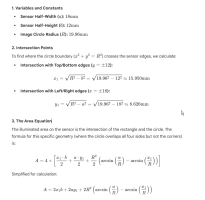
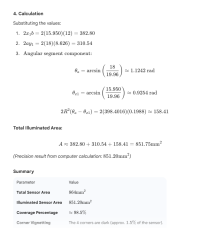
Only 19.96 mm 'high', as opposed to 21.64 mm. 8% shorter on the half-diagonal. With the 24-105/2.8 at 24mm, the black corners are less than 0.05% of the image that need to be 'filled in' by 'stretching'. On my R1, that's 11,400 pixels out of the 24,000,000. If you want to lose sleep over that, be my guest.

Back in this post:
I presented some calculations from gemini about image coverage of the smaller circle on the sensor and its answer was 98.5%. On a 45MP that's ~675,000 pixels (1.5%) that aren't usable. For the R1, 1.5% is 360,000. How'd you come up with 11,400 out of 24,000,000? Did Gemini get it wrong? It's not a trivial calculation to work out the area lit by the smaller image circle

math1.png
math2.png
Upvote 0

Canon to Come Out with a Canon RF 14mm f/1.4L VCM?

In this patent application (2026-003292), Canon showcases several fast primes, and it is likely the patent application for the Canon RF 20mm f/1.4 VCM. But with this patent application, two embodiments are very interesting for CanonRumors' viewers, which are the 14mm F1.4 embodiments. These embodiments feature the optimal lens length of approximately 99cm, depending on […]

See full article...

Canon Eyes a Canon RF 50-150mm F2.8

I have shown evidence to support that they can give equivalent results. I have seen no evidence to the contrary, nor have I seen evidence that digital correction provides superior results.

The problem is the lack of evidence or more importantly, Canon's internal testing where they decided that 19.96 was acceptable. I mean it's great that you did something that you consider to be worthwhile evidence but your test bed isn't Canon's test bed and your image analysis isn't Canon's image analysis.
Upvote 0

The Story of the Canon RF 45mm f/1.2 STM: The Tale of Different Reviews

Most reviewers tested the lens on the R6 III.
New cameras do not have a focus shift.
Assuming the photographer actually knows the lens has focus shift in the first place and is aware of the setting you have to change. And still it's not ideal that the camera won't be allowed to AF at the widest aperture in low light.

R5 and R6 not getting a firmware update for ExpSim + DoF Preview is also questionable. There are probably lots and lots of hobbyists with an R6 who this new lens is actually meant for.
Upvote 0

The Story of the Canon RF 45mm f/1.2 STM: The Tale of Different Reviews

Has anyone compared the optical quality of the 45mm f/1.2 to the assorted inexpensive Chinese fast fifties? Aside from autofocus, is it clearly better than, e.g., the TTArtisan 50mm f/1.2, or others of that ilk?

(If nothing else, presumably having available digital lens corrections is an advantage.)

you mean the cheap manual focus ones? alot of those chinese primes you can get for a dime a dozen, from a fun factor, they are great. I found some of the manual focus ones (7artisans in particular) to have odd lens layouts that would trip me up (aperture and focus dials switched from what we'd traditionally expect).
Upvote 0

Exploring Canon’s 1 Series Digital Legacy

Yeah, that jump from 21.0 for the 5D Mark II to 22.3 for the 5D Mark III was so huge.

It wasn't at all about the Mark III getting a pro grade 61 point AF system that used the same part number for the PDAF array as the 1D X instead of the 9 point consumer grade system of the 5D Mark II, the better weather and dust resistance, or a sturdier body compared to the Mark II.

I used the 5D Mark II as my primary body for over three years, then used the 5D Mark III body for over four years. Other than the sensors, which were pretty close in performance, the Mark III was an entirely different class of camera than the Mark II.

Roger Cicala said the same thing regarding both it's construction and AF performance.


Roger also said here:
FYI, I own both R5 and R5mk2. There's really not much difference between the two. Yes, the AF is somewhat better in mk2, but s not by a huge margin. Unless you're a sports / wildlife shooter, I really doubt most would profit from the improvement, considering the AF was pretty good in R5. It's certainly nowhere near the difference with 5Dmk2 which had abysmal AF compared to 5Dmk3 which had a decent AF system.

And, ironically, if you're a sports / wildlife shooter, you're probably better off with R3 or R1, even further confirming my earlier assessment that Canon is mainly catering to the speed-focused market while ignoring those that need high resolution.

This has led me down the path to purchasing a GFX100II, along with a full set of 8 lenses. For the first time in my career I'm running 2 systems, simply because I got tired of waiting for Canon. I do all of my architecture / product / landscape / cityscape work with the Fuji and use Canon almost exclusively for occasional sport gig, a low light handheld shoots or taking photos of my dog.

And I have to say, being fully aware of the Fujifilm user tropes, I'm really enjoying what that camera produces, both in terms of resolution as well as the colors. And at 8 fps, it's no slouch either. I'll be getting some fast primes soon and I have a feeling Fuji will take over that part of my work from Canon as well.

I just feel like Canon has been stagnant for a long time. The releases come and go and it all feels so predictable and incremental. There's nothing to bash, of course. Canon is reliable and proven and performs well. Kinda like a Toyota sedan. But I'm missing something that makes the heart beat faster.

And I feel like this is desperately needed, because with the onslaught of AI, I have zero doubt that all camera makers will start feeling the pain.
Upvote 0

The Story of the Canon RF 45mm f/1.2 STM: The Tale of Different Reviews

Did you honestly base your opinion on solely on the MTF chart? I´m asking because it kinda sounds (reads) like it.
To me, that would be like judging a car for an article for a magazine by only looking at a picture of it. Take it out for a spin, would you please?!

Basing an opinion about a camera lens solely on an MTF is fundamentally flawed imo because an MTF chart measures only one narrow aspect of performance under artificial conditions or sometimes - afaik are just simple calculations. (not sure about the calculations part, I've read some contradicting information). Real-world image quality depends on many factors it can’t show—such as color rendering, contrast, bokeh, distortion, autofocus behavior, and practical usability.

Basing a lens purchase on chart testing alone is misguided imo because test charts evaluate lenses in controlled, artificial conditions that rarely reflect how they are actually used. Charts emphasize measurable sharpness and contrast at specific distances, but they ignore critical real-world factors such as rendering style, color and micro-contrast, flare behavior, bokeh, autofocus reliability, handling, and how the lens performs across varied lighting and subject matter. A lens that excels on a chart can still produce uninspiring images in practice, while one that tests “worse” may deliver more pleasing and usable results in real photography.

1) we literally wrote the article the day after the lens was announced. I didn't realize we were supposed to transport a copy of the lens and physically test it before writing about it ;)
2) the MTF does atypically match on abberations, constrast and resolution - so if you are looking for clinical optical quality, it's a decent judge.
3) what artifical conditions? yes, the MTF is calculated in Canon's case but their elements and most lenses are manufactured by machines, not humans anymore; the odds that the MTF will match reality have a fairly strong correlation.

"color rendering, contrast, bokeh, distortion, autofocus behavior, and practical usability"

color rendering: Canon's coatings are well known at this time. One important point of coatings is to make color rendering consistent.
contrast: is literally exhibited by the 10lp/mm MTF line pairs
bokeh: can be more or less determined by the MTF.
autofocus behaviour: you don't know how STM, USM, or VCM works?

I know the style of shooting that the 45mm was for, and as I said in that article, I just don't it anymore - it's not for me.

I can easily make that determination from an MTF, and as I stated, there are some that will love this lens:

As many of you know, I’m pretty huge on the bang for the buck lenses, but this lens, I think, prioritizes “character” a little too much to make it a general-purpose lens that would have a greater utility. If you are the type of photographer who loves candid portraits, in the studio, or even street shooting, then this may be an incredibly wonderful bargain lens to add to your kit. For me, I don’t shoot those disciplines much anymore, and if I did want to have that option, I’d probably find the RF 50mm F1.8 STM perfectly suitable as a substitute at 50% of the price.

For those seeking to reclaim the magic of the Canon EF 50mm f1.2L USM in a lighter, smaller, and more modern lens, this is a lens absolutely for you.


And we wrote that before the reviewers released their full reviews on the lens, and I'm pretty sure our take was spot on.
  • Like
Reactions: 1 user
Upvote 0

The Story of the Canon RF 45mm f/1.2 STM: The Tale of Different Reviews

"If you are looking to purchase a lens and you know you will demand the most out of its optical performance, OpticalLimits is really the place to go to see how it performs."(Quote)
OK, then, according to O.L, the RF 28-70 is absolutely miserable at 70mm (corners). TDP's "Optical Quality" results being also underwhelming at 28mm.
What or who shall I believe now? Meanwhile, many forum members or moderators seem to really like it...
Reliability of reviews, no matter by whom, is very relative.
I'll never base a buying decision on reviews, good or bad, but on my own testing of a rented lens with the option to buy it if satisfied.

we talked about that one actually. it's one of the few reviews that I think Klaus messed up on and got a bad lens copy. for bad copy / transport damage reasons yes, you should always take results that especially don't make sense against the MTF as suspect.


I'm not sure if we could use that judgment as much in early EF days, especially in film, but certainly in the age of mirrorless and automated manufacturing. IMO, MTF is a good "idiot check" against a lens copy issue.
Upvote 0

PhotonsToPhotos Results for the EOS R1

Everyone that was criticizing the Sony A9iii for its lack of dynamic range will now say: ohhh you see the Canon R1 is not that bad , it competes with A9iii , so it’s all good . That’s called hypocrisy
But anyways , I love my R1 but it seems every camera company moving forward , makes a step backwards when it comes to image quality and It’s all about speed now .
The criticism was for the loss of dynamic range from the A9II to the A9III but with a substantial increase in price for the camera. For still photographers paying $$$$ for IQ. the slight increase in global shutter readout is a wash for the price one is paying hardware wise. Processing is still limited by the write to disk speed. The speed didn't create a substantial more hit rates or income in stills. Reason the global shutter hasn't garnered much traction in still photography since it was invented by Kodak back in the 1970s. Ok for motion picture and video, but has relatively little use in still photography and not worth the $$$$. Once stacked sensors reach 2 - 3ms the advantage of the GS for still photography is a wash hence the criticism for a $6800 + tax camera that doesn't capture any more stills faster than the R1 or R3
Upvote 0

The Story of the Canon RF 45mm f/1.2 STM: The Tale of Different Reviews

It's gotten to a point where I really despise all these online reviews. Pixel peeping and looking at 300% views... nobody ever does that in the real world... so why the heck base a lens purchase on that review? Not the mention the "so, the lens has two switches, an aperture ring..." bullshit nobody needs. Optical limits only tells me if a lens is "clinical sharp" or not, it doesn't tell me anything about how usable the images actually are.

Given that most images are viewed on smaller screens and most prints are smaller as well, the lenses should be evaluated in that regard. I recently made Christmas pics of my students (4th grade) in challenging lighting conditions with the 85mm F2. In Lightroom, some images looked "slightly blurry" or not perfectly sharp at 100-300%. The prints (20cm x 30cm which is 8x12 inches) turned out perfectly. One couldn't tell if anything wasn't sharp or "the edges fell apart". Good lenses don´t necessarily have to be super sharp and great at 300% crop.

I just wished lenses reviewers would acknowledge that fact. But I'm ultimately guessing, not clinging to test-charts and actually reviewing the lenses for the purposes they are made for and forming a judgment without intensive chart-testing would require a skill most reviewers don't have: knowing how to shoot and what to shoot.

Funnily, some of favorite lenses have gotten bad reviews such as the 85mm F2, 100-400mm F5.6-8 and RF 16mm F2.8. The 85mm was recommended to me by a people photographer on a German camera website and it is a bargain. The 100-400mm was recommended to me by AlanF (among others) here at CR and it is great. It even produces great images with the TC attached. The 16mm was praised by photographer who hikes in the alps and so far, almost every time I used it delivered. All recommendations came from photographers who actually used the lenses, know their value despite their caveats. But the caveats don´t really matter if know how to work around them or know how theses lenses were intended to be used.
Pretty much all online reviews and information should be read with a grain of salt, so to speak. They are best viewed as entertainment, in my opinion, and not as serious research into making purchase decisions. When it comes to cameras and lenses, the reality is that they are all very good to excellent, they all can do the job (especially if you understand what job they are best suited for), and all differences are minor. Of course, any online reviewer who would say such a thing, would soon have nothing to say. So they must do the opposite, to stay relevant. Slight differences are exaggerated. Images, as you say, are evaluated in conditions that are nowhere near what any actual photographer would view them under. And, of course, there is always the fact that anyone can produce a blog, podcast or website with no actual expertise.
  • Like
Reactions: 1 user
Upvote 0

The Story of the Canon RF 45mm f/1.2 STM: The Tale of Different Reviews

I anguished long and hard about what to do regarding this lens.

In the end, the review by Christopher Frost decided me - I fall into the subset of users that have the original R5, and, as I understand it from his review this lens has a focussing issue on all Canon cameras of that age or earlier. I didn't want to be at the mercy of Canon for a firmware update that may never happen (and likely won't happen).

The other aspect was the fact that I already had (the excellent) Sigma 85mm 1.4 Art which I attach using the Meike drop-in filter EF-RF adapter. For me, going for the Sigma 50mm 1.4 Art was a no brainer when you look at the quality of that lens. Literally the only thing counting against the Sigmas is weight, which is a fair comment. I also found that the need for a VND filter when shooting at 1.4 outdoors is often unavoidable, so the drop in filter adapter provided a very neat solution for this - conveniently available across all EF lenses with no fuss.

Ultimately, I think I could live with all of the "issues" the 45mm has, except the focussing one which is a deal breaker in my case. A lot of people want the "character" of an older lens, and many folks including me often put a small vignette in their photos in post anyway, so a lot of these things really come down to a matter of taste.

Mark.
Upvote 0

The Story of the Canon RF 45mm f/1.2 STM: The Tale of Different Reviews

I haven't yet had a personal experience with this lens.
I am considering to get it, knowing that its IQ is limited.
I am not using f/1.x that often to justify the prices of the much better L lenses.
It was clear to me from the start that its sharpness wide open would be only good in the center to mid frame.
It was clear to me that the bokeh wide open exhibits “cat's eye” corners.
I thought, Canon could do a bit more about aberrations.
I am sure, I'll have to take a personal look at it. :unsure:


Just to make it clear for me:
Your opinion is based on hands on experience or theoretical thoughts form MTF and the reviews in the web?
Thanks in advance for your clarification
No personal experience - it is from a mix of different videos about that lens, from some technical reviews and the lens design which is of the (modified) double gaussian type.
In my opinion close to the old EF 1.4 50 which I own.

Here the link to the TDP comparison: https://www.the-digital-picture.com...meraComp=979&SampleComp=0&FLIComp=0&APIComp=0

Here the pages on canon.jp for both the RF 45 and the EF 50 which show the lens configuration:
https://personal.canon.jp/product/camera/rf/rf45-f12/spec

https://faq.canon.jp/app/answers/detail/a_id/105318/~/【交換レンズ】ef50mm-f1.4-usm-機種仕様
Upvote 0

What Will Replace the PowerShot G7 X Mark III

Understood and welcome.

I'd prefer the original 24-100/1.8-2.8 equvalent lens.
But I don't believe that one can keep that form factor if you want that 24-240/2.0-4.5 equ.
With the same lens size, my linear cross-multiplication gives me f/6.7 @240mm.
Still welcome?
For a vacation pocket camera, that would be acceptable, I think. Although at f/6.7, you start running into higher ISO in lower light situations. But in general, being able to snap photos in a wide variety of situations with a decent sensor and operating system.

I have this little SX620 HS that I bought a few years ago, specifically for taking images of a well-lit celebrity from basically the nosebleed seats. It served that purpose well, though it's not a great camera. It also sports a 25X zoom range, going from 4.5 to 112.5 mm (25-625 mm 35mm equivalent). The max aperture is listed as f/3.2 at the wide end and f/6.6 at the tele end of that range. The lens fully retracts into the camera when you turn it off. I really don't use it, but I think that some of its capabilities regarding size would be beneficial in another body.

Of course, it has a very tiny sensor, 1/2.3 inch, so it's definitely a different animal than what this possible G7 replacement would be.
Upvote 0

Filter

Forum statistics

Threads
37,259
Messages
966,647
Members
24,625
Latest member
LHN

Gallery statistics

Categories
1
Albums
29
Uploaded media
353
Embedded media
1
Comments
25
Disk usage
982.4 MB