Two Never Before Seen Lenses Coming from Canon This Year
I could not have said it better myself!!!Well, any new lens is technically a 'never seen before lens'.
Upvote
0
I could not have said it better myself!!!Well, any new lens is technically a 'never seen before lens'
.I disagree: for tele lens birding/wildlife photography the R7 is within Canon's current eco system still the camera that provides the highest resolution in the center of an image, and that allows for more "reach" (if there is enough light available so noise doesn't kick in too much). With the same pixel pitch, a FF camera would have about 80 MP. Wildlife photography is of course a special branch of photography, but I guess most buyers of the R7 do use it for tele photography and possess also a FF camera for other settings (like me). So, I am overall happy with my R7 for that purpose, despite its shortcomings. Okay, if Canon would come up with an 80 MP FF camera, then one could activate the crop mode in typical birding settings. Such a camera would maybe kill the high res APS line. But the question whether an 80-100 MP FF camera really makes sense in real life photography, was discussed here already extensively - I don't want to open THAT can of worms.
Yepp, that's for me more a "minus" than a "plus", despite the fact that I don't care much about RF-S lenses. But this may also be a hint that Canon realized at least that R7 users have also FF cameras anyway.

With higher resolution sensors, this difference between FF and APS-C is getting slimer with each new generation of camera and in a few years we probably won't compare FF and APS-C on diffraction.One other difference is that given the same sensor resolution you lose about one f/stop before diffraction becomes a problem because the photo site in an APS-C sensor of the same sensor resolution is that much smaller. Going in the other direction, keeping the photo sites the same size and not hitting diffraction losses earlier is going to cut overall sensor resolution.
Note I didn't say where diffraction becomes a problem since that depends on what the photographer considers acceptable loss of sharpness but given the same photographer, you lose about one stop by going APS-C. If diffraction bothers you at f/11 on full frame then you'll find it bothers you at f/8 on APS-C.

One other difference is that given the same sensor resolution you lose about one f/stop before diffraction becomes a problem because the photo site in an APS-C sensor of the same sensor resolution is that much smaller. Going in the other direction, keeping the photo sites the same size and not hitting diffraction losses earlier is going to cut overall sensor resolution.Don't sweat, you'd be hard pressed to find any difference between APS-C and FF under proper lighting.
It's $1000 / 1000€ more expensive new, but you can have it second hand for about 2500€ so not much more than the 200-800.RF 100-500L is on my wish list... is it worth more than 200-800 for R7?

RF 100-500L is on my wish list... is it worth more than 200-800 for R7?Don't sweat, you'd be hard pressed to find any difference between APS-C and FF under proper lighting.
Full frame merely raises the ceiling of what you can theoretically achieve in terms of image quality by giving you a bit more flexibility, that's it. I take much better pictures with my R7 + RF 100-500L than the R5 Mark II + 200-800 I was lent. Possibly because I know my setup much better and know how to go around its weaknesses, but also because I simply have a superior lens.
Depth of field is a much more compelling argument in favor of FF for portrait photographers than dynamic range is for birders.
In my opinion, you are mixing apples and pears. The comparison with rain and area is wrong. The same amount of water falls on the area. That's the principle of the rain gauge, gentlemen
I really don't know what you're talking about here. I know the R7 takes nice pictures of animals. And that's why I bought it.
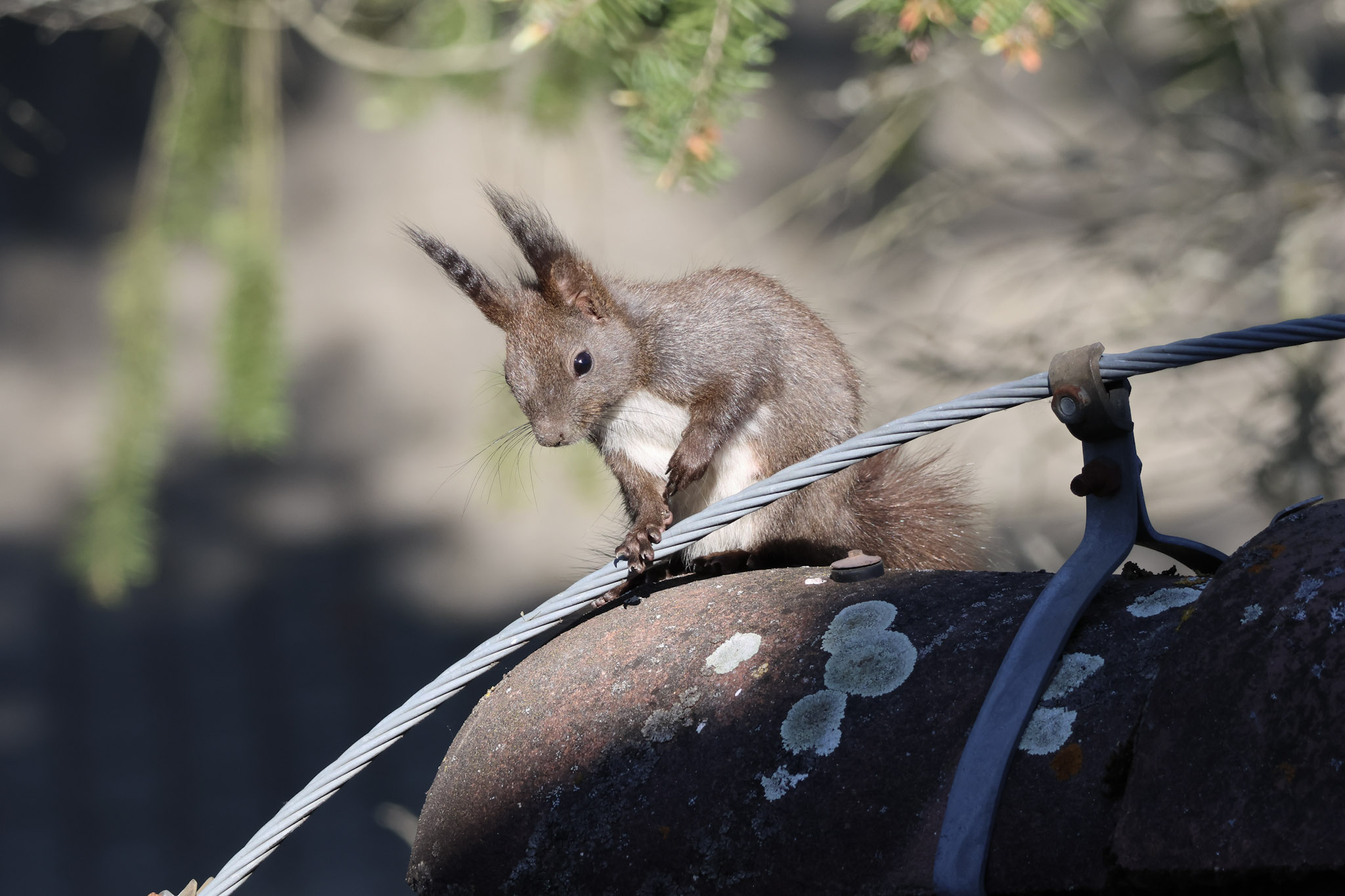
Here you have a squirrel, for example.
Do you see her fine whiskers? Are those the buckets of water?
When I go back to the raw files from the 5DS I had I’m always blown away by the colours it was an ideal studio camera / fashion camera and paired with the right glass and at base ISOs it was stellar.The 5DSR was not an entry level DSLR but an expensive 5 series, and an excellent one at that. It had pretty good AF through the viewfinder.
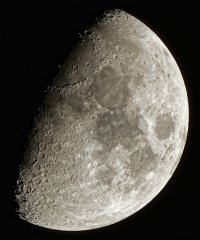
Not half bad for an f/18 on a 20MP APS-c sensor. And no (to me) visible motion blur!Back in 2015 in Cyprus, I took a live-view shot of the moon hand holding a 7Dii with a 300mm f/2.8 ii with a Canon 2xTC + 3rd party 3xTC at 1800mm - but I did rest the lens on a tree branch!
View attachment 229747
I like to think even with an 80+ MP FF R5 - style camera (which would probably cost 5-6 K Euro, Dollar, Pounds) there could be a place for APS-c sports- and wildlife-capable cameras, for instance for new or young photographers and as backup to the high MP camera. If the rumours of 39-40MP R7 II are true (who knows nowadays...) one would need 100 MP FF for the same pixel density in an APS-c crop. Even a 2.5 K$ R7II would be more in the price bracket of an R6 line model which sells more units than the higher end R5 line models.I disagree: for tele lens birding/wildlife photography the R7 is within Canon's current eco system still the camera that provides the highest resolution in the center of an image, and that allows for more "reach" (if there is enough light available so noise doesn't kick in too much). With the same pixel pitch, a FF camera would have about 80 MP. Wildlife photography is of course a special branch of photography, but I guess most buyers of the R7 do use it for tele photography and possess also a FF camera for other settings (like me). So, I am overall happy with my R7 for that purpose, despite its shortcomings. Okay, if Canon would come up with an 80 MP FF camera, then one could activate the crop mode in typical birding settings. Such a camera would maybe kill the high res APS line. But the question whether an 80-100 MP FF camera really makes sense in real life photography, was discussed here already extensively - I don't want to open THAT can of worms.
Yepp, that's for me more a "minus" than a "plus", despite the fact that I don't care much about RF-S lenses. But this may also be a hint that Canon realized at least that R7 users have also FF cameras anyway.
Back in 2015 in Cyprus, I took a live-view shot of the moon hand holding a 7Dii with a 300mm f/2.8 ii with a Canon 2xTC + 3rd party 3xTC at 1800mm - but I did rest the lens on a tree branch!Actually, I did use LV with dual pixel AF e.g. of my 7DII in (not very frequent) cases when I had my old EF 500mm f/4.5 attached with a 2x TC, because the AF sensor then stopped working @ f = 9.0. But of course that was always on a tripod. Btw AF was quite slow back then with this particular combo, so it was only useable for quite steady settings.

Yeah — for me it was my kid for a long time (now in university), and during that time we bought a farm and live in a rural community. (I know, weird for a tech guy.) As such, I've gravitated towards domesticated animals (e.g., ducks, horses, hounds); wild animals (e.g., eagles, deer, elk); and people or my own experience in that context (my avatar pic is from a rodeo), such as portraits around barns, warehouses, shops, etc.Depends on what you want to mainly shoot with that lens: the f/4.0 is a very good landscape and short sports tele zoom; the f/2.8 shines when you shoot people, including portrait (that's why reporters love this lens), and it is of course the better choice if you want to use it with extenders. But I do not want to teach you, you surely know exactly for which purposes you want such a lens.
Btw the f/4.0 L IS USM is not only quite compact & light (like the non-IS version), feels very nice in the hands, in particular turning the zoom ring feels so light and smooth, it is a real fun to use that lens. The f/2.8 L IS USM II that I have feels extremely solid, too, but it is much more massive.
Love the R5C. When you think of a hybrid camera, do you consider hybrid as being one body that does good video and photos seamlessly in one operating system? R5C feels like two completely different cameras sharing one body hardware, with that short reboot cycle between operating systems. So, I’m not sure how hybrid is defined in that case comparing the R5II and the R5C. Both are technically hybrid (R5 line, R6 line).Also, the R5 C.

I disagree: for tele lens birding/wildlife photography the R7 is within Canon's current eco system still the camera that provides the highest resolution in the center of an image, and that allows for more "reach" (if there is enough light available so noise doesn't kick in too much). With the same pixel pitch, a FF camera would have about 80 MP. Wildlife photography is of course a special branch of photography, but I guess most buyers of the R7 do use it for tele photography and possess also a FF camera for other settings (like me). So, I am overall happy with my R7 for that purpose, despite its shortcomings. Okay, if Canon would come up with an 80 MP FF camera, then one could activate the crop mode in typical birding settings. Such a camera would maybe kill the high res APS line. But the question whether an 80-100 MP FF camera really makes sense in real life photography, was discussed here already extensively - I don't want to open THAT can of worms.Imho evolution of photo tech these years should include the transition from crop sensor more towards to full frame.
Yepp, that's for me more a "minus" than a "plus", despite the fact that I don't care much about RF-S lenses. But this may also be a hint that Canon realized at least that R7 users have also FF cameras anyway.Canon STILL not having a proper crop-lens lineup is just +1.
Do you know Ming Thein's great review of that camera that he postet in 2015? As a Nikon photographer he was particularly floored by the fact that a digital camera can produce pleasant colors just out of the box. Based on my wife's extended Nikon gear, I immediately understood what he meant. My wife was extremely frustrated by Nikon's color rendition back then, but when anyone tried to address that problem in Nikon forums he ended up in a better knower's shizzle storm. You still can read Ming Thein's highly influential blog that started the internet fame of Canon's really great color science (= satisfying results in many settings w/o massive post-editing):The 5DSR was not an entry level DSLR but an expensive 5 series, and an excellent one at that. It had pretty good AF through the viewfinder.
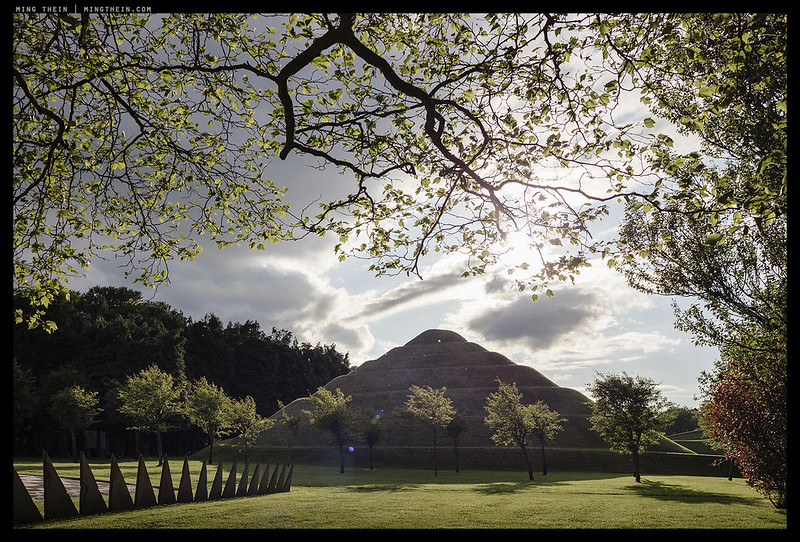
 blog.mingthein.com
The 5D series did start to take off as very good action tool with the 5D3, with which I had a surprisingly high in-focus hit rate with birds in flight (with an old club of an EF 500mm f/4.5 lens). This particular camera kept me with Canon, I loved it, despite its shortcomings (not the biggest DR and critical shadow noise).The 5DSR was not an entry level DSLR but an expensive 5 series, and an excellent one at that. It had pretty good AF through the viewfinder.
Actually, I did use LV with dual pixel AF e.g. of my 7DII in (not very frequent) cases when I had my old EF 500mm f/4.5 attached with a 2x TC, because the AF sensor then stopped working @ f = 9.0. But of course that was always on a tripod. Btw AF was quite slow back then with this particular combo, so it was only useable for quite steady settings.Did you ever use rear screen live view AF while hand holding one of those with a telephoto lens for action shots?
The world runs on emotions, not performance. I own both: The 50 1.8 is close to zero emotions but worth being used. the 45 1.2 is nothing but emotions and the very most relevant argument: This little girl has married my camera's bayonet.Since the 45mm has so poor IQ, at least without correction (and the corners even if corrected) - I really hope for a jump in price for better optical performance
Also, the R5 C.We have the R6III for a true photo and video hybrid

Exactly! Besides the two obvious focal length choices at the wide and the long end, 8mm (APS-C) would be used by professional 360° producers to maximise final resolution. Furthermore, about 9mm could come handy when recording video in 16:9.I'll add that we RF 7-14mm shooters, (or EF 8-15mm) never called our lenses "dual fisheye lens shooters". It's a zoom lens, with lots of great options.