• The Canon Rumors Forum has officially been shut down as of July 10, 2026.

    All data will be deleted on September 16, 2026.

    the ad free experience will return by July 17, 2026.

Review: Rokinon 50mm f/1.4 AS IF UMC

TWI by Dustin Abbott said:
jd7 said:
TWI by Dustin Abbott said:
My two greatest gripes with the original Sigma 50 was the inconsistent focus and the the very strong green fringing. I know a lot of people love it. I don't. I'd actually take the Rokinon over it myself.

Thanks Dustin. I can't say I'd found the green fringing particularly bad as wide aperture lenses go, although I'm not used to L primes much less Zeiss Otus primes so perhaps my expectations are not so high in that regard? And I have to say in going through some old photos tonight there is a bit more green fringing than I had noticed before. Hhhmmm.

As for AF, I do occasionally doubt the AF but then again it could just be me not being careful enough. Perhaps I should test it more carefully, but I haven't found it too bad overall.

In all honesty, the opinion on your gear that matters the most is your own. If you are happy with a lens, then just shoot it and enjoy it and forget about what I or any other reviewer says.

I haven't thrown away my S50 EX just yet :) You're right of course. Easy to get carried away with the technical aspects of lenses (or cameras) and lose sight of the fact that in the end, what counts is whether you like the images. Still, colour fringing is not helpful. That said, I mostly use the S50 indoors / in low light these days, and I don't *think* the colour fringing is too apparent in those circumstances so I don't think it is that big a deal for me ... although I'll certainly be keeping a closer eye on it now!
Upvote 0

Samyang To Announce 100mm Macro This Summer

HTML:
<p>It looks like Samyang will be announcing a 100mm f/2.8 macro lens this summer. The price of the lens is rumored to be in the area of $800, which is around what the equivalent Canon and Nikon are.</p>
<p>Source: [<a href="http://photorumors.com/2015/03/22/samyang-100mm-macro-lens-rumored-to-be-announced-this-summer/" target="_blank">PhotoRumors</a>]</p>

70D + 16-35 f/4L IS USM - DPAF noise/smoothness?

I didn't know you had the 6D otherwise I wouldn't have recommended the 18-135. I believe there is a 24-105 stm although not constant aperture it is stm so it would have smoother auto focus. Basically the usm lenses are good for video focus but they tend to hunt where the stm don't hunt. Either way you will have a good focus system but it really just depends on what look you're going for. You will get a far more cinematic look with stm especially with your 70D as you can adjust focus speed with movie servo focus.
Upvote 0

KR: NO 5D Mark IV Coming - ever

pwp said:
Light_Pilgrim said:
Why people are so worried on what KR says? So much that it even deserves to have a dedicated thread:-)
I do not know, but for me he is the Chuck Norris of photography....
Love it. That's hilarious!
Now we really need a Chuck Norris thread.

Let's not forget that Sir Edmund Hilary forgot his camera, but luckily found Chuck Norris' at the summit of Everest.

-pw

LOL...And Ken was on Chuck's back to take the photo. :)
Upvote 0

Novo to produce filter range using sapphire crystal and Gorilla Glass

anthonyd said:
Regarding optical properties, sapphire has excellent clarity. It allows much more than the visible spectrum to go through, so it won't give you a tint. However, this means that you are relying on the coatings for removing UV and the coatings can be scratched.

oO ... I did forget about the coating. I only use multi-coated filters - to minimize unwanted reflections/flares. UV i don't care about - sensor takes care of it anyways. I hate scratches in coatings. So sapphire and gorilla glass create no tangible improvements for me.
i'll therefore stick with B&W "regular optical glass" filters. Multicoated, of course.
Upvote 0

5DIII minimum shutter speed is not working

JenniferSvenja said:
neuroanatomist said:
JenniferSvenja said:
Hi everyone,
I found this old post and it seems to be dealing with kind of my problem. My Canon 5D Mark III just ignores my minimum shutter speed at low ISO e.g. ISO 400.
My Max ISO is set to 12800. Instead of upregulating the ISO , it just upregulates the shutter time first. And i checked the safety shift, it is OFF. I don't know what to do. I just invested a huge sum into this camera and now such a simple thing is not working...... :'( Please help me with this issue.

To confirm, are you in Av mode with ISO set to Auto?

Sorry, I realized later that I forgot to mention this and modified my question post.
Yes, definitely: I tried both Av and P Mode. And ISO is set to Auto. And the awkward thing is, that sometimes it seems to be working after changing the minimum shutter time due to troubleshooting. But it always goes back to "not working" after some time.

It won't apply in P, only Av. As light dims, shutter speed should increase to your set minimum, and only then should ISO rise to your maximum, and after that the shutter speed will start to increase again.

What shutter speed do you have set as your min shutter in Av mode?
Upvote 0

Lensbaby 55mm f/1.6 On The Way

clicstudio said:
I don't understand the concept of the LensBaby. Why would u want to have a lens with FX or selective focus which are permanent? I mean, u have tons of filters for Photoshop that do the same and can be tweaked.
I don't get it. :o

I don't understand the concept of the LensBabyPhotoshop. Why would u want to have a lens software with FX or selective focus which are not permanent? I mean, u have tons of filters and lenses for Photoshop cameras that do the same and can be tweaked.
I don't get it. :o

Sorry, just my sense of humour, and no offence intended! :D
Upvote 0

Ultra Wide Angle Cinema Lens Coming [CR1]

Tugela said:
Well, I hope they do the right thing and get competitive, for you guys. It will be no matter beyond interest to me, since I have already given up on them and crossed the wall, so to speak. They won't be getting my money, it is too late for that now :)

Out of curiosity, what did you get and what feature enticed you to get it?
Upvote 0

Could Canon's Next Leap in IQ be a big one?

Neutral said:
StudentOfLight said:
I stand under correction, but as far as I know Quantum Effieciency is how many incident photons are converted to an electron by the sensor. A QE of 476% means that when one photon hits the sensor then on average it liberates about 5 electrons. I'm not a physicist but that I think that's impossible.
It might seem to be impossible but this fact this is possible.
And I think this could be found in some specialized applications.
Trick here is using special electrons multiplication circuit.
One photon is converted to one electron but then this electron is casing emission of several more electrons in this electrons multiplication circuit. This is different process then analog amplification. Kind of nuclear reaction but using electrons. And multiplication coefficient could be adjusted.
I remember I've seen some patent for that somewhere some time ago.
http://www.sensorgen.info/NikonD2X.html

Here is the D2X, where QE of 476% is claimed... I will let you make you own conclusions on the validity of the the data.
Upvote 0

7D MK II skin tones/color issues (5d Mk III +7D MK II owners)

When you say same WB, are you using a graycard or simply dialing the same K and tint in post? Because different bodies have different WB settings.

A custom profile will help you, as others have mentioned already. But there's no guarantee that they will look exactly the same. I use ColorChecker Passport for all my cameras but there's a difference in rendering anyway. My 1Ds3 will not render the same as my 6D for example - both profiled. Mainly because of different CFA's and the fact that the 1Ds3 is more balanced in all channels.

Do you have any examples to share?
Upvote 0

Fun with teleconverters

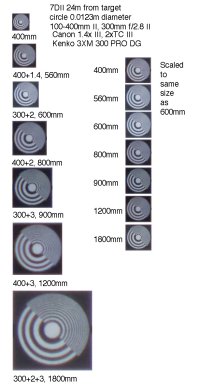
When you look at the TDP site, it seems that all TCs degrade the image. But, Bryan moves the camera further away from the chart to produce the same size image when a TC is attached. What I want to know is what the images are like from the same distance and does the gain in focal length more than compensate for the degradation of image with the lenses and TCs I use. Inspired by my recent purchase of a Kenco Teleplus 300 Pro DG 3xTC and a bright sunny day (the clouds having cleared after the eclipse), I compared the 100-400mm II and 300mm f/2.8 II bare and with Canon 1.4 and 2xTCs and the Kenco on the 7DII. The target was an iso12233 chart 24m away. Focussing was done automatically in liveview. Here is a collage of the centre ring, which is only 12.3 mm across. The unsharpened images are on the left.

At 400mm, only the two broadest of the fine semicircular lines can be resolved. Resolution gradually increases until a focal length of 1800mm is reached by stacking the Canon 2xTC III with the Kenco 3x on the 300/2.8. The stacked TCs at f/17 just about resolve all the lines.

I resized all images to the size produced by the 300/2.8 x 2 combo, on the right. The downsampled image from stacked TCs is the best.

Attachments

  • Extenders_on7DII_Extra.jpg
    Extenders_on7DII_Extra.jpg
    168.8 KB · Views: 236

Canon EF 50mm f/1.2L II Mention [CR2]

All the super-fast lenses are only that fast in the very center of the image. If you go just slightly to the corners wide open you realize that a 1.4 rated lens for example is mostly a 2.8 lens or so, except in the very center as I've said... All due to heavy vignetting. I'd give a thousand bucks more if the FF corners of modern super-fast lenses would be a bit brighter.

I do landscape-astrophotography. When you brighten up darker corners, you also raise the image-noise in that area to a certain degree. Or you can stop down a super fast lens to f2 or f2.8 to even out the incoming light and reduce vignetting, but then f2 and beyond isn't really "fast" to me anymore.

For portraits, this doesn't matter as some people like the effect of "framing" the subject and the fact that you are not shooting in the dark using high ISO. At daytime, vignetting is absolutely no problem because when you want to correct it, it doesn't affect the IQ at all and you won't notice it.

Other thing what's important to me is coma. That's also something you won't notice at daytime. But in the dark this can be very annoying esp. if you have city lights or stars in your frame. Still, most modern primes don't have appropriate coma correction like the EF 35 IS USM for example.

So, I wish, at least in the L-series, that Canon is giving me as good coma correction wide open as the Samyang lenses and a little less vignetting.
Upvote 0

Review: Tamron 15-30mm f/2.8 Di VC

lintoni said:
BeenThere said:
ahsanford said:
As you can see, the lenses are very, very close from a resolution perspective, which is a high compliment for the Tamron. ......


But this Tamron may be awesome for your needs. Congrats if this is the one you've been looking for -- other than coma, this lens looks impressive.

- A
I would have to say that from the lens tip test, coma looked pretty good to me.
Agreed. I'm wondering if ahsanford has confused the recent Lenstip review of the Sigma 24 Art, which does have disappointing coma, with the review of the Tamron zoom? ::)

Myyyyy bad. I absolutely did mix up the Tamron and the Sigma 24. Apologies!

(The resolution data I reported was correct, however.)

- A
Upvote 0

Canon is the preferred camera

Just a thought: The USM focusing motor whines at 30 kHz while Lions have an extraordinary ability to hear sounds that come from many different frequencies. They can detect frequencies that range from 55 Hz up to 79 kHz.. It might have been the ultrasound that attracted the lionesse's curiosity.

I've noticed some dogs get jumpy when I try to take their picture at a close range.
This in fact gave me the idea.
Upvote 0

Filter

Forum statistics

Threads
37,480
Messages
975,426
Members
24,816
Latest member
GLBDD

Gallery statistics

Categories
1
Albums
29
Uploaded media
372
Embedded media
1
Comments
25
Disk usage
1 GB