Visiting USA, need some advice pls.

I think you should stay in NY state for the camping part, and here is the park website most are talking about:

http://visitadirondacks.com/stay/campgrounds

says 4 hours from NY City to there.

http://visitadirondacks.com/first-time-visitors/getting-here


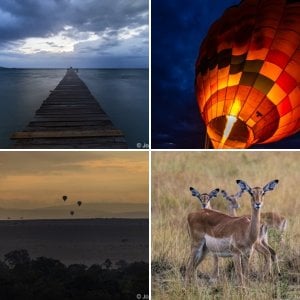
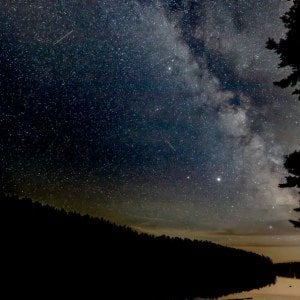
I think a campsite along one of the lakes would be the best bet for sunset/astro photography.

I'm pretty sure it is hard to understand how big the US of A is - 6 hours is how long it takes to cross the state of Kansas east to west - that is just one state, and not a really big one at that.

You could easily spend 3 days in NY City proper and not see all there is to see. Very easy to spend way too much time in a car traveling, and not enough time looking and seeing what is all around you. Find a nice park close to you and enjoy the experience!
Upvote 0

Help me decide on my next camera purchase - full frame high end

danski0224 said:
When the 5D3 came out, there were many comparisons to the 7D, and essentially the 5D3 cropped to the FOV of the 7D was better in most real world shooting conditions. In the same way, the 1dx loses nothing to the 5D3.
+1.

I have all three bodies and did the same comparison -- especially when migrating from the 7D to the 5D3. I had to know if and when it was advantages to bring the 7D.

During indoor situations, cropping a 5D3 image is definitely better than a full 7D image. Outside, with lots of light, the differences fade some -- especially when pixel-peeping. However, last fall I shot a kids soccer game with the 70-200 2.8L II as my primary lens and used both the 7D and the 5D3. I was expecting some "reach benefits" of the 7D. But, after culling the best shots of the day, the vast majority were from the 5D3. Other factors, including small DOF and greater color depth gave these images more pop. I see no real benefit with the so-called extra reach factor of crop bodies.
Upvote 0

Glow umbrellas?

Dear Friend Mr. SirClownfish.
I use many of this 40 Inches Umbrellas, But Difference Brand Name---So Cheap less than $ 20 US Dollars, and all of them Made in China any way.
Just buy and try to use, If you do not like just throw them away. For me, all of them works, Except, the strong wind damaged them, when fall to the ground with the stand.
Surapon
Upvote 0

Canon 5D mark 3 in-camera HDR shots

Having just purchased a 6D and being disappointed with the in-camera "HDR" I hoped that this thread would give me inspiration and maybe a few suggestions. Sorry, but it doesn't. The only images of a scene with a truly high dynamic range are by Rienz. The rest are of what I would call normal dynamic range where some judicious pulling and pushing could have saved the highlights and put detail into the shadows. Many of the posted images are flat and meh.
I have yet to process a 6D RAW file that is not superior to the in-camera HDR taken at the same time. Post-processed HDR using RAW files in Lightroom 6 is a different matter - this works very well and without the "HDR-look" - see attached file. Silly that the 6D does not save the original files, just the HDR jpeg.
Of course the in-camera HDR can be done in the field, but I rarely post anything without at least cropping and leveling.

Attachments

  • IMG_0821-HDR.jpg
    IMG_0821-HDR.jpg
    989.6 KB · Views: 459
Upvote 0

Patent: Canon Improved Mirror, AF at High FPS & EVF

Mt Spokane Photography said:
What I am reading is that the half mirror (Pellicle Mirror) is fixed. A part of the image beam from the lens is deflected down to the autofocus sensor while the rest passes thru to the main image sensor.

Right, that does make sense - it enables advanced image processing from a (2nd) digital sensor that you cannot achieve with a dslr-style phase af system, but circumvents to overload the main sensor with functionality (af system and picking up the actual image).

I take it the semi-transparent mirror is there to reduce shutter lag, just like on the good ol' EOS RT, with the added benefit of being able to continue tracking while images are taken?

And I understand this design change means that the camera has to have an evf which gets the image from the main sensor, i.e. it still has a shutter blackout (like a traditional dslr, and unlike the EOS RT)?
Upvote 0

Canon 28-300L 'super-zoom'

johfot said:
To be able to rapidly shift from 28 to 300 with out a lens shift has been critical. Yep, the Canon EF 300/2,8 L IS II USM would do a better job at 300mm, but the 28-300 doesn't have to be ashamed about it's performance. 95 out of 100 off my instagram pictures (@johfot) are shot with the 28-300, the others by Canon EF 24-70/2,8 L II USM or the Canon EF 14/2,8L II USM.
Thumbs up for the 28-300, looking forward for it's replacement :)

Thank you :)
Upvote 0

Upgrade from 7D

7D MKII vs your 7D

-60p at 1080p
-No aliasing or moire
-Much improved low light performance (closer to 5D3)
-Dual Pixel Autofocus, brilliant piece of technology
-Clean HDMI output with full Audio and Timecode for external recording to ProRes
-Headphone jack to monitor your audio whilst recording
-Better, less compressed codec, 90mbps ALL-I vs 30-mbps Long-Gop
-29:59 minutes recording time vs. 12 minutes on the 7D
-Internal Timelapse mode (intervalometer)

I think it's the best choice for you to mix with the footage from a Canon DSLR (same picture styles and colour science) and since you're uncomfortable with learning an entirely new system.

The 7D mk II is the best Canon DSLR for video right now, as while the 5D3 gains a bigger sensor it lacks many new features on the new 7D mk II.
Upvote 0

Leaked: Leica Q Full Frame Camera

Bernard said:
That part is not in the article, but it's a valid opinion. Why would you say that you read it somewhere instead of claiming it as your own?

I look at these predictions with some weariness. People were making the same predictions when I was a teenager in the 1980s. Eventually they will come true (they very nearly did before the M8 came out), but it's probably not soon.

I think there will always be an audience for the Leica rangefinder experience, just like there will always be an audience for 3 star restaurants, or improvisational jazz. These things don't need to be "relevant" in order to be successful.
I concede to your point not because your interpretation is correct but I am too lazy to discuss further.

Relevancy has numbers and the number of TLRs are... not worth counting. ;)
Upvote 0

5dsr & cropping

Don't confuse yourself. It will be just like shooting with an APS-C 1.6/1.5x DSLR in terms of final image. (especially identical to the 7D mk II)

A 50mm lens gives the FOV of about an 80 on APS-C
A 200mm gives the FOV of about 300mm on APS-C.

Just multiply by the crop factor available on the 5Ds (1.6 and 1.3) and you'll get the field of view and depth of field equivalent to FF.
Upvote 0

Which lens to add to kit for wedding photography?

niels123 said:
I personally notice that in those moments when 50mm is not enough, I have all the time to switch to 85 or 100L.

My lack of flexibility is in the fast wide angles which makes 18-35 (on crop!) so interesting. It equals 29 - 56mm on full frame and it's only $800, so a lot cheaper than canon's 24-70. I think I don't need the 24-29mm and the 57-70mm focal ranges a lot, especially since < 28mm distortion gets more and more visible.

What do you think, would 18-35 1.8 Art on 7D2 be an alternative to 24-70 2.8 on 5D3? I can then use 5D3 with 50, 85 or 100mm depending on the moment. Also f/1.8 versus f/2.8 makes quite a difference in low-light situations where there is not time to switch from 24 1.4 to 50 1.4.

btw: I also have the 135 f/2L and the 200 f/2.8L (the prime, not the zoom), but I rarely use them on a wedding because I find them too long.

I also heard about horror stories of expensive lens/body combo's falling of (in the water) with the blackrapid :-X
I haven't owned the Sigma 18-35mm Art but reports suggest it is a great lens in APSC cameras so it is a very promissing option and save you time by changing lenses and the risk to miss a shot. You're correct that f1.8 makes a big difference in terms of light gathering.
Give it a try!
Upvote 0

Better Beamer?

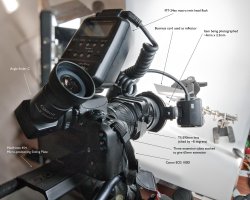
I've used one with my 60d and 100-400 mki with great results. You can get some really different shots at later times, in forested situations, and in snowy conditions. I will say that if you get shots with the bird looking at you, you'll get reflections in the eyes, but that's easily removed in post.

It does make for a more intimidating camera look which I've found can scare birds.
Upvote 0

600EX-RT + ST-E3-RT remote zoom setting?

Marsu42 said:
neuroanatomist said:
Marsu42 said:
I'd be surprised if there wouldn't be a new flash lineup with ettl3 (remote zoom & 2nd curtain remote) down the road to expand on the existing system.
What does E-TTL flash metering have to do with remote zoom or remote 2nd curtain sync? I suspect Canon could have implemented those in the -RT protocol had they wanted to do so.

I was taking of "ettl3" in the sense of a new camera-flash protocol, not in terms of different metering - so it could also be called "rt2" if you like that better, though they might want to have remote zoom & 2nd curtain remote for optical link, too.

I don't know if it would have been possible to implement this over the current rt protocol just like that, if so, I really wonder why they didn't at least allow for remote zoom that doesn't have timing problems like 2nd curtain sync might. The argument "the zoom is there to match the lens' focal length" doesn't quite cut it for me, I suspect a lot of people use the zoom for directed lighting instead of "light everything from the hotshoe".

Got it.

Personally, I've never found a need for changing the head zoom setting remotely, but I can see where some might find it useful. I have tested different zoom settings with a variety of modifiers, and I find that each modifier has an optimal zoom setting. That setting certainly differs by modifier, from snoots to grids to softboxes, and even within modifier type (length of snoot, fineness of grid, etc.), but doesn't change for a given modifier. So it's set-it-and-forget-it, e.g. 135mm zoom for my 1/8" speed grid, it goes up on the boom, done. Or, with bare flash I'm bouncing off a ceiling, and again the zoom is set based on the bounce distance, which is fixed. I change the power, of course, but that's by RT remote. If I shot with off-camera direct bare flash, maybe I'd find remote zoom useful – but the point of getting flashes off camera is to shape the light, and that generally means a modifier.

Thinking further, I do see some future-proofing in excluding remote zoom. The 600 zooms to 200mm, if they come out with a 4x0EX-RT, it likely won't zoom to 200mm. How do you fully control zoom on both if they're in the same group? (Yes, the 600 could be capped at less in that case, but that's a kludge).
Upvote 0

What is the best lens for astrophotography - 35mm or wider?

East Wind Photography said:
That being said, I just picked up the Sigma 35mm f1.4 ART. Does a wonderful job on stars. Wide enough to get good star fields but not so wide that you lose all semblance in nebula.

I am very pleased to hear this! I live in the SE US, so I rarely have clear air, and have not yet been able to use my 35mm Art for astro. But it is quite nice - very sharp, AF is moderately fast and very accurate, and no decentering.

Thanks!

John
Upvote 0

CANON 5DS REVIEW BY FERNANDO GUERRA

ReTake said:
FPS doesn't have anything to do with architectural photography, but it was a review of the 5DS, not a review of the 5DS as an architectural tool.

I believe a review from an architectural photographer pretty much shows it from the perspective as someone using it for architecture. I don't look at camera reviews from wedding or events people to get an idea of what a camera will do for architecture work.
Upvote 0

Filter

Forum statistics

Threads
37,445
Messages
973,934
Members
24,808
Latest member
Djiran

Gallery statistics

Categories
1
Albums
29
Uploaded media
372
Embedded media
1
Comments
25
Disk usage
1 GB