FLASH! New refurb's at the Sigma outlet store

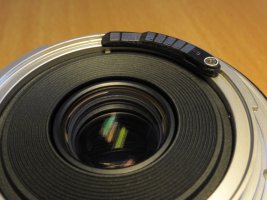
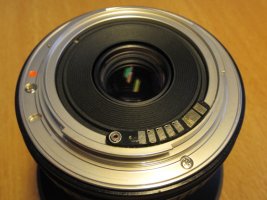
Just got my package.
I had completely overestimated the size (and it had been a major hang-up from deciding between the f/1.4s and the f/2 IS). It isn't tiny, but still quite compact, very well-balanced on my 5DIII with L-bracket and has a great feel to it.
I didn't check AFMA via FoCal yet, but initial tests seem to show no adjustment needed (both with center and peripheral spot focusing, do I need to test anything else?).
The refurb lens arrived in a nicely padded shipping box, with the regular Sigma white and black box and all the usual suspects inside. Only the warranty sticker says 90 days refurbished limited warranty.
The lens is cosmetically spotless.
FYI, for those considering Sigma refurbs.
Very happy. Very.
Upvote 0

When Canon registers a patent, what does it mean?

neuroanatomist said:
StudentOfLight said:
Anyway, after you submitting your patent application your idea becomes public knowledge...

I don't think that's true. The patent becomes public knowledge when it's published, not when the application is submitted. Publication is usually ~18 months after submission.
Thanks for the correction.
Upvote 0

Canon FD to EOS Adaptation

Mt Spokane Photography said:
You can use the same adapter that you use to mount the lens to the camera. don't expect too much, unless its a high end lens, it will not be as good as a cheap EF lens, and the TC will bring it down a big notch.

As to infinity focus using a TC, I don't know if its a issue or not.

You can't use the same adapter that he has now. He has an adapter for mounting an FD lens on a EF body. What he needs now is an adapter to mount an EF lens to a FD body. That is the exact opposite.

No one has ever made one, and no one ever will, because it would be impossible to change the aperture.
Upvote 0

Focal lengths

jrista said:
scyrene said:
jrista said:
Excluding telescopes, I've used the EF 600/4 L II with both 2x and 1.4x TCs (a Kenko in this case, as they stack directly without the need for an extension tube...IQ suffers a little bit). That gets you to 1680mm.

With telescopes, I've poked around with focal lengths up to around 8000mm to 10,000mm using SCT and RC type OTAs with barlow lenses. The only real reason you would use such focal lengths is for planetary (to get any real kind of sharp detail on planets, you need at least 8000mm), solar (sunspot closeups) and lunar (individual craters and finer surface detail).

I haven't purchased my own OTA yet, once I do, I really can't wait to do planetary imaging at over 8000mm. :P

How do telescope focal lengths relate to sensor size? Like, is 8000mm an equivalent in full frame lens terms?

Well, it depends on the scope. When it comes to the popular SCTs (like Celestron EdgeHD and the Meade Aplantics) and RCs, they are usually designed to cover at least the 42mm diagonal of a 35mm sensor frame. But when it comes to telescopes in general, they have a pretty wide range of image circle sizes. If you attach focal reducers, that affects the amount of backfocus, which in turn usually has an impact on image circle size. It seems to be a general standard that your average refractors (which often need at least a field flattener, if not a full focal reducer, to get a flat field) support a 22mm image circle. That is for fairly small sensors, which are more common in astrophotography CCD imagers. APS-C sized sensors are usually supported "natively" without focal reducers usually (~27mm diagonal.)

Larger scopes, as well as the new Rowe-Ackermann Schmidt Astrograph from Celestron, support image circles from 50mm up to 70mm. The larger scopes are ultimately designed to be used with both full-frame (36x24mm) and square full frame (37x37mm or larger, usually 4096x4096 pixels) CCD sensors. The 37x37mm sensors have a 52mm diagonal. There are some newer, larger sensors coming on the market soon that will have around a 65mm diagonal, and the ultimate top of the line is expected to be around 70mm in the future. Kodak is primarily the manufacturer supplying either FF or large square sensors, with 9µm, 11µm, and 24µm pixels. Sony has entered the market as well, and is supplying some of the highest sensitivity (highest Q.E.) small sensors (up to 22mm) that are often used in autoguiding cameras (ultra high sensitivity, configurable frame rate video cameras that are very similar to webcams, basically.) Some Sony sensors have found their way into entry-level Atik CCD cameras. Aptina also supplies 22mm and APS-C sized sensors.

There really isn't a standard sensor size that is supported by telescopes. Most support the 22mm and APS-C sensor diagonals. Larger OTAs usually support 35mm full frame. Outside of Celestrons new RASC Astrograph (which produces a 70mm image circle and costs a mere $3400), you usually have to buy either an RC Optical Systems or PlaneWave truss to get a 65mm (RCOS) or 70mm (PlaneWave) image circle...and those puppies cost tens of thousands of dollars.

Eek... I suppose what I meant was, is 8000mm in telescope terms the same as, say, a lens with attached teleconverters amounting to a 8000mm focal length? Would a planet be magnified the same amount by both?
Upvote 0

a 50mm dilemma.

You haven't mentioned what body/bodies you shoot with and what kind of subject matter you generally shoot.

I would only really consider the 50L if you are shooting full frame. On APS-C the the 50L lens will essentially have "the look" of lens that is 80mm f/1.9 on full frame. To get the most out of it you'll need to be shooting full frame as then you can get relatively closer to your subject to really melt away the background when shooting at f/1.2.

I have a feeling that the 50L is one of those lenses that will lose some value when a new version is released. There is significant room for improvement and strong competition in terms of IQ and price.
Upvote 0

Kitlenses - 50D

Hi thanks for the replies! :)

As a planespotter I'm using 50D's and 70-300 IS L + 400 L non IS, so enough mm's there.

I want to use my current 18-55 non IS lens on a back-up 400D for some family-pics, and that's it.
This means my new 'smaller' lens needs to serve for photo's of static/expo and some taxyshots of planes. For this 55mm is fine, but a bit more is better. IS is a must :)

Therefore my budget is limited to approx. 200€. ;)


Gert.
Upvote 0

Phottix Mitros Flash for Canon - Review @ Dpreview.com

StudentOfLight said:
privatebydesign said:
StudentOfLight said:
Do you have a guide number chart for the Phottix Mitros+? I can't seem to find one online either for the Mitros or Mitros+. Canon's 600ex-RT has a table of guide numbers for each zoom setting in the user manual.

58 @ 105mm, it is the same as the 600, you can use the same GN at the same zoom setting.

I know the listed (on B&H et al.) is 58@105mm, I wanted to know if Phottix provides a guide number chart for all their zoom settings.

Also, it has been suggested that the Phottix Mitros flash is less powerful than its claimed specs (https://www.youtube.com/watch?v=QRg89Mqtdfw) and was wondering if this also been the case in your experience or is the Mitros+ an improvement in this regard.

O

Well if it is the same power at one setting common sense would dictate it is the same at others. Don't forget all these speedlite gn values are dependent on zoom, which is an anomaly as that then dictates an area of coverage that changes, the 600's even have a coverage adjustment in the custom functions, but that doesn't alter the actual light comming out of the flash.

If you want to look into the differences between specs and one individuals actual flash you need to use caution, specs tend to be very specific, but, it is very easy to measure yourself in post. I strongly suspect they are using the same flash tube and same spec though different quality capacitors and IGBT circuits.
Upvote 0

Astrophotography - which camera?

sulla said:
Wonderfully explained!

Conclusion: a 200mm lens is wwwwwwwway too short for the ISS. It's hopeless, meaning, that even if you capture it perfecty, you will have a hard time spotting it in the final image. And for streak images, 70 is wwwwwway too long.

So, the question is not "which camera" but rather "which lens". The answer is: No lens at all, you will need a telescope for that. So if you plan to get into astrophotography, there just is no other option than getting a telescope. Fortunately, compared to EF glass, telescopes are rather cheap. They are basically mirrors, after all.

I think the real question is "which tripod"... Astrophotography can be of very small objects that require LARGE telescopes, it can be of wide images like the milky way, or it can be anything in-between... but for all of them you need a decent tracking mount. I have an 8 inch telescope that I use for planetary imaging and I also mount my DSLR onto the tripod for imaging nebulas and the night skies...

If you do not have a tracking mount, you will be limited to short exposures and you will have streaks of light on them.... The tracking mount comes before any camera/lens/or telescope in your wish list.
Upvote 0

Canon TS-E 17mm f/4L Tilt-Shift Lens - your thoughts?

Most seem to be said already, so all I can do is confirm some of the earlier posts. The 17 TS-E is optically and mechanically a phenomenal lens. But in my view, you buy it for the tilt&shift functionality and on a tripod. It is clearly useable handheld also, but to make it work handheld with tilt and/or shift requires a lot of practice. My use is 99% on a tripod.

There are filter options available, but to me it is too cumbersome, so I shoot it as it comes. I have a 15mm Zeiss, for which I bought the (frightfully expensive) CPL. And if a more standard UWA lens is what you want, I can definitely recommend that. Other alternative is the 21 or 18mm Zeiss lenses.

I also agree with he who pointed out that if you have a good UWA prime and the 24-70 II, you don´t need the 16-35 II. I actually sold mine, with no regrets. It is good stopped down, but full of flaws shot wide open (which is what I normally do).

But if you take the time it takes to master the 17 TS-E, it will give you lots of joy!
Upvote 0

12MP FF, 4k Video, What us video people have always wanted (it seems)

mkabi said:
not for handheld, steadycam stuff. I can't even imagine it on a crane....

Its highly modular - with that large cine-zoom and all the potentially useful external stuff it gets huge. But so would a A7.
The camera itself plus a photo-prime, w/o external monitoring&remote control(or that on a long tether) and you're back in the man portable ballpark. How global shutter for movement vs. higher payload capacity turns out for drone usage might be interesting, at least for 1080, in 2160 its much closer again.
Upvote 0

Sigma 12-24mm f/4.5-5.6 EX DG ASP HSM II versus Samyang 14mm f/2.8 IF ED UMC

Not tried either yet, but plan to buy the Rokinon/Samyang in the near future. For its budget price, there just is nothing else to consider.

I've heard and read good things about the Sigma zoom, but it is 3x the price of the Rokinon, and has slower aperture. However, besides zoom, you get autofocus and aperture set in camera, so that's a major plus. If you are shooting long exposure on a tripod, or otherwise have control of the lighting (or you're using strobes or other lights)...then wide aperture is less important. It would be very important though, if you prefer hand-holding, and shooting in a dark room.

12mm is certainly much wider than 14mm. Whether or not you can make use of the "rectilinear projection"...which basically looks like distortion...is another matter. There are ways to correct it manually in photoshop, but you wind up with an image that has less pixels, and takes in less of an angle of view. 14mm also shows significant rectilinear projection. Your straight lines will be straight, but objects (such as people, or anything round) get stretched toward the borders and corners...becoming "fat" or "egg-shaped". Certainly there is aesthetic appeal to leaving this uncorrected...but not always.

There's even a bit of this at 24mm...but it's far less necessary to correct.
Upvote 0

First time SLR user looking for advice on lenses/accessories

Jim Saunders said:
scyrene said:
edit: I notice I'm in a minority here. Without wanting to hijack the thread, what are people using the remote release for? I must be missing something :)

I have used one for bulb for fireworks. There are no doubt other ways of doing that but that has worked for me.

Jim

Oh sure, they're pretty much essential for that. But it's a pretty minor pursuit... :)
Upvote 0

Filter

Forum statistics

Threads
37,439
Messages
973,629
Members
24,805
Latest member
track inspector

Gallery statistics

Categories
1
Albums
29
Uploaded media
372
Embedded media
1
Comments
25
Disk usage
1 GB