Canon Announces the Canon RF 7-14mm f/2.8-3.5 Fisheye Zoom lens

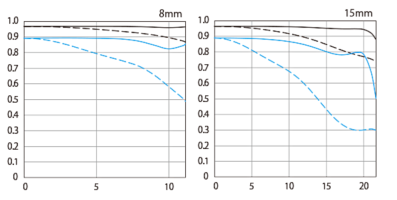
The MTFs you posted for the discontinued EF 8-15 are old versions, calculated differently, and not allowing for diffraction. Here are the ones Canon replaced them with:

Screenshot 2026-02-05 at 10.54.59.png

Ah thanks! Was very quickly romping through the internet, pulling it all together this morning / afternoon - and missed the new ones.
 
Last edited by a moderator:
Upvote 0
Even though the 7-14 is sadly a bit larger than its EF predecessor, it's kinda sexy that Canon managed to keep this lens in the VCM series format. Nice.
Not really, it's pretty much the EF version with an integrated Ef ot R adapter with dropin filters. Very sweet, this is the first RF lens taht can use these particular drop in filters. I hope Canon does a few more UWA lenses with this feature!
 
Upvote 0
Not really, it's pretty much the EF version with an integrated Ef ot R adapter with dropin filters. Very sweet, this is the first RF lens taht can use these particular drop in filters. I hope Canon does a few more UWA lenses with this feature!
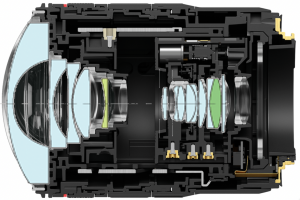
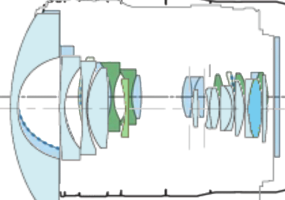
Looking at the cutaway view of the new RF 7-14mm, it's apparent that it is a reuse with minor modification of the EF 8-15mm optics (block diagram superimposed), meaning the lens needed the 'adapter' (spacing) anyway...so why not include a drop-in slot?

Screenshot 2026-02-05 at 11.10.25 AM.png

I was hoping for a drop-in slot on the RF 14/1.4, but clearly there is not enough room as the barrel is packed with glass. IMO, the inclusion of a drop-in slot in a non-telephoto lens means that the design is really not taking advantage of the short RF flange focal distance. I suspect that means we won't see this feature very often.
 
  • Like
Reactions: 1 user
Upvote 0
Not really, it's pretty much the EF version with an integrated Ef ot R adapter with dropin filters. Very sweet, this is the first RF lens taht can use these particular drop in filters. I hope Canon does a few more UWA lenses with this feature!
Comparing the MTF diagrams of the RF lens vs. the EF version, the RF performs much better, and although the optical construction at first sight may look similar, several elements are clearly different (RF: 16 elements, 11 groups, 2 aspherical, 5 Ultra-low Dispersion (UD) vs. EF: 14 elements, 11 groups, 1 aspherical, 1 UD) - which I suppose explains the marked improvement in performance.
 
Upvote 0