Fast Full Frame Unique Zoom Lenses

I wouldn’t like to say, but what I can say is that the optical performance of the RF 28/2.8 is really quite impressive, with superb clarity. So called ‘micro contrast’ doesn’t seem to suffer from the resin elements, there’s not a lot not to like.
I fully agree!
As I wrote in a former post, the RF 28mm f/2,8 is as sharp as my Leica M 28mm f/2,8 Asph.
There's absolutely nothing "not to like", not even the price! :love:
 
  • Like
Reactions: 1 users
Upvote 0
Sigh. Because physics. Wide and standard lens designs are limited by the image circle diameter, telephoto designs are not. There is no point in a telephoto lens ‘for crop cameras’ since such a lens would work fine on FF. That’s why there are no such lenses.

Look at the Oly/OM 150-400mm, for example. It’s for m4/3 (2x crop) but it’s about the same size as the Canon 100-500 (and if OM made a FF camera, the lens would work on it).

As for wide lenses not making money, I really don’t get why some people seem to think they know better than Canon what lenses people will buy. I mean, Canon has led the ILC market for over two decades and dominates it today…but you know more about what lenses they need to make? LOL. You get to decide what lenses you want to buy, but Canon doesn’t care what you personally want.
I think we need an automatic button to click everybody time this suggestion of making dedicated teles for APS-C is posted.
 
  • Like
  • Haha
Reactions: 3 users
Upvote 0
The 28-45mm f/1.2 would do it for me, it's the perfect range :D

That lens would be crazy.

To be honest, I wouldn't buy it. I barely use f/2 on my 28-70mm f/2, I was just lucky I got it for about the price of a RF 24-70mm f/2.8 on sale, and even now sometimes I question myself if I should replace it with the 28-70mm f/2.8 STM, mostly for the weight savings, BUT it would be exciting seeing a lens like that.
 
Upvote 0
Omg, that weight saving would be insane, probably a record :) saving nearly 1 kg... crazy
Yup…specially now, that I added the 45mm f/1.2 to my kit, which means I’ll always have something faster available in my bag and in my standard range, but the 28-70 is fully paid so, at least for now, it stays. Also, it’s not that it’d make much of a difference with my cameras, but this idea implies a downgrade, which would need to be very well considered. The 28-70mm f/2 is my most used lens for work.

The 45 1.2 is a complementary lens to me, hence going with such a budget option instead of, for instance, a VCM prime. The emphasis of my working kit is on the 28-70. If I replaced my main lens with a slower and lower end option, I’d probably have to reconsider the quality of the prime lens to go with it as well.

These lenses definitely reach new heights. It’s not just about specs, they can revolutionise entire kits for many users. To me, the 28-70 f/2 replaced two f/1.4 Art Primes and the EF 24-70 II. I actually sold three lenses after getting it.

I could imagine a 28-45mm f/1.2 going for 8~10k though:ROFLMAO:


The loss of quality as well...
Insane loss of quality? To be honest, with my cameras, I doubt. I’d be more concerned with the retractable mechanism, weather sealing and autofocus performance (the f/2 zoom is very, very capable regarding low light autofocus).
 
Upvote 0
OM 150-400mm is about a stop faster at 400mm than the Canon 100-500 though. Also internal vs. external zoom. Bad comparison I guess.
You have entirely missed @neuroanatomist 's point. The image circle of a 400mm lens is much greater than required to cover an FF sensor, and the lens can't be made smaller for crop or for M4/3. Most here know that so see my earlier post:

I think we need an automatic button to click everybody time this suggestion of making dedicated teles for APS-C is posted.
 
Upvote 0
OM 150-400mm is about a stop faster at 400mm than the Canon 100-500 though. Also internal vs. external zoom. Bad comparison I guess.
Fair in that I mistyped and meant to use the OM 100-400/5-6.3 as the comparator. But as @AlanF states, the point is that for a telephoto lens the image circle is not limiting and thus there is zero point in a manufacturer making such a lens 'for crop cameras'.
 
  • Like
Reactions: 1 user
Upvote 0
You have entirely missed @neuroanatomist 's point. The image circle of a 400mm lens is much greater than required to cover an FF sensor, and the lens can't be made smaller for crop or for M4/3. Most here know that so see my earlier post:
You completely missed the point of my comment. Using the OM 150-400 and the Canon 100-500 to prove his statement is an inappropriate comparison.

I didn’t disagree with his statement.
 
Upvote 0
You completely missed the point of my comment. Using the OM 150-400 and the Canon 100-500 to prove his statement is an inappropriate comparison.

I didn’t disagree with his statement.
He did say in his statement that : if OM made a FF camera, the lens (OM 150-400) would work on it, which is the whole point he is making. If you didn't disagree with that then you should have made that clear. Otherwise, it reads as if you are contradicting him.
 
Upvote 0
How would the light know only bounce one round-trip?
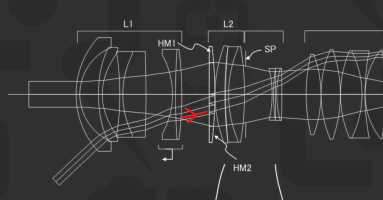
It's rather complicated to understand, a least for me. The HM element (HM = Holographic Mirror) acts like a catadioptric lens. The centre of the front allows transmission but directs light to peripheral areas of the back surface that reflect it back to reflective regions of the front surface that then reflect it to transmissive regions of the back surface. So the light is folded as in the patent for one round trip. It requires incredible accuracy of engineering at the nanometer level to work.
 
  • Like
  • Wow
Reactions: 2 users
Upvote 0
So for example if you look the lowest path of those 3 lines starting from down drawn on the patent, it bounces once and then goes through the second time.

But if you had another photon coming on the red arrow I drew (poorly) so it enters the same trajectory as the bounced photon, would they both pass the same spot on the back of the lens or would the red arrow photon make bounce while the other one goes through.

Photons don't have memory so if they hit the same spot, they should both behave the same. But then the red arrow path wouldn't make the bounce. So there's something strange here, maybe they left out something critical.

lenss.png
 
Upvote 0
So for example if you look the lowest path of those 3 lines starting from down drawn on the patent, it bounces once and then goes through the second time.

But if you had another photon coming on the red arrow I drew (poorly) so it enters the same trajectory as the bounced photon, would they both pass the same spot on the back of the lens or would the red arrow photon make bounce while the other one goes through.

Photons don't have memory so if they hit the same spot, they should both behave the same. But then the red arrow path wouldn't make the bounce. So there's something strange here, maybe they left out something critical.

View attachment 228259
You have to use the wave nature of light to account for the interference/diffraction/phase shift etc and not think about bouncing photons.
 
Upvote 0
You have to use the wave nature of light to account for the interference/diffraction/phase shift etc and not think about bouncing photons.
Ok, can you explain how that helps it bounce only once while another photon/wave on same trajectory wouldn't if it had already completed one bounce?

Fyi I have masters in physics so complex explanation is ok. I just can't figure out how that could work the way they have it in the picture, other than that they haven't told something critical about the design and how it operates.
 
Upvote 0
Ok, can you explain how that helps it bounce only once while another photon/wave on same trajectory wouldn't if it had already completed one bounce?

Fyi I have masters in physics so complex explanation is ok. I just can't figure out how that could work the way they have it in the picture, other than that they haven't told something critical about the design and how it operates.
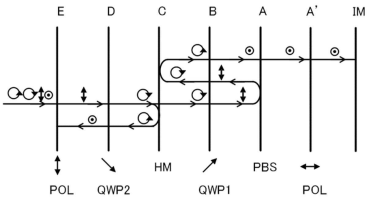
It's not that Canon didn't tell us, it's that Richard didn't pass along the full explanation. He hints at it, though, right at the start: "I had previously discussed these as quarter-wave optical designs...," in reference to the quarter wave plates (QWP) that convert linearly polarized light to circularly polarized light and back.

Details are in the patent, and the light manipulation you're missing is polarization, more than once in the optical path and both linear (POL) and circular (QWP2, QWP1), plus selective reflection/transmission.

Screenshot 2026-03-05 at 5.09.06 PM.png
By the above operation, only the light transmitted through the half mirror C, reflected by the polarization selective transmission reflection element PBS, reflected by the half mirror C, and transmitted through the polarization selective transmission reflection element PBS is guided to the imaging plane IM.
 
  • Like
Reactions: 1 user
Upvote 0