Show your Bird Portraits

The ornithologists usually know the scientific names of the birds (for sure the names in the group of birds in which they specialize...). The problem with the common names is that they are frequently ambiguous. For one who doesn't have the English as a primary language it makes a kind of burden: So many times I have to search in the Internet via the Latin name in order to recover the common name (in English!) in my memory (old man😞 ...). Many times the common name in English is popping up before I can recover the scientific name (go figure it :))!
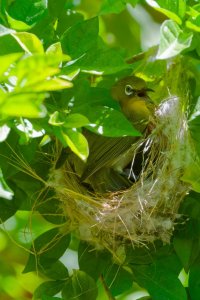
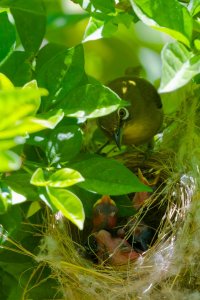
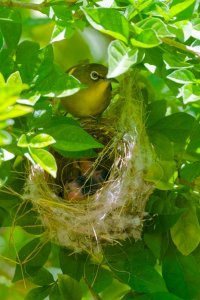
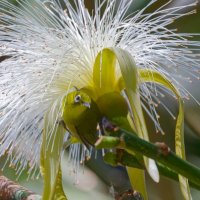
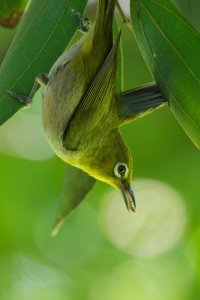
Never mind! Today the clouds above the mountain were looking pretty hostile and I went to my favorite Botanical garden - to check if the gardeners are still keeping the barriers around the nest of the Japanese White-eye and how the birds are doing. Surprisingly for a fraction of the second I noticed a hatched bird trying to get food from the arrived parent (I missed the exact moment!!!). It seems I (we) can see fledglings in 10-14 days!
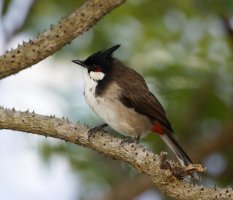
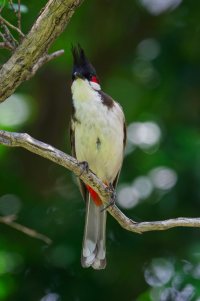
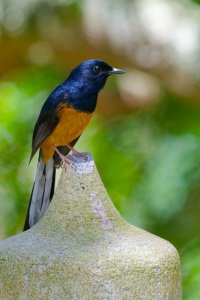
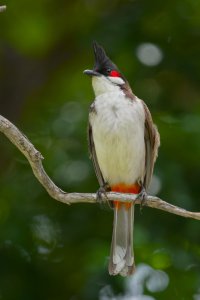
After that White-rumped Shama and Red-whiskered Bulbul.

View attachment 229377View attachment 229378View attachment 229379View attachment 229380
That's a MUCH better view of the Red-whiskered Bulbul than I was able to get in Vietnam!
 
Upvote 0
  • Like
Reactions: 1 user
Upvote 0
That's a MUCH better view of the Red-whiskered Bulbul than I was able to get in Vietnam!
That day I made plenty of photos of that birds (par). Unfortunately they were looking usually up for flying insect, not at me. Doing fast take off in the air and trying to get on the same branch before the other bird takes it, sometimes arguing who was first there :D! Not such a good light/background as on Alan's photo (especially the thorns :)...)!
DSC_4607_DxO.jpgDSC_4656_DxO.jpg
 
Last edited:
  • Like
Reactions: 4 users
Upvote 0
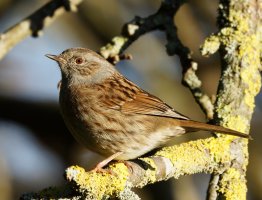
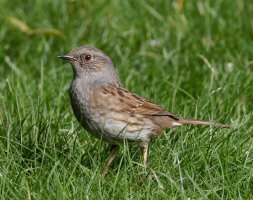
It’s the plumage and chick-like cheep as well that distinguishes from the fully mature adult.
I can't hear the "cheep" but the plumage is of a fully grown adult: the immature (incl. the first winter birds!) are much more (and boldly!) streaked starting from the throat and going down to the vent. Immature are also (boldly) streaked on the head and neck and they, I think are not suppose to have the white tips on the greater covers of the wing (the tips of the lesser covers are not visible on these photos, otherwise they should be white too for your bird).
 
Upvote 0
I can't hear the "cheep" but the plumage is of a fully grown adult: the immature (incl. the first winter birds!) are much more (and boldly!) streaked starting from the throat and going down to the vent. Immature are also (boldly) streaked on the head and neck and they, I think are not suppose to have the white tips on the greater covers of the wing (the tips of the lesser covers are not visible on these photos, otherwise they should be white too for your bird).
I uploaded the photo to ChatGPT and asked: Can you identify whether this Dunnock is a full mature adult or a juvenile?

Answer

This looks like a juvenile / recently fledged Dunnock, not a fully mature adult.

The strongest clues are:

  • Prominent yellow gape flanges at the corners of the bill — adults lose these. They are typical of fledglings and recently independent juveniles.
  • Soft, fluffy plumage texture rather than the cleaner, tighter feathering of an adult.
  • Brownish streaking on the head and mantle. Adult Dunnocks usually show a cleaner slate-grey head and breast with less diffuse facial patterning.
  • The bird is also giving a typical begging or food-soliciting call posture with the open bill.
However, it is not a very young nestling. The plumage is already fairly developed, so this is probably a:

  • late juvenile / fledgling
  • likely a few weeks out of the nest
  • possibly moulting toward more adult-like plumage.
A fully mature adult Dunnock would normally show:

  • a much cleaner grey head and breast,
  • darker, sharper eye,
  • little or no yellow at the gape,
  • and a more refined feather texture overall.
 
Upvote 0
Today was my regular check if the nest of the Japanese (Warbling) White eye is OK. So far it looks kind of successful: there are two hatchling (I saw 3 eggs when I discovered the nest!) looking good! The problem is that they mostly used a cotton from the Red Cotton tree (Bombax ceiba) for attaching the nest to the branches and it doesn't look good after the birds hatched: it tilted from the weight, the branches are very thin and the last days are very windy! On the third photo one of the parents looks warring too (well, who knows what actually they see...)!
After that just opportunistic photos...
BTW: I'm resizing the photos because with PL 9 they are getting too big (despite the cropping! With PL 8 I didn't have that problem). Resizing in Windows Photos. The color is ~there, de-noising is as it should be BUT: I'm out of sharpness (I'm sharpening by the default of PL 9, noting added! Every thing RAW files!). Concerning the sharpness photos are looking as the RAW (NEF) files sometimes worst!

DSC_4674_DxO.jpgDSC_4725_DxO.jpgDSC_4747_DxO.jpgDSC_4680_DxO-1.jpgDSC_4845_DxO.jpgDSC_4766_DxO.jpg
 
Last edited:
  • Like
Reactions: 1 users
Upvote 0