New Big White Lenses from Canon are Coming in Late Q4 and Possibly a 500mm Prime

Why the switch? My guess would be to address the issue of the MH-100 putting the center of mass to the side instead of over the monopod, but to me it looks like that side gimbal wouldn’t shift it back enough unless used with a low profile foot (I’ve seen some that are too low to be used comfortably as a handle). I use the RRS replacement foot on my EF 600/4 II.

My solution is to use the MH-100 on top of the RRS MH-02 Pro tilt head. With a few degrees of tilt on that, the monopod gimbal is level while the monopod itself is tilted off the vertical axis. That puts the center of mass over the monopod foot on the ground, meaning I just need to balance the rig instead of supporting the weight of the off-center rig to keep it from tipping over.
They replaced it with a zoom.
its not in the same Class as the 300 F2.8 it was one hell of a lens
 
Upvote 0
its not in the same Class as the 300 F2.8 it was one hell of a lens
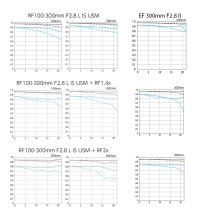
Technically, you’re correct – one is a prime and the other is a zoom, and those are different classes of lenses. But optically, the RF 100-300/2.8 is just as good as the excellent 300/2.8 II at 300mm, and infinitely better from 100-299mm.

The price you pay for the added capability of a zoom lens is an extra 5 cm of length and an extra 200 g of weight (and higher cost, of course). Personally, I was initially hoping for an RF 300/2.8 and was not thrilled about the extra 5 cm of the zoom lens. After using it, the additional flexibility of a zoom lens is more than worth it. 35% of my shots with the lens are at 300mm, and 50% of my shots with it are shorter than 250mm.

The zoom is a little bulkier than the prime, but gives up nothing optically. One camera with the 100-300/2.8 is also a lot more convenient than one camera with a 300/2.8 and a second camera with a 70-200/2.8.
 
  • Like
Reactions: 1 users
Upvote 0
The never-seen-before primes predicted for 2026 will be big whites with TCs.
The never-seen-before zoom predicted for 2026 will be.......(?)
What's the fuzz with built in TCs?
Let's go into details:
The EF200-400 with the 1.4 engaged offered 280-560 5.6 @ infinity (you never shoot at infinity!) I used it for years: Stellar IQ, bad for birds, bad for smaller objects like butterflies, dragonflies: by far too heavy and a lack of shooting distance and magnification at the short end, the effective focal length at minimum distance is just 287mm (metadata lie and tell you 560mm). Magnification 0.21x
The RF100-300 with the added 2x converter offers 200-600 5.6 @ infinity (again: you never shoot at infinity!): Still superb IQ, great for birds, great for butterflies and dragonflies: handhold ablility, focusses down to the ground just infront of your shoes, the effective focal length at minimum distance is 338mm (metadata lie and tell you 600mm). Magnification 0.31x. What a difference in weight @ versatility! (even not thinking about the options to shoot without TC or the 1.4x version)

Friends: The future is zoom! I am so happy with the practical use, I sold the EF 600 4.0 version 2 which gave stellar performance as well but wasn't used too much due to a lack of handhold ability and versatility. Let us not forget: The 100-300 + engaged hood + TC fits in a pack where the v600 without hood and TC does not fit. A lens not being ready to shoot never gives you the intended success (as long as you are not sitting in a photo blind ...)

BTW: The real replacement of the EF180mm Macro is the 70-200 Z with 2x TC: Max magnification 0.66x, effective focal length 173mm (whereas the 180 offers 140mm @ 0.66x mag. . It is f/3.5 vs f/5.6 in these shooting conditions - but who shoots f/3.5 in the wild with a digital sensor at magnification 0.66x??? Don't let us talk about versatility, the zoom is one leg of the 2.8 trinity. And this lens is stellar for closeup work in the wild - all just as a windfall profit of up to date technology!

Friends: Do not stick to legacy experience: My 180 is gone, my 200-400 is gone, my 600 is gone. I am happy!
I am ready for a ultra light 500mm prime (no built in TC) or a 200-600 zoom giving the option to extend to 1000mm/1200mm focal length if "needed" and hot air does not destroy any expected IQ.

All shots with 100-300+2x, none would exist with the previous equipment
 

Attachments

  • Ebel Vögel-8452.jpg
    Ebel Vögel-8452.jpg
    2.3 MB · Views: 15
  • Ebel Vögel-7696-DxO_DeepPRIME XD3.jpg
    Ebel Vögel-7696-DxO_DeepPRIME XD3.jpg
    1.5 MB · Views: 15
  • Ebel Vögel-1459.jpg
    Ebel Vögel-1459.jpg
    2.6 MB · Views: 17
  • Ebel Vögel-1439-DxO_DeepPRIME XD3.jpg
    Ebel Vögel-1439-DxO_DeepPRIME XD3.jpg
    2.5 MB · Views: 16
  • Ebel Vögel-4927-DxO_DeepPRIME XD3.jpg
    Ebel Vögel-4927-DxO_DeepPRIME XD3.jpg
    1 MB · Views: 20
  • Like
Reactions: 1 user
Upvote 0
Why the switch? My guess would be to address the issue of the MH-100 putting the center of mass to the side instead of over the monopod, but to me it looks like that side gimbal wouldn’t shift it back enough unless used with a low profile foot (I’ve seen some that are too low to be used comfortably as a handle). I use the RRS replacement foot on my EF 600/4 II.

My solution is to use the MH-100 on top of the RRS MH-02 Pro tilt head. With a few degrees of tilt on that, the monopod gimbal is level while the monopod itself is tilted off the vertical axis. That puts the center of mass over the monopod foot on the ground, meaning I just need to balance the rig instead of supporting the weight of the off-center rig to keep it from tipping over.
Yes, the center of mass being off to the side with the Wimberley MH-100 does create an extra balancing issue. The ProMediaGear tomahawk only partially corrects the issue, but it helps. I hadn't thought of using an extra monopod head to center it. Thanks; I'll give it a try.
 
  • Like
Reactions: 1 user
Upvote 0
BTW: The real replacement of the EF180mm Macro is the 70-200 Z with 2x TC: Max magnification 0.66x, effective focal length 173mm (whereas the 180 offers 140mm @ 0.66x mag. . It is f/3.5 vs f/5.6 in these shooting conditions - but who shoots f/3.5 in the wild with a digital sensor at magnification 0.66x???
Huh? Are you suggesting people would never use the macro wide open? I use the rather similar Sigma 180 macro and almost always shoot at f/2.8.

How is the sharpness of the new 70-200, especially at MFD? I tried the mark II EF as an alternative to a long macro lens and found the IQ too poor for close shots of flowers and insects. Macro lenses tend to have exceptional sharpness at 1x magnification.
 
  • Like
Reactions: 1 user
Upvote 0
Huh? Are you suggesting people would never use the macro wide open? I use the rather similar Sigma 180 macro and almost always shoot at f/2.8.

How is the sharpness of the new 70-200, especially at MFD? I tried the mark II EF as an alternative to a long macro lens and found the IQ too poor for close shots of flowers and insects. Macro lenses tend to have exceptional sharpness at 1x magnification.
PS I agree that new lenses have changed the landscape somewhat. The RF 100-400 is a great near-macro alternative for insects, although the narrow maximum aperture means less dreamy OOF areas.
 
Upvote 0
Technically, you’re correct – one is a prime and the other is a zoom, and those are different classes of lenses. But optically, the RF 100-300/2.8 is just as good as the excellent 300/2.8 II at 300mm, and infinitely better from 100-299mm.

The price you pay for the added capability of a zoom lens is an extra 5 cm of length and an extra 200 g of weight (and higher cost, of course). Personally, I was initially hoping for an RF 300/2.8 and was not thrilled about the extra 5 cm of the zoom lens. After using it, the additional flexibility of a zoom lens is more than worth it. 35% of my shots with the lens are at 300mm, and 50% of my shots with it are shorter than 250mm.

The zoom is a little bulkier than the prime, but gives up nothing optically. One camera with the 100-300/2.8 is also a lot more convenient than one camera with a 300/2.8 and a second camera with a 70-200/2.8.
Sony has knocked a huge amount of weight off the 300/2.8. Their prime weighs 1 kg/ 35 oz less than the Canon zoom coming it at 1.74 kg with hood etc. Canon could do the same. That I would buy.
 
  • Like
Reactions: 1 user
Upvote 0
Huh? Are you suggesting people would never use the macro wide open? I use the rather similar Sigma 180 macro and almost always shoot at f/2.8.

How is the sharpness of the new 70-200, especially at MFD? I tried the mark II EF as an alternative to a long macro lens and found the IQ too poor for close shots of flowers and insects. Macro lenses tend to have exceptional sharpness at 1x magnification.
I just took a look at the macros I shot with the RF 100mm f/2,8 last Sunday.
40% at f/2,8...
 
  • Like
Reactions: 1 user
Upvote 0
Technically, you’re correct – one is a prime and the other is a zoom, and those are different classes of lenses. But optically, the RF 100-300/2.8 is just as good as the excellent 300/2.8 II at 300mm, and infinitely better from 100-299mm.

The price you pay for the added capability of a zoom lens is an extra 5 cm of length and an extra 200 g of weight (and higher cost, of course). Personally, I was initially hoping for an RF 300/2.8 and was not thrilled about the extra 5 cm of the zoom lens. After using it, the additional flexibility of a zoom lens is more than worth it. 35% of my shots with the lens are at 300mm, and 50% of my shots with it are shorter than 250mm.

The zoom is a little bulkier than the prime, but gives up nothing optically. One camera with the 100-300/2.8 is also a lot more convenient than one camera with a 300/2.8 and a second camera with a 70-200/2.8.
Had this self same conversation with a reputable optical engineer at a camera / lens rental company yesterday. His view was the RF 100-300mm f2.8 gives up nothing in image quality to the 300mm f2.8 II at 300mm and has much more versatility in his view it was a "no brainer".
 
  • Like
Reactions: 1 users
Upvote 0
Huh? Are you suggesting people would never use the macro wide open? I use the rather similar Sigma 180 macro and almost always shoot at f/2.8.

How is the sharpness of the new 70-200, especially at MFD? I tried the mark II EF as an alternative to a long macro lens and found the IQ too poor for close shots of flowers and insects. Macro lenses tend to have exceptional sharpness at 1x magnification.
The sharpness on the 70-200Z+2x at MFD is decent so far, I need to take a lot more photos to say more than that. Without the extender it's an excellent 70-200, which is what I bought it for. I've only had it for 3 days, it does a great job at rainy sport events :)
 
  • Like
Reactions: 1 user
Upvote 0