Is the new Canon full frame mirrorless called the EOS R?

Pretty sure it's the following (I've included EF-M since that could set precedent for what Canon selects as their flange distance for a new mount):
EF diameter - 54mm; flange - 44mm
Z diameter - 55mm; flange - 16mm
EF-M diameter - 47mm; flange - 18mm

Thanks. I appreciate that. So what I see from that is that Nikon’s New mount is actually a mm smaller in diameter. That’s interesting, as we read that the mount is so big.

Supposedly, the fact that it’s so much closer gives an advantage, but only if lenses don’t protrude into the mount as Leica M lenese do. So for lens making and image quality, as well as lens speed goes, there’s no actual advantage to Nikon’s new mount vs Canon’s.

I can also see why Canon states that their EF-M mount isn’t suited to FF.
 
Upvote 0
Oh god - I hope these rumors are not true. To me, if the "new mount" doesn't somehow support EF, this is going to be a disastrous decision.


It will have a full EF mount or it will have a thinner-than-full mount and come with an EF adaptor -- either way EF glass will work well with it on day one. That's a take-it-to-the-bank certainty. The #1 design input of this new platform.

My assumption as some had suggested was that Canon would stick to a more traditional DSLR body or a "slim DSLR" body, but a body more akin to the EOS-M isn't going to be doing any favors. This will just end up being another EOS-M series.


...with a FF sensor. So, not EOS-M at all as far as lenses and output goes. I appreciate Canon might not deliver the other form factor aspects each of us want -- it might be too big or too small for some folks. But provided they get the mount right, there always can be more bodies to follow that sort out the form factor.

- A
 
Upvote 0
Offhand (so that I don’t have to do it) does anyone have the specs for the diameter of Nikon’s new mount and Canon”s EOS mount, as well as the respective flange distances?

I’m now curious as what physical advantages Nikon’s Mount may offer, if any, other than a thinner body, which doesn’t mean much to me.


I want to say the throat diameter for Nikon Z is 55mm and Canon EF is 54mm. So Nikon is gonna party like it's 1987 with their new toy. Expect them to attempt a few lenses that go to ludicrous speed. I'm less curious about their 58 f/0.95 as it's manual focus only, but there is a 50 f/1.2 in the pipeline, surely with AF.

Flange distances I couldn't tell you.

- A
 
Upvote 0
Pretty sure it's the following (I've included EF-M since that could set precedent for what Canon selects as their flange distance for a new mount):
EF diameter - 54mm; flange - 44mm
Z diameter - 55mm; flange - 16mm
EF-M diameter - 47mm; flange - 18mm

Key constant in all of these mirrorless systems: you save about 25mm (i.e. 1 inch) in thickness compared to the SLR. That appears to be a universal trend with these rigs. They must be about an inch thinner.

They don't have to be, of course, and in Canon's case there is a legitimate case to go full EF with FF mirrorless. But the face value first impression of not doing this is painful market-wise. The 'you have to make it smaller', 'I want to adapt lenses', etc. simply must be served. So I still contend a thin mount will happen on day one, but doing both thin and full EF is a masterstroke if they position things correctly.

- A
 
Upvote 0
Thanks. I appreciate that. So what I see from that is that Nikon’s New mount is actually a mm smaller in diameter.

Other way around. Nikon is 1mm larger diameter than EF.

That doesn't unlock anything super magical. I see this new mount as simply one capable of doing fast standard primes (f/1.0, f/1.2) like Canon has been able to do for a long time.

Mirrorless does however (we presume) eliminate the mirrorbox, which is believed to clip the bokeh balls on some Canon large aperture glass (85 f/1.2L II, 85 f/1.4L, etc.). So mirrorless + advanced focusing technology + ultra-large aperture glass might fare better than it did with SLRs (in general, Canon could do the same).

Many people have said that the clipped bokeh is something 'you cannot unsee' once you see it, so now I plague you with this curse. Samples from PP (from an 85 f/1.2L II) are readily on display here.

- A
 
Last edited:
Upvote 0
One could argue, that Canon and Nikon has been doing something wrong for years, given that Sony has mannaged to gain a foodhold in the Pro Photography market.
One could argue that if a company of Sony's size buys photo business from Konica Minolta, it may be able to manage to let that business recover.

My point was that, it would not make much sens for the people who never or very seldom use bracketing, to complaint about the inclusion of this feature in a camera. The same as I dont think it makes much sens for people to complaint about the inclusion of advanced video features, because it is not a feature that is used all the time, by everybody.
My point was that bracketing as a feature does not need to be added. It has been "always" there. Moreover, a typical bracketing implementation is not optimized for HDRs.
 
Upvote 0
Other way around. Nikon is 1mm larger diameter than EF.

That doesn't unlock anything super magical. I see this new mount as simply one capable of doing fast standard primes (f/1.0, f/1.2) like Canon has been able to do for a long time.

Mirrorless does however (we presume) eliminate the mirrorbox, which is believed to clip the bokeh balls on some Canon large aperture glass (85 f/1.2L II, 85 f/1.4L, etc.). So mirrorless + advanced focusing technology + ultra-large aperture glass might fare better than it did with SLRs (in general, Canon could do the same).

Many people have said that the clipped bokeh is something 'you cannot unsee' once you see it, so now I plague you with this curse. Samples from PP (from an 85 f/1.2L II) are readily on display here.

- A
Yeah, I somehow read that wrong. Still, 1mm means little. Bokeh is complex. I don’t think flange difference is going to make a difference. Again, Leica has been doing this for 100 years. Usually their bokeh is very good, but not always.
 
  • Like
Reactions: 1 user
Upvote 0
What - you mean you can' t take decent video with any camera out there? I suggest it is your skills rather than the camera that is lacking.
Wow. ok. So people who want 120 fps on video don't know how to shoot video? All that matters is that I take better video and photos than you and I'm sure I do. You're one of the slow ones on this forum too I bet.
 
Upvote 0
Key constant in all of these mirrorless systems: you save about 25mm (i.e. 1 inch) in thickness compared to the SLR. That appears to be a universal trend with these rigs. They must be about an inch thinner.

They don't have to be, of course, and in Canon's case there is a legitimate case to go full EF with FF mirrorless. But the face value first impression of not doing this is painful market-wise. The 'you have to make it smaller', 'I want to adapt lenses', etc. simply must be served. So I still contend a thin mount will happen on day one, but doing both thin and full EF is a masterstroke if they position things correctly.

- A
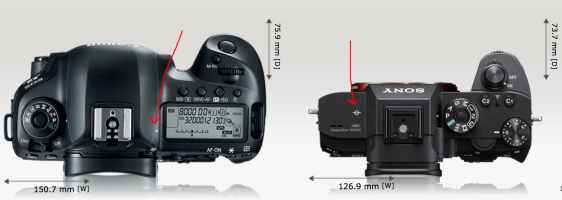
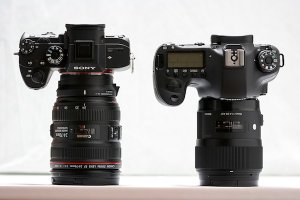
I think these bodies can be an inch thinner, but looking at Sony's a7Riii, their sensor position in the body appears to be a bit further off the back based on the sensor symbol. Canon's body appears to have less used space behind the sensor:

Screen Shot 2018-08-30 at 11.33.30 AM.png
I'm guessing that technically Sony's full frame mirrorless body could be even thinner than it currently is, but as with many things - just because you can doesn't mean you should!
 
  • Like
Reactions: 1 user
Upvote 0
I think these bodies can be an inch thinner, but looking at Sony's a7Riii, their sensor position in the body appears to be a bit further off the back based on the sensor symbol. Canon's body appears to have less used space behind the sensor:


Yeah, I stared at this prior post's pic (forgive me, I'm terribly at linking stuff from other pages in this new quoting system -- think was from page 6 or 7 of this thread) for quite some time to figure this out...

ilc.jpg

...and then I looked at the focal plane indicator and it made sense. Sony might shave an inch off the mount compared to EF, but they might have a good 1/4-1/2" more stuff behind the FP indicator than a Canon SLR does.

You learn something every day!

- A
 
Upvote 0
I'm guessing that technically Sony's full frame mirrorless body could be even thinner than it currently is

If it has unused empty space in it.


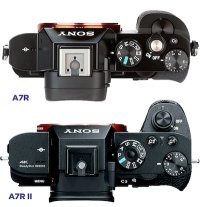
You're both right. It can be thinner because it was thinner:
A7R-vs-A7RII.jpg


Look at the added thickness behind the step down from the top plate to the back -- the surface where you see Menu and C3 in the A7R2. All the A7s got thicker over time, presumably due to all those cameras were being asked to do -- 4K + IBIS + higher throughput surely put a higher cooling burden on the camera.

I highly, highly doubt they didn't just leave an air gap in there with that added thickness. It's either added cooling features, additional processing horsepower, or possibly something to do with the addition of IBIS.

- A
 
Upvote 0
I think it's fair to assume everything in Canon's cameras is subject to a cost-benefit analysis (and every other manufacturer too!). A great deal of the arguing on these forums can be boiled down to - some people think that, however odd a decision may seem to us, the company has looked into it and decided that including or exclusing a feature was (or wasn't) worth the cost for the benefit - while others (I'm not talking about you incidentally, this is a general point; the people tending to throw around terms like 'fanboy') think it's a big conspiracy, and Canon are somehow cynical or mean or even stupid.

Fundamentally, we all have slightly different needs and desires, and no device can satisfy them all.

In addition to cost-benefit analysis, the other important factor is feasibility. Things like 4k (in the past) and 120 fps video (now) may not be feasible for Canon to implement due to processing speed/heat issues. When people compare the specs of a phone compared to a camera, they only show their ignorance because things are feasible in a phone that aren't in a camera. Others in the past have mentioned that DPAF may need additional speed and power to implement compared to camera systems that don't have it. So just because Sony has it, doesn't mean that Canon can have it. Not even getting into the issue of patents, which allows some companies to have features or lead in some areas while others fall behind.

Of course, the ignorant will continue to believe that Canon just doesn't want YOU to have every feature that YOU want.
 
  • Like
Reactions: 1 user
Upvote 0
This is supposition - we don't know for sure what their reasoning was. My guess would be either they didn't think it was a priority on a 5 series camera when it was launched, and perhaps some technical details about heat dissipation or data thoughput.


Even if your suppositions above were correct, this conclusion does not necessarily follow. If they didn't think it was necessary when the 5D4 was launched, that doesn't mean things haven't changed in the meantime (or even that they had an internal roadmap for introducing it in future models even back then). And if it was a technical challenge, maybe they've solved it.


First, you do realise that some things are easier to implement on a phone? A tiny sensor with a big computer attached - less heat generated, and much more processing power. People who claim that because a phone can do X, every high end camera should also do it seem to have no conception of the difference in how those devices work (not to mention, just because a phone has a spec, doesn't mean the output quality matches that of a dedicated camera). Second, on a more general point: high end ILC cameras are not competing with camera phones for the most part. People in the market for a 5D4 or even a 6D2 are considering spending thousands of dollars on a big, heavy, complicated device - they either have a need that only this type of device can fulfil, or they have enough money that it does't matter. And virtually everyone buying these cameras already has a phone anyway.

Ahh, but things have “changed in the meantime,” as Canon execs have admitted they are now willing to risk cannibalizing DSLR sales to go after MILC money (then they released the M50 with crippled 4K, but 4K nonetheless, so they could market it as such.)

Maybe you’re well off, so you can’t understand that some people will always have to choose between a $800-1000 phone that takes okay pictures and video, or a $1800-2000 camera. I’m lucky in this regard, but economics plays a role for many in these purchasing decisions.

As for heat dissipation, I doubt that was the issue- Canon’s either been lazy and/or has shown no interest in implementing high specced video in their cameras for quite some time.
 
Upvote 0
It seems to me that if your main product lines are seeing falling sales, and therefore, profits, because that R&D, marketing and start-up costs remain about the same whether you’re selling 50,000 units of a model a year, or 500,000, that you would be very happy to canabilize those sales in favor of product lines that are increasing in sales, or have the potential to increase in sales.

Too many companies are so afraid of the unknown that they would rather do nothing until they sink beneath the waves than risk doing something to decrease their current product sales.

When Steve Jobs was asked if he was afraid that the newly introduced iPhone would canabilize the record iPod sales Apple was having, his response was:

I’d rather we canabilize our sales than another company do it. That was paraphrased, which is why I didn’t put into quotes. But you get the idea.
 
  • Like
Reactions: 1 user
Upvote 0