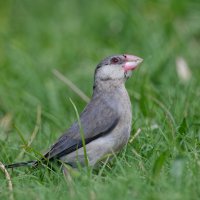
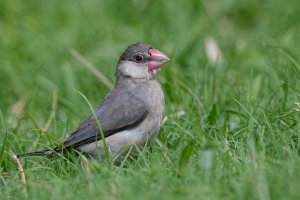
Show your Bird Portraits

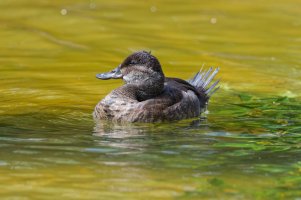
I watched a pair of Mallards fighting for about 10 minutes, about as viciously as some of the confrontations on CR.

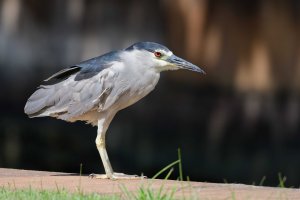
View attachment 207565View attachment 207566View attachment 207567View attachment 207568
Ha ha ha - only because the CR confrontations are online, not face to face :LOL::ROFLMAO::poop: ! Here there are only feathers flying around! In CR the ground is eventually covered with lenses, cameras and the differences about them (well it's not only in CR - it's very human...)!
 
Upvote 0
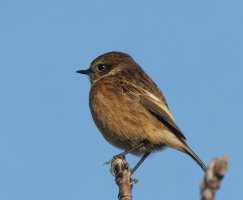
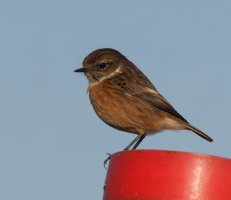
A stonechat
RF100-500mm F4.5-7.1 L IS USM + EXTENDER RF1.4x

338A8834 by Cog2012, on Flickr
Do you have more photos of this one (no mater how good they are) from different angles? I'm just curious: probably you have there also the Eastern Stonechat and these two are difficult to separate (at least for me) in some circumstances. Most probably you have the right ID but I really want to learn something...
Otherwise very nice photo!
 
Upvote 0
Do you have more photos of this one (no mater how good they are) from different angles? I'm just curious: probably you have there also the Eastern Stonechat and these two are difficult to separate (at least for me) in some circumstances. Most probably you have the right ID but I really want to learn something...
Otherwise very nice photo!
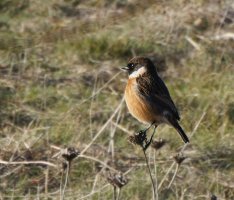
I've been tracking down Stonechats this week. I have found a female in one location and got pretty close with the R5 + RF 100-500mm + 2xTC. I then found a male a couple of miles away, but he appeared for just a few moments, too far away, just 400 px high in the image. I'll be going back there hoping he'll be territorial. These are clearly the common Stonechat.

309A7741-DxO_female_stonechat-ls-sm.jpg309A7761-DxO_female_stonechat-ls-ts.jpeg309A7773-DxO_Male_stonechat-ls-sm.jpeg
 
  • Like
Reactions: 10 users
Upvote 0
Do you have more photos of this one (no mater how good they are) from different angles? I'm just curious: probably you have there also the Eastern Stonechat and these two are difficult to separate (at least for me) in some circumstances. Most probably you have the right ID but I really want to learn something...
Otherwise very nice photo!
Thanks! You are probably right. I was practically unaware of Siberian Stonechat, so I never considered it for IDing. A few more, shot on a Sony. But I cannot guaranty that it's the same exemplar. There were several birds near that bush, and they landed on the branches in turn, sometimes attacking each other, sometimes being attached by sparrows.

DSC02123 by Cog2012, on Flickr


DSC01933 by Cog2012, on Flickr

And a video:

Stonechat by Cog2012, on Flickr
 
Last edited:
  • Like
Reactions: 11 users
Upvote 0
Thanks! You are probably right. I was practically unaware of Siberian Stonechat, so I never considered it for IDing. A few more, shot on a Sony. But I cannot guaranty that it's the same exemplar. There were several birds near that bush, and they landed on the branches in turn, sometimes attacking each other, sometimes being attached by sparrows.

DSC02123 by Cog2012, on Flickr


DSC01933 by Cog2012, on Flickr

And a video:

Stonechat by Cog2012, on Flickr
Nice shots Cog!
 
  • Like
Reactions: 1 user
Upvote 0
I've been tracking down Stonechats this week. I have found a female in one location and got pretty close with the R5 + RF 100-500mm + 2xTC. I then found a male a couple of miles away, but he appeared for just a few moments, too far away, just 400 px high in the image. I'll be going back there hoping he'll be territorial. These are clearly the common Stonechat.

View attachment 207584View attachment 207585View attachment 207586
Yes it is. The Eastern (=Siberian, =Asian) Stonechat looks like the one from Cog's photos and most probably doesn't reach GB.
 
Upvote 0
Thanks! You are probably right. I was practically unaware of Siberian Stonechat, so I never considered it for IDing. A few more, shot on a Sony. But I cannot guaranty that it's the same exemplar. There were several birds near that bush, and they landed on the branches in turn, sometimes attacking each other, sometimes being attached by sparrows.

DSC02123 by Cog2012, on Flickr


DSC01933 by Cog2012, on Flickr

And a video:

Stonechat by Cog2012, on Flickr
I'm sure it is a male Eastern Stonechat (Saxicola maurus): the orange spot is practically restricted on the breast (in the European Stonechat it could go allover the underparts), but in some odd birds it could be intermediate. And your birds have a hint of supercilium. I was asking for another angles photos to see the primaries length and the rump.
Very distinctive is the jet-black color of the underparts of the wing in the area of the shoulder - in the European it is gray. Look for them in BIF.
To make the ID "easier" this species has ~several subspecies:rolleyes:
 
  • Like
Reactions: 1 user
Upvote 0
And these are from today: went there in +/- full sunshine but shortly after that it started drizzling and when I notice the dark clouds coming - just retreated...
Nothing interesting.
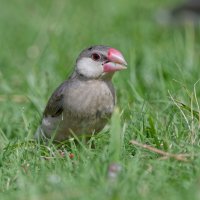
The Java Sparrow is displaying a very common (and strange!) behavior after the sound of my "mirror slapping camera": by some reasons they start looking to the sky (and many birds around do it)! Once they figure out the source for the noise and relax, I start looking "strange" (if not worst:ROFLMAO:!!!) for the by-passers in the park, because I'm making some sounds to attract the attention of the bird - it should look at me, no?! And the by-passers usually don't see the small birds that I'm trying to photo!

BTW: I'm not posting any thing about the White Terns in my neighborhood (as I was planing) because they lost their egg - the winds here were sustainable 30-40 mph Thu-Fri with a gusts 50-60 mph! Very close to their tree there is a fallen chunk of Rainbow Eucalyptus ~5-6 meters long by ~30-35cm diameter and it's a strong tree!

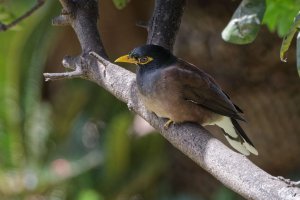
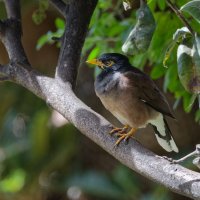
DSC_3291_DxO.jpgDSC_3317_DxO.jpgDSC_3329_DxO.jpgDSC_3351_DxO.jpg
 
  • Like
Reactions: 12 users
Upvote 0
I'm sure it is a male Eastern Stonechat (Saxicola maurus): the orange spot is practically restricted on the breast (in the European Stonechat it could go allover the underparts), but in some odd birds it could be intermediate. And your birds have a hint of supercilium. I was asking for another angles photos to see the primaries length and the rump.
Very distinctive is the jet-black color of the underparts of the wing in the area of the shoulder - in the European it is gray. Look for them in BIF.
To make the ID "easier" this species has ~several subspecies:rolleyes:
Thank you, ISv! These photos are all I have. Typically it's the right or left side and en face.
 
Last edited:
Upvote 0