
Patent - EF 135 f/2.8 & 180 f/3.5 with Apodization Filter

Status
Not open for further replies.
My 2 ct.:

I think they will use two cylindrical elements (AO1, AO2) which are filled with two liquids separated by a clear membrane. Left and right sketch of the optics show the same outline of the cylindrical elements except that the membranes have a different shape.

If you use two fluids per AO with different refractive index you can give the cylindrical element a focusing or defocusing function. Both AOs compensate themselves to keep the image in focus. But the shape of the membrane changes the properties - it softens the usually hard aperture edges. Or - as Fleety said - they have two fluids with different transmission (one clear, the other one neutral gray) where the transmission characteristics is changed by changing the shape of the AO named elements.

IMHO this will be a lens for some photographers and a lot of professional film makers. It will incorporate some fluidics and will be a very expensive tool if it really hits the "market" - in the order of 10000 $/EUR.

EDIT: The lens might have a conventional diaphragm at the position marked "SP" - that position "feels" right ...
 

Attachments
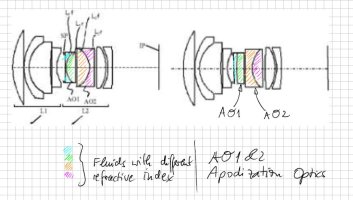
  • cr_apodi_my_take.jpg
    cr_apodi_my_take.jpg
    58.7 KB · Views: 850
Upvote 0
Yes, as I understand it, what you are doing is similar to applying spatial filtering in a Fourier plane, to remove HF components, so that the bokeh disc is less harsh more smooth-n-creameh. It kinda acts as an LPF for the bokeh disc, getting rid of things like harsh annular bokeh, which looks awful.

Probably isn't quite that simple though, cos you DON'T want to remove any HF content from the in-focus part of the image!

However, I am sure this is only an approximation to the full truth. It's a long time since I did signal theory at uni, and even then, it was more in the acoustic and crystal lattice fields (at different times in my academic life)!

Educate me, if anyone knows more! :-)
 
Upvote 0
Fleetie said:
Yes, as I understand it, what you are doing is similar to applying spatial filtering in a Fourier plane, to remove HF components, so that the bokeh disc is less harsh more smooth-n-creameh. It kinda acts as an LPF for the bokeh disc, getting rid of things like harsh annular bokeh, which looks awful.

[...]

That's just what I understood from the english wikipedia article about apodization: You remove the harsh transition of the rectangular function which describes the transmission function across the cut through a lens' aperture diaphragm.

I have observed some intensified outlines of highlights in out of focus regions of images. Their shape and structure is defined by the aperture geometry and its position within the optical system. A "soft edged" aperture will show us soft edged highlights in out of focus regions and should lead to a very soft bokeh.

Best - Michael
 
Upvote 0
mb66energy said:
My 2 ct.:

I think they will use two cylindrical elements (AO1, AO2) which are filled with two liquids separated by a clear membrane. Left and right sketch of the optics show the same outline of the cylindrical elements except that the membranes have a different shape.

If you use two fluids per AO with different refractive index you can give the cylindrical element a focusing or defocusing function. Both AOs compensate themselves to keep the image in focus. But the shape of the membrane changes the properties - it softens the usually hard aperture edges. Or - as Fleety said - they have two fluids with different transmission (one clear, the other one neutral gray) where the transmission characteristics is changed by changing the shape of the AO named elements....

I think they have a apodisation element, which is for example with plane front and back - could be some kind of (as)shpheric element too. But the main interest is in the mid: A thin flexible foil between the two fluids in front and back chamber.
These fluids have the same refractive index - otherwise this would act like a lens with different focal length that need to be neutralized with other lenses. One fluid is very transparent, the other very high neutral density grey. Think the neutrad grey fluid is a problem to get, should not scatter the light.
With for example pressure on the one fluid the second fluid goes away in a kind of elastic bag for example (or closed airthight compartment) - and the foil bends. So one can vary the lens curve. And this vary the the apodization effect.

Fluid lenses are avialable since few years, so this is only a small further step.
When Canon has a gery fluid with high optical density (low transmission per mm thickness), they could even get rid of the iris. It would be great, wehen the apodisation effect works with every f-stop :-)

I have made homemade apodization lenses with a slide film as apodization filter. This filter is located near the aperture blades:
http://www.4photos.de/camera-diy/Apodization-Filter.html
With these apodization filtering one could make good photographs with very nasty backround structures, because they are soft. With a normal lens the backgrond strucures are mainly expanded without structure.
 
Upvote 0
Ellen Schmidtee said:
MarkusK said:
When Canon has a gery fluid with high optical density (low transmission per mm thickness), they could even get rid of the iris. It would be great, when the apodisation effect works with every f-stop :-)

Wouldn't that take away from the ability to control the DoF?

I think it is possible to have DOF control when they could integrate the iris function inside the variable apodisation module.
It is not neccesary to have a Guassian illumination profile. I could imaging that a profile with smaller or wider maximum could regulate the DOF nearly like a iris. But still with very smooth unscharp areas. But it depends how good the fluid variable apodisation elemtes works. When they only get maximum density of 1.5 I woudl think there is not a good way to repolace the iris. When they get D maximum about 2 or 3 I cuold imaging this is good enough for mst cases.
 
Upvote 0
Status
Not open for further replies.