3500 Kelvin to balance red and blue?

Question regarding the Canon 5D3:

It is correct that setting white-balance to 3500K will result in a similar scale-factor (the multiplier value) between the red and blue channel?

Or in other words; is the color-filter-array over the sensor (the RGB color-filters) physically balanced for 3500K rather than daylight?

If so, what kind of impact does this have on the colors of the image, compared to if the CFA was daylight-balanced?
(does it define the cameras metamerism-qualities only, or does it have a greater impact on the look of the photos in terms of color?)

Any info you may have on this is welcome (including links that talk about this in detail)
Thanks
jacob.
 
Back up a step – what's your goal/intent, here?

The WB setting you choose has no effect on the RAW image, so unless you're shooting JPG, there's no need to care much about the in-camera setting (with one exception, below).

If your goal is accurate color representation, the only way to reasonsbly achieve that is with a full color profile, e.g. with a ColorChecker Passport or similar.

The exception is if your goal is to have the in-camera histogram, which is based on the in-camera JPG image (saved in the RAW container even if shooting only RAW), most closely approximate the RAW exposure histogram. In that case, do not pass Go, do not collect a Kelvin WB, but go directly to UniWB (Google 'canon uniwb').
 
Upvote 0
neuroanatomist said:
what's your goal/intent, here?

The goal is to determine the white-balance the 5D3 is physically balanced to (the physical CFA properties)

If the 5D3 is daylight-balanced or tungsten-balanced or, as my findings seem to indicate, balanced to ~3500K

I'm trying to determine this by looking for the whitebalance-setting on the camera that results in similar multiplier-values on the red and blue channel (somewhat similar to what is achieved with uniWB, except just focusing on the red and blue channel in this case and ignoring the green channel)

The purpose is to be able to use physical color-filters on the lens that filters incoming light such that optimal physical daylight-balance exposure (rather than digital correction) can be achieved in both the red and blue channel (ideally in all 3 channels; RGB, but since uniWB doesn't report any meaningful whitebalance-value I can't calculate which color-filters should be used to go from uniWB to daylight-balance)
 
Upvote 0
ajfotofilmagem said:
I suppose the RGB color filter in each pixel is balanced for the sunlight, as the color films are too. So 5600K.

This website lists the multiplier-values for the Canon 350D:

http://www.guillermoluijk.com/tutorial/dcraw/index_en.htm

Find here a table of the RGB multipliers to achieve different white balance presets in the Canon 350D:
Default (D65 lamp): multipliers 2.395443 1.000000 1.253807
Tungsten: multipliers 1.392498 1.000000 2.375114
Daylight: multipliers 2.132483 1.000000 1.480864
Fluorescent: multipliers 1.783446 1.000000 1.997113
Shade: multipliers 2.531894 1.000000 1.223749
Flash: multipliers 2.429833 1.000000 1.284593
Cloudy: multipliers 2.336605 1.000000 1.334642

The fluorescent whitebalance is the one where red and blue multipliers are closest to each-other.
Setting white-balance to fluorescent gives almost the same colors as 3500K.

So IF this is true for the 5D3, then MY guess is that it's more like shooting with a tungsten-film than a daylight-film. I'm just not sure if I'm interpreting things correctly or missing something :)
 
Upvote 0
JEL said:
ajfotofilmagem said:
I suppose the RGB color filter in each pixel is balanced for the sunlight, as the color films are too. So 5600K.

This website lists the multiplier-values for the Canon 350D:

http://www.guillermoluijk.com/tutorial/dcraw/index_en.htm

Find here a table of the RGB multipliers to achieve different white balance presets in the Canon 350D:
Default (D65 lamp): multipliers 2.395443 1.000000 1.253807
Tungsten: multipliers 1.392498 1.000000 2.375114
Daylight: multipliers 2.132483 1.000000 1.480864
Fluorescent: multipliers 1.783446 1.000000 1.997113
Shade: multipliers 2.531894 1.000000 1.223749
Flash: multipliers 2.429833 1.000000 1.284593
Cloudy: multipliers 2.336605 1.000000 1.334642

The fluorescent whitebalance is the one where red and blue multipliers are closest to each-other.
Setting white-balance to fluorescent gives almost the same colors as 3500K.

So IF this is true for the 5D3, then MY guess is that it's more like shooting with a tungsten-film than a daylight-film. I'm just not sure if I'm interpreting things correctly or missing something :)
As the various fluorescent lamps have different proportions of RGB, it seems only a "estimate" to correct the excess green.

Following the logic of this table, it seems that the point where the red and blue channels have the same amplification, would be around 4000 Kelvin.

Still, it is surprising to see that the red channel required much more amplification than the blue channel, with the sunlight, in the Rebel 350D.
 
Upvote 0
Ok, I suppose I get the what, but not really the why.

Although I haven't seen a spectral plot for the 5DIII CFA, I've seen them for many other Canon sensors, and they're all very similar over many generations, and I highly doubt the 5DIII would be a radical departure.

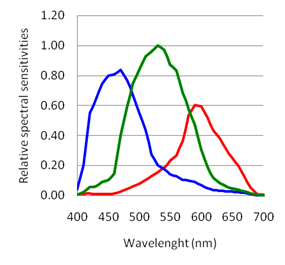
For the 5DIII, I'd expect the resulting data to be similar to DxO's response curves for the T1i/500D:

image018.png


If you consider the curves above vs. the relevant spectra for different illumination sources, the correction factors for DCRAW make sense. For example, to ajfotofilmagem's point (much more amplification of red relative to blue for daylight), the red channel has lower relative sensitivity than the blue channel, and the sun's visible light emission spectrum is more intense in the blue wavelengths and less intense in the red wavelengths – that's consistent with the correction values.

There are a couple of caveats to the above. One is mentioned in this DxO article – the above RGB sensor spectrum is 'normalized' to an sRGB color space (true in DCRAW as well), as the actual RAW values aren't in any typical color space, but rather are mainly representative of the absorption properties of the underlying silicon, where sensitivity is R > G > B. That's not reflected in the above T1i spectrum, in part because of the sRGB normalization, but mostly (the other caveat) because the illuminant for the spectrum is a standard D50 ('white' light at ~5000 K).

If you'd like to sacrifice a 5DIII ;) , I could break apart the sensor and put a piece of the CFA into my hyperspectral microimaging system (if you're curious, it's a Pariss Lightform system on a Zeiss Axioimager, it covers 360-920 nm in 1 nm increments). But short of going to that extreme, I expect I'd get similar data to this recent publication – http://www.nature.com/articles/srep28665#f1 – where they illuminated a T3i sensor with monochromatic light in 5 nm increments. There, you see the silicon-dependent rank ordering of the sensitivities. However, the spectra you see with broad-spectrum illumination are much more relevant for photography than monochromatic light experiments.

Back to your goal – the physical filter you'd need to correct to 'CFA-neutral' will depend on the light source you're trying to correct. Think back to film – there are filters to balance tungsten to daylight, or to balance fluorescent to daylight – but there isn't a single filter that can balance both tungsten and fluorescent to daylight. So, it seems you'd need to cart around a whole set of filters to physically balance the incoming light to your sensor. One of the great advantages of digital is getting away from that need, and I'm not sure why you'd want to regress.
 
Upvote 0
neuroanatomist said:
Ok, I suppose I get the what, but not really the why.

Thank you very much for the info :)

I see now I made a mistake.

The 5D3's CFA is daylight-balanced, which is why the red/blue multipliers are equal at around 3500K (or at least 3500K is where they generally seem to be equal to me)

As you mention; daylight is blue-dominant, so a daylight-balanced camera/film should give images with blue tones. This matches what I get from film, so now that makes more sense :)

This is both good and bad news to me, as it leaves me back at square-one in terms of what I'm trying to achieve as the end-result:
I'm attempting to get the 5D3 to take photos that match those I get on film, but so far all my attempts have been less than satisfying.
When I started this thread I had a small hope that using physical color-filters could alter the way the sensor is fed and thus give metamerism-effects not achievable via digital manipulation alone, but given the 5D3 is already daylight-balanced that idea doesn't seem very useful anymore.

Well, back to studying some more :)

Incidentally, color-filters on digital still could have some merit I think, if not for color-changes then for noise-reduction: http://www.libraw.org/articles/magenta-filters-on-digicam.html
 
Upvote 0