StudentOfLight said:In fairness I think Dilbert was referring to 35mm (preferably fast) primes:privatebydesign said:dilbert said:privatebydesign said:The product differentiation between a 35 f1.4 L MkII at around $1,500, and the 35 f2 IS at $500 makes the L MkII a hard sell imho, especially seeing as how the IQ from the f2 IS is so good and the size and weight so small.
The differences between the 35 f1.4L MkI, which I never was happy with on digital cameras, and the old 35mm f2 made the L a comparative easy sell. Certainly the 35 f2 IS out performs the MkI 35 L by a long way in everything but that one stop.
There is a lot of room for improvement in Canon's 35mm designs and the 35/1.4L II could differentiate itself there - especially in the corners.
Clearly you haven't used the 35 f2 IS, the 24 TS-E MkII with 1.4TC, or the 16-35 f4 IS, all of which are excellent 35mm lenses.
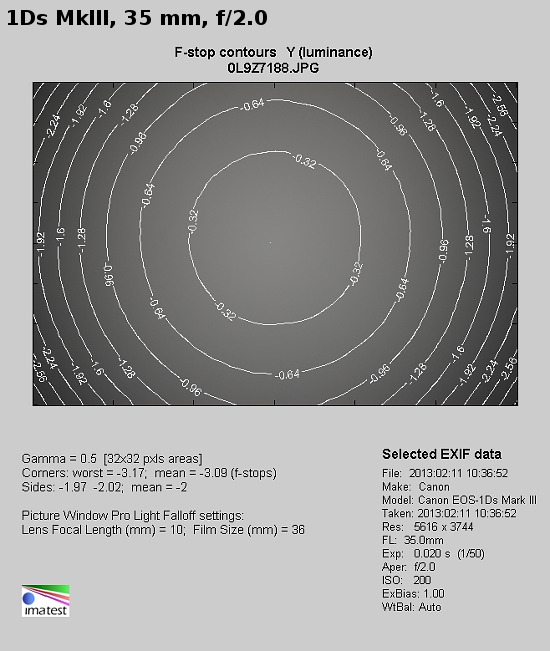
1. the 35 f/2 IS has dark corners (massive vignette, about 3Ev) wide open. Even closed down to 5.6 it is still there at almost 1Ev.
2. the TS-E 24L-II with 1.4xTC has a max apertureisof f/5.6 and by that setting most 35mm primes are showing decent performance in the corners.
3. The 16-35 is not a fast and not a prime.
P.S. The 24-70L II is also not a prime but is reasonably fast and pretty much like a barrel full of primes. That should have been your go-to lens if zooms were on the table.
That might be what you took him to mean, in which case he is still missing the 35 f2 IS which is a very good design and vignetting is simplicity itself to correct, but that isn't what he said so isn't what I replied to.
As for the 24-70 f2.8 MkII, yes it is a good and many many people have also compared it to some of the best primes in the range, but dilbert has previously dismissed it because of barrel distortion so I didn't include it.
Upvote
0