36+ Mp EOS dSLR (rumored): How do existing EF lenses cope?

  • Thread starter Thread starter GND
  • Start date Start date
Status
Not open for further replies.
Well, yes, a 45MP full frame sensor does have the same pixel size as an 18MP APS-C. But it is actually really hard to out resolve that 7D sensor. Of course, pictures may look really sharp at 100%, but that doesn't mean the sensor got pushed to the limit. I use a 7D, mostly with a Canon 50/f1.4 in the studio, this means optimal lighting conditions. It does a good job at its sweet spot, thats somewhere between f4 and f8, but it gets really soft at 1.8 to hardly usable (for studio pictures) at 1.4. I can reduce a picture taken at 1.8 to 8MP and upscale it again to 18MP, without any loss of detail. And that is for the very center of the frame, the borders are considerably worse. Also note, that the 50/1.2L does not exceed the 1.4 in resolution.

I'm wondering though, how the line widths/ picture height (LW/PH) figures from lense tests translate to sensor resolution.
So 18MP result in 3456 "lines per picture height", while the highest LW/PH scores for APS-C I found were around 2600. If this was a 1:1 conversion, no APS-C sensor above 12MP would be of much use. So I'm guessing that's probably not it. I'd like to find a way to calculate the corresponding sensor resolution to any given lens resolution (and vice versa) OR know why this is not possible. Can anyone help?
 
Upvote 0
Leon said:
I'm wondering though, how the line widths/ picture height (LW/PH) figures from lense tests translate to sensor resolution.
So 18MP result in 3456 "lines per picture height", while the highest LW/PH scores for APS-C I found were around 2600. If this was a 1:1 conversion, no APS-C sensor above 12MP would be of much use. So I'm guessing that's probably not it. I'd like to find a way to calculate the corresponding sensor resolution to any given lens resolution (and vice versa) OR know why this is not possible. Can anyone help?
If you apply the Nyquist theorem you'll figure out you need at least double the number of sensor cells to resolve lines (you need at least a bright row of pixels followed by a dark row of them to actually have lines and not a solid area). And this is not even considering that almost all sensors are bayer patterned, for which the rule of thumb stipulates you have about 75% of luma resolution after de-bayering. In short: A sensor with 1000 height cells is able to resolve about (1000*0.75)/2 = 375 lines.

EDIT: I left out further resolution losses incurred by the optical low pass filter, which is necessary to avoid aliasing (the artifact that appears once you go beyond the barrier established by Nyquist), but has less than ideal characteristics due to design constraints.
 
Upvote 0
Leon said:
I'm wondering though, how the line widths/ picture height (LW/PH) figures from lense tests translate to sensor resolution.
So 18MP result in 3456 "lines per picture height", while the highest LW/PH scores for APS-C I found were around 2600. If this was a 1:1 conversion, no APS-C sensor above 12MP would be of much use. So I'm guessing that's probably not it. I'd like to find a way to calculate the corresponding sensor resolution to any given lens resolution (and vice versa) OR know why this is not possible. Can anyone help?

If I understand how your measuring LW/PH, then an 18mp APS-C sensor resolves the same as an 18mp FF...both the 7D and the 1D X produce images that have 3456 lines. Generally speaking, a more tech-agnostic way to measure resolution is with lp/mm, or line pairs per millimeter (its important to use the term line pair, which denotes the waveform nature of spatial frequencies, a light line (white) followed by a dark line (black)...for camera sensors, line pairs generally need an MTF of 50% contrast, or not fully resolved but about half way there...to be clearly imaged as a full "line pair"...anything less and you are losing resolution to diffraction). In that respect, the highest resolution APS-C's are able to resolve more detail than an 18mp FF sensor, which is exactly correct...the 7D (or for that matter the Sony A77 @ 24mp APS-C) is a higher resolution sensor from the level of fineness of detail resolved than the 1D X...its just in a smaller package with a crop factor. In resolvable lp/mm, an 18mp APS-C sensor can resolve 115.97 lp/mm (3456 lines/14.9mm sensor height = 231.94 l/mm, divide by two to get lp/mm). The 18mp FF sensor of the 1D X, however, can resolve 72 lp/mm (3456 lines/24mm sensor height = 144 l/mm, divide by two to get lp/mm). It is possible to derive the necessary FF megapixels that would produce the same fineness of detail as an 18mp APS-C sensor if you were interested. Take the height and width of the APS-C, calculate the lp/mm for both dimensions, and derive the image width and height for FF from that by multiplying by the correlated sensor dimensions:

3456L/14.9mm = 231.94 l/mm
5184L/22.3mm = 232.47 l/mm

231.94 l/mm * 24mm = 5566 L
232.47 l/mm * 36mm = 8368 L

5566 * 8368 = 46,576,288 pixels ~= 46.6mp

You would need a 47mp FF sensor to capture the same lp/mm, or "resolution", as an 18mp APS-C sensor. For reference, the 36.3mp Nikon D800 sensor resolves about 102.3 lp/mm, so even though it has greater megapixels than an 18mp 7D, the 7D is still resolving slightly more detail at a pixel level (barring any intrusive factors such as sensor noise...can't say exactly how the noise of the D800 will be in real-world tests.)

The story is not quite as cut and dry as that, given that (excluding Foveon) most sensors are bayer arrays, usually with a low pass filter in front of them, so that mucks with the final resolution a little bit, and makes it tough to nail down nyquist limit...but from a theoretical standpoint, there you have it.

As for correlating sensor resolution to lens resolution, thats exactly what MTF charts are for, to measure the resolution of independent aspects of an optical imaging system or optical imaging systems as a whole. If you want a handy table that correlates diffraction-limited lens resolution with sensor resolution, the last table of this Luminous Landscape article "Do Sensors 'Outresolve' Lenses?" probably has what your looking for (at least from a theoretical standpoint): http://www.luminous-landscape.com/tutorials/resolution.shtml. You would need to do your own tests on any given lens to determine whether a lens resolves enough detail for a sensor or not. When it comes to Canon's newer lenses (the Mark II's and new designs released in recent years), they are really starting to push the envelope on resolution for common apertures (i.e. f/8) which essentially means...outside of the corners...they are indeed "diffraction limited", and for those apertures the chart in the LL article would apply quite nicely.
 
Upvote 0
jrista:
It is possible to derive the necessary FF megapixels that would produce the same fineness of detail as an 18mp APS-C sensor if you were interested.
Yes, well I do have the math for that here already, it's not what I meant. I might have gotten a little confused about the right terminology. I'll attach a table with the numbers for a couple of cameras.
That article you posted will take me some time to read through, but I bookmarked it, so thanks!

rav:
A sensor with 1000 height cells is able to resolve about (1000*0.75)/2 = 375 lines.
Ok, now I'm still not sure what to do with that formula to get to my goal.
Let's have a look at these MTF charts:

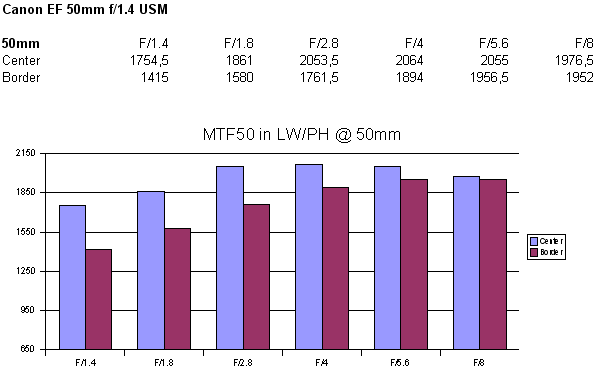
Canon 50/1.4 on 350D (350D is APS-C and has 2304 height cells):
mtf.gif


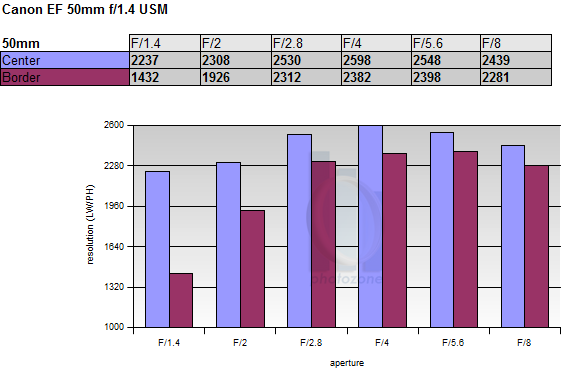
Canon 50/1.4 on 50D (50D is APS-C and has 3168 height cells):
mtf.png


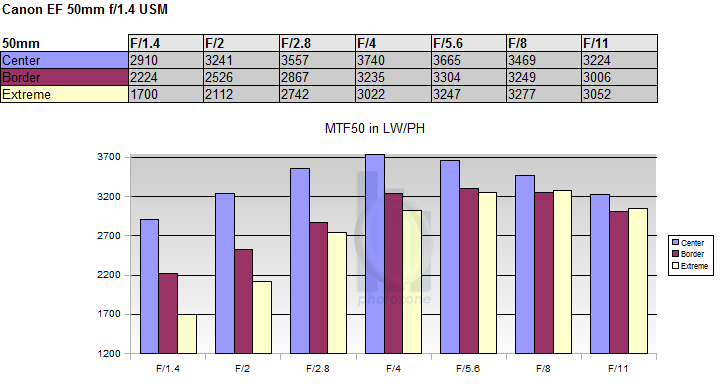
Canon 50/1.4 on 5D2 (5D2 has 3744 height cells):
mtf.png


Now these MTF figures were derived from images that were taken with 8MP and 15MP (APS-C) and 21MP (FF) bodies. Comparing the 350D and 50D figures, they look kinda (oh well...) the same except being cut off at some point (around 2050) by the 350D. Now that cut-off-point, could that be 2304 height cells minus the AA-filter effect?

The question remains: Are these charts in any way helpful on determining if a sensor with a given pixel size (e.g. 4,31µm) will be outresolved by a certain lens at a certain setting?

Also, given this situation: A certain lens (lets say the 50/1.4) is tested on a certain body (350D). The MTF figures at a certain setting (1.8 ) are clearly lower (1850 LW/PH) than the maximum the camera can resolve (lets say 2050 LW/PH for the 8MP 350D). Can we assume that a higher resolution sensor of the same physical size will not give us any more picture detail? I know the charts above say differently - but why?
(OR could that be due to inaccurate measuring (the tests were a couple of years apart) or assembling deviations (no two lenses are the same)?)

Again, what I found was, that when you take an 18MP picture with the 50/[email protected] on an APS-C camera, downscale it to 8MP and reupscale it to 18MP, there is no loss of detail (at all). Thats why I figured that this lens @1.8 doesnt even outresolve an 8MP APS-C sensor, which I think is supported by the MTF figures above.
 

Attachments

Upvote 0
Leon said:
rav:
A sensor with 1000 height cells is able to resolve about (1000*0.75)/2 = 375 lines.
Ok, now I'm still not sure what to do with that formula to get to my goal.
Let's have a look at these MTF charts:

I think rav is multiplying by 0.75 to account for bayer array nuances and low-pass filter effect. That would be a fairly rough way to account for those factors, and maybe a little excessive, but its a start.

Now these MTF figures were derived from images that were taken with 8MP and 15MP (APS-C) and 21MP (FF) bodies. Comparing the 350D and 50D figures, they look kinda (oh well...) the same except being cut off at some point (around 2050) by the 350D. Now that cut-off-point, could that be 2304 height cells minus the AA-filter effect?

It could be partly the AA (low-pass) filter, which does indeed do some blurring. Generally speaking, a well-designed low-pass filter will not really blur an image much...the point is to cut off spatial frequencies that are already below what the sensor can usefully resolve anyway. Removing a low-pass filter will generally result in more noise at very high frequencies below the nyquist limit of the sensor, so by "blurring" those frequencies helps prevent adding more noisy information to the image, thereby preserving frequencies that CAN be usefully recorded by the sensor. A low-pass filter should improve IQ when used correctly, not reduce it, but its a fine line, and at least with more recent Canon cameras, the low-pass filters seem to be just a tad over-aggressive.

The question remains: Are these charts in any way helpful on determining if a sensor with a given pixel size (e.g. 4,31µm) will be outresolved by a certain lens at a certain setting?

Yes...there are several tables in the Luminous Landscape article I linked that will either tell you that information strait up, or help you derive such information yourself...from a theoretical standpoint. From a real-world standpoint, there are a lot of factors involved related to both the sensor and the lens that affect resolution, many of which can be difficult to evaluate from an objective standpoint. You can roughly approximate whether a lens is outresolving a sensor or whether a sensor is outresolving a lens at any given aperture setting, but it will never be exact without extensive testing.

Also, given this situation: A certain lens (lets say the 50/1.4) is tested on a certain body (350D). The MTF figures at a certain setting (1.8 ) are clearly lower (1850 LW/PH) than the maximum the camera can resolve (lets say 2050 LW/PH for the 8MP 350D). Can we assume that a higher resolution sensor of the same physical size will not give us any more picture detail?

If we assume that the 50/1.4 is a perfect lens, such that it has no optical aberrations or problems with flare (a physical impossibility, but lets assume for discussion sake for the moment), then yes...until you reach the physical limit of resolution for the 50/1.4 at f/1.8, a higher resolution sensor of the same physical size will continue to resolve more detail. A perfect 50mm lens at f/1.8 could probably resolve around 375lp/mm. Assuming an APS-C sensor, you would need 187mp, or dimensions of 16725x11175 pixels, to resolve 375lp/mm. Such a lens, however, is going to be overpowered by optical aberrations at that aperture, as well as at f/1.4, and probably enough at f/2 that it is still aberration limited. It wouldn't be until f/2.8 or maybe f/4 that the lens becomes diffraction limited, or where aberrations and diffraction have roughly an equal effect. At f/4 the lens could resolve about 173lp/mm, in which case the maximum useful sensor resolution at APS-C would be about 40mp, or 7716x5155 pixels.

If we use the numbers in your charts, it does indeed appear that the 50/1.4 lens becomes diffraction limited around f/4. The 350D peaks at a resolution of 2064 lw/ph, 50D at 2598 lw/ph, and the 5DII peaks at 3740 lw/ph. Thats 90%, 82%, and 99.9% of the maximum capabilities of each sensor. Would make you think the 5D II is resolving more detail...but that wouldn't actually be correct, interestingly enough. Lets convert the resolutions of each sensor from lw/ph to lp/mm:

50D = 106lp/mm
5DII = 78lp/mm
350D = 76lp/mm

Of the three cameras, the 50D actually has the highest resolving power, followed by the 5D II and then the 350D. Given that, the fact that the 50D resolves less of its picture height than the rest by percentage, one of a few things could be wrong: a) the 50D has an aggressive low-pass filter that is affecting resolution more than on the other cameras, b) that the lens was not focused perfectly...it may have been front or back focused ever so slightly, c) the copy of the 50/1.4 used in that particular test was not a great copy. The fact that the 5D II resolves more of its picture height than the 350D is not surprising in the least, given the difference in camera and quality grade between those two...one is a bottom-line consumer grade camera while the other is a top of the line professional grade camera. Resolving 99.9% of what its capable of is damn good, and probably slightly better than expected for a camera of its caliber and price.

The EF 50mm f/1.4 lens has an MTF chart that indicates the lens has high contrast but acceptable resolution. Even at its ideal aperture, which appears to be f/4, this lens is not going to resolve as much detail (lp/mm) as a perfect lens. Its about 65% of the way there at worst, and 87% there at best, or 76% on average. Rav's computation would be roughly accurate for this lens, Apoligies, I used the wrong MTF chart before. Its about 50% resolution at worst, 86% at best, or on average 68%. This indicates that an 18.4mp APS-C sensor would be the highest resolution it could reasonably resolve to before the sensor starts consistently outresolving the lens at all apertures.

I know the charts above say differently - but why?
(OR could that be due to inaccurate measuring (the tests were a couple of years apart) or assembling deviations (no two lenses are the same)?)

If the tests were done years apart, then there are certainly questions about the accuracy and consistency of the combined results. If the same exact lens was not used in all three tests, then you have to suspect the quality and calibration of each lens, and whether the lenses and cameras were calibrated to each other for maximum performance. The 5D II and possibly 50D (can't remmber off the top of my head) offer microfocus adjustment, which can largely correct front/back focus problems. Without proper adjustment and tuning of each lens to the camera body its used on, a significant portion of margin of error would have to be attributed to the lens. I think that could easily account for the discrepancy with the 50D, which has the highest resolution sensor of all the cameras tested.

Again, what I found was, that when you take an 18MP picture with the 50/[email protected] on an APS-C camera, downscale it to 8MP and reupscale it to 18MP, there is no loss of detail (at all). Thats why I figured that this lens @1.8 doesnt even outresolve an 8MP APS-C sensor, which I think is supported by the MTF figures above.

You are absolutely correct, at f/1.8 optical aberrations are going to greatly overpower diffraction, so the sensor would indeed outresolve the lens at f/1.8. However if you stopped the lens down to f/4, and had it properly calibrated for your particular camera body by using microfocus adjustments (and possibly sending both in for proper calibration by a Canon service rep if microfocus doesn't correct all missfocus problems), then I would expect the 7D to resolve the maximum amount of detail the 50/1.4 is capable of resolving at the center. Corner sharpness drops off drastically, and its unlikely the 50/1.4 would outresolve the 7D at any aperture except maybe f/4.

 
Upvote 0
Such a technical and debatable Q & A. Interesting, though.

I don't think we have reached that limit yet...if it really can be reached. Wouldn't you still get sharper images if, all being equal, the resolving power of the sensor kept improving? In other words, even by using older lenses, if the sensor was "better" it would still improve IQ indefinitely. I think. Shoot, I don't know. ::)
 
Upvote 0
birdman said:
Such a technical and debatable Q & A. Interesting, though.

I don't think we have reached that limit yet...if it really can be reached. Wouldn't you still get sharper images if, all being equal, the resolving power of the sensor kept improving? In other words, even by using older lenses, if the sensor was "better" it would still improve IQ indefinitely. I think. Shoot, I don't know. ::)

If you had read the previous posts you'd know the answer to that ;-)
 
Upvote 0
birdman said:
Such a technical and debatable Q & A. Interesting, though.

I don't think we have reached that limit yet...if it really can be reached. Wouldn't you still get sharper images if, all being equal, the resolving power of the sensor kept improving? In other words, even by using older lenses, if the sensor was "better" it would still improve IQ indefinitely. I think. Shoot, I don't know. ::)

As Leon stated...I believe my last couple answers should thoroughly answer that. ;) To keep it succinct though:

If you keep increasing sensor resolution beyond the resolving power of the lens, you will reach a point at which you no longer gain any measurable benefit (diminishing returns). You will never reduce quality with a higher resolution lens, however you can make it harder to get perceptibly "sharp" photos at a pixel-peeping level. The higher the resolution, the greater the impact of deficiencies like camera shake, front/back focus, limited lens resolution and contrast, etc.
 
Upvote 0
First of all, thanks for your long post, much appreciated.

At f/4 the lens could resolve about 173lp/mm, in which case the maximum useful sensor resolution at APS-C would be about 40mp, or 7716x5155 pixels.

How you get to that approximation will be obvious to me when I read through that link you posted, I suppose? Looking forward to some time to do that.

The EF 50mm f/1.4 lens has an MTF chart that indicates the lens has high contrast but acceptable resolution. Even at its ideal aperture, which appears to be f/4, this lens is not going to resolve as much detail (lp/mm) as a perfect lens. Its about 50% resolution at worst, 86% at best, or on average 68%. This indicates that an 18.4mp APS-C sensor would be the highest resolution it could reasonably resolve to before the sensor starts consistently outresolving the lens at all apertures.

Ok, now the underlying math here seems to be interesting. Will get back to it.

From the three charts, the finest resolving sensor is in the 50D, maxed out it could (best case) deliver 106lp/mm. The MTF figure for the lens at f4 on the 50D is 2598. Can I, without any reservations, say that this figure equals 87lp/mm? (87lp/mm in turn equals about 10MP resolution on an APS-C.) If so: We now don't know what caused the gap between the sensors maximum 106lp/mm and the actual 87lp/mm, but couldn't it just be that the lens is already maxed out right there?!

Back to your post: 68% of 173lp/mm is 117lp/mm, which is like 18.5MP on APS-C, check. But: Best case you say, the 50/1.4 resolves 86% of a perfect lens. that would be 173lp/mm * 0.86 = 149lp/mm. Where does this come from?
 
Upvote 0
There are films out there which claim a resolution of 800 lines per mm. (see for example http://www.adox.de/english/ADOX_Films/ADOX_Films/ADOX_CMS_Films.html) I've used these films, and they provide pretty amazing results using existing Ef lenses such as 17-40mm L. I cannot confirm that they actually reach 800 lines per mm, as I have no means of measuring, and they sure are a pain to use, but I don't have any doubts that a good EF lens will have no difficulty with 50MP or thereabouts. I think the limiting factor is more likely softness resulting from diffraction limits at f8 and above, and the processing overheads of large files. Even on this latter point, I regularly work with scanned film images in the 80-100mb size range without any problem. It is only once you get into the 200-400mb range (which you do scanning 120 format negatives at 4800 dpi) that my poor laptop struggles (Windows 7 32 bit, 4 gb RAM). My understanding is that 50MP or less translates to RAW files less than 100mb. Just my 2 cents anyhow.
 
Upvote 0
BillyBean said:
There are films out there which claim a resolution of 800 lines per mm. (see for example http://www.adox.de/english/ADOX_Films/ADOX_Films/ADOX_CMS_Films.html) I've used these films, and they provide pretty amazing results using existing Ef lenses such as 17-40mm L. I cannot confirm that they actually reach 800 lines per mm, as I have no means of measuring, and they sure are a pain to use, but I don't have any doubts that a good EF lens will have no difficulty with 50MP or thereabouts.

Remember that, assuming a lens was nearly optically perfect, it could only achieve such a resolution at wide apertures. An f/4 aperture could only resolve 39.77mp APS-C at 173 lp/mm (as its diffraction-limited at that point). A truly perfect lens at f/2.8 could resolve as much as 81mp APS-C, however I don't know of any Canon lens that doesn't have enough issues with optical aberrations at that aperture such that they overpower diffraction. Perhaps Zeiss has a specialty lens, as I've heard of one or two that can supposedly resolve 400lp/mm...which would have to be at around f/1.4, in which case they should certainly resolve the maximum resolution at f/2.8...but I've only heard of a couple rather obscure lenses that actually achieve that.
 
Upvote 0
Leon said:
First of all, thanks for your long post, much appreciated.

At f/4 the lens could resolve about 173lp/mm, in which case the maximum useful sensor resolution at APS-C would be about 40mp, or 7716x5155 pixels.

How you get to that approximation will be obvious to me when I read through that link you posted, I suppose? Looking forward to some time to do that.

Yes...in the Luminous Landscape article, Table 1 lists the diffraction-limited (maximum physically possible) resolutions at all primary aperture stops for any "perfect" lens. Most lenses are not perfect, often by quite a degree, so the resolutions listed in that table are theoretical, but rarely achieved in reality. There are some rather obscure lenses, I think by Zeiss, that have (claimed) to achieve around 400 lp/mm, I've never seen one myself or used one, however that would have to be around an f/1.4 aperture...it would be physically impossible to achieve that resolution at any lower aperture. One would assume, however, that lower apertures were as nearly perfect as could be if f/1.4 reached 400 lp/mm (physical maximum at that aperture would be 494 lp/mm according to Table 1.)

Leon said:
The EF 50mm f/1.4 lens has an MTF chart that indicates the lens has high contrast but acceptable resolution. Even at its ideal aperture, which appears to be f/4, this lens is not going to resolve as much detail (lp/mm) as a perfect lens. Its about 50% resolution at worst, 86% at best, or on average 68%. This indicates that an 18.4mp APS-C sensor would be the highest resolution it could reasonably resolve to before the sensor starts consistently outresolving the lens at all apertures.

Ok, now the underlying math here seems to be interesting. Will get back to it.

From the three charts, the finest resolving sensor is in the 50D, maxed out it could (best case) deliver 106lp/mm. The MTF figure for the lens at f4 on the 50D is 2598. Can I, without any reservations, say that this figure equals 87lp/mm? (87lp/mm in turn equals about 10MP resolution on an APS-C.) If so: We now don't know what caused the gap between the sensors maximum 106lp/mm and the actual 87lp/mm, but couldn't it just be that the lens is already maxed out right there?!

You are indeed correct, resolution at 2598 lines over the 14.9mm height of the 50D sensor would be 87lp/mm. Its plausible that the lens maxes out at that point, however I own the 50/1.4 and a 7D, and I am pretty sure it is capable of resolving more detail than that at f/4. I'm not sure I've ever taken a shot that did not look a little soft on my 7D when pixel-peeping, but I have not spent a lot of time fine-tuning microfocus adjustment for that lens on that body, so I can't say definitively I've seen the most the lens has to offer. Given how good most of the reviews about that lens are, I would assume its capable of well more than 87 lp/mm @ f/4.

Leon said:
Back to your post: 68% of 173lp/mm is 117lp/mm, which is like 18.5MP on APS-C, check. But: Best case you say, the 50/1.4 resolves 86% of a perfect lens. that would be 173lp/mm * 0.86 = 149lp/mm. Where does this come from?

Canon MTF charts are somewhat complex. They plot several sets of information, including contrast and sharpness for both maximum aperture and f/8, from center to corner of the lens. The vertical scale is the degree of perfection of the replicated image..from 0 to 1.0...or effectively 0% to 100%. If, at the center of the lens, wide-open sharpness is about 0.5, that would mean the lens reproduces the original image with about half the sharpness it could if it was perfect. At least, thats my understanding of Canon MTF charts...and not every manufacturer uses the same exact speficications when generating their own MTF's...so correlating Canon's MTF information with other lens brands can be difficult. Anyway...the 50mm f/1.4 lens' MTF chart can be seen on the Canon page for that lens here: http://www.usa.canon.com/cusa/consumer/products/cameras/ef_lens_lineup/ef_50mm_f_1_4_usm

Thin lines represent sharpness, thick lines represent contrast (or put another way, thin lines represent high frequency replication, thick lines represent low frequency replication...the two are useful for measuring the two key aspects of resolution...sharpness and contrast.) I'm drawing a blank on color and dashed vs. solid...one represents aperture (wide open vs. f/8), the other represents sagittal vs. meridonial, or the angle offset of the lines used to measure resolution (positive vs. negative 45°). So, from a resolution standpoint, wide open the lens can offer at best 50% the maximum sharpness that could be extracted from a scene with a perfect lens, and at f/8 it can offer about 86%. The average of those two is 68%. Its a rough number that I guess I was using to demonstrate the lens at around f/4, or "more frequently used apertures". As I mentioned before...lenses don't offer just one resolution, and you really need to pick the aperture your interested in to compare the lenses resolution at that aperture to the sensor resolution.

If you used the lens at f/8, theoretically according to Canon's MTF, you should be able to achieve about 149 lp/mm. Canon uses specialized devices and methods to measure lens resolution that are capable of far higher resolution than we can achieve with a Camera sensor. So, if their measurements are true, then the 50mm f/1.4 should outresolve any sensor on the market today...which would mean we could never really verify outselves...with a DSLR...whether the lens is actually capable of that or not. Most tests seem to indicate that the 50/1.4 tops out around f/4-f/5.6, but there could be a variety of other factors involved affecting those results (as seems obvious with the 50D test you included in your post.)
 
Upvote 0
I guess a small nuance of Canon MTF charts should be clarified. I mentioned that they depict a lot of information, both at maximum aperture as well as f/8. It is a bit confusing, but at f/8, the maximum resolution is limited by diffraction at that aperture. At f/8, while maximum resolution is limited, it produces an 86% accurate reproduction of the test chart, where as at f/1.4, where maximum resolution is incredibly high, it produces only a 50% accurate reproduction of the test chart. The reason for the lower reproduction accuracy at f/1.4 is due to the presence of significant, uncorrected optical aberrations. As such, you are effectively getting LESS than the 86 lp/mm maximum resolution possible at f/8, and far less than the 494 lp/mm maximum resolution possible at f/1.4.

Additionally, for most lenses, it usually only takes a couple full stops down on the aperture to eliminate optical aberrations as the most significant resolution-diminishing factor, leaving diffraction as the only remaining detractor. That would be why f/4 exhibits more resolution than f/8, since the maximum diffraction-limited resolution at f/4 is 173 lp/mm, where as the maximum diffraction-limited resolution at f/8 is 86 lp/mm.

In light of this, I may be abusing the Canon MTF chart to depict "approximate resolution" at any given aperture, and I'm not really sure thats possible. At f/4 for the 50/1.4, its apparent that you get the best scene replication possible at that aperture, as that seems to be where the effects of diffraction and aberration normalize. At best, you could resolve the maximum amount of detail theoretically possible by whatever given sensor you are using (i.e. 116 lp/mm for the Canon 7D), however in reality you will see some diminished accuracy due to the low-pass filter and the nature of bayer sensors. In all honesty, I cannot accurately claim any resolution above what you could get at f/4, as at any wider or narrower aperture, resolution will fall off only semi-predictably.
 
Upvote 0
Status
Not open for further replies.