Leon said:
rav:
A sensor with 1000 height cells is able to resolve about (1000*0.75)/2 = 375 lines.
Ok, now I'm still not sure what to do with that formula to get to my goal.
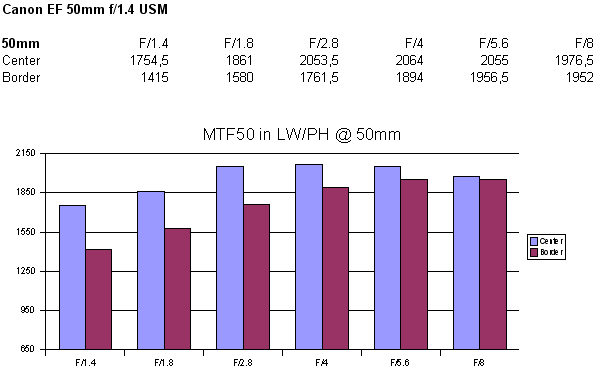
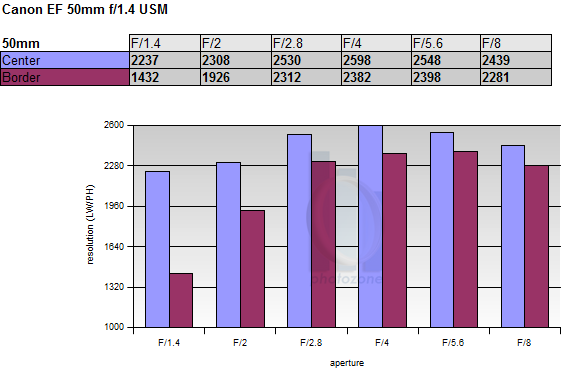
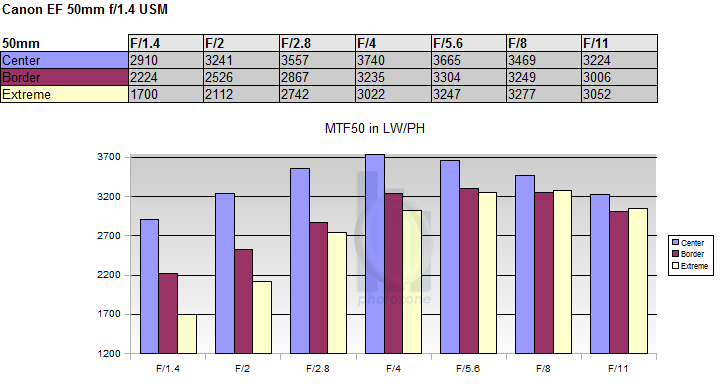
Let's have a look at these MTF charts:
I think rav is multiplying by 0.75 to account for bayer array nuances and low-pass filter effect. That would be a fairly rough way to account for those factors, and maybe a little excessive, but its a start.
Now these MTF figures were derived from images that were taken with 8MP and 15MP (APS-C) and 21MP (FF) bodies. Comparing the 350D and 50D figures, they look kinda (oh well...) the same except being cut off at some point (around 2050) by the 350D. Now that cut-off-point, could that be 2304 height cells minus the AA-filter effect?
It could be partly the AA (low-pass) filter, which does indeed do some blurring. Generally speaking, a well-designed low-pass filter will not really blur an image much...the point is to cut off spatial frequencies that are already below what the sensor can usefully resolve anyway. Removing a low-pass filter will generally result in more noise at very high frequencies below the nyquist limit of the sensor, so by "blurring" those frequencies helps prevent adding more noisy information to the image, thereby preserving frequencies that CAN be usefully recorded by the sensor. A low-pass filter should improve IQ when used correctly, not reduce it, but its a fine line, and at least with more recent Canon cameras, the low-pass filters seem to be just a tad over-aggressive.
The question remains: Are these charts in any way helpful on determining if a sensor with a given pixel size (e.g. 4,31µm) will be outresolved by a certain lens at a certain setting?
Yes...there are several tables in the Luminous Landscape article I linked that will either tell you that information strait up, or help you derive such information yourself...from a theoretical standpoint. From a real-world standpoint, there are a lot of factors involved related to both the sensor and the lens that affect resolution, many of which can be difficult to evaluate from an objective standpoint. You can roughly approximate whether a lens is outresolving a sensor or whether a sensor is outresolving a lens at any given aperture setting, but it will never be exact without extensive testing.
Also, given this situation: A certain lens (lets say the 50/1.4) is tested on a certain body (350D). The MTF figures at a certain setting (1.8 ) are clearly lower (1850 LW/PH) than the maximum the camera can resolve (lets say 2050 LW/PH for the 8MP 350D). Can we assume that a higher resolution sensor of the same physical size will not give us any more picture detail?
If we assume that the 50/1.4 is a perfect lens, such that it has no optical aberrations or problems with flare (a physical impossibility, but lets assume for discussion sake for the moment), then yes...until you reach the physical limit of resolution for the 50/1.4 at f/1.8, a higher resolution sensor of the same physical size will continue to resolve more detail. A perfect 50mm lens at f/1.8 could probably resolve around 375lp/mm. Assuming an APS-C sensor, you would need 187mp, or dimensions of 16725x11175 pixels, to resolve 375lp/mm. Such a lens, however, is going to be overpowered by optical aberrations at that aperture, as well as at f/1.4, and probably enough at f/2 that it is still aberration limited. It wouldn't be until f/2.8 or maybe f/4 that the lens becomes diffraction limited, or where aberrations and diffraction have roughly an equal effect. At f/4 the lens could resolve about 173lp/mm, in which case the maximum useful sensor resolution at APS-C would be about 40mp, or 7716x5155 pixels.
If we use the numbers in your charts, it does indeed appear that the 50/1.4 lens becomes diffraction limited around f/4. The 350D peaks at a resolution of 2064 lw/ph, 50D at 2598 lw/ph, and the 5DII peaks at 3740 lw/ph. Thats 90%, 82%, and 99.9% of the maximum capabilities of each sensor. Would make you think the 5D II is resolving more detail...but that wouldn't actually be correct, interestingly enough. Lets convert the resolutions of each sensor from lw/ph to lp/mm:
50D = 106lp/mm
5DII = 78lp/mm
350D = 76lp/mm
Of the three cameras, the 50D actually has the highest resolving power, followed by the 5D II and then the 350D. Given that, the fact that the 50D resolves less of its picture height than the rest by percentage, one of a few things could be wrong: a) the 50D has an aggressive low-pass filter that is affecting resolution more than on the other cameras, b) that the lens was not focused perfectly...it may have been front or back focused ever so slightly, c) the copy of the 50/1.4 used in that particular test was not a great copy. The fact that the 5D II resolves more of its picture height than the 350D is not surprising in the least, given the difference in camera and quality grade between those two...one is a bottom-line consumer grade camera while the other is a top of the line professional grade camera. Resolving 99.9% of what its capable of is damn good, and probably slightly better than expected for a camera of its caliber and price.
The EF 50mm f/1.4 lens has an MTF chart that indicates the lens has high contrast but acceptable resolution. Even at its ideal aperture, which appears to be f/4, this lens is not going to resolve as much detail (lp/mm) as a perfect lens.
Its about 65% of the way there at worst, and 87% there at best, or 76% on average. Rav's computation would be roughly accurate for this lens, Apoligies, I used the wrong MTF chart before. Its about 50% resolution at worst, 86% at best, or on average 68%. This indicates that an 18.4mp APS-C sensor would be the highest resolution it could reasonably resolve to before the sensor starts consistently outresolving the lens at all apertures.
I know the charts above say differently - but why?
(OR could that be due to inaccurate measuring (the tests were a couple of years apart) or assembling deviations (no two lenses are the same)?)
If the tests were done years apart, then there are certainly questions about the accuracy and consistency of the combined results. If the same exact lens was not used in all three tests, then you have to suspect the quality and calibration of each lens, and whether the lenses and cameras were calibrated to each other for maximum performance. The 5D II and possibly 50D (can't remmber off the top of my head) offer microfocus adjustment, which can largely correct front/back focus problems. Without proper adjustment and tuning of each lens to the camera body its used on, a significant portion of margin of error would have to be attributed to the lens. I think that could easily account for the discrepancy with the 50D, which has the highest resolution sensor of all the cameras tested.
Again, what I found was, that when you take an 18MP picture with the 50/
[email protected] on an APS-C camera, downscale it to 8MP and reupscale it to 18MP, there is no loss of detail (at all). Thats why I figured that this lens @1.8 doesnt even outresolve an 8MP APS-C sensor, which I think is supported by the MTF figures above.
You are absolutely correct, at f/1.8 optical aberrations are going to greatly overpower diffraction, so the sensor would indeed outresolve the lens at f/1.8. However if you stopped the lens down to f/4, and had it properly calibrated for your particular camera body by using microfocus adjustments (and possibly sending both in for proper calibration by a Canon service rep if microfocus doesn't correct all missfocus problems), then I would expect the 7D to resolve the maximum amount of detail the 50/1.4 is capable of resolving at the center. Corner sharpness drops off drastically, and its unlikely the 50/1.4 would outresolve the 7D at any aperture except
maybe f/4.




 To keep it succinct though:


