climber said:
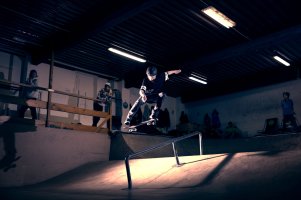
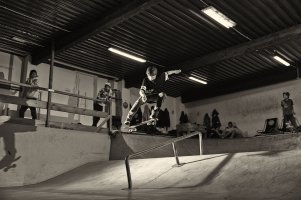
Hi. I took the attached picture at ISO 200 and it looks quite noisy/grainy in the shadows at 100%. Could someone take a look and say if this is normal or not? Or it is just me doing something wrong? Picture is converted in LR 4.3 and unprocessed.
You've used a very low ISO setting. For action, you need higher shutter speeds, and that means using a higher ISO setting. You might actually find that using a higher ISO in this case might actually reduce the appearance of shadow noise, as it will increase your utilization of the camera's available dynamic range to create a more saturated image before read noise is injected into the image. That won't entirely solve the "noise" issue, though.
The only other thing you MIGHT be doing wrong is overestimating how much noise there is in the shadows.

Noise is a NATURAL consequence of the physical nature of light. Sensors have discrete elements that sense light, however light falls randomly and slightly unevenly on those elements, so there is an intrinsic error rate...some pixels are slightly brighter than they should be, others are slightly darker than they should be, resulting in "noise".
It's ALWAYS occurred in photos. In the film days, noise was often much worse than what we deal with today, on all but the highest grade (and usually slower) films. For example, one of the most loved films for its high quality, exceptional color, and fine grain was (and actually still is) Velvia 50. This SLOW film has long been THE film for serious large format landscape photographers. It isn't cheap (and only seems to get more expensive with time), however thanks to its slow speed, it is able to achieve a very fine grain size and is therefor low noise...however it's 100% useless for the kind of action photograph you've taken!
In the film era, you would be using at least an ISO 400 film, maybe even an ISO 800 film. Higher ISO films used larger grains in order to increase the film's sensitivity. That resulted in high ISO film images appearing MUCH noisier than high ISO digital images are today. You should count yourself lucky you have the option to crank ISO as high as ISO 12800 these days and still not experience the same kind of film grain you would have with ISO 800 film.
Your image, though underexposed, is actually relatively clean. It IS underexposed, however. If you lift it by a couple stops in Lightroom, you'll be lifting read noise along with the image. That means your shadows will actually be noisier than if you had taken the image at ISO 800 in the camera. Increasing ISO is actually a means of REDUCING read noise, therefor resulting in cleaner shadows, since the image signal is amplified before the pixels are read...so read noise is added AFTER (and therefor it is a lesser fraction of the output signal.) You do need to be aware that in the presence of less light, total signal noise (not just the noise in the shadows that's added by the cameras readout electronics, but noise intrinsic to the signal, derived from the nature of light) will increase. That's physics, nothing we can do to change that.
If you don't like the amount of noise that is present in an image at ISO 800 with the natural levels of light in your photo, the only real option you have is to
add light! If you bring along artificial light, either bounced flash or some kind of flash or continuous lighting on stands, you will open up the option of using a lower ISO setting while still exposing your subject properly.
EDIT: On closer inspection of the image at 100%, you really do need to crank up the ISO, lot! ISO 800 is probably the minimum you need, but I think ISO 1600 at least is necessary. You can see both subject motion blur (due to his motion) as well as camera shake blur in your example shot. That is an indication of a shutter speed that is much too low. You want to use the highest shutter speed you can get away with, at LEAST 1/focalLength (and 1/focalLengthx2 if your using an APS-C sensor), in order to prevent blur from camera shake. Depending on how fast your subject is moving, you may need an even higher shutter speed than that. That is going to warrant 3-4 stops higher ISO than you were using...or bring in a LOT more light.



 Now is that a make ? looks like an ollie north but back foot looks like a reply sketchy land!!