5DS R for bird photography

AlanF

Desperately seeking birds
Canon Rumors Premium
Aug 16, 2012
14,189
28,513
226,191
I am on a business visit to Malaysia, Singapore and Hong Kong, and have packed my new 5DS R along with the 100-400mm II for some bird photography on the side. Now, almost any lens with any body can take spectacular photographs of birds, with every detail of every feather gleaming, if you can get close enough. What the 5DS R has enabled me to do is to extract usable images for printing in my albums from extreme circumstances.

The weather has been awful, and the birds haven't been cooperative, but the 5DS R has made it worthwhile.

1. Sharpness. The 5DS R and the 7DII have the same size pixels and theoretically the same resolution. The absence of the low pass filter in the 5DS R makes a huge difference in poor lighting conditions. In good light, you can sharpen the 7DII images well using USM or "smart sharpen" to get close to the resolution of the 5DS R. But, at high isos, the noise gets too great as it is amplified by sharpening. With the 5DS R, there is no need to sharpen and so you can use much higher isos.

2. AF. I have never had such consistent AF as with the 5DS R. There is little need to take multi-shots of the the same target, which makes up for the over-large file size and slower frame rate. The tracking of birds in flight is just so much more precise.

3. Large field of view. The 100-400 II on the 5DS R gives a 1.6x1.6 times larger field, which makes it so much easier to find and track.

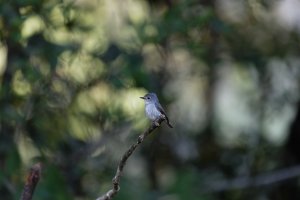
I'll follow with some examples, which aren't my best photos, but are just to illustrate how useful the 5DS R is. It pairs very nicely with the 100-400 II. The light has been so bad in the main that I haven't even considered using the 1.4xTC, and I have not gone below iso640.
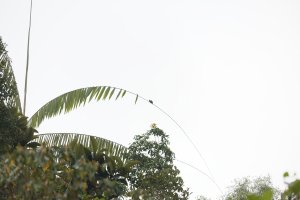
 
First, resolution.
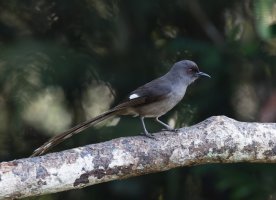
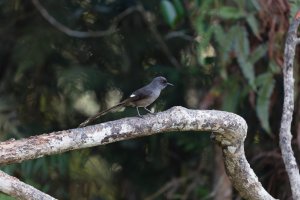
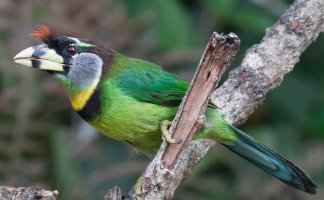
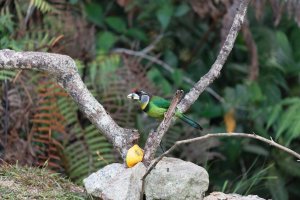
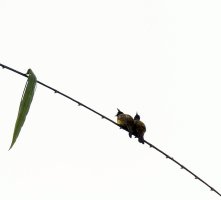
A pair of birds miles away, that I couldn't see what they were. But there is just enough resolution to to see that they are Black-crested bulbuls. Then there are some birds that are reasonably close but crop extremely well.
 

Attachments

  • BlackCrestedBulbuls_3Q7A1737-small.jpg
    BlackCrestedBulbuls_3Q7A1737-small.jpg
    232.2 KB · Views: 240
  • longtailedsibia_3Q7A1574-DxO.jpg
    longtailedsibia_3Q7A1574-DxO.jpg
    2.3 MB · Views: 243
  • longtailedsibia_3Q7A1574-small.jpg
    longtailedsibia_3Q7A1574-small.jpg
    277.8 KB · Views: 237
  • FireTuftedBarbet_3Q7A1509-DxO.jpg
    FireTuftedBarbet_3Q7A1509-DxO.jpg
    960.3 KB · Views: 321
  • FireTufteBarbet_3Q7A1509-small_125th.jpg
    FireTufteBarbet_3Q7A1509-small_125th.jpg
    124.1 KB · Views: 244
  • AsianBrownFlycatcher_3Q7A1560-DxO.jpg
    AsianBrownFlycatcher_3Q7A1560-DxO.jpg
    1.2 MB · Views: 283
  • AsianBrownFlycatcher_3Q7A1560-small.jpg
    AsianBrownFlycatcher_3Q7A1560-small.jpg
    179.9 KB · Views: 243
  • BlackCrestedbulbuls_3Q7A1737-DxO.jpg
    BlackCrestedbulbuls_3Q7A1737-DxO.jpg
    72.8 KB · Views: 243
Upvote 0
A few more.
 

Attachments

  • MaroonBreastedCrownedPigeon_3Q7A1966.jpg
    MaroonBreastedCrownedPigeon_3Q7A1966.jpg
    2.5 MB · Views: 254
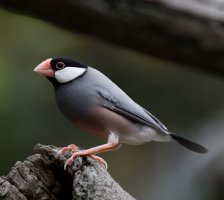
  • JavaSparrow_iso640_160th.jpg
    JavaSparrow_iso640_160th.jpg
    1.7 MB · Views: 238
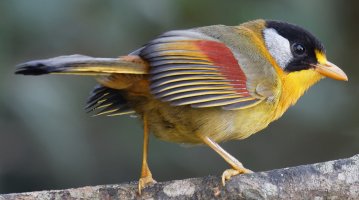
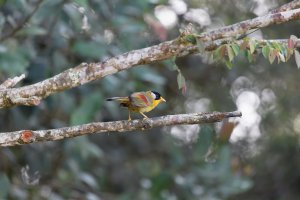
  • SilverEaredMesia_3Q7A1592.jpg
    SilverEaredMesia_3Q7A1592.jpg
    541.1 KB · Views: 327
  • SilverEaredMesia_3Q7A1592small.jpg
    SilverEaredMesia_3Q7A1592small.jpg
    265.8 KB · Views: 237
  • Orangebelliedleafbird_3Q7A1603-DxO.jpg
    Orangebelliedleafbird_3Q7A1603-DxO.jpg
    624.2 KB · Views: 283
  • orangebelliedleafpicker_3Q7A1603-DxO_small.jpg
    orangebelliedleafpicker_3Q7A1603-DxO_small.jpg
    589.6 KB · Views: 243
Upvote 0
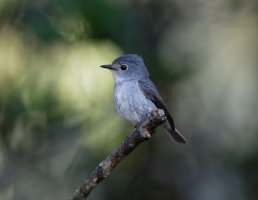
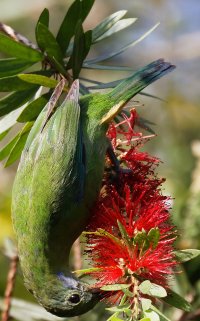
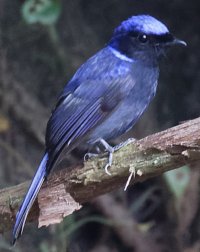
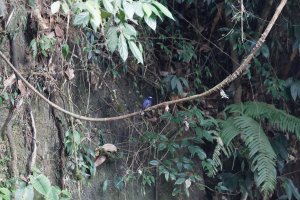
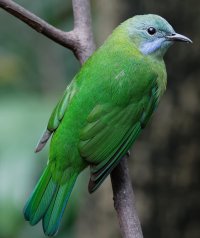
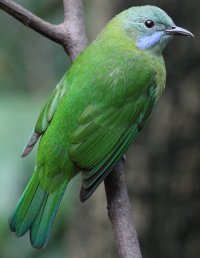
Here are some higher iso jobs I couldn't have done with the 7DII. The female orange bellied green leafbird was at iso 2000, and close enough for a good shart. The Large Niltava was very far away, in the shade, and taken at 1/30s and iso 2500. Not a publishable shot but OK for my album. No sharpening, of course. (All hand held).
 

Attachments

  • LargeNiltava_3Q7A1821-DxO.jpg
    LargeNiltava_3Q7A1821-DxO.jpg
    122.1 KB · Views: 1,076
  • LargeNiltava_3Q7A1821small_iso2500_30th.jpg
    LargeNiltava_3Q7A1821small_iso2500_30th.jpg
    581.2 KB · Views: 221
  • OrangeBelliedleafbird_female_3Q7A2025-iso2000.jpg
    OrangeBelliedleafbird_female_3Q7A2025-iso2000.jpg
    654.7 KB · Views: 321
Upvote 0
Brilliant, thanks for posting this! The full frame versus crops really show how much detail the 50MP gets you. I'm getting the 5Ds soon and will use it a lot for birds.

Did you find the fine feather filaments exhibited any moiré, given the lack of a functional AA filter on this camera?
 
Upvote 0
neuroanatomist said:
scyrene said:
Did you find the fine feather filaments exhibited any moiré, given the lack of a functional AA filter on this camera?

Yes, as exemplified by the orange bellied green leafbird image...

I didn't click on them full size :) Also resizing can affect moiré can't it? Either way, I'm sticking with the non-r model - I don't need to pay an extra £200 for a feature that might make things worse in critical images.
 
Upvote 0
I am quite happy with my 5DS R for BIF, and being able to use my 1.4X TC III with the 100-400mm II and have AF work for general wildlife shooting. I did find that the 1.4X TC isn't a good fit with my 400mm f/5.6 on the 5DS R since the CA is pretty obvious. I still prefer the prime to the zoom for BIF since the focus limiter at 8.5 meters is much better than 3 meters. I wish the 100-400mm II had both a 3m and 10m focus limit option. If I loose focus with the zoom, and it hunts to 3m, I am dead in the water. Cannot locate the bird to recapture focus.
 
Upvote 0
neuroanatomist said:
scyrene said:
Did you find the fine feather filaments exhibited any moiré, given the lack of a functional AA filter on this camera?

Yes, as exemplified by the orange bellied green leafbird image...

Good morning here from Hong Kong. The Moire seems to be introduced by using DxO as the RAW converter. Here is the crop from using DPP4 to convert, which is noisier (no sharpening or noise reduction applied) but lacks the Moire in the long tail feathers and on the left of the DxO. The regular repeating patterns of the feathers in this shot are perfect for setting up Moire, independent of having a low pass filter. Otherwise, I haven't seen Moire patterns.
 

Attachments

  • Orangebellied_3Q7A2025DPP4_Crop.jpg
    Orangebellied_3Q7A2025DPP4_Crop.jpg
    1.6 MB · Views: 370
Upvote 0
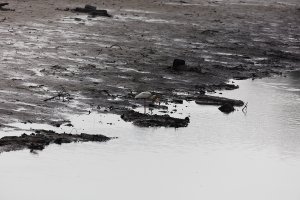
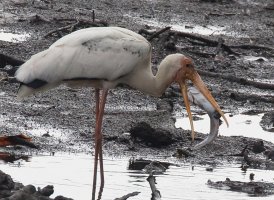
Finally, don't bite off more than you can chew.
I couldn't see what the stork was doing until I saw in this on the screen.
 

Attachments

  • Paintedstorksmall_3Q7A1349-DxO_stork+fish.jpg
    Paintedstorksmall_3Q7A1349-DxO_stork+fish.jpg
    359.1 KB · Views: 228
  • PaintedStork+Fish_3Q7A1349_vcrop.jpg
    PaintedStork+Fish_3Q7A1349_vcrop.jpg
    435.8 KB · Views: 244
Upvote 0
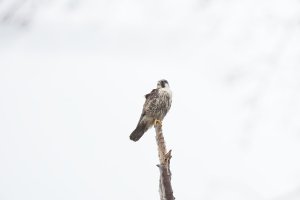
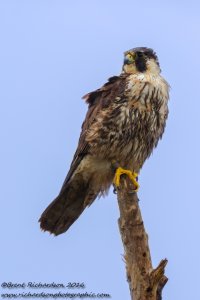
Thanks for starting this post Alan. Glad you're enjoying the 5DsR for birding. Unfortunately I have not been able to spend much time birding on my business trips to Malaysia. Beautiful country. Here is a sample of a Peregrine Falcon I found on a recent trip to Bombay Hook, Delaware. 5DsR, 600 F/4 (non IS) with 1.4MIII TC. 1/640, F/8, ISO 800. This was a rainy, overcast gray day. Hoping to do better this weekend.
 

Attachments

  • 5DSR8197_original.jpg
    5DSR8197_original.jpg
    119.8 KB · Views: 231
  • peregrine falcon 2 - Copy.jpg
    peregrine falcon 2 - Copy.jpg
    381 KB · Views: 296
Upvote 0
AlanF said:
The Moire seems to be introduced by using DxO as the RAW converter. Here is the crop from using DPP4 to convert, which is noisier (no sharpening or noise reduction applied) but lacks the Moire in the long tail feathers and on the left of the DxO. The regular repeating patterns of the feathers in this shot are perfect for setting up Moire, independent of having a low pass filter. Otherwise, I haven't seen Moire patterns.

There is less moiré in the DPP4-converted image than in the DxO-converted image, but it's definitely still there. So I suspect that DxO is just accentuating it (e.g. with 'lens softness correction' / sharpening).
 
Upvote 0