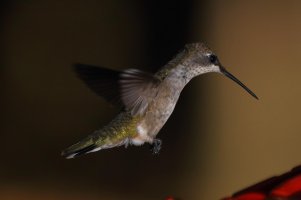
For BIF, I would say AF system is the most important thing, followed by frame rate. Having the right focal length helps as well...it can be very tough to frame birds in flight with a small frame.
I would recommend the 7D II and 70-200mm f/2.8 as a start. That will get you around a 315mm effective focal length (the 7D II sensor is slightly larger than past Canon APS-C sensors, maybe around 1.55x crop or so), which IMO is very nice for BIF. You could probably slap on a 1.4x TC for maybe around 435-440mm effective focal length, however your losing that stop of light.
Having a FAST lens is also important for BIF, you want as much light a you can get, for two reasons. First, it allows you to take full advantage of the f/2.8 dual cross-type AF point. In lower light, this can be huge for BIF. Second, it improves your SNR for each shot, allowing you to avoid having to REALLY crank up the ISO to get the necessary shutter speed. With a cropped sensor, even the 7D II, you want that extra light. (It might not be quite as important with a 5D III, which would be my second body recommendation.)
The other benefit with a fast prime is you can use a 1.4x TC, and not drop yourself into f/8 territory. While it is possible to do BIF at f/8, it is extremely difficult. Even with AF point expansion (so five or nine points around the center point), your chances of actually locking onto your subject quickly enough to actually get the shot at f/8 are very low. You really don't want to be doing BIF slower than f/5.6, and even then, it's going to be tough. You want f/4 or f/2.8 for BIF.
Finally, frame rate is important. I wouldn't say it is the most important thing for BIF, but after AF, it is probably the next most important. Getting the right wing position and head position relative to the body for a really great BIF shot requires a higher frame rate. The 10fps of the 7D II is going to be a real bonus here. You could get away with it with the 5D III...however having used the 7D for years myself, I really do feel the drop in frame rate with the 5D III (and it's only 2fps, vs. the 4fps difference relative to the 7D II) and BIF. I largely stick to perching and wading songbirds and shorebirds/waders with the 5D III, because it is pretty tough to get just that right pose with the slower frame rate.
If you do get the 5D III, my top recommended lens for BIF would be the 300mm f/2.8 L II, with and without the 1.4x TC III. I think the 420mm f/4 aperture with the 5D III is pretty great for BIF (I've rented that lens twice now, and I really like it...probably the next lens I intend to purchase from Canon, as it's actually great for wildlife, BIF w/ the 5D III, and astrophotography.) Going longer than ~420mm on FF (or effective focal length on APS-C) often presents issues keeping the bird in the frame, and nicely composed within the frame....I've tried BIF with my 600mm f/4 L II, and it is usually very difficult unless the bird is quite far away. About the only BIF I do these days is fairly distant hawks circling overhead, and then, they are usually often too far away even for the 600. Once I get the 300/2.8, I'll probably get back to doing BIF more, as the wider field just makes it so much easier.
Anyway, those are my recommendations. I'd say 7D II + 70-200 f/2.8 L II is my first, and 5D III + 300 f/2.8 L II + 1.4x TC is my second.





 No sarcasm here. (I guess I woke up on the right side of the bed...oh, right....I didn't wake up at all, guess that's one benefit of insomnia, no side of the bed to worry about, period! ???

