OK, put the popcorn away for a minute.  Let's do some quick analysis using DxOmark's data.
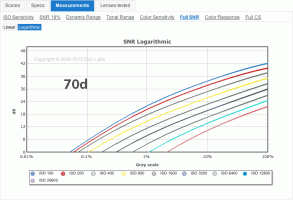
Putting aside the 70D's sensor-based AF achievement for a moment, let's look at the Signal to Noise Ratio (SNR) of today's 70d, compared with the 20d from 9 years ago, and the 10d from 10 years ago.
As SNR goes, so does DR to a large extent but SNR is a little more telling and when you compare them overlaid you can see how they differ and where the changes in sensor performance are.
The upper blue line is the ISO 100 SNR plot for all 3 cameras.
On all 3 cameras you'll see that the 100% gray scale (white) is at about the same 42dB level. So all 3 have the same SNR at white.
Where the line meets the bottom axis is where signal = noise and the image information gets lost in the noise and vice-versa. Well, unless there's a pattern that's discernible but DxOmark is still not publishing noise pattern data as far as I know. (I've requested that they do so we can estimate FPN severity of a sensor.)
Anyway, the signal=noise level of 0db is the cutoff level for all ISO measurements. That is at gray scale 0.052% for the 70d at 100(claimed) ISO. That's about 10.9 stops of highlite-to-dark range where dark = average noise. (It's late at night, somebody please correct me if I make a math mistake here, auto-correct may also mess up some spelling)
Without getting the specific data points for the other 2 cameras we can see that they also have about the same end points for 0db and white.
Net result. At a per-pixel level, the 70d's base ISO performance has not improved in 10 years. But, because it's pixels are about half the total area of the 10d's pixels (likely slightly more because of better fill-factor in modern sensors where more surface is actually actively used but lets go with half as that's in the 70d's favour) the
70d has made a technical achievement of about 1 full effective stop for one full effective pixel.
This may be even better by one more stop because of the way the split-pixel AF system functions but since I have no technical details on how this is really done at the sensor level I'll leave this to other tech types to expound. I'm also not considering each camera's real-effective ISO performance, just the rated level.
If we look at some other ISO levels:
- the 20D has better SNR results at white for all ISO levels. This is not something that's easy to see in prints since a little noise on a big signal pretty much disappears. This is also due in part to the physics of larger pixels, which is why full-frame sensors do even better. The 10D is similar to the 20D except for its highest ISO which falls down a bit
- the 20D's curves are ALL higher in every part of the graph, denoting that its SNR is better than the 70D's at all intensities from white right down into very dark shades at matching ISOs. The 10D's curves are considerably lower; it has worse SNR than the 20D pretty much at every point below base ISO.
SUMMARY.
At a per-pixel level, the 20D was a significant improvement over the 10D which came 1 year before it. The 70D, at the same per-pixel level, has not improved and is slightly worse than the 9 year old 20D. Taking into account the smaller pixels of the 70D's sensor, the practical net improvement is less than 1 stop in 9 years. (possibly close to 2 stops, depending on how the dual-sensel-AF-pixels really work)
Compared the 20D to the 60D/7D and Rebel xx0 using 18MP sensors we have an honest improvement of less than 1 stop in the period between the 20D and the 7D's release.
So, if Canon's 70D sensor is read out in such a way as to provide the same level of read noise as a regular single sensel pixel then they may be able to achieve a measurable improvement (nearly 1 stop) in base ISO dark noise which should translate into a similar improvement in total DR of a similar sensor NOT using this new AF system.
So, will the 7D Mark II have no such split AF pixels and offer us slightly improved SNR and DR because of this method or will they do something more akin to the Exmor's superior noise elimination?
Or will they provide these new AF pixels and compromise the stills performance for the sake of video and improved live-view AF?
Please Canon, give us the best possible STILLS camera in the 7D Mark II. I might then buy one.





 .
.


