A Rundown of EOS 7D Mark II Information

Marauder said:
Don Haines said:
To get us back on topic, a rundown of EOS 7D Mark II information.....

What we know so far is in the list below:

Point 1: We don't even know if it will be called the 7D Mark II

That's it! That's all we know! ...... but let's see if we can get over 1000 posts to discuss this wealth of information...

It will be called the EOS VII Mark II....because that wouldn't be confusing at all... ::)

Oops, make that EOS VIID Mark II! (Yeah, I could have just modified the post, but leaving the "error" in is more amusing....I hope!) ::) :P :o
 
Upvote 0
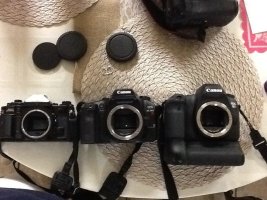
Yes, as you can see by the picture, Canon has not updated the sensors since at least 1979. Left to right. Canon A1. Élan 7E. 6D. Note the glassy, flippy uppy thingies are all the same size and shape. Shame. It was difficult back then to edit pictures that were only 100KB in RAW. I'm glad we at least stepped up resolution from the old A1 ;D
 

Attachments

  • image.jpg
    image.jpg
    159.6 KB · Views: 243
Upvote 0
neuroanatomist said:
msm said:
dtaylor said:
msm said:
In case someone doesn't get it:

You won't see more steps in a shot of a transmission step wedge by downscaling, the downscaled image will look exactly the same unless you downscale so much that you see pixelization. If you compare a shot taken with a 8mpix sensor against shot taken with a 36mpix sensor where each pixel has exactly the same DR in both sensors however...

You will see the exact same DR in both shots. No different then if you shot 8x10 Velvia 50 and 35mm Velvia 50 and compared them in terms of DR.

First of my examples yes you will same DR, second of example wrong, you will see different DR and that is precisely why comparing print DR makes sense and screen DR is of limited value. If signal to noise performance per pixel is equal, a higher megapixel sensor will always capture more information. Why this happens is already explained in one of the other 2000 DR threads here.

As dtaylor previously stated, there's a difference between the generic definition of dynamic range (as applied to signals of all types) and the meaning of photographic dynamic range. Get a Stouffer step wedge and a light table and try it out...

So what? There are different ways to declare what the lower limit should be. Person A may think level 1 is OK person B may think that is bad onyl leve 2 is needed etc. All we care about it getting a relative difference between sensors in an easy to test, repeatable way. Engineering DR covers that. Sure the exact numbers it claims may not agree with what you find usable which would almost certainly be a lower number, but it would be uniformly lower. If you want to know what usable DR you can get out the file at full resolution that is one thing. If you just want to know to what degree one camera will differ from another in relative terms nothing wrong with using normalized engineering DR.
 
Upvote 0
LetTheRightLensIn said:
All we care about it getting a relative difference between sensors in an easy to test, repeatable way. Engineering DR covers that.

No it does not. It's related to it, but it does not directly translate to it.

Sure the exact numbers it claims may not agree with what you find usable which would almost certainly be a lower number, but it would be uniformly lower.

But it's not. The differences between DxO reports on one hand and step wedge tests or Imatest reports on the other are not uniform, and are not even consistently lower. As has been pointed out, Canon scores much higher on the latter tests.

If you just want to know to what degree one camera will differ from another in relative terms nothing wrong with using normalized engineering DR.

It just doesn't tell you anything about photographic DR.
 
Upvote 0
jrista said:
There is noise, and there is editing latitude. In pretty much every thread on here that ends up with the DR debate, what do people talk about? The amount of noise they can see, or the amount they can lift the shadows? In all the threads I've been party to, it all ultimately comes down to how much you can lift shadows.

In none of the DR debates I've ever been party to has anyone ever said "You don't see as much noise with an Exmor sensor." No, the thing everyone always says, and the thing everyone always tries to demonstrate, is "Look how much I lifted the shadows! Look, I have a fully detailed sun, and detailed shadows, in this landscape photo. Oh, and look over here, the Canon sensor has tons of nasty red banding noise when I lift the shadows."

As far as I can tell, as far as most consumers are concerned, DR all boils down to EDITING LATITUDE. It means more shadow lifting.

Yeah and the greater the engineering DR Print DR measurement for one camera compared to another the greater the degree you have in editing latitude when the goal it to compare a final result at the same scale.

So, why do I treat them differently? First, you are not wrong about comparing cameras...you need to normalize. And normalization affects read noise as much as it affects photon shot noise. But that is comparing final IQ. That's fine and dandy...but I believe people are misusing final IQ (of UNEDITED images) to refer to editing latitude. It's THAT, the use of normalized images to refer to editing latitude, that I believe is wrong. I believe DXO's publishing of Print DR exclusively on their ratings, completely ignoring Screen DR entirely, has lead to the misinterpretation of REAL WORLD editing latitude in a RAW.

Once again as we say and they say if you want to view at 100% and see what you can do use their Screen DR.
Sure you are correct about that.

But then you turn around and call anything BS when it is not. If you want to compare one camera to another and find out the relative difference in what you could get out of it you use the Print plots instead.

And you realize that you can use the same arguments you try to use in a weird way against Print DR against PrintSNR. Why not just say they edit the RAW at 100% view so the amount of noise they have to deal with and NR applied and sharpening applied is determined by that so forget about PrintSNR and just use ScreenSNR? Why not penalize high MP cams for that too? Why penalize high MP cams for DR but not for SNR? (or better why penalize them for either!)


Since everyone always ultimately arrives at "pulling shadows" in DR debates at one point or another, I'm always harping on that point. More DR means less noise, and normalizing means even less noise for larger sensors, but we cannot edit normalized images. We only edit full size images.

You don't have to, your first step could be to normalize the image and then edit, if you wanted to.

So, from an editing latitude standpoint...I believe Print DR is invalid.

With that twisted point of view why from an editing noise appearance is PrintSNR not also invalid then?
And in that case though you magically change your mind and agree that using ScreenSNR would unfairly penalize high MP cams. Is that because you'd then end up having to claim that a very low MP ASP-C camera might be 'better' for noise than a very high MP FF camera (both using the same tech)? But with the way read noise tends to work you manage to less easily hit such paradoxes???


For one thing, the Print DR numbers at DXO are only valid if you downsample an image to exactly that size.

Of course.
Nobody says to care about the ABSOLUTE normalized numbers each in isolation. All we care about with normalized values is carrying out relative comparisons. To be fair they have to pick some size to normalize to unless they were to make up tables for every single sensor difference (and to what point?), what size and what absolute numbers come out who cares? All you care about is the difference.


I don't think many people actually downsample their images to exactly 8x12 @ 300PPI all the time...hell, I think it's actually probably quite rare. So always referring to 14.4 stop of DR when discussing shadow lifting ability is plain and simply wrong in all the infinite other possibilities for image size.

Where I am talking about 14.4 stops of shadow lifting latitude? First of all engineering DR doesn't account for banding so if any of that was around the usable amount would be less. Second (really first), you probably wouldn't be satisfied with the engineering level base term and probably wouldn't want to push that low. And finally the absolute number you can push to also depends upon the output scale and detail you are going after.

So sure, in probably very few cases would you feel you had 14.4 stops to work with.

But that is NOT what we are talking about, we are talking about relatively how one camera fairs vs another.


And that's not even mentioning that when it comes to the types of photography that tons of DR are most useful for, say landscapes, your probably UPsampling, rather than downsampling, which makes it even more invalid.

not if you want to know how one camera would relatively do comapred to another

sure if you are talking waht absolute value of stops you get in editing latitude the absolute PrintDR isn't so useful, but then again, you probably won't agree that you have the ScreenDR number either even if working at 100% view on a 30" 1080p monitor since you'd likely think the low parts that the engineering value uses are total junk.

If someone uses ScreenDR and says oh look this digital sensor here is giving me 13 stops so much more than I felt I could ever get working with film, that is misleading. But were did I mention saying that?

If you are pointing to ScreenDR or PrintDR and say I can get that many stops latitude it's not likely you'd feel that working with the image.

But if after normalizing that high MP camera comes out a few stops better under PrintDR but about the same under ScreenDR then viewing both at 100% ScreenDR would tell you the relative story, but if you want to know if that high MP would give you a worse result printed to the same size and viewed from the same distance then it would be misleading and imply you wouldn't do better when the PrintDR would tell you you'd do better.


So yes, normalization will reduce all noise, including read noise, we can't downsample our RAWs...we must edit them at native size. If we take DXO's Print DR numbers as a reference for editing latitude, they would have you believe that you have more than an additional stop of editing latitude with a D800, and nearly two additional stops of editing latitude with a D810. That is plain and simply false. Hence the reason I treat read noise uniquely in the case of editing latitude.

You must edit them in terms of the mid-tone noise measurement they take at full RAW too (unless foveon in which case that is not true, you could downsample and still keep RAW, even for Bayer you could if you downsampled to very particular sizes but whatever). And here you agree you can't fairly compare them at 100% view. So why can you not fairly compare them at 100% view for noise at say mid-tone (just using mid-tone gray since that seems to be what DxO uses for their SNR plots) but you fairly compare viewing pulled shadows at 100%?? What is the difference??


So, I don't believe that read noise frequencies are consequential to normalization...you can't see them anyway.

First why are you calling them read noise frequencies? You could sample over large blobs or individual photosites in the darks or mids or brights.

And second if you say that read noise only happens in such dark tones that you can't see any difference regardless of what the read noise is then how come even you admit that you can pull shadows better with an Exmor sensor??


That leaves photon shot noise as the primary noise culprit we are dealing with when normalizing images for comparison.

Yeah much of the images tones are affected more by shot noise, but not at all. So you look at two different things and they give you two different plots. What does this have to do with anything under discussion?


Sure, read noise frequencies get normalized as well, but only a computer algorithm can tell the difference,

First, I think you are getting confused by mixing up spatial frequencies with something or other? Not sure why you are referring to it in that way.

If the signal you are looking at is so low that the normalization has no effect that you are looking deeper than you are using anyway since you won't spot any non-normalized differences anyway I'd think.

You might say well maybe the eye finds anything in the realm where read noise starts affecting the signal too deep and dark and a mess to care about after raising shadows, which could be, only it doesn't seem to be since the differences in the shadows can very clearly be seen so the read noise is stomping over stuff that is visually useful and it seems to match up to about what is suggested. So it doesn't seem to be the case that the measurement is looking in too deep at this point.

The only time read noise becomes a meaningful factor is when your pulling shadows. THEN, and only then, does the advantage of having LESS read noise really become a meaningful issue.

Well, yeah of course.

In that case, the D800, and any other Sony Exmor based camera, wins, hands down, no contest. However, and here is where DXO comes in again...A D800, D810, A7r, A7s, etc. don't have an 8x light gathering advantage over a Canon camera (as DXO's PrintDR numbers would have you believe). In fact, its about HALF that, one stop less, or a 4x advantage. Personally, I think being off by 100% is a meaningful thing. If DXO was saying the D800 had a 4.1x advantage over Canon cameras, I'd have never said a peep. But saying the D800 has nearly an 8x advantage over Canon cameras...yeah, I have a problem with that.

Because you decide to not normalize for shadows but only for upper tones for some reason.

The difference seems pretty major to me at ISO100. I mean really quite, quite, jump out at you so and 1 stop certainly doesn't produce that and even 2 stops not really, so the getting close to 3 stops seems reasonable to me although I haven't tried to do a careful study with custom uniform RAW converter that treats them all them same and then visually comparing by stop. But just what you see using say ACR it seems reasonable although it's tricky to get clear measurements out of that because so many variables.

So...I keep read noise levels in the context of discussions on DR (which pretty much ALWAYS end up referring to shadow lifting ability at some point), distinct from the whole concept of normalization. Because were talking about editing latitude, something that cannot be compared in a normalized context (at least, as far as I see it.)

Well, I don't think I can explain my stance any better than that. I'm guessing you still disagree, but that's ok. Nothing either of us can do about that at this point. :P

:'(

Anyway I'm sick of this, so I will quit, you can have any last word if you wish, have at it. I've become bored and didn't mean to waste so much time on this response.

 
Upvote 0
I don't care at all about DXO. And I don't care whether it's called "DR", "photographic DR" or "latitude".
I do care about images ... and i know, I cannot get images like in the following link (Nikon D810 review) from my 7D or the EOS-M and also not from a Canon 6D or 5D3 or 1D-X or any other Canon EOS.

Here goes:
http://aboutphotography-tomgrill.blogspot.co.at/2014/08/nikon-d810-hands-on-review.html?m=1

BEcause I (greatly) prefer the Canon user interface, I would like to get this type of IQ and "DR" from a Canon EOS ... preferably mirrorless FF camera the size and weight if a Sony A7.

And I don't care, whether it is called 5D IV, 6D II, EOS-M Pro or whatever. As long as they bring it to market at competitive prices = somewhere between Alpha 7R and Nikon D810 ;D
 
Upvote 0
neuroanatomist said:
msm said:
dtaylor said:
msm said:
In case someone doesn't get it:

You won't see more steps in a shot of a transmission step wedge by downscaling, the downscaled image will look exactly the same unless you downscale so much that you see pixelization. If you compare a shot taken with a 8mpix sensor against shot taken with a 36mpix sensor where each pixel has exactly the same DR in both sensors however...

You will see the exact same DR in both shots. No different then if you shot 8x10 Velvia 50 and 35mm Velvia 50 and compared them in terms of DR.

First of my examples yes you will same DR, second of example wrong, you will see different DR and that is precisely why comparing print DR makes sense and screen DR is of limited value. If signal to noise performance per pixel is equal, a higher megapixel sensor will always capture more information. Why this happens is already explained in one of the other 2000 DR threads here.

As dtaylor previously stated, there's a difference between the generic definition of dynamic range (as applied to signals of all types) and the meaning of photographic dynamic range. Get a Stouffer step wedge and a light table and try it out...

Actually I can't find a generic definition for DR, different fields, different definitions. However the ones I have seen for photography are engineering DR and Bill Claff's photographic DR which is something else than dtaylor's photographic DR. I guess I used the term SNR wrongly in the above post, electronics is not my field, what I meant is pixel DR i.e. engineering DR. Apologies for any confusion that might have caused.

If dtaylor's DR is related to shooting wedges however (which I kinda assumed from his post, he does not explain at all what he means by photographic DR):

If shooting Stouffer step wedges with the 2 different sensors and observing the result at a meaningful and equal distance at a given print size, then the individual photosites in your eyes won't see individual pixels, they will see the sum of multiple pixels (and it will be more pixels with a higher resolution sensor) and then it just boils down to statistics. Under the assumptions in my post, if you sum 4 pixels with maximum value x/4 and standard deviation s/4 you get one pixel with maximum value x and standard deviation s/2, i.e. you gain one stop DR compared to just a large pixel with maximum value x and standard deviation s. This lowered noise in the high megapixel sensor should allow you to see another step.

I can't however try it out as I don't have access to sensors with identical engineering DR but different pixelcounts.

Screen DR is only interesting when pixel peeping at 100%, without considering the total pixel count it doesn't say all about the image as a whole. It only says how much information you have in a single pixel.

Print DR says something about how much information the image as a whole contains. While the print DR number itself is only valid at the given "print size", the DR numbers at other print sizes can be derived from this.

Unlike jrista, when I edit my images I care about the end result as a whole and not just a 100% view of parts of the image and thus I find "print DR" to be the most meaningful on the DXO site.
 
Upvote 0
AvTvM said:
All i care about is images ... And i know, i cannot get such images with the 7D or the EOS-M and also not with a Canon 6D or 5D3 or 1D-X.

Changing this post because I shouldn't hand wave the claim.

Let's take his first shot of the model in the chair with "Exceptional dynamic range, from the bright window to the deep shadows with no noise and smooth tonal trasition. No fill was added to this severely back lit shot."

* The window is blown completely out.
* The shadow to the right is lost completely to black.
* Critical point: a strand of hair on the model's head is also blown out. She wasn't as underexposed as you might imagine.

Please note that these are technical observations. The shot itself is very nice. Sometimes you want clipped highlights or shadows for contrast with the subject. He is making very good use of bright, blown out backgrounds for "glow" and contrast.

But this shot does not have "exceptional dynamic range." I'm sure the model was underexposed in the original file, but I doubt he had to push more then a stop or two, and this would not have been from the deepest shadows. She was closer to middle gray then to black.

If you cannot get a similar image under similar circumstances with one of the Canon cameras listed, the problem is not the camera.

Same thing for the next two samples. The third sample is the most underexposed, but he did not push the shadows very hard as she is not as brightly exposed in the final version. I've pulled more detail then that back from shadows like that with Canon sensors, but you will want to apply some NR when you do so.

You can come up with examples where Exmor yields more DR / better latitude (ability to push shadows around).

These are not it.
 
Upvote 0
msm said:
Actually I can't find a generic definition for DR, different fields, different definitions. However the ones I have seen for photography are engineering DR and Bill Claff's photographic DR which is something else than dtaylor's photographic DR.

I hate when people push a theory without having first observed the very things the theory attempts to explain. It seems to be a core part of human nature and is rampant from silly forum debates all the way to the leaders of nations.

Order a Stouffer transmission step wedge. Shoot it with different MP sensors at the same tech level (Sony A7 and A7R; Nikon D600 and D800; etc). Scale. Observe.

You will not see what your theory predicts you will see.
 
Upvote 0
dtaylor said:
AvTvM said:
All i care about is images ... And i know, i cannot get such images with the 7D or the EOS-M and also not with a Canon 6D or 5D3 or 1D-X.

Then why do I see similar images from those cameras all the time? Browse a photo sharing site some time.

Well, I have shot myself and seen enough images from all sorts of current Canon EOS cameras ... and NONE of them can deliver these kind of images out of cam / without REALLY HEAVY post processing.

ti01075317bl.jpg

http://aboutphotography-tomgrill.blogspot.co.at/
Exceptional dynamic range, from the bright window to the deep shadows with no noise and smooth tonal trasition. No fill was added to this severely back lit shot.

ti01075346bl.jpg
 
Upvote 0
dtaylor said:
msm said:
Actually I can't find a generic definition for DR, different fields, different definitions. However the ones I have seen for photography are engineering DR and Bill Claff's photographic DR which is something else than dtaylor's photographic DR.

I hate when people push a theory without having first observed the very things the theory attempts to explain. It seems to be a core part of human nature and is rampant from silly forum debates all the way to the leaders of nations.

Order a Stouffer transmission step wedge. Shoot it with different MP sensors at the same tech level (Sony A7 and A7R; Nikon D600 and D800; etc). Scale. Observe.

You will not see what your theory predicts you will see.

And I dislike it when people post stuff like this without actually reading and understanding what they respond to.
 
Upvote 0
Information from Japanese Canon fan girls, who are working @Canon:

Information about the successor of the 7D and the 5DIII are under total NDA. And total means total. There is just an small circle of engeneers and managers who know all of these Cameras. Others are just working on fragments of this Cameras to avoid leaks. If anyone says, he knows details on these products, he is not telling the truth.
In earlier times print jobs for tranportation and manuals were given to the printeries weeks before announcement. This time, there ist still just printing time reservated. No files have been sent to them (status from 08/12).

Canon is still thinking that they do not have to produce the best and most innovative products in the low and mid price segments. Sales figures show that the market analysts are right. Canon is still the best power seller on the market. And the analysts know that in future time, the market wil not grow and other brands are coming in. Sony will be very active, maybe an 5DIII and 1DX mirrorless competitor is coming in the near future.
The slow reaction on the D7100 and the still "no reaction" on the excellent D800/810 is well calculated. No need to hurry, Canon products are still sold well. There are not many persons switching to Nikon, because the majority of Canonians will not be able to spend a lot of money on new expensive lenses. The average Canon customer will be satisfied by new Canon products, even if other brands will produce superior products.

And the rumored prices of the 7D successor are just rumors. Some Canon fans in Japan think that there will be an hefty price increase on Canon products on coming products. Analysts say, that customers are willed to pay the increase. The increasing number of tests and scores, where Canon products are often just a few points /percents better than e.g. third party lenses, will prompt the average (and scores fixed) Canon fan to buy this "bettert product".
If you can see that in their pictures? I do not know.
 
Upvote 0
msm said:
And I dislike it when people post stuff like this without actually reading and understanding what they respond to.

You made the same wrong claim and prediction that you've made before. You will not see another step in the higher MP image. I know because I've tried these things. I wish you would to.
 
Upvote 0
dtaylor said:
msm said:
And I dislike it when people post stuff like this without actually reading and understanding what they respond to.

You made the same wrong claim and prediction that you've made before. You will not see another step in the higher MP image. I know because I've tried these things. I wish you would to.

I wish you would actually read my post and realize that I never said you will see a difference by rescaling image taken by one sensor. I am talking about 2 different sensors.
 
Upvote 0
That's interesting and sounds plausible.

daniela said:
Information from Japanese Canon fan girls, who are working @Canon:

Information about the successor of the 7D and the 5DIII are under total NDA. And total means total. There is just an small circle of engeneers and managers who know all of these Cameras. Others are just working on fragments of this Cameras to avoid leaks. If anyone says, he knows details on these products, he is not telling the truth.
In earlier times print jobs for tranportation and manuals were given to the printeries weeks before announcement. This time, there ist still just printing time reservated. No files have been sent to them (status from 08/12).

Canon is still thinking that they do not have to produce the best and most innovative products in the low and mid price segments. Sales figures show that the market analysts are right. Canon is still the best power seller on the market. And the analysts know that in future time, the market wil not grow and other brands are coming in. Sony will be very active, maybe an 5DIII and 1DX mirrorless competitor is coming in the near future.
The slow reaction on the D7100 and the still "no reaction" on the excellent D800/810 is well calculated. No need to hurry, Canon products are still sold well. There are not many persons switching to Nikon, because the majority of Canonians will not be able to spend a lot of money on new expensive lenses. The average Canon customer will be satisfied by new Canon products, even if other brands will produce superior products.

And the rumored prices of the 7D successor are just rumors. Some Canon fans in Japan think that there will be an hefty price increase on Canon products on coming products. Analysts say, that customers are willed to pay the increase. The increasing number of tests and scores, where Canon products are often just a few points /percents better than e.g. third party lenses, will prompt the average (and scores fixed) Canon fan to buy this "bettert product".
If you can see that in their pictures? I do not know.
 
Upvote 0
Alino said:
"Information about the successor of the 7D and the 5DIII are under total NDA."

Is there also a NDA on a 5DIII successor????

First news!!! The fan girl don't want to speak, but speak too much!

Everybody knows, that Caonon is working on successors of the 5DIII and 1DX.
But treat this not as an near announcement!! They just wrote, that Canon is doing the further product development under an strict NDA.
 
Upvote 0
AvTvM said:
Well, I have shot myself and seen enough images from all sorts of current Canon EOS cameras ... and NONE of them can deliver these kind of images out of cam / without REALLY HEAVY post processing.

His images are not "out of cam." It is quite evident from his review that he is post processing RAW files.

Find a portrait photographer who uses Canon and he will deliver images like those to you all day long.
 
Upvote 0
msm said:
I wish you would actually read my post and realize that I never said you will see a difference by rescaling image taken by one sensor. I am talking about 2 different sensors.

Obviously. Why on Earth would you be talking about one???

Did you read my posts because I told you to actually shoot a transmission step wedge with 2 different sensors. The results will not match your predictions.
 
Upvote 0