A Rundown of EOS 7D Mark II Information

Lee Jay said:
Does anyone else have a full sensor full of dual-pixel phase-detection capable pixels?

Not yet. However, based on some of the patents and other announcements of technology that have floated through the imagesensorsworld blog, Omnivision and Sony, and I think maybe Fuji, all seem to have competition for DPAF in the works.

I think most of that stuff is for small form factor sensors, and a lot of those sensors are now being directed towards the automotive market (high res, wide field, rear-view video cameras have suddenly become booming business and everyone wants a piece of it), but one of them, maybe Omni?, was saying they were making a larger format sensor with a form of dual-pixel technology.

Massively competitive market out there...
 
Upvote 0
jrista said:
It's pretty amazing how one single thing, not having two additional stops of low ISO sensor DR, is all it took for everyone to forget all the other innovations, technological advancements, and general leadership in the industry Canon has made throughout their history as a photography company. ::)

Certainly not everyone. Not the majority of dSLR buyers. Mostly, just the DRones conveniently forget. ???
 
Upvote 0
jrista said:
At least, they didn't figure it out until much too late in the game. A significant part of that problem was developing the AmigaOS...there were difficulties in developing that for the RISC platform, which lead to very long development cycles, ultimately resulting in AmigaOS falling far behind Windows on the PC. The other problem with Amiga was the simple fact that it WAS built on RISC processors...Motorola RISC processors specifically. When Motorola left that market, Amiga was left high and dry. The only other real option a the time was PA-RISC, but given the difficulties in developing AmigaOS in the first place, a move to PA-RISC ultimately never occurred. Amiga management missed their window of opportunity, their product was selling extremely well in Europe until the bottom simply fell out, and they never really got a solid foothold in the US. Amiga management did not take the PC competition seriously until it was too late, then they were too inflexible, because of processor architecture, poor product design, etc. to be able to compete with the lightning pace at which the PC evolved from the late 80's/early 90's through the early 2000's.

Well I think that is a bit distorted. The initial most serious problem was way back in the Atari days when Atari had the basic tech for the Amiga. The Atari engineers wanted to move forward with the advanced tech they had under the wings, but Atari management said there was no need. We just wanna make more money and keep milking what we have. The Atari 8bits are selling well, we don't need to spend any money, why bother moving things forward?

But imagine if they had listened to the engineers begging them to move forward ASAP. Suddenly this crazy powerful computer drops on the market and actually has a shot despite the dirty tricks of Apple/MS/IBM, it probably would've simply too much for those companies to obfuscate the truth over. Instead by the time Atari lost the tech and CBM managed to snare it and get it finished and out, the MAC had already landed. Now sure the Amiga was better six ways to Sunday, but with the story that Jobs and Gates had woven to the public about how 'toy' companies like Atari and CBM are nothing to be bothered about and how one should pay more money (for less) to get a 'real' computer if one wanted to be 'real' and 'serious' simply having a machine out there with a fancy GUI interface to an OS and a fast 68000 chip inside and the Apple name on front (and Gates name and a new semi-decently pseudo, a little bit fast Intel chip on the other side) they had enough to play the game and, aided by just generally poor CBM management, keep the Amiga (and later the inferior but still better than the other stuff, Atari ST) hidden under the covers as it were. BYTE magazine made a huge deal about the Amiga in a 1985 issue and that was about the only splash the machine was ever allowed to get in the U.S. The power players squashed it and quieted down the press and the sheep made up a large proportion of the computer store salesforce and it it never caught on to the degree it needed to in the U.S. (although it managed to do fairly well in Europe, at least solely as a home computer, in time).

I'm not sure if you want to really call the 68000 a RISC CPU, although it was a bit more like one than say a modern Intel/AMD found in most machines today.

But then even still the engineers wanted more down with the machines and eventually wanted to move to a new updated custom chipset sooner, but dither, dither, dither and eventually they just got a half-baked intermediate chipset out rather late. Still more impressive than the competition, but the war had so been lost by them, they needed the earth-shattering design and needed it sooner.

By the time they eventually ported AmigaOS to the PowerPC chips after the MC680x0 line ran it's course that was so, so late in the game, most of the battle had long been shot. It is a bit unfortunate that the Intel chipsets and the interrupt methods and etc. etc. made porting of certain types of advanced OS over to Intel architecture trickier, it could be done, but would take some time and money and they didn't make a start and didn't spend. Although with fantastic management it's not impossible it may have been able to rise. People did get sick of Windows and Apple and Linux rose up to an extent and the AmigaOS had within itself a lot more promise than Linux (so did BeOS, have a lot more promise than Linux as an alternative). But again, so often in tech, the best doesn't become mainstream or make it.

The PC clones and Apple actually evolved at a snails pace. Just remember Amiga already had a full GUI OS with a power shell interface to an advanced pre-emptive multi-tasking OS already back in 1985. It tooks years upon years for Apple and Microsoft to finally manage to put decent multi-tasking into their OSes. And it took years for the clone hardware makers to finally push past the primitive Apple II-like basic hardware conceptions and move to custom graphics bus and autoconfig hardware systems and advanced DMA controllers and get the mish-mash of sound and graphics third party hardware organized in a way that could be reliably controlled almost as if all machines used the same custom hardware chipsets and it took a lot of power for the non to the metal programming through graphics libraries to overcome the huge speed penalties by not writing straight to the hardware (OTOH the freedom of the non to the metal let a few third party graphics guys then explode forth and have the cash and sales to then drive graphics hardware forward at a terrific rate and at some point that proved to be a bit better than the main maker using sole proprietary hardware system to drive things forward and eventually, now we have a bit of the best of both worlds, lots of the fancy system architecture originally imagined by the original atari/amiga kinda guys mixed with advanced custom chipsets but not proprietary and locked into a single set or two (although today we are basically down to Nvidia or AMD so it's almost proprietary in a sense, but they can drive many different levels of chipsets and old and new all at once through the libraries in uniform fashion which is different).

And it also took crazy fast CPUs to overcome the hideous bloated programming used to produce Windows OS. at one point in time it was said that I think just to do a single task switch Apple OS and Windows OS had to run through 4x and 16x times the code just to do the same thing as in AmigaOS, I forget at his point whether it was Apple or Windows that was the 4x vs the 16x). Heck a 16Mhz 68020 based AmigaOS machine had much of the OS feeling at least as snappy as a 130Mhz Intel Windows box circa 1999 (although obviously stuff like decoding a jpg would be much fast on the 130Mhz machine). And we are stuck with the nasty registry system on Windows, the source of much of the horror and nightmare of a Windows box. And the archaic dynamic library system and some other core components of Windows, especially, but even with Apple/Linux.


However, failing to be competitive because you built a rigid system architecture and did not really recognize your most significant threat until it was too late, is different than purposely gimping your products to "bring your customers back for more in the 'next release' of Product X".

They didn't fail to realize the threat. APple and IBM clones and such were selling better from day 1 and they were a threat from before it ever got released. And they did gimp things. Atari put them off and put them and off and wanted to milk the 8bits and they dribbled out cheap to produce little 8bit updates while sitting on advanced stuff. CBM kept putting off updated the chipsets and carrying out other things and sitting on stuff that should've been done too. And they didn't make a good go at swapping certain architecture elements at the end either.

The former is just bad management...and that does happen. The latter is just plain idiotic and terribly bad economic and business practice, and is GUARANTEED to ruin your company. It would take the most incompetent of management staff to come up with an idea like that, to purposely withhold features in a COMPETITIVE MARKETPLACE with the unproven hope that you'll somehow keep your current customers and bring them, as well as new customers, back for more with the next round of releases. In reality, the exact opposite is going to happen...a competitor is going to leverage your idiocy for their own benefit, and steal all your customers away.

And yet it happens. Atari did that to a huge degree. And they did more or less go out of business. CBM did it to some extent. And they are out of business. Nokia sat on tons patents and ideas. Kodak sat on a lot of stuff.
etc. etc.

Canon is sitting on lots of patents (granted some might take a good deal of money to be able to implement even more than some of the stuff mentioned above would have).

And they certainly play all sorts of silly little games with things like AutoISO and MFA and basic video usability features and it is certainly curious why magic lantern can get radically more detailed video out of the 5D3 than the 5D3 is able to produce with the firmware as shipped (although maybe that is simply down to DIGIC being utterly abysmal at processing images to high quality, it's hard to say).


To be strait up, I DO NOT believe that Canon management is incompetent on that level.

Maybe not to that level and it may take them more expense and risk to implement more stuff than it would have some of the other companies.

But they have even made statements, on video tape and shown on youtube and such, where they have been caught saying stuff like why in the world do we need to bother putting out a high performance FF body, sure we can we are kings, but we are kings so we have no need, Nikon doesn't even have a FF so why do we need to bother, we will sit, we have no need. I mean they obviously could've charged forward back some years ago and just made Nikon look beyond silly, but they played conservative instead (maybe it's just as well though as Nikon might have been barely around by now and maybe with little pressure it would be ages for Canon to ever think about improving DR and such).

Canon isn't a petty corporation. They are not a corporation utterly driven by the short term (if they were, they wouldn't be one of THE MOST innovative companies in the world.)

the little MFA and AutoISO games and such demonstrate a bit otherwise


I don't think Canon is another Amiga...Amiga really had terrible management.

Yeah I'm not saying that and the camera business is a bit more locked in and safe so even acting like that it's harder to get hit like that, plus it's tricky for other companies to buy out press and pull snow jobs over the public when it comes to camera performance the way Apple and IBM and Microfsoft were able to do, so it's certainly quite a different scenario. But there are light hints of it.

However Canon may be too comfortable, they may just be riding the wave of past success...and that could be a problem. (However, that STILL doesn't mean Canon's management is sitting in their corner offices plotting ways they can keep their customers coming back for more by withholding features...that would be SUICIDE for them in the current market environment!)

you can see little hints of the latter though in the dribblings out of certain minor features and talk of well if we do the sensor this time we can hold back on the body performance and if we do the body performance this time we can get away with not spending to go to new fabs yet, etc. and yeah the $$ calculations are different than in the examples above though

and they certainly could've charged the video farther, faster, they really caught the film (movie) guys by storm and they begged for them to charge forward and dominate, but they played the regular game and

anyway I'm certainly not saying that Canon will be a mere shell in a couple years as happened with Atari

i am saying that I don't think it was the engineers who wanted to put in silly little limits on min auto iso shutter speeds and so on and so forth, it's the other guys who tend to order that kinda stuff to be done and in some cases the other also do tell them to sit on stuff so they can milk the current stuff more (it's all a balance, don't sit long enough leave a bit of money on the table, sit way too long and totally blow it long or even semi-short term)

 
Upvote 0
unfocused said:
Comparing them to flash-in-the-pan tech companies that were conceived, born, lived and died in a fraction of the time that Canon has been around, is a gross underestimation of the skill that Canon's management has developed over the years.

I'm not meaning to compare them to such tech companies, this is a different business. I was just using those (which are all safely old history) as arguments that the marketing/managers/etc. DO at times muddle up what the engineers want and hold back big stuff and so on and so forth.
 
Upvote 0
LetTheRightLensIn said:
But they have even made statements, on video tape and shown on youtube and such, where they have been caught saying stuff like why in the world do we need to bother putting out a high performance FF body, sure we can we are kings, but we are kings so we have no need, Nikon doesn't even have a FF so why do we need to bother, we will sit, we have no need. I mean they obviously could've charged forward back some years ago and just made Nikon look beyond silly, but they played conservative instead (maybe it's just as well though as Nikon might have been barely around by now and maybe with little pressure it would be ages for Canon to ever think about improving DR and such).

Your going to have to actually back that up with some links to those actual videos. There is no way Canon would have that stance in any official capacity. I could understand some idiot boneheaded employee voicing his own personal opinion, but Canon officially having that stance sounds ludicrous to me.

That's the same as your "Some random Canon rep at some random conference said such and such." That's just hearsay, and it's highly doubtful the rep's opinion reflect's Canon's actual business plan.

LetTheRightLensIn said:
i am saying that I don't think it was the engineers who wanted to put in silly little limits on min auto iso shutter speeds and so on and so forth, it's the other guys who tend to order that kinda stuff to be done and in some cases the other also do tell them to sit on stuff so they can milk the current stuff more (it's all a balance, don't sit long enough leave a bit of money on the table, sit way too long and totally blow it long or even semi-short term)

I'm a software engineer myself. I've been doing this job for two decades. I've worked for a lot of companies, big, small, highly ambitious and just plain stupid. The one consistent theme from all of them? THEY ALL ASK FOR WAY TOO MUCH!! :P Management people at competitive companies always have endless lists of things they want their engineers to do. It's a never ending parade of "Why isn't this done yet? We demanded that feature six months ago?! And where is the one from six months before that?!?!?" All the while, most of these corporations, all but those with the most ingenious and clever people in management who know how to actually manage and get things done, the management at these companies fails to realize that the continual overload of demands is what ultimately mucks up the works. One week Item A is the top priority, it absolutely without question MUST get done! Of course, the next week, Item B is the top priority, completely trumping Item A, and of course, it absolutely without question MUST get done! And so on, and so forth, week after week, month after month, year after year, companies that can't quite manage their goals, their demands, their production flow...never actually get anything done. Hmm...Atari? Amiga? Kodak? Nokia?

Canon, on the other hand, does get shit done. They are not a fast paced company, but they do achieve their goals. So does Nikon, actually, although at a faster...and in my opinion, more schizophrenic manner...and in a manner that has NOT improved their bottom line. But why do Canon and Nikon get things done? Because they know where to cut. Because they know where to stop or hold back or slow down. These are ESSENTIAL traits of successful companies...ones that don't crumble from the inside by sheer overload, not an indication of some evil executive mentality that just want's to milk their customers dry. They know where to say no. They know when they are tapped out, and cannot add any more load to teams of engineers, designers, manufacture, whoever, that are already working at capacity.

In Canon's case, it's slow and steady, the tried and true. They are a more conservative company, so one shouldn't expect them to crank out new high end camera models every year. As far as Canon is concerned, from what I can gather about them via their public business practices, they don't like to shake things up that are working. Neither should they...things are working! A content beast is a beast slow to move.

Nikon also knows the same thing. Just like Canon, they know where to cut. Nikon just cut different things. Instead of allocating their internal resources to the features and functionality of their products they deem most critical to their success, like Canon has likely done with say Auto ISO on lower end cameras...Nikon chose to cut out entire business processes like sensor manufacture and farm the bulk of that out to third parties. Nikon's business approach is quick and dirty...keep iterating on products and keep cranking em out. Of course...that's quick...and dirty. As evidenced by common themes that keep arising with Nikon's DSLRs....oil spots on the sensor, white spots on the D810, AF problems with the D800, etc. (Often many of these issues went unrecognized and unsupported by Nikon for months on end.)

Nikon's approach certainly gave them an edge in the short term. The real question is who's will maintain and grow revenues in the long term? Canon's policy has been very successful for the long term...however the one thing you've said that I agree with: They seem to be sitting on patents. SEEM being the operative word there...maybe they aren't, maybe it's just Canon's slower cycle that makes it seem that way. However if that doesn't change, then long term I think Canon could indeed face the same fate as Nokia and Kodak (at least in the photographic division...Canon has a lot of other lucrative businesses in the imaging world).

Still, back to the same old point...just because Canon has not actually implemented some of the patented technology they own does not mean they are doing it for the express purpose of trying to hold back features to keep customers coming back for more in future product releases. I think that's a ludicrous concept, and given how the management at all the various diverse companies I've worked for are always constantly shoving ideas and goals and plans and new features and new products down their engineers faces on a continuous basis, I think most companies would find it ludicrous as well. In the case of an innovative company like Canon, some technology proves to be too expensive to implement with current manufacturing capabilities and capacities. Some technology simply isn't viable. Some technology may be sound, but not necessarily competitive. I don't even believe Nokia or Kodak did that. Those companies had major internal communications disconnects. The left hand wasn't talking to the right...or worse, the left hand did not WANT to talk to the right. Internal turf wars and political battles are really what killed Nokia. All the while, while those turf wars and petty political games were going on, certain divisions just kept on plugging away....R&D centers just kept on innovating. They created some amazing technology, but because of their pettyness, higher level management was either blind to the powerful patent library they actually had, or were too deadlocked or distracted or just plain dumb to put it to good use.

I don't think Canon is that kind of company. They innovate and produce products with their innovation...it's just at a slower pace than some of their competitors. At least, so it has seemed for a while now. I'm hoping that's still the case, that the 7D II and 5D IV (or whatever is next, maybe a BigMP camera) will be game changers for Canon. I hope Don is right about Canon winding down fabrication capacity on their better, newer fabs for point and shoot camera sensors, and reallocating it for APS-C and FF sensors. The next year or so will tell us what Canon has up their sleeve, and whether they bring more of the technology in their patent library to bear or not.
 
Upvote 0
jrista said:
Lee Jay said:
AvTvM said:
Image stabilization ... no Canon invention.
"The Canon EF 75-300mm f/4-5.6 IS USM (Japan)[255] of 1995 was the first interchangeable lens with built-in image stabilization"
http://en.wikipedia.org/wiki/History_of_photographic_lens_design#The_image_stabilized_lens

Ultrasonic AF drive .. no Canon invention.
"Canon was the first camera maker to successfully commercialise the USM technology."
http://en.wikipedia.org/wiki/Canon_EF_lens_mount#Ultrasonic_motor_drive

Hi-def video in DSLRs .. hardly much of an innovation.
It practically created a whole industry over night.

Those who need it shall buy proper video cams. Should not be forced on regular DSLR buyers.
Show me a full-frame video camera at the cost of the 5DII when it was released. Forcing it on regular DSLR buyers reduces the cost of the bodies substantially.

And, diffractive optics.

Totally agree. Canon has been a highly innovative company for decades. The simple fact that they were successful in making a diffractive optics lens is an amazing feat, given that they were pretty much a laughing stock among high end optics companies for even trying.

Even where Canon was not the first to innovate something, or the first to use it in SLR/DSLR/digital camera equipment, they were very often the first to make features viable and bring them to the masses at reasonable cost (i.e. AF with EOS.)

It's pretty amazing how one single thing, not having two additional stops of low ISO sensor DR, is all it took for everyone to forget all the other innovations, technological advancements, and general leadership in the industry Canon has made throughout their history as a photography company. ::)

Well said Jon! As well as Neuro, Unfocused, dtaylor, Lee Jay and others. Canon has certainly been a very inventive and innovative company. And they will continue to be so!
 
Upvote 0
DominoDude said:
Don Haines said:
Marauder said:
Oh, who am I kidding!? I'm going to get drunk and cry in my beer if the 7D2 doesn't rock! :o
I've got $2500 set aside for the 7D2.... if it does not rock, that's a lot of beer!

Don and Marauder: Stay away from Westvleteren "Yellow cap" (a Belgian Trappist beer) and the $'s will last longer. :P

I'll trade 5 cases of the stuff for a 7D mark 2... :)
 
Upvote 0
scaptic said:
DominoDude said:
Don Haines said:
Marauder said:
Oh, who am I kidding!? I'm going to get drunk and cry in my beer if the 7D2 doesn't rock! :o
I've got $2500 set aside for the 7D2.... if it does not rock, that's a lot of beer!

Don and Marauder: Stay away from Westvleteren "Yellow cap" (a Belgian Trappist beer) and the $'s will last longer. :P

I'll trade 5 cases of the stuff for a 7D mark 2... :)

I'll drink to that! (Of course, I'll drink to nearly anything, so it's not as meaningful as it might have been. LOL)
 
Upvote 0
x-vision said:
You get cleaner shadows, which does contribute to better photographic DR as well.

"Cleaner shadows" has been subverted to equate to "better DR", but it's nothing of the sort: it's just cleaner shadows.

Or can we say that if I know how to clean up the shadows in my Canon file's images (and for the record, I do - to a pretty damn' useful exent, while retaining detail) I'm "adding" DR?

Nope. I'm just cleaning the shadows...

By exactly the same token, I don't claim that my old 7D has "better" DR than the old 5D simply because it doesn't generate the high ISO pattern noise that bedevilled the 5D.

Lower pattern noise does not equal better DR, no matter how often, in low ISO, pushed shadow comparisons between Canon and Sony sensors, it's the lack of pattern noise from the Sonys that people latch onto.
 
Upvote 0
jrista said:
I'm a software engineer myself. I've been doing this job for two decades. I've worked for a lot of companies, big, small, highly ambitious and just plain stupid. The one consistent theme from all of them? THEY ALL ASK FOR WAY TOO MUCH!! :P Management people at competitive companies always have endless lists of things they want their engineers to do. It's a never ending parade of "Why isn't this done yet? We demanded that feature six months ago?! And where is the one from six months before that?!?!?" All the while, most of these corporations, all but those with the most ingenious and clever people in management who know how to actually manage and get things done, the management at these companies fails to realize that the continual overload of demands is what ultimately mucks up the works. One week Item A is the top priority, it absolutely without question MUST get done! Of course, the next week, Item B is the top priority, completely trumping Item A, and of course, it absolutely without question MUST get done! And so on, and so forth, week after week, month after month, year after year, companies that can't quite manage their goals, their demands, their production flow...never actually get anything done. Hmm...Atari? Amiga? Kodak? Nokia?

Canon, on the other hand, does get S___ done. They are not a fast paced company, but they do achieve their goals. So does Nikon, actually, although at a faster...and in my opinion, more schizophrenic manner...and in a manner that has NOT improved their bottom line. But why do Canon and Nikon get things done? Because they know where to cut. Because they know where to stop or hold back or slow down. These are ESSENTIAL traits of successful companies...ones that don't crumble from the inside by sheer overload, not an indication of some evil executive mentality that just want's to milk their customers dry. They know where to say no. They know when they are tapped out, and cannot add any more load to teams of engineers, designers, manufacture, whoever, that are already working at capacity.

Very well said, having done the software engineering thing, the team leading thing, the project manager thing and now the manager thing it drives me crazy how most people in technical companies still don't realise less is normally more. Let a technical team concentrate on a small number of objectives and the chances are with good practices that you'll get good quality plus near budget and schedule completion. Continually jerk them around and change / add priorities and you end up getting a lot of so-so things to look at probably later than if you'd done them more linearly.

The amazing thing is that it's something that everyone knows to be true but manages to find ways to ignore. If I could figure out a cure for this kind of plum stupidity I'd be Wall Street's hottest property and be the most famous management consultant that ever walked the face of the planet! I can promise you it's not just a case of telling people ;D.

And often these "silly limits" mentioned elsewhere are put in at the engineer's insistence because he knows that in his schedule / budget he just can't get that to work right away or even at all. It's not just about management in that instance, it can be a good thing.
 
Upvote 0
Keith_Reeder said:
AvTvM said:
Canon has been innovative exactly 2 times in all of their history.

That's truly the most asinine, facile and just plain wrong-headed thing I think I've ever read on an internet forum.

Seriously - there should be a prize.
Exactly.... it's at least 3 times :)
Those thousands of patents came in a crackerjack box.....
 
Upvote 0
raptor3x said:
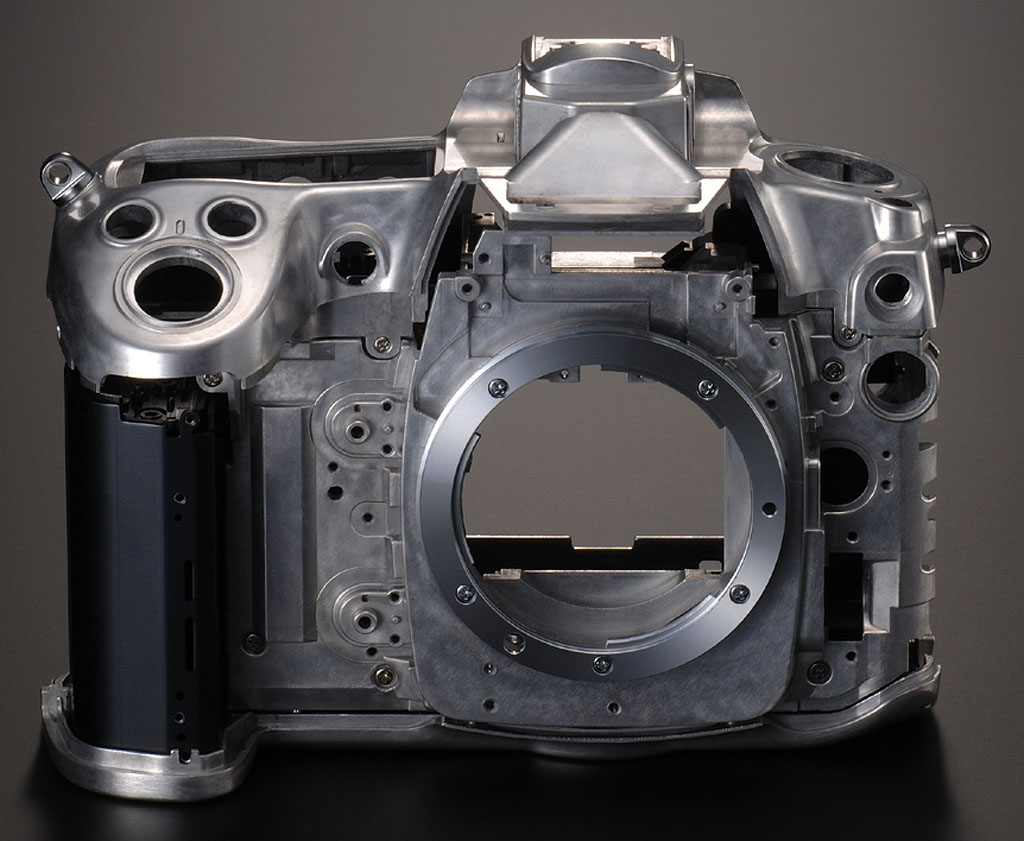
Found a picture of the insides of the D300. Same full metal skeleton as the D800/1D/D4 so I don't really think this kind of build quality can be that expensive to produce.

ZBODY.JPG
Nice but our D300 died after only roughly 90.000 shutter actuations, its mirror mechanism is broken and repair cost would have overtopped its value. So its chassis is a nice coffin for a dead camera...
 
Upvote 0