Advice on Gray Fong's Lightsphere compared to Sto-fen Omni-bounce

Status
Not open for further replies.
Aug 25, 2012
296
12
20,601
I consider myself a hobbyist and have just gotten into flash photography, and I was hoping to seek some advice and recommendations on portable diffusers for the flash unit. I have a 580 EXII (Sto-fen diffuser attached on head) which at times I need to shoot on or off camera at birthday events or parties (indoors). The events are not professional shoots just family and friends throwing private events. At times circumstances forces me to shoot with minimal gear/equipment, I am usually shooting solo and moving around the venue quite a bit to capture candid shots of adults and kids. Having said that I wish i had something that could soften the shadows like you get when using a shoot through umbrella. But like I said, mobility is an issue for me.

I was checking out the videos and demos of Gary Fong's lightspheres. Are they any good in terms of softening the harshness of the shadows while at the same time illuminating the subject nicely? Few problem I often run into are high ceilings or non-white colored walls, hence cant bounce off off them. I am looking for a diffuser or anything that is practical and portable, preferably something that can be mounted on the flash head to take nice portrait shots at parties events mentioned above.

If it helps, I currently have a lightstand, 40" shoot through umbrella, a pair of radio triggers.
 
killswitch said:
I was checking out the videos and demos of Gary Fong's lightspheres. Are they any good in terms of softening the harshness of the shadows while at the same time illuminating the subject nicely?

A photog I know has it, and while the ightsphere does what it's supposed to do he says it's too heavy and large (it sits on top of the flash after all) ... and a lot of $$$ for a piece of plastic. So if you have the opportunity test-mount it on your flash in a shop.
 
Upvote 0
The bigger the light source, the softer the light. A StoFen works well but is designed for bounce flash - it diffuses the light a bit, but doesn't soften it much or at all when used direct. The LightSphere is a little bigger, and that means a little softer, but it still sends a lot of light up - lost power at best, and with low colored ceilings you'll get a color cast

One option that I've used successfully is a Lumiquest Softbox III - it has an 8x9" surface which provides decent softening of the direct flash. It's about the biggest modifier that you can attach to your flash head and still move around with it (as opposed to a light stand with remote triggering). You'll still want to get it off-camera with a flash bracket and OC-E3-type cord. If it would help, I can take a pic of the setup I'm talking about...
 
Upvote 0
neuroanatomist said:
One option that I've used successfully is a Lumiquest Softbox III - it has an 8x9" surface which provides decent softening of the direct flash. It's about the biggest modifier that you can attach to your flash head and still move around with it (as opposed to a light stand with remote triggering). You'll still want to get it off-camera with a flash bracket and OC-E3-type cord. If it would help, I can take a pic of the setup I'm talking about...

* I can imagine what it looks like, and it's just the setup I have in mind - could you please share some insight about differences in ettl-cords (if any, but 3rd party is 1/3 price of canon) and what flash bracket to get, it needn't be the most expensive one but should still be sturdy & flexible?

* Does using an add-on diffuser really make a difference for bounce (the flashes have a pop-out diffuser after all)?
 
Upvote 0
neuroanatomist said:
The bigger the light source, the softer the light. A StoFen works well but is designed for bounce flash - it diffuses the light a bit, but doesn't soften it much or at all when used direct. The LightSphere is a little bigger, and that means a little softer, but it still sends a lot of light up - lost power at best, and with low colored ceilings you'll get a color cast

One option that I've used successfully is a Lumiquest Softbox III - it has an 8x9" surface which provides decent softening of the direct flash. It's about the biggest modifier that you can attach to your flash head and still move around with it (as opposed to a light stand with remote triggering). You'll still want to get it off-camera with a flash bracket and OC-E3-type cord. If it would help, I can take a pic of the setup I'm talking about...

Neuroanatomist, that would be awesome if you could share a photo of the setup. I think that is exactly I would prefer on the flash head, a mini softbox that I can point directly at the subject off camera and yet pick up softer shadows. Thanks yet again for the suggestion.
 
Upvote 0
Light stand and oc-e3 cord is the fastest way do send your flash to the floor, the cable is to short and stiff, and when you try to move around with your eye in the VF, it will tip over.

The bigger light the softer the light, BUT remember this is appearant light size, meaning a smaller light can look soft by moving it VERY close to the subject. That is why the biggest light source of them all, the sun, gives very harsh shadows, it looks tiny for us. So in other words, how soft light you can get depends on how close the light is and how big it looks to your subject.
 
Upvote 0
Lumiquest also makes this thing which broadens the apparent lightsource size - its OK . . .
http://store.lumiquest.com/lumiquest-pocket-bouncer/

As neuro pointed out, it is imperative you get the flash off the camera hotshoe and onto a bracket so the small lightsource is not in line with your lens/subject angle. This eliminates red-eye (which can still occur with these small modifiers) and changes shadow appearance beyond. Several other techniques to bear in mind - (1)choose your position carefully, when you can, so there is a great expanse behind your subject where no shadows can appear in the photo, (2)bouncing is always best, when there are no walls/ceilings sometimes people with white shirts/dresses can serve as the bounce surface! (Done this many times) (3)I frequently skip the bracket and simply hold the flash in my hand tethered to the hotshoe cable and hold up the flash to the right or left without having to flip a bracket or the camera orientation (4)always shoot in manual when using a flash - set exposure for the background (and within flash's synq range - may require an ISO adjustment). Sometimes a half-stop of underexposure works well to seperate subject and background. The ETTL of the flash will automatically set exposure for subject. With camera set for background exposure, you will find you can move about and the background exposure within a given venue will vary little - and slight variations in background exposure value can usually be ignored.
Hope this helps!
 
Upvote 0
Soft boxes, off camera lighting and several lights are always the best way to go.

Comparing the Gary Fong to a soft box, the lightsphere is much more portable. You can take the lightspere many places that hauling around even the smallest soft box may be problematic. A soft box will generally do a better job, but it sometimes it isn't about the best lighting it is about the amount and size of the gear you can take.

Comparing the lightsphere to the Sto-fen, the lightsphere is much nicer and usable. It can produce a fairly even soft light. For what it costs it is worth the money. It is large mounted on your flash.

I own the Sto-fen, the Lightsphere, several soft boxes both small and large. The Lightsphere has its place and is worth owning, I use the Sto-fen's very little since buying it.
 
Upvote 0
neuroanatomist said:
The bigger the light source, the softer the light. A StoFen works well but is designed for bounce flash - it diffuses the light a bit, but doesn't soften it much or at all when used direct. The LightSphere is a little bigger, and that means a little softer, but it still sends a lot of light up - lost power at best, and with low colored ceilings you'll get a color cast

One option that I've used successfully is a Lumiquest Softbox III - it has an 8x9" surface which provides decent softening of the direct flash. It's about the biggest modifier that you can attach to your flash head and still move around with it (as opposed to a light stand with remote triggering). You'll still want to get it off-camera with a flash bracket and OC-E3-type cord. If it would help, I can take a pic of the setup I'm talking about...

I guess you are not kidding about the size ;D
 
Upvote 0
For softer shadows, like Neuro said, flash on a bracket with a decent sized directional diffuser and get close. Even a large diffuser will make hard shadows from far distances. Soft shadows are created by proximity. Even a bare flash can be soft close and at lower power.

I don't like Sto-fen or Gary Fong. They send light all over and you end up with color cast.
 
Upvote 0
the lightsphere works great in certain conditions, but has limitations that you'll find annoying.

* it dumps a LOT of light and therefore inefficient for bounce, making it only useful in small/med size rooms (depending on the GN of your speedlite).

* it's large and a bit heavy, so if you're not careful, flipping between vertical/horizontal orientation can cause it to fall off

* cumbersome to store and travel with due to size.

that said, i use it primarily for family pictures indoors, where the ceilings are always "white" and the rooms are small enough for even a 430ex to bounce a bit. for this purpose, it works in spades!

3308637214_18fc7e0fd5.jpg
 
Upvote 0
Marsu42 said:
* I can imagine what it looks like, and it's just the setup I have in mind - could you please share some insight about differences in ettl-cords (if any, but 3rd party is 1/3 price of canon) and what flash bracket to get, it needn't be the most expensive one but should still be sturdy & flexible?

* Does using an add-on diffuser really make a difference for bounce (the flashes have a pop-out diffuser after all)?

No experience with 3rd party E-TTL cords, but I imagine they'd work just fine since they're just contacts and wires. Only concern might be the durability of the flash end - a 580/600 flash with small softbox is a reasonable load. But then, the Canon OC-E3 is mostly plastic, although the 1/4"-20 threads on the flash end are metal, obviously. One other consideration is that the Canon OC-E3 maintains the weather sealing of the 580/600 flashes, likely not a concern for indoor events, but I also use mine with a Better Beamer and 600 II for birds, in all sorts of weather.

What do you mean by 'pop out diffuser'? Most flashes have a wide panel for WA shots, that just spreads the light more, actually making bounce less effective. The 580/600 flashes also have a catchlight panel, which directs some of the light forward to the subject. I prefer the StoFen in that situation - the catchlight panel is designed to be used with the head pointing straight up (so a little light is bounced 90° forward), and that also means the main flash illumination is straight up. I prefer to angle the flash head toward the subject (45-60° up, depending on distance) which directs more light to the subject, and in that case the StoFen will throw some of the light forward (at many angles) vs. the catchlight panel which would be directing it more downwards.

PackLight said:
Comparing the Gary Fong to a soft box, the lightsphere is much more portable. You can take the lightspere many places that hauling around even the smallest soft box may be problematic. A soft box will generally do a better job, but it sometimes it isn't about the best lighting it is about the amount and size of the gear you can take.

FWIW, the Lumiquest Softbox III folds flat into an 8x9" size that's about 0.5" thick, and fits easily in a photo backpack, etc.

killswitch said:
Neuroanatomist, that would be awesome if you could share a photo of the setup. I think that is exactly I would prefer on the flash head, a mini softbox that I can point directly at the subject off camera and yet pick up softer shadows. Thanks yet again for the suggestion.

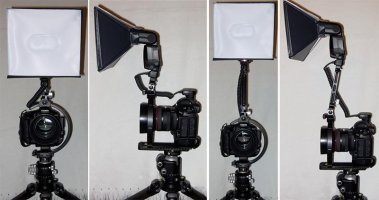
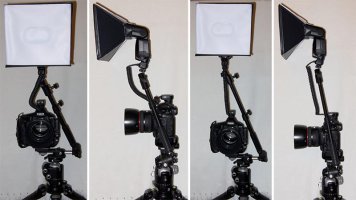
Below are two sets of images of a bracket-mounted Lumiquest Softbox III. It's attached to the 600EX-RT with a Lumiquest Ultra Strap (so I don't have to stick velcro pieces to the head, since those get in the way of the StoFen, Canon gel holder, etc.). Both are quite handholdable, I just mounted them on a tripod to take the pics of them.

The first set is a Really Right Stuff setup - an RRS B-91QR bracket, without and with the FA-QREX2 extender. The extender gets it further off-axis (and is shown retracted - it can be extended another 4"). The bracket is connected to the camera with a MPR-CL II rail that connects to the L-bracket for the correct plate orientation (with a collared lens, the rail isn't necessary). The mount on the ring can be easily slid around so the flash is above the camera in portrait orientation. It's convenient, sturdy, and stable...but expensive.

The second set is a Manfrotto 233B bracket with a Giottos MH1004 mini ballhead on the end. I have a Wimberley C-12 clamp attached to the 233B bracket for a quick release connection to the L-bracket, but the 1/4"-20 screw on the bracket could be directly connected to the tripod socket. The bracket has a telescoping arm, which is shown both retracted and fully extended. It can be adjusted so the flash is above the camera in portrait orientation, but it's more work than the RRS setup, and a third hand would help. The setup is slightly less sturdy than the RRS, sticks out a bit more, but is stable...and much less expensive.

Hope that helps!

 

Attachments

  • Lumiquest Softbox RRS Bracket.jpg
    Lumiquest Softbox RRS Bracket.jpg
    45.7 KB · Views: 2,158
  • Lumiquest Softbox Manfrotto Bracket.jpg
    Lumiquest Softbox Manfrotto Bracket.jpg
    45.8 KB · Views: 3,890
Upvote 0
neuroanatomist said:
I prefer to angle the flash head toward the subject (45-60° up, depending on distance) which directs more light to the subject, and in that case the StoFen will throw some of the light forward (at many angles) vs. the catchlight panel which would be directing it more downwards.

Wow, great information, thanks again so much :-) - and concerning the catchlight panel (I erroneously called it pop-out diffuser) you caught me not reading the manual :-p and I'll try a real diffuser for the 45-60 degree shots which are ~90% of mine.
 
Upvote 0
I too have the Manfrotto 233B bracket which neuro shows in his second set of photos. It is reasonably priced and offers many adjustments/orientations. Love the mini-ballhead addition Neuro!
One word of caution with the Manfrotto 233B bracket - it has several points of adjustment and all of them must be securely tightened else the bracket can "droop" in a myriad of directions. The thumbscrews are plastic and sometimes I get a little nervous when I have to torque one down!
 
Upvote 0
I'm an event shooter, so I use flash all of the time in situations you are talking about. My criteria for a modifier is as follows (kind of in priority order):

[list type=decimal]
[*] HIGHLY portable. Needs to be able to move around everywhere I go without slowing me down or getting in the way, plus it must be rapidly adjustable.
[*] Effective. For me that means it softens the direct light, provides diffuse lighting to boost background lighting, and it must provide light to the full frame of the image (no obvious fall-off at the bottom of the frame).
[*] Can't look ridiculous. To me the Lightsphere is pushing the envelope...if I am going to walk around with large tupperware on my flash it damn well better be worth it. This isn't a pride thing...I need to look professional, so pie plates, and portable bounce walls just won't do.
[*] Flexible. I may not always want direct light...may want to bounce from only above or behind me. I don't want a modifier that requires me to disassemble things every time I need to get creative.
[/list]

I have a plethora of flash modifiers collecting dust and the one I have consistently stuck with for the past 4 years or so is the Demb Flip-it. It allows me to adjust the ratio of ceiling bounce to foward light, effectively increases the relative size of the lights source by 4x over the bare flash, provides very wide-spread lighting coverage with no fall-off, and it's very portable. I even use it outside because of the size increase and because it eliminates the light fall-off that bare flash can give you.

For comparing the Sto-Fen to Lightsphere, they are essentially doing the exact same thing. Both are designed to throw light everywhere, and if you're indoors that can lead to reflections that soften shadows. The Lightsphere will give you a larger relative light source and probably does a better job with the light distribution, but not by a lot. Both are totally useless outdoors by the way. The exception to that is having the lightsphere with a dome on top pointing straight forward -- that only gives you a little larger relative light source. I do occasionally use the Sto-Fen if I am in a tight crowd or if I am shooting into an umbrella/softbox to get a wider spread of light. To me, the Sto-Fen is close enough to the Lightsphere that the extra size and tupperware looks just aren't worth it.

Neuro's setup is no doubt better than any of the about as far as quality of light, but I would never consider mounting the to my on-camera flash. I own one and don't even feel confident mounting to a flash on a stand because it's heavy and forward on the flash. One rapid turn and I can't imagine it flying off into a crowd of people. If you've made that work for you, I'm impressed, but I wouldn't be so brave.

The people who are talking about external lights on stands with umbrellas and such don't shoot events. Great if you want to make a portrait station, but worst idea ever if you plan to be portable. I actually do use that setup when I am shooting on location portraits (like posed wedding shots and such), but once I am shooting candids, everything has to be on camera.

Since someone brought up flash cords, I'll give a big endorsement to third party brands if only because they can be so much cheaper. For instance, B&H makes a brand called Vello and you can get their off-camera cords for about $15 (pretty much identical build quality as far as I can tell). The Canon version is about $70. That means you can get almost 5 Vello cables for the price of the Canon version. If the Canon cords lasted forever, I would say stick with the name brand. The problem is they don't...at all...mine last about a year. Maybe the Canon cable will last longer than the Vello, but it certainly won't last longer than 5 of the Vellos. Plus the Vello brand comes in a 1.5ft model, which is perfect for a flash bracket.

Since I'm plugging gear...ProMediaGear brackets are awesome!
 
Upvote 0
neuroanatomist said:
FWIW, the Lumiquest Softbox III folds flat into an 8x9" size that's about 0.5" thick, and fits easily in a photo backpack, etc.

Yes, but not in the front pocket of my hoody. :P

Personally I could see a use for all three, the little soft box, the lightspher and the Sto-fens.
 
Upvote 0
Chris Burch said:
I have a plethora of flash modifiers collecting dust and the one I have consistently stuck with for the past 4 years or so is the Demb Flip-it.

Thanks, that makes sense - exactly what diffuser do you have: http://www.dembflashproducts.com/flipit/

The Manfrotto 233B might be sturdier than it looks (and I'll try it in a shop), but my first thought when I saw it was how some screw came loose and my flash turned into a chain and ball, hitting a bystander :-o ... and really sturdy brackets are just too expensive for me atm.

One question though: I'd like to have a nicer flash reflection in the eyes than the rectangular "bare" flash, esp. on macro shots - how does the demb-type diffuser do here (If it is available in Europe at all)? Thats seems to be one advantage of the Lightsphere - it's round.
 
Upvote 0
I have the GF Lightsphere Collapsible and really like it plus it doesn't take up very much room in my bag. It's a nice defuser for what it is. I like that you can just pop the top out and fold the deal down to go back to normal flash without taking it off the flash. I also mount the dome different ways for different uses. because the dome sits in the cup it's easy to put a tissue in there to have it give off a much softer light.

I agree with everyone above. Nero's setup is great but you can't move that bad boy around easily enough for me. I couldn't do it for events.
 
Upvote 0
I also shoot a lot of events and have tried just about all the diffusers...it's a little like the search for the holy grail. I have a couple of Gary Fong Lightsphere Collapsible diffusers; they are OK in the right environment but because they spray light in every direction, they chew up the power at a crazy rate, and usually require big apertures and high iso settings. You definitely need external power. I have the unbustable Quantum Turbo T3 with the twin outputs http://www.qtm.com/index.php/products/2012-05-17-18-18-59/turbos/turbo-4

The most technically reliable and configurable Gary Fong I've had is the now discontinued, brittle, bizarre looking Whaletail http://www.garyfongestore.com/whaletail-studio-complete-system.html#.UK1eDoZvrng But bits fell off, the mounting cracked up and it was quickly retired. Pity...

The Lumiquest http://store.lumiquest.com/lumiquest-softbox-iii/ looked like a good thing on paper, but was soon sent off to the landfill. I found the quality of the light highly unattractive, the unit was bulky and for reasons I cannot explain, my flash exposures were all over the shop.

Stofen's are occasionally useful in a room with low white ceilings, and has the advantage of being so light, unbreakable and compact that it can have a permanent place in the camera bag. Still, it's very limited.

Ah ha! So is there a holy grail? Maybe in mythology, but in the real world plenty of photographers are discovering the very useful, configurable, light weight products from Joe Demb. The Flash Diffuser Pro http://www.dembflashproducts.com/diffuser/ is the best yet. It wins on price, ability to instantly configure to suit the shot, energy efficiency and of course the quality and shape of the light. So until someone invents a better device, I'm a Joe Demb fan.

-PW
 
Upvote 0
Status
Not open for further replies.