Marsu42 said:
* I can imagine what it looks like, and it's just the setup I have in mind - could you please share some insight about differences in ettl-cords (if any, but 3rd party is 1/3 price of canon) and what flash bracket to get, it needn't be the most expensive one but should still be sturdy & flexible?
* Does using an add-on diffuser really make a difference for bounce (the flashes have a pop-out diffuser after all)?
No experience with 3rd party E-TTL cords, but I imagine they'd work just fine since they're just contacts and wires. Only concern might be the durability of the flash end - a 580/600 flash with small softbox is a reasonable load. But then, the Canon OC-E3 is mostly plastic, although the 1/4"-20 threads on the flash end are metal, obviously. One other consideration is that the Canon OC-E3 maintains the weather sealing of the 580/600 flashes, likely not a concern for indoor events, but I also use mine with a Better Beamer and 600 II for birds, in all sorts of weather.
What do you mean by 'pop out diffuser'? Most flashes have a wide panel for WA shots, that just spreads the light more, actually making bounce less effective. The 580/600 flashes also have a catchlight panel, which directs some of the light forward to the subject. I prefer the StoFen in that situation - the catchlight panel is designed to be used with the head pointing straight up (so a little light is bounced 90° forward), and that also means the main flash illumination is straight up. I prefer to angle the flash head toward the subject (45-60° up, depending on distance) which directs more light to the subject, and in that case the StoFen will throw some of the light forward (at many angles) vs. the catchlight panel which would be directing it more downwards.
PackLight said:
Comparing the Gary Fong to a soft box, the lightsphere is much more portable. You can take the lightspere many places that hauling around even the smallest soft box may be problematic. A soft box will generally do a better job, but it sometimes it isn't about the best lighting it is about the amount and size of the gear you can take.
FWIW, the Lumiquest Softbox III folds flat into an 8x9" size that's about 0.5" thick, and fits easily in a photo backpack, etc.
killswitch said:
Neuroanatomist, that would be awesome if you could share a photo of the setup. I think that is exactly I would prefer on the flash head, a mini softbox that I can point directly at the subject off camera and yet pick up softer shadows. Thanks yet again for the suggestion.
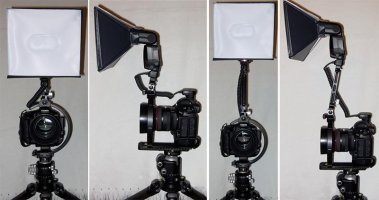
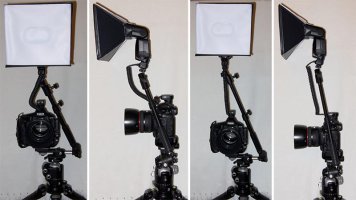
Below are two sets of images of a bracket-mounted Lumiquest Softbox III. It's attached to the 600EX-RT with a Lumiquest Ultra Strap (so I don't have to stick velcro pieces to the head, since those get in the way of the StoFen, Canon gel holder, etc.). Both are quite handholdable, I just mounted them on a tripod to take the pics of them.
The first set is a Really Right Stuff setup - an RRS B-91QR bracket, without and with the FA-QREX2 extender. The extender gets it further off-axis (and is shown retracted - it can be extended another 4"). The bracket is connected to the camera with a MPR-CL II rail that connects to the L-bracket for the correct plate orientation (with a collared lens, the rail isn't necessary). The mount on the ring can be easily slid around so the flash is above the camera in portrait orientation. It's convenient, sturdy, and stable...but expensive.
The second set is a Manfrotto 233B bracket with a Giottos MH1004 mini ballhead on the end. I have a Wimberley C-12 clamp attached to the 233B bracket for a quick release connection to the L-bracket, but the 1/4"-20 screw on the bracket could be directly connected to the tripod socket. The bracket has a telescoping arm, which is shown both retracted and fully extended. It can be adjusted so the flash is above the camera in portrait orientation, but it's more work than the RRS setup, and a third hand would help. The setup is slightly less sturdy than the RRS, sticks out a bit more, but is stable...and much less expensive.
Hope that helps!



 - and concerning the catchlight panel (I erroneously called it pop-out diffuser) you caught me not reading the manual
  and I'll try a real diffuser for the 45-60 degree shots which are ~90% of mine.


