Analysis of RAW samples at Fred Miranda show weak DR

bdunbar79 said:
I hope everyone realizes that more DR at low ISO is only beneficial in real terms when you either push shadows or pull highlights, right? What studio photographer is going to do that? How many landscape photogs are doing that? Probably close to zero. There are special cases like BIF but who shoots that is going to buy a 6D2??

This whole thing is really, really stupid.

Well, some landscape photographers (or other kinds of photographers) seem to end up with deeper shadows than others. Some of us are more exposure challenged than others.
 
Upvote 0
ahsanford said:
dak723 said:
I wonder if Canon's market research for potential 6D customers made it clear that DR was not an issue that needed to be addressed - that photographers were more than happy with the current DR and did want to sacrifice contrast.

This is an interesting theory on why Canon might leave on-chip off the camera. We haven't really mined this avenue yet.

- A

Contrast is a moot point for anyone doing any work in post.

You can define the contrast curve however your want to restrict the effective DR to however many stops you wish.
Having more useful shadow data (more DR) does not mean you LOSE contrast. You just have more data to work with and more options to process your image.

That said, plenty of people are happy with OOC jpgs and the default transfer curve used which defines "the characteristic look" of a given camera.

I sometimes shoot my Fuji's for that reason as their OOC jpgs are often good to go cuz I can get it right in camera based on the EVF.
Having the raw file means I can change my mind later and re-process it.
I can also adjust the heck out of the camera's jpg conversion algorithm to get "the look" I like if I don't like their somewhat over-contrasty stock settings.

There, mine-sweeping done for that avenue. ;)
 
Upvote 0
BillB said:
It seems to me that there are two possible reasons for a 6DII with off sensor ADC: (1) save money or (2) increase performance in some way. Saving money seems much more likely, but is it really that much cheaper to go with an off sensor ADC design for the 6DII when you are using on sensor ADC for everything else, including cheaper crop sensor cameras? Very strange.

it's pure number two! ;)

it's all about the money, making the most of it they can by doing what they do best... MARKETING

why would Canon give their customers yet another much better performing product when they already have some of those to choose from and they can sprinkle some glitter on the original 6D and still sell a boatload of them while keeping the costs down?

It's all about the margins and I suspect it's a lot cheaper for them to produce a FF system with off-sensor ADCs.
 
Upvote 0
rrcphoto said:
if you can't shoot landscape on any modern camera, look 6 inches behind the camera for the answer to the problem.

that's nice and trite and not correct in all cases, therefore not a closed argument.

and tripods / don't make up for the lack of shutter speed which *IS* far more of a criteria for landscape than base ISO.

what do you mean? are you shooting landscape from a low-flying aircraft and need 1/2000s or faster ?..
 
Upvote 0
BillB said:
bdunbar79 said:
I hope everyone realizes that more DR at low ISO is only beneficial in real terms when you either push shadows or pull highlights, right? What studio photographer is going to do that? How many landscape photogs are doing that? Probably close to zero. There are special cases like BIF but who shoots that is going to buy a 6D2??

This whole thing is really, really stupid.

Well, some landscape photographers (or other kinds of photographers) seem to end up with deeper shadows than others. Some of us are more exposure challenged than others.

Oh ok, so 12 stops just isn't enough. It's gotta be 13.4 or higher or it just doesn't work. If that's the case then the great thing is you can buy another camera that has 13+ stops at ISO 100. There are plenty of choices.
 
Upvote 0
Re: Analysis of RAW samples at Fred Miranda show weak D

BillB said:
Well, some landscape photographers (or other kinds of photographers) seem to end up with deeper shadows than others. Some of us are more exposure challenged than others.

The ability of cameras to capture DR actually within a scene is entirely dependent on the Photograpic Dynamic Range score not the normalized scores that are so often bandied about.

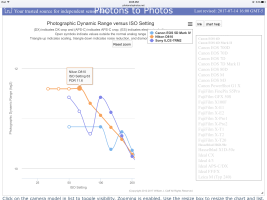
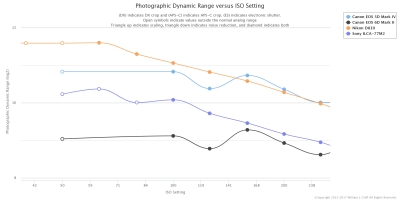
As the screen shot below illustrates there is less than one stop difference (0.8 ) in PDR between the D810, the A7R II, and the 5D MkIV.

I thought we had put this DR garbage to bed since Canon moved to the on chip ADC for most of its new releases, and certainly the ones where knowledgeable and experienced shooters have demanded that metric as an important factor. There is essentially no difference between the various manufacturers now in the ability to capture luminance values within a scene.

That Canon have decided not to put on sensor ADC's in the 6D MkII means they think cost is a more important factor to their target market than the base level dynamic range.
 

Attachments

  • IMG_0182.PNG
    IMG_0182.PNG
    442.1 KB · Views: 139
Upvote 0
Re: Analysis of RAW samples at Fred Miranda show weak D

privatebydesign said:
BillB said:
Well, some landscape photographers (or other kinds of photographers) seem to end up with deeper shadows than others. Some of us are more exposure challenged than others.

The ability of cameras to capture DR actually within a scene is entirely dependent on the Photograpic Dynamic Range score not the normalized scores that are so often bandied about.

As the screen shot below illustrates there is less than one stop difference (0.8 ) in PDR between the D810, the A7R II, and the 5D MkIV.

I thought we had put this DR garbage to bed since Canon moved to the on chip ADC for most of its new releases, and certainly the ones where knowledgeable and experienced shooters have demanded that metric as an important factor. There is essentially no difference between the various manufacturers now in the ability to capture luminance values within a scene.

That Canon have decided not to put on sensor ADC's in the 6D MkII means they think cost is a more important factor to their target market than the base level dynamic range.

Another piece of the puzzle is that cost control is Canon's strength, certainly in comparison to Nikon. I don't know how Sony will try to compete with a $2000 Canon camera with touchscreen focussing either.
 
Upvote 0
Re: Analysis of RAW samples at Fred Miranda show weak D

BillB said:
Another piece of the puzzle is that cost control is Canon's strength, certainly in comparison to Nikon. I don't know how Sony will try to compete with a $2000 Canon camera with touchscreen focussing either.

Pentax seems to be able to put a LOT of tech features into a FF K-1 body while still buying sensors from Sony...

ABC mfrs put as much as they can into most of their products AND they have better sensor performance while outsourcing major components.

So, again, what's Canon got going for it?.... internal cost control and Retail shelf space. (and now less than a handful of decent IQ bodies)
So you're buying the hype more than advanced product, at least until they can deliver products that advance more than just quarterly profits.
 
Upvote 0
Re: Analysis of RAW samples at Fred Miranda show weak D

Aglet said:
BillB said:
Another piece of the puzzle is that cost control is Canon's strength, certainly in comparison to Nikon. I don't know how Sony will try to compete with a $2000 Canon camera with touchscreen focussing either.

Pentax seems to be able to put a LOT of tech features into a FF K-1 body while still buying sensors from Sony...

ABC mfrs put as much as they can into most of their products AND they have better sensor performance while outsourcing major components.

So, again, what's Canon got going for it?.... internal cost control and Retail shelf space. (and now less than a handful of decent IQ bodies)
So you're buying the hype more than advanced product, at least until they can deliver products that advance more than just quarterly profits.

Canon is very lucky that there are so many people out there that aren't as smart as those of us who frequent internet forums.
 
Upvote 0
Re: Analysis of RAW samples at Fred Miranda show weak D

privatebydesign said:
BillB said:
Well, some landscape photographers (or other kinds of photographers) seem to end up with deeper shadows than others. Some of us are more exposure challenged than others.
The ability of cameras to capture DR actually within a scene is entirely dependent on the Photographic Dynamic Range score not the normalized scores that are so often bandied about.

As the screen shot below illustrates there is less than one stop difference (0.8 ) in PDR between the D810, the A7R II, and the 5D MkIV.
...
FWIW, PDR is a normalized measure.
Why did you exclude the camera that is the topic of this thread?
 

Attachments

  • PDR_5DM4_6DM2_D810_77M2_zoom.png
    PDR_5DM4_6DM2_D810_77M2_zoom.png
    159 KB · Views: 108
Upvote 0
Aglet said:
BillB said:
It seems to me that there are two possible reasons for a 6DII with off sensor ADC: (1) save money or (2) increase performance in some way. Saving money seems much more likely, but is it really that much cheaper to go with an off sensor ADC design for the 6DII when you are using on sensor ADC for everything else, including cheaper crop sensor cameras? Very strange.

it's pure number two! ;)

it's all about the money, making the most of it they can by doing what they do best... MARKETING

why would Canon give their customers yet another much better performing product when they already have some of those to choose from and they can sprinkle some glitter on the original 6D and still sell a boatload of them while keeping the costs down?

It's all about the margins and I suspect it's a lot cheaper for them to produce a FF system with off-sensor ADCs.

So, you're sure that it's got nothing to do with a performance tradeoff, based on your vast technical knowledge? I suppose that means you also understand how Nikon was able to increase the low ISO DR of their flagship D5 relative to its predecessors, without any tradeoffs. Oh, wait...the D5 lost a full stop of low ISO DR compared to the D4s and the D4.

I'm not saying it's not about the money (although one could certainly argue that keeping an old FF sensor fab line running after implementing a new fab line isn't a good way to reduce costs). But...you have no evidence that a performance tradeoff isn't what's happening here. I believe Bill Cliff even alluded to higher readout noise resulting from the 6DII's faster readout (à la D5), and even your poor grasp of technical concepts must give you some sense that more readout noise can negatively impact DR.
 
Upvote 0
Re: Analysis of RAW samples at Fred Miranda show weak D

bclaff said:
privatebydesign said:
BillB said:
Well, some landscape photographers (or other kinds of photographers) seem to end up with deeper shadows than others. Some of us are more exposure challenged than others.
The ability of cameras to capture DR actually within a scene is entirely dependent on the Photographic Dynamic Range score not the normalized scores that are so often bandied about.

As the screen shot below illustrates there is less than one stop difference (0.8 ) in PDR between the D810, the A7R II, and the 5D MkIV.
...
FWIW, PDR is a normalized measure.
Why did you exclude the camera that is the topic of this thread?

Second point first, because the conversation was veering off into the all too familiar 'Canon cameras are not capable of scene capture close to others' meme. Which simply isn't true now. There was no mention of the threads subject in the criticism (post I included and was commenting on) so no mention in my point, there is very little difference between the manufacturers in their cameras ability to capture scene illumination range.

As for the normalization question, I am no scientist so my terminology or understanding of it might be wrong in this instance, and if it is I apologize. I assumed your results reflected actual luminance value capture capability with a given noise floor, in DXO speak the 'screen' score as opposed to the 'print' score. As far as I can tell the print score does not reflect actual scene illumination range capture capability.

But correct me if I am wrong, the best, the Nikon D810, can capture 11.6 stops of dr contained within a scene, a 5D MkIV can capture 10.83 stops of dynamic range within a scene. A difference of less than 0.8 of a stop.
 
Upvote 0
Re: Analysis of RAW samples at Fred Miranda show weak D

BillB said:
Canon is very lucky that there are so many people out there that aren't as smart as those of us who frequent internet forums.

I assume you are joking.

There are many adjectives to describe forum dwellers, but "smart" is pretty far down on the list.
 
Upvote 0
Re: Analysis of RAW samples at Fred Miranda show weak D

privatebydesign said:
bclaff said:
privatebydesign said:
BillB said:
Well, some landscape photographers (or other kinds of photographers) seem to end up with deeper shadows than others. Some of us are more exposure challenged than others.
The ability of cameras to capture DR actually within a scene is entirely dependent on the Photographic Dynamic Range score not the normalized scores that are so often bandied about.
...
FWIW, PDR is a normalized measure.
...

... I am no scientist so my terminology or understanding of it might be wrong in this instance, and if it is I apologize. I assumed your results reflected actual luminance value capture capability with a given noise floor, in DXO speak the 'screen' score as opposed to the 'print' score. As far as I can tell the print score does not reflect actual scene illumination range capture capability.
...
I think perhaps you have "Screen" (pixel level) and "Print" (resolution normalized) backwards with regard to capturing actual scene dynamic range.
Ultimately you'll view your image at some size and viewing distance and that influences how faithfully you capture dynamic range.
DxOMark Landscape Score is a "Print" or normalized value. It comes solely from read noise and resolution.
Photographic Dynamic Range (PDR) is also a normalized value. It comes from Signal to Noise Ratio (SNR) and a resolution dependent threshold.
You can read the details of PDR by following the Further Reading topics under the PDR chart at PhotonsToPhotos.net
 
Upvote 0
Changing the resolution post capture (Print) does not increase or decrease the amount of scene DR captured. The Print value reflects scores of over 14 stops from a 14 bit file, how can more than 14 stops of scene dynamic range be captured in a 14 bit file?

Isn't the relevant metric what range each pixel can capture (Screen)? That is what limits the scene illumination range that the sensor can accurately record, surely it is the thing that limits a photographers ability to capture scenes with large dr.
 
Upvote 0
privatebydesign said:
Changing the resolution post capture (Print) does not increase or decrease the amount of scene DR captured. The Print value reflects scores of over 14 stops from a 14 bit file, how can more than 14 stops of scene dynamic range be captured in a 14 bit file?

Isn't the relevant metric what range each pixel can capture (Screen)? That is what limits the scene illumination range that the sensor can accurately record, surely it is the thing that limits a photographers ability to capture scenes with large dr.

if you mean "scaling" after capture?...

Then, yes, it does affect DR.
because you end up scaling down and averaging pixels you effectively smooth the noise floor which increases SNR and, therefore, apparent DR.

in math, you didn't increase the numerator, you decreased the donominator.

if you captured four 14-bit files with full dynamic range (let's say 12 stops) of the same scene, then averaged them into one 14 bit file, you'd have gained one more stop by averaging the noise floor, making it lower so the high point, divided by the low point (which is now halved because of the noise averaging effect) will now = 13 stops. (done in 16 bit calculation to provide the room)
If read noise were absolutely zero then this effect would not be apparent.

It's just math, and i'm not the pro at it, others are and maybe they can pipe-up and explain it better, but that's the basics AFAIK.
 
Upvote 0
neuroanatomist said:
Aglet said:
BillB said:
It seems to me that there are two possible reasons for a 6DII with off sensor ADC: (1) save money or (2) increase performance in some way. Saving money seems much more likely, but is it really that much cheaper to go with an off sensor ADC design for the 6DII when you are using on sensor ADC for everything else, including cheaper crop sensor cameras? Very strange.

it's pure number two! ;)

it's all about the money, making the most of it they can by doing what they do best... MARKETING

why would Canon give their customers yet another much better performing product when they already have some of those to choose from and they can sprinkle some glitter on the original 6D and still sell a boatload of them while keeping the costs down?

It's all about the margins and I suspect it's a lot cheaper for them to produce a FF system with off-sensor ADCs.

So, you're sure that it's got nothing to do with a performance tradeoff, based on your vast technical knowledge? I suppose that means you also understand how Nikon was able to increase the low ISO DR of their flagship D5 relative to its predecessors, without any tradeoffs. Oh, wait...the D5 lost a full stop of low ISO DR compared to the D4s and the D4.

I'm not saying it's not about the money (although one could certainly argue that keeping an old FF sensor fab line running after implementing a new fab line isn't a good way to reduce costs). But...you have no evidence that a performance tradeoff isn't what's happening here. I believe Bill Cliff even alluded to higher readout noise resulting from the 6DII's faster readout (à la D5), and even your poor grasp of technical concepts must give you some sense that more readout noise can negatively impact DR.

sure, performance trade-off is likely

a few more MP + slightly faster readout = slightly increased read noise

the compromise is nearly a wash, perhaps a slight improvement in normalized low-iso DR over the 6d was planned but it didn't quite work out... yet.
Maybe minor production tweaks will get it up to where it equals the original 6d.

Doesn't matter what fab line they run simple sensors on, it's likely to be a little cheaper to produce than on-chip ADC types with more masking steps.

This looks, to me, like TYPICAL CANON M-O of the past.
Compromise whatever minor technical gains were achieved in a standard design component and deliver a product with a marginal overall (IQ) improvement, add some farkle, and viola! Great new product!
Line up, everyone, you're gonna want to step up to buy this great new product! :)

... and they do. (cough! lemming-like! cough cough ;) )

And it can be pointed out... they do have 2 FF and 2 crop bodies to cover any line of work with high iso ability and decent low iso DR. .. IF you pay the price.
But for those FF aspirations on lower budgets, here's something that's OK... "But please, steadfast Canon-buyers, aspire to purchase the 5d4 or 1dx2."

ABC gives you more IQ/$ in pretty much every metric, few exceptions.
... and often various unique features Canon just does not, CAN NOT, provide.
 
Upvote 0
Assuming you believe DXO numbers:-

If a scene contains 14.76 stops of dynamic range can a D810 accurately capture that? (Print)

No it can't.

If a scene contains 13.67 stops of dynamic range can a D810 accurately capture that? (Screen)

Yes it can.

If a scene contains 13.59 stops of dynamic range can a 5D MkIV accurately capture that? (Print)

No it can't.

If a scene contains 12.60 stops of dynamic range can a 5D MkIV accurately capture that? (Screen)

Yes it can.


If you believe Mr Claff's numbers then the D810 is closer to 11.6 actual recording capacity and the 5D MkIV is 10.83. This is a difference of 0.77 stops.

I understand that to mean, if you agree with Mr Claff's noise floor limit which is a constant, that a D810 can capture a scene accurately that contains 11 stops of DR, a 5D MkIV can't. Downsampling does not affect the capture capability, it might, arguably, impact the real world output capability in some way, but it doesn't increase the sensors ability to accurately record a range of luminance values.

I was responding to a specific comment regarding capture capabilities, "Some of us are more exposure challenged than others.".
 
Upvote 0
Jschmitt said:
Long time lurker on this forum.

Just to give some perspective, I feel like I'm in one of Canon's target markets for this camera. I've been shooting with a T3i since it came out and bought my wife a 70D when she was using my T3i a lot more than the other point and shoot we had. Unlike a lot of people on this forum, I'm obviously not a pro but I'm certainly an advanced amateur. I spend a lot of time trying to get the most out of the pictures that my camera body produces (using Lightroom and exposure blending in Raya Pro) but I've been looking towards getting a FF for a few years now. I shoot probably 75% landscapes and 25% wildlife.

Given the limitations that I've encountered when using my current camera, I've been saving up for a FF for multiple years and have been waiting specifically for this camera. I've spent way too many hours on this site and forum trying to glean what the specs of this camera would be and when it would finally be released. Unlike many of you, I don't have an investment in EF lenses that would prevent me from switching to another brand, but I have liked my shooting experience with the camera I have.

When the specifications were released, I was about 95% sure that I was going to buy this camera. The resolution was in a sweet spot for me in terms of printing out large images (i.e. 20 x 30, which I have done in the past), it had a tilty-flippy screen (don't knock it until you've tried it - it is especially nice for those of us who are tall and don't want the potential vibration that comes with extending the center column of our tripod), and it had sufficient FPS for what I'm likely to shoot regarding wildlife. Maybe I was just being naive, but it didn't even occur to me as a possibility that the DR wouldn't have some improvement from the 6D. Truly, I'm not asking for pro body performance at an intro body price; I'm willing to accept some deficiencies that act as a differentiator between this and the 5D MIV. Base ISO DR seems like a strange place to make such a large gap, especially when they have the technology to make it better (but still sufficiently below the 5D MIV).

As this is a big purchase for someone like me, I was obviously going to wait for the reviews but the reviews were likely just a formality. Given all of the "little things" that have come out (lack of improvement of DR, somewhat compressed AF points, etc.) I've gone from 95% to probably 50% in terms of whether or not I'll get this camera. The reviews have gone from a formality to a necessity - and I'll probably spend a lot of time on DP playing with their DR and ISO studio scenes. If I don't get this camera, I'm not going to get the 5D MIV as I don't have that kind of money to invest in a hobby, even if it is one of my primary ones. I'll either look a lot more seriously at other brands (which I've only been doing a bit up until this point) or I'll settle for another crop frame camera that will still be a lot better than what I have. Either way, Canon would lose out on all of the EF lenses that I would be buying in the future.

There are obviously a lot of good things about this camera and I'm still weighing things like low-light performance versus this base ISO DR issue and other potential limitations. I'm sure that DP will not be as generous with this base ISO DR issue with this camera as they were with the D5 (really, you should go read their review on that particular issue), so I'll being looking at reviews from a lot of different sites to come to a conclusion. That being said, Canon has not made this the "easy buy" that it could have or should have been for someone like me.

Certain folk like to rain on every party. Typically it's finding a shortcoming and then blah blah blah. I'll never forget all the insults directed toward the 6D on CR and elsewhere because it HAD WiFi. I was fairly new to DSLR's coming from a Nikon D5100 when I bought the 6D 4 years ago. I've absolutely loved it in spite of its shortcomings and if my wife hadn't "forced" me to get the "best" camera (I tried hard to explain there was no "best") I quite possibly would be a 6D2 only guy, having now sold my 6D (I needed F8 focus). The 6D2 will be a great camera and a very nice step up from the 6D. It'll do you just fine I'm sure.

I consider reliability, service, lens quality etc. as part of the purchase mix. Canon is where I will stay. I'm not shy about saying take a look at my National Geographic link below and see if the 6D didn't serve me well. These are just a sampling and not all the best I've taken. If I was a better photographer the camera would have delivered better than these, I'm sure. ;)

Jack
 
Upvote 0
privatebydesign said:
Changing the resolution post capture (Print) does not increase or decrease the amount of scene DR captured. The Print value reflects scores of over 14 stops from a 14 bit file, how can more than 14 stops of scene dynamic range be captured in a 14 bit file?

Isn't the relevant metric what range each pixel can capture (Screen)? That is what limits the scene illumination range that the sensor can accurately record, surely it is the thing that limits a photographers ability to capture scenes with large dr.

You nead to read up about decimation https://en.wikipedia.org/wiki/Decimation_(signal_processing) & oversampling https://en.wikipedia.org/wiki/Oversampling .... in Analog to Digital Converters this is part of delta-sigma conversion, it allows a "1 bit" system to represent any amount of dynamic range.

In Delta-Sigma digital to analog converters a high speed stream of 1s and 0s are averaged by analog componenets to produce an accurate voltage at any level between the levels of the 1s and the 0s.. and similarly in analog to digital converters or fractional-N-PLLs

If on a camera sensor you had a trillion pixels, each one being so small that it becomes a single photon detector, and has a "bit depth" of one bit, then at the pixel level your dynamic range would be next to zero, but as you down sample to fewer pixels decimation means you gain dynamic range in return for lower resolution, once reduced to say 20Mpix your dynamic range could be 8 or more stops.
 
Upvote 0