
Analysis of RAW samples at Fred Miranda show weak DR

Ah, all the gear and no idea type of folks. It is good though that they do exist. Once the initial excitement worn off, they tend to sell their gear off on local classifieds website or the FlickBay and often at a very good discount.
I was able to find a virtually new 5D III with only 250 shutter count, in full retail package and at A$1,350.00 (us$1,100?) only. Hopefully it shipes tomorrow and in my hands by Thursday later this week.

Talys said:
Jack Douglas said:
Most of this excess focus on DR is simply bragging rights.

At popular birding spots, once in a while, I will see people who hang around the parking lot for a while with a big camera and a big lens, and show off 10+fps by holding down the shutter for 5 seconds to hear the mirror whir, all the while pointing at pavement or blue sky. There have been times when I want to point out that it might be more convincing if they took the lens cap off, but bite my tongue out of politeness. They usually laugh and yap a bit, then head off, without ever having taken a picture of an real bird.

I suspect the bragging rights crew often falls in this category.
 
Upvote 0
Talys said:
Jack Douglas said:
Most of this excess focus on DR is simply bragging rights.

At popular birding spots, once in a while, I will see people who hang around the parking lot for a while with a big camera and a big lens, and show off 10+fps by holding down the shutter for 5 seconds to hear the mirror whir, all the while pointing at pavement or blue sky. There have been times when I want to point out that it might be more convincing if they took the lens cap off, but bite my tongue out of politeness. They usually laugh and yap a bit, then head off, without ever having taken a picture of an real bird.

I suspect the bragging rights crew often falls in this category.

This is actually hilarious!
 
Upvote 0
Jack Douglas said:
Work-arounds can be simple but they require some skill/mental capability.
I've been paying a bit more attention to the DR of my current T3i to get a better grip on how much more I actually need (On the side of wanting, I'm unfortunately in he bragging group I fear). And with most of my shots, I found that even the 2 Stop push the T3i can handle at base ISO before showing that terrible banding pattern was mostly fine.

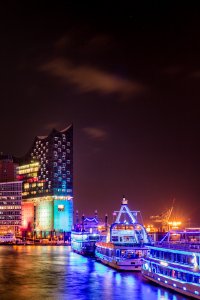
But I have one spot that never worked out for me so far, on all three occasions that I took pictures of it (See Attachment? First try on posting a picture, not sure if that works).

The bright blue LEDs on the boats are just so much stronger than anything around them, I always end up with patches of pure color on the water and the boats themselfes, where there is no detail. 10 seconds, ISO 200, f 7.1. This file is pushed by 1.4 Stops in LR, the highlightsslider is all the way down and the shadow slider slightly upped. There's already banding in the sky, but the edit isn't final anyway.

I'm just wondering about any workarounds for this. Blending isn't really an option, as the lights on the building changed their color rather quickly, and the reflections in the water did so too. Also, the boats are moving a little from the water, which would make regaining fine detail there through blending rather hard I think. Is this an image that basically "Can't be captured"? Or is the 6D2 dynamic range possibly enough for it? The 80D? I'm wondering about this. Maybe the artificial lightning itself is the problem, and not actually the dynamic range?

Just interested in it, since I read something along the lines of "You just need to expose properly" around here a few times. I'm not as good at taking pictures as I'd like, so: How to you expose something like this properly?
 

Attachments

  • _MG_5690-2.jpg
    _MG_5690-2.jpg
    4.1 MB · Views: 147
Upvote 0
I think that the Sony Cameras would struggle with that as well. I would suggest you check out the Magic Lanterns Dual ISO hack. Before you get to hung up on the DR discussion. There are simply times where no camera has enough DR. There are also times when you need to be at ISO 3200. Believe it at not most Canon Cameras have quite good DR at 3200. It is nearly always base ISO that people complain about.

Joules said:
Jack Douglas said:
Work-arounds can be simple but they require some skill/mental capability.
I've been paying a bit more attention to the DR of my current T3i to get a better grip on how much more I actually need (On the side of wanting, I'm unfortunately in he bragging group I fear). And with most of my shots, I found that even the 2 Stop push the T3i can handle at base ISO before showing that terrible banding pattern was mostly fine.

But I have one spot that never worked out for me so far, on all three occasions that I took pictures of it (See Attachment? First try on posting a picture, not sure if that works).

The bright blue LEDs on the boats are just so much stronger than anything around them, I always end up with patches of pure color on the water and the boats themselfes, where there is no detail. 10 seconds, ISO 200, f 7.1. This file is pushed by 1.4 Stops in LR, the highlightsslider is all the way down and the shadow slider slightly upped. There's already banding in the sky, but the edit isn't final anyway.

I'm just wondering about any workarounds for this. Blending isn't really an option, as the lights on the building changed their color rather quickly, and the reflections in the water did so too. Also, the boats are moving a little from the water, which would make regaining fine detail there through blending rather hard I think. Is this an image that basically "Can't be captured"? Or is the 6D2 dynamic range possibly enough for it? The 80D? I'm wondering about this. Maybe the artificial lightning itself is the problem, and not actually the dynamic range?

Just interested in it, since I read something along the lines of "You just need to expose properly" around here a few times. I'm not as good at taking pictures as I'd like, so: How to you expose something like this properly?
 
Upvote 0
Joules said:
Jack Douglas said:
Work-arounds can be simple but they require some skill/mental capability.
I've been paying a bit more attention to the DR of my current T3i to get a better grip on how much more I actually need (On the side of wanting, I'm unfortunately in he bragging group I fear). And with most of my shots, I found that even the 2 Stop push the T3i can handle at base ISO before showing that terrible banding pattern was mostly fine.

But I have one spot that never worked out for me so far, on all three occasions that I took pictures of it (See Attachment? First try on posting a picture, not sure if that works).

The bright blue LEDs on the boats are just so much stronger than anything around them, I always end up with patches of pure color on the water and the boats themselfes, where there is no detail. 10 seconds, ISO 200, f 7.1. This file is pushed by 1.4 Stops in LR, the highlightsslider is all the way down and the shadow slider slightly upped. There's already banding in the sky, but the edit isn't final anyway.

I'm just wondering about any workarounds for this. Blending isn't really an option, as the lights on the building changed their color rather quickly, and the reflections in the water did so too. Also, the boats are moving a little from the water, which would make regaining fine detail there through blending rather hard I think. Is this an image that basically "Can't be captured"? Or is the 6D2 dynamic range possibly enough for it? The 80D? I'm wondering about this. Maybe the artificial lightning itself is the problem, and not actually the dynamic range?

Just interested in it, since I read something along the lines of "You just need to expose properly" around here a few times. I'm not as good at taking pictures as I'd like, so: How to you expose something like this properly?

While artificial light sources can have a brightness close to the sun's brightness the night sky and the shadows of buildings are nearly without any light.
Here something about 20 stops of DR would be convenient to simulate our eyes which can handle this DR - just compare 1 000 Joule per second and square meter in the bright sun to 0.001 Joule per Second and square meter with a tiny LED lamp illuminating a room. EDIT: Forgotten to praise our built-in biological imaging system which can handle this extreme DR by different adaptation processes.

So it is not always about exposing correctly - sometimes our tools capabilities are limiting / matter.

I do not understand these war-like discussions about what DR is necessary - I (as scientist, here physicist) always enjoy to have the best data quality of an experiment. And each photograph is an experiment which has to be evaluated during post processing. So I enjoy more DR / less noise / precise ADCs and I hate sometimes the physics which limits the quality of the data taken intrinsically.

The "pure color problem" might be caused by LEDs which have narrow spectral distributions which might be inside the spectral windows of the R, B or G channels. Maybe it is a good idea to check the R-G-B histograms to see what happens - e.g. saturation in one or more color channels.
 
Upvote 0
Now here's an illustration of a "wonderful" photo being made even better! ;)

https://www.on1.com/promo/spring-into-summer/?utm_campaign=Spring-Summer&utm_source=RAW_Own&utm_content=email14_Blake&utm_medium=email

My comment was sarcasm. The sunflower photo came in my email from ON1 animated to show original and improved. This link is the video of the process. It struck me that it was a very poorly exposed photo to start with so I guess the idea was that an ON1 customer could be so poor at exposure but still be PP there photos.

Jack
 
Upvote 0
mb66energy said:
While artificial light sources can have a brightness close to the sun's brightness the night sky and the shadows of buildings are nearly without any light.
Here something about 20 stops of DR would be convenient to simulate our eyes which can handle this DR
So, in that case it's probably too much for any camera and it would be acceptable to want more DR if scenes like that were something I shot often. It's a shame then, that the boats are so strongly illuminated. The building with the colored lighting is Hamburg's Elbphilharmonie, the thing was so insanely expensive to build I had hoped it would get illuminated properly too. Why doesn't anybody think about the poor photographers :D

Good idea with the color channels as well. Sadly, I'm not quite as advanced with Photoshop yet, but it might be something that's worth playing around with. Thanks.

BTW, should someone think the image is fine, I generally agree. But when I showed a friend of mine a similar picture of the boats and building, just taken from a different angle and on another day, he asked me if the picture was "Photoshopped". When I asked him why he thought that, he pointed out that the blues looked so unnaturally solid, not like water should look like in his opinion. And he does have a point there, I think.

tcmatthews, good call with the magic lantern Dual ISO feature. I use ML on the T3i, but I only tried Dual ISO when it first came out and the processing wasn't fully developed. I had some artifacts back than, but I know it was improved later. I'll try that at times. Sadly, it's not an option for the 80D or 6DII I guess (i'm saving to upgrade to one of those, most likely), and the T3i falls apart above ISO 800 so that's what, 3 Stops extra DR?

EDIT: @Jack Douglas, is your link working? It brings me to my Google Mailbox, which doesn't seem right!?
 
Upvote 0
Blending will work out just fine as the rest of the frame will be simply black. There is that much difference in light levels between the lights and the rest of the frame :))
Take one shot exposed for your lights. Adjust exposure so the lights are exposed correctly, check your histogram / highlights blinkies or spot meter with a longer lens right on the lights. Take a shot, check the image on your LCD ( do not forget to set LCD brightness level to 3-4 instead of auto).
Trust me, the frame will be completely black with your lights nicely exposed.
Now take your long exposure, make sure the photo exposed correctly. Do not worry about blown lights. You will get them back in post easily.
One more suggestion if I may:the colour of that sodium vapour affected sky can be corrected too ;)
Happy shooting


Joules said:
Jack Douglas said:
Work-arounds can be simple but they require some skill/mental capability.
I've been paying a bit more attention to the DR of my current T3i to get a better grip on how much more I actually need (On the side of wanting, I'm unfortunately in he bragging group I fear). And with most of my shots, I found that even the 2 Stop push the T3i can handle at base ISO before showing that terrible banding pattern was mostly fine.

But I have one spot that never worked out for me so far, on all three occasions that I took pictures of it (See Attachment? First try on posting a picture, not sure if that works).

The bright blue LEDs on the boats are just so much stronger than anything around them, I always end up with patches of pure color on the water and the boats themselfes, where there is no detail. 10 seconds, ISO 200, f 7.1. This file is pushed by 1.4 Stops in LR, the highlightsslider is all the way down and the shadow slider slightly upped. There's already banding in the sky, but the edit isn't final anyway.

I'm just wondering about any workarounds for this. Blending isn't really an option, as the lights on the building changed their color rather quickly, and the reflections in the water did so too. Also, the boats are moving a little from the water, which would make regaining fine detail there through blending rather hard I think. Is this an image that basically "Can't be captured"? Or is the 6D2 dynamic range possibly enough for it? The 80D? I'm wondering about this. Maybe the artificial lightning itself is the problem, and not actually the dynamic range?

Just interested in it, since I read something along the lines of "You just need to expose properly" around here a few times. I'm not as good at taking pictures as I'd like, so: How to you expose something like this properly?
 
Upvote 0
Joules said:
mb66energy said:
While artificial light sources can have a brightness close to the sun's brightness the night sky and the shadows of buildings are nearly without any light.
Here something about 20 stops of DR would be convenient to simulate our eyes which can handle this DR
So, in that case it's probably too much for any camera and it would be acceptable to want more DR if scenes like that were something I shot often.

Good idea with the color channels as well. Sadly, I'm not quite as advanced with Photoshop yet, but it might be something that's worth playing around with. Thanks.

Don't fall for the "DR is not a problem" trap, if this is the kind of image you want to be taking you'd greatly benefit from more dynamic range. A crop camera such as the Nikon d7200 has 3 full stops of DR over the t3i, which is an whole lot of wiggle room in the shadows, and 2.5 more bits when it comes to color depth, which might help you have less solid color patches in the water - providing they're not there to the naked eye.

Other options are the Sony a6500 and to a lesser extend the 80d, though it'd do just fine.
 
Upvote 0
Cthulhu said:
Joules said:
mb66energy said:
While artificial light sources can have a brightness close to the sun's brightness the night sky and the shadows of buildings are nearly without any light.
Here something about 20 stops of DR would be convenient to simulate our eyes which can handle this DR
So, in that case it's probably too much for any camera and it would be acceptable to want more DR if scenes like that were something I shot often.

Good idea with the color channels as well. Sadly, I'm not quite as advanced with Photoshop yet, but it might be something that's worth playing around with. Thanks.

Don't fall for the "DR is not a problem" trap, if this is the kind of image you want to be taking you'd greatly benefit from more dynamic range. A crop camera such as the Nikon d7200 has 3 full stops of DR over the t3i, which is an whole lot of wiggle room in the shadows, and 2.5 more bits when it comes to color depth, which might help you have less solid color patches in the water - providing they're not there to the naked eye.

Other options are the Sony a6500 and to a lesser extend the 80d, though it'd do just fine.

Thank-you. :) Well put.
 
Upvote 0
scyrene said:
You've missed my point (but of course) - in many situations, an output image can be produced with a Canon camera that's the same as a Nikon, Sony, etc, but the technique differs - so instead of, e.g. shooting at ISO 100 and raising shadows five stops, you shoot at ISO 400 and pull the exposure down and maybe shadow lift 1-2 stops (ETTR). In many situations, you have highlight headroom* and ETTR means the shadows are cleaner. Neither technique is perfect; the Sony sensor allows for a bit more flexibility in some ways, I don't think that's in dispute. But it's possible to produce images that are equivalent with modern cameras from every manufacturer, if you know what you're doing (*and as an aside, as many here have pointed out, in most situations where there's too much DR for a single Canon exposure, there's likely to be too much for a Sony sensor too - the difference is only a stop and a bit at most either way isn't it?).

Or to put it another way, people like you only love shadow lifting and go on about it so much because it's what Canon is least good at, and you like to stir the pot. Most people just want to produce the best images they can, and that means learning how best to use their gear, whoever it's made by.

much of what you say is correct, I'm not going to argue that.

My point is that someone who's looking to push some creative boundaries with Canon files has to learn the technique to compensate for the particular shortcomings of that system.. Both in shooting and in post.
And, in a few situations, no matter what techniques you use, ABC will still deliver much better data to work with. i.e. no pattern noise.

DR is less limiting than the pattern noise problems inherent in so many Canon cameras.
The fact that these 2 are related does not put me on the DR bandwagon.
I'm blowing the horn on the anti-FPN float. :)
 
Upvote 0
Joules said:
I've been paying a bit more attention to the DR of my current T3i to get a better grip on how much more I actually need (On the side of wanting, I'm unfortunately in he bragging group I fear). And with most of my shots, I found that even the 2 Stop push the T3i can handle at base ISO before showing that terrible banding pattern was mostly fine.

And here's a good example of someone who'd trying to creat his image (which looks pretty nice as-is, BTW) and is finding pattern noise to be a problem in some areas.
ABC camera - no banding.
80D or 5d4 - no banding

Everything else you try to do is going to require some thinking and compromise.

The "just expose properly crowd" is just going to tell you their compromise.
 
Upvote 0
tcmatthews said:
I think that the Sony Cameras would struggle with that as well. I would suggest you check out the Magic Lanterns Dual ISO hack. Before you get to hung up on the DR discussion. There are simply times where no camera has enough DR. There are also times when you need to be at ISO 3200. Believe it at not most Canon Cameras have quite good DR at 3200. It is nearly always base ISO that people complain about.

Any camera will struggle with bright light and night photos.
difference is, when the artist is creating his image, which cameras are not going to put banding noise in there for them to deal with?

Good DR at iso 3200?!?
No. There isn't. you'll have less than 6 stops on a crop body. Certainly good enough for some images but you're going to clip a lot at both ends on a scene like the one above. Which is fine if clipped is what you want.
 
Upvote 0
Joules said:
So, in that case it's probably too much for any camera and it would be acceptable to want more DR if scenes like that were something I shot often. It's a shame then, that the boats are so strongly illuminated. The building with the colored lighting is Hamburg's Elbphilharmonie, the thing was so insanely expensive to build I had hoped it would get illuminated properly too. Why doesn't anybody think about the poor photographers :D

same problem in my home city with an iconic hotel so overlit it's nearly blown out at base ISO on the best DR camera in a night shot. Fortunately it doesn't move around so bracket and blend works for that. :)

consider cheap used ABC camera like Nikon D5x00?
 
Upvote 0
Mikehit said:
The only solution is to take the picture earlier in the evening when the sky still has some natural light and the range is not a large.
But yes, I do like the picture as it is.

another compromise

good advice when you can come back to the scene at your convenience... only.

but... what it the boats weren't even there until after twilight?
Or what if he wants a naturally black sky?
 
Upvote 0
@ Joules I corrected the link. It now takes you to the video of the not so great flower that gets worked on. Unfortunately, my sarcastic comment doesn't make as much sense as it would viewing what I got directly in my email (animated before/after) as opposed to the link when opened. Oh well.

Jack
 
Upvote 0
Joules said:
[...]

Good idea with the color channels as well. Sadly, I'm not quite as advanced with Photoshop yet, but it might be something that's worth playing around with. Thanks.

[...]

The histograms split into RGB channels is a feature of the 600D / T3i (i own the camera) and is available in image play back as one option accessible via the info button. The brightness histogram seems to be o.k. but sometimes one color channel is on his limits.

Elbphilharmonie and lighting: Maybe the building of it ate up all the money which was reserved for some better lighting or it is not allowed due to environmental laws - it would waste energy :)
 
Upvote 0
SecureGSM said:
Blending will work out just fine as the rest of the frame will be simply black. There is that much difference in light levels between the lights and the rest of the frame :))

[...]
One more suggestion if I may:the colour of that sodium vapour affected sky can be corrected too ;)
We'll see about that, I'm not sure... Like I said, the lights on the building cycled through all the colors of the rainbow in a good speed, so no two exporsures would be lit the same. I actually have three different brightness levels that come pretty close though. I'll try blending them once I find the time. But as one exposure is really short, it has way more detail in the reflections in the water than the other two longer exposures, which have that almost silky water. And the boats shake in the water slightly ... Although that might be fine as I was pretty far away from them this time.

Well, doesn't seem so easily for me right now, but I'll try.

The night sky is supposed to be blue too, right? Hard to tell there, the opposing waterfront is crowded with the citys industrial and harbour buildings, which for some reason are all lit up in that boring yellow light... The clouds look yellow from that too, so much even that I can see the location of the harbour from my home just by looking into the night sky.

[quote author=mb66energy]
The histograms split into RGB channels is a feature of the 600D / T3i (i own the camera) and is available in image play back as one option accessible via the info button. The brightness histogram seems to be o.k. but sometimes one color channel is on his limits.

Elbphilharmonie and lighting: Maybe the building of it ate up all the money which was reserved for some better lighting or it is not allowed due to environmental laws - it would waste energy :)
[/quote]
Hm, true. That's quite a good idea, I always just have it set to luminance as I find it less distracting and easier to read. But it might help a lot with getting these boats under control if I head back there again.

I think it's just lit to look good for the eye, not for the camera. After all, with it having cost almost 800 Million € to build and swallowing millions of € to operate per year, it really doesn't seem to matter anymore how much money is thrown at that thing ::) Besides, it's just a few minute walk from there to building that's seemingly a gift just for photographers: https://500px.com/photo/177330507/canal-castle-by-julius?ctx_page=1&from=user&user_id=18747037

Whenever I go there I find at least two other ILC owners and a bunch of tourists with their smartphones.

[quote author=Aglet]
good advice when you can come back to the scene at your convenience... only.

but... what it the boats weren't even there until after twilight?
Or what if he wants a naturally black sky?
[/quote]
Well, I can go back there, but now the lights on the building aren't there anymore. They just go on for special occasions, such as the homosexual pride parade that was this weekend in Hamburg. And spent the time around sunset at the Wasserschloss (See link above), so that's why it was so dark. Can't be everywhere at once. Besides I wonder if the colors would come of so strongly if it hadn't been so late. Well, I'll won't find out I guess.

Well, thanks for the input. If I get my hands on some better bodies to try them out I#ll make sure to check the boats and see what i can do with them. It's certainly the most extreme lighting condition that I'd actually shoot, even if not very often.
 
Upvote 0
No, nigth skies not supposed to be blue. Do not get sarcastic. The "yellow light" can and needs to be dealt with. This is typical sodium Vapour street lighting that kills everything. It is easy to correct in post. You need to pay attention though.

Joules said:
SecureGSM said:
Blending will work out just fine as the rest of the frame will be simply black. There is that much difference in light levels between the lights and the rest of the frame :))

[...]
One more suggestion if I may:the colour of that sodium vapour affected sky can be corrected too ;)
We'll see about that, I'm not sure... Like I said, the lights on the building cycled through all the colors of the rainbow in a good speed, so no two exporsures would be lit the same. I actually have three different brightness levels that come pretty close though. I'll try blending them once I find the time. But as one exposure is really short, it has way more detail in the reflections in the water than the other two longer exposures, which have that almost silky water. And the boats shake in the water slightly ... Although that might be fine as I was pretty far away from them this time.

Well, doesn't seem so easily for me right now, but I'll try.

The night sky is supposed to be blue too, right? Hard to tell there, the opposing waterfront is crowded with the citys industrial and harbour buildings, which for some reason are all lit up in that boring yellow light... The clouds look yellow from that too, so much even that I can see the location of the harbour from my home just by looking into the night sky.

[quote author=mb66energy]
The histograms split into RGB channels is a feature of the 600D / T3i (i own the camera) and is available in image play back as one option accessible via the info button. The brightness histogram seems to be o.k. but sometimes one color channel is on his limits.

Elbphilharmonie and lighting: Maybe the building of it ate up all the money which was reserved for some better lighting or it is not allowed due to environmental laws - it would waste energy :)
Hm, true. That's quite a good idea, I always just have it set to luminance as I find it less distracting and easier to read. But it might help a lot with getting these boats under control if I head back there again.

I think it's just lit to look good for the eye, not for the camera. After all, with it having cost almost 800 Million € to build and swallowing millions of € to operate per year, it really doesn't seem to matter anymore how much money is thrown at that thing ::) Besides, it's just a few minute walk from there to building that's seemingly a gift just for photographers: https://500px.com/photo/177330507/canal-castle-by-julius?ctx_page=1&from=user&user_id=18747037

Whenever I go there I find at least two other ILC owners and a bunch of tourists with their smartphones.

[quote author=Aglet]
good advice when you can come back to the scene at your convenience... only.

but... what it the boats weren't even there until after twilight?
Or what if he wants a naturally black sky?
[/quote]
Well, I can go back there, but now the lights on the building aren't there anymore. They just go on for special occasions, such as the homosexual pride parade that was this weekend in Hamburg. And spent the time around sunset at the Wasserschloss (See link above), so that's why it was so dark. Can't be everywhere at once. Besides I wonder if the colors would come of so strongly if it hadn't been so late. Well, I'll won't find out I guess.

Well, thanks for the input. If I get my hands on some better bodies to try them out I#ll make sure to check the boats and see what i can do with them. It's certainly the most extreme lighting condition that I'd actually shoot, even if not very often.
[/quote]
 
Upvote 0