
Why are so many people confused about the focal length(s) of APS-C lenses? For example, I have the Canon 18-135mm APS-C lens. For some reason, people think that you have to multiply it by 1.6 for the "correct" focal lengths of 29-216mm. The conversion factor does not apply to APS-C-only lenses. If an APS-C-only lens says its 18-135mm, then it is 18-135mm. If an APS-C-only lens says its 57mm, then its 57mm. Even B&H, in the product description, makes the error by saying its equivalent to 29-216mm.
You are using an out of date browser. It may not display this or other websites correctly.
You should upgrade or use an alternative browser.
You should upgrade or use an alternative browser.
APS-C lens mm are correct
- Thread starter Tristan944
- Start date
- Status
- Not open for further replies.
That isn't true.
if you want to have the same field of view with a crop and a FF and your using your ef-s lens at 18mm you'll have to put an 28,8 lens on the FF for the same picture.
and a FF 18mm will give you the same field of view on your crop as an ef-s 18mm lens will.
I shoot with an 7d and have ef-s and FF lenses
if you want to have the same field of view with a crop and a FF and your using your ef-s lens at 18mm you'll have to put an 28,8 lens on the FF for the same picture.
and a FF 18mm will give you the same field of view on your crop as an ef-s 18mm lens will.
I shoot with an 7d and have ef-s and FF lenses
Upvote
0
You are both completely correct, and completely wrong. Focal length is focal length is focal length (except 18mm is usually an estimation on what may really be 17.4 or 18.8, etc). 18mm is 18mm for the lens. So you are correct that the 18-135 is 18mm and 135mm just like the 24-105 is 24mm and 105mm.Tristan944 said:The conversion factor does not apply to APS-C-only lenses. If an APS-C-only lens says its 18-135mm, then it is 18-135mm. If an APS-C-only lens says its 57mm, then its 57mm. Even B&H, in the product description, makes the error by saying its equivalent to 29-216mm.
Where you are wrong is that all lenses have their apparent focal length impacted by the crop factor of the camera. So, any lens (even EF-S) that you put onto an APS-C body will be multiplied by 1.6. Any lens you put on a 4/3 camera will be multiplied by 2x, and so on. The EF-S stands for small image circle, meaning the lens is designed to only work for an APS-C field of view without vignetting, which allows them to make it smaller and lighter.
Canon itself confirms this in discussing the EF-S 18-55: http://www.canon.com/camera-museum/tech/report/200401/200401.html
Wide zoom range (eqv. to 29-88mm in 135-format)
To design a lens that would appear to be 18mm on an APS-C camera, you would have to create an 11mm lens. Thus why all the EF-S designs tend to mimic the popular EF focal lengths (55-250 mimics 100-400, 10-22 mimics 16-35, 17-55 mimics 24-70 or 24-105, and so on)
Upvote
0
You are confusing it like other people do. You saying what the focal range would be if the 18-135mm lens were put on a full frame body. But here is your error, you can't put APS-C-only lenses on a full frame body. The 18-135mm CANNOT be attached to a full frame body like the Canon 5D. It can only be put on a APS-C body. Therefore, calculating the crop factor of what it "would" be on a full frame body is irrelevant. The only thing that matters on an APS-C-only lens is the stated focal range, in this instance, the 18-135mm. The focal range for this lens will never need to be recalculated for a full frame camera, because you cant even mount it on a full frame camera. Thats why so many people get confused and automatically multiply it by 1.6. Its 18-135mm, thats it.
Consider this scenario. The view and angle through the viewfinders for the following two scenarios will be identical:
Canon 7D with the 18-135mm zoomed to 18mm.
Canon 5D with an 18mm Full Frame only lens.
If you had no idea what camera I handed you, and gave you these two configurations, the image through the viewfinder would be identical and you wouldn't know which configuration I gave you. The 7D with the 18-135mm at 18mm will not be more "zoomed" in at "29mm". If the lens is at 18mm, then its at 18mm. If its at 135mm, its at 135mm.
The only time this changes is when a lens that is compatible with full frame cameras is put on an APS-C body. Then you multiply the focal length(s) by 1.6.
Consider this scenario. The view and angle through the viewfinders for the following two scenarios will be identical:
Canon 7D with the 18-135mm zoomed to 18mm.
Canon 5D with an 18mm Full Frame only lens.
If you had no idea what camera I handed you, and gave you these two configurations, the image through the viewfinder would be identical and you wouldn't know which configuration I gave you. The 7D with the 18-135mm at 18mm will not be more "zoomed" in at "29mm". If the lens is at 18mm, then its at 18mm. If its at 135mm, its at 135mm.
The only time this changes is when a lens that is compatible with full frame cameras is put on an APS-C body. Then you multiply the focal length(s) by 1.6.
Upvote
0
Tristan944 said:Consider this scenario. The view and angle through the viewfinders for the following two scenarios will be identical:
Canon 7D with the 18-135mm zoomed to 18mm.
Canon 5D with an 18mm Full Frame only lens.
Sorry, that is 100% wrong.
Upvote
0
L
Loswr
Guest
Tristan944 said:Consider this scenario. The view and angle through the viewfinders for the following two scenarios will be identical:
Canon 7D with the 18-135mm zoomed to 18mm.
Canon 5D with an 18mm Full Frame only lens.
If you had no idea what camera I handed you, and gave you these two configurations, the image through the viewfinder would be identical and you wouldn't know which configuration I gave you.
100% WRONG.
In that scenario (EF-S lens at 18mm on APS-C vs. EF lens at 18mm on FF), the FF viewfinder (and captured image) would show a much wider angle of view.
If you are at 18mm on APS-C and 29mm on FF, then what you see in the VF will be the same.
Upvote
0
Actually, that's also not true (this example is APS-H): http://www.flickr.com/groups/canondslr/discuss/72157604422834954Tristan944 said:You are confusing it like other people do. You saying what the focal range would be if the 18-135mm lens were put on a full frame body.
The reason you wouldn't traditionally use EF-S lenses is two-fold. One, they are lower quality than their full-frame equivalents, and often a similar price (17-55 and 24-105 are close, 10-22 and 17-40 are close, etc). And, because the EF-S lenses aren't designed to cover the full-frame or APS-H image circle. So using them at their widest settings will create severe vignetting (a literal black circle) and may cause them to hit the mirror. But, it's doable. You can use a 10-22 at about 15-16mm, much like you can use the Tokina 11-16 at about 15-16mm on Full-Frame. You can use them at about 12-13mm on APS-H. The crop factor applies in all cases, of course. The below example is the 10-22 on full-frame, APS-H, and APS-C by image box. Remember that images get sharper when you use the center of the glass. So you can see why APS-C use of the 10-22 would be good (no vignetting, not using extreme corners) and full-frame would be awful (unless you like circle mattes)

So, I could use an EF-S lens on full-frame if I wanted to; but I like my photos to not be mostly black
Upvote
0
L
Loswr
Guest
Focal length is an intrinsic property of the lens, regardless of the sensor at the image plane. Focal length is the distance from the rear nodal point (an optical point that may or may not be within the physical space of the lens) and the image plane. An APS-C sensor samples a smaller portion of the image circle, so it will give a narrower AoV than a FF sensor. EF-S lenses project a smaller image circle, sufficient for APS-C but insufficient for FF - but that doesn't change their focal length.
Not exactly. They are better if you are talking about using all of them on the same APS-C body. But if you compare the EF-S lens on APS-C to the L lens on FF, the latter will deliver better overall IQ (although worse in some measures, especially distortion).
tnargs said:preppyak, the 17-55 and 10-22 are at least as good and probably better than 24-105 and 17-40 in terms of IQ. EF-S rules!
Not exactly. They are better if you are talking about using all of them on the same APS-C body. But if you compare the EF-S lens on APS-C to the L lens on FF, the latter will deliver better overall IQ (although worse in some measures, especially distortion).
Upvote
0
I'm assuming I own a 5d mark II in this scenario, in which case, the 10-22 and 17-55 would probably not be better for my purposes in terms of sharpness/vignetting/being a pain in the a** to deal withtnargs said:preppyak, the 17-55 and 10-22 are at least as good and probably better than 24-105 and 17-40 in terms of IQ. EF-S rules
There we go, that's an even better way to state itneuroanatomist said:Focal length is an intrinsic property of the lens, regardless of the sensor at the image plane.
Upvote
0
I've done it myself. I took a picture with the following configuration and the pictures were identical.
Canon 7d with 18-135mm lens at 35mm.
Canon Rebel (film, so full frame) with 35-80mm lens at 35mm.
Why did the picture turn out the exact same? Because the 18-135mm at 35mm is at 35mm on my 7D. Since this is an APS-C only lens, the stated focal length is correct. It was not "zoomed" in to 56mm. The picture was IDENTICAL to the Canon film Rebel at 35mm.
Do it yourself and be amazed.
Get an APS-C-only lens and sent it to XYmm on a crop body. Then, get a EF lens and set it to the same XYmm on a full frame body and the two images will be the same. (I understand that the image will be different if an EF lens at the same focal length will be different when put on an APS-C body). Trust me, do exactly what I said and you will see that I am correct.
Do it right now and report back.
Canon 7d with 18-135mm lens at 35mm.
Canon Rebel (film, so full frame) with 35-80mm lens at 35mm.
Why did the picture turn out the exact same? Because the 18-135mm at 35mm is at 35mm on my 7D. Since this is an APS-C only lens, the stated focal length is correct. It was not "zoomed" in to 56mm. The picture was IDENTICAL to the Canon film Rebel at 35mm.
Do it yourself and be amazed.
Get an APS-C-only lens and sent it to XYmm on a crop body. Then, get a EF lens and set it to the same XYmm on a full frame body and the two images will be the same. (I understand that the image will be different if an EF lens at the same focal length will be different when put on an APS-C body). Trust me, do exactly what I said and you will see that I am correct.
Do it right now and report back.
Upvote
0
Also, think about this. If the 18-135mm lens is really 29-216mm, why didnt they just call it that? Remember, this lens will never be put on a full frame body, so the 1.6 crop factor is non-existent.
The only way you will see what I am talking about is if you do a crop body and full frame comparison. Put an EF-S lens on a crop body and a EF lens on a full frame at the same focal length as indicated on the lens, such as at 18mm and 18mm, or 50mm and 50mm, and the images will be the same.
The only way you will see what I am talking about is if you do a crop body and full frame comparison. Put an EF-S lens on a crop body and a EF lens on a full frame at the same focal length as indicated on the lens, such as at 18mm and 18mm, or 50mm and 50mm, and the images will be the same.
Upvote
0
Tristan944 said:I've done it myself. I took a picture with the following configuration and the pictures were identical.
Canon 7d with 18-135mm lens at 35mm.
Canon Rebel (film, so full frame) with 35-80mm lens at 35mm.
Why did the picture turn out the exact same? Because the 18-135mm at 35mm is at 35mm on my 7D. Since this is an APS-C only lens, the stated focal length is correct. It was not "zoomed" in to 56mm. The picture was IDENTICAL to the Canon film Rebel at 35mm.
Do it yourself and be amazed.
Get an APS-C-only lens and sent it to XYmm on a crop body. Then, get a EF lens and set it to the same XYmm on a full frame body and the two images will be the same. (I understand that the image will be different if an EF lens at the same focal length will be different when put on an APS-C body). Trust me, do exactly what I said and you will see that I am correct.
Do it right now and report back.
I don't know what to say, but you're the only person who's experiencing this. Everything everyone else is writing is both consistent and correct (even if there are arguments over semantics relating to focal length not being an absolute measure of field of view).
I had a 17-55mm on my t2i and a 17-40mm on my 5D III. Used both very frequently at 17mm.
One of them was a lot wider.
I'm sorry to be so blunt, but you're wrong. "Equivalent" doesn't mean the focal lengths are mis-marked and 35mm on the EF-S lens is the same as 35mm on the EF lens exactly; what equivalent means is it's the equivalent field of view in terms of what 135 film or a FF sensor would see.
If this were true, the 10-22mm would be the widest Canon lens available for any dSLR. But the 14mm f2.8 is wider on FF than the 10mm is on a crop body.
All focal length means is the distance from the focal plane at which the lens's optical center focuses at infinity. That distance and the size of the sensor determines the field of view.
Upvote
0
C
ChilledXpress
Guest
Tristan944 said:I've done it myself. I took a picture with the following configuration and the pictures were identical.
Canon 7d with 18-135mm lens at 35mm.
Canon Rebel (film, so full frame) with 35-80mm lens at 35mm.
Why did the picture turn out the exact same? Because the 18-135mm at 35mm is at 35mm on my 7D. Since this is an APS-C only lens, the stated focal length is correct. It was not "zoomed" in to 56mm. The picture was IDENTICAL to the Canon film Rebel at 35mm.
Do it yourself and be amazed.
Get an APS-C-only lens and sent it to XYmm on a crop body. Then, get a EF lens and set it to the same XYmm on a full frame body and the two images will be the same. (I understand that the image will be different if an EF lens at the same focal length will be different when put on an APS-C body). Trust me, do exactly what I said and you will see that I am correct.
Do it right now and report back.
Wrong !!! You did it with a fakey camera then... I own both crops and FF and the do not behave this way. Yes, the are real cameras... XS, 7D, 5D2 and 5D3.
Upvote
0
R
rj79in
Guest
Tristan944 said:Also, think about this. If the 18-135mm lens is really 29-216mm, why didnt they just call it that? Remember, this lens will never be put on a full frame body, so the 1.6 crop factor is non-existent.
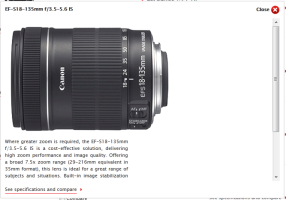
Canon does just that ... Downloaded the screenshot from Canon's website regarding the 18-135 lens. It specifically mentions that the zoom range will be 29-216 in FF equivalent.
If what you were saying was correct then 10mm on a 10-22 would be 10mm right? Try shooting at 10mm and you would know what everyone is talking about.
Attachments
Upvote
0

you might want to check and see that your settings were correct, because its more than possible, that you may have overlooked what you had set it to, and in amazement rushed to the forums with a new discovery.
That.. or you saying something you know not to be true and get excited by the responses, maybe?
That.. or you saying something you know not to be true and get excited by the responses, maybe?
Upvote
0
P
PackLight
Guest
Tristan944 said:Do it right now and report back.
No sorry didn't work. The FF body had image showed slightly over 2.5x the total area of the target I was using.
Rather than just telling you that you are wrong.
If need to figure out why there is a discrepancy in sizes this is it.
A Full Frame sensor is 24x36mm
A lens no matter what length focuses approximately the same size on either the FF or Crop Sensor
The 7D's sensor is 14.9x22.3 mm. The focused image being the same size the 7D only covers a smaller portion of the image. The FF sensor is 1.6x taller and 1.6 times wider so it only senses a smaller area of the focused light circle.
EF-S lenses and EF lenses for the most part an 18mm lens is an 18mm lens regardless. (less manufacturing discrepancies).
The relationship has nothing to do with the length of lenses. It is only a comparison of sensor size and FOV comparisons between a Full Frame and Crop sensor with equal length lenses.
Upvote
0
If I'm wrong I'll be the first to admit it, I'm not a proud person. I will check it again right now and see if I had done it incorrectly.
But why doesn't Canon print on the lens itself 29-216mm? The 18-135mm printing is misleading then.
But why doesn't Canon print on the lens itself 29-216mm? The 18-135mm printing is misleading then.
Upvote
0
P
PackLight
Guest
Tristan944 said:If I'm wrong I'll be the first to admit it, I'm not a proud person. I will check it again right now and see if I had done it incorrectly.
But why doesn't Canon print on the lens itself 29-216mm? The 18-135mm printing is misleading then.
Because it is only a relationship that they are showing. It is salesmanship to make you think you are getting 1.6 times as much of something.
Upvote
0
Because the lens IS 18-135 in focal length. 24mm on the 18-135 is the same as 24mm on the 24-105 when mounted on the same camera...because focal length doesn't rely on the sensor at all. But, focal length is just one part of the equation; the other being the sensor. A larger sensor leads to a wider field of view (and thus what seems to be a "longer" focal length on APS-C cameras).Tristan944 said:But why doesn't Canon print on the lens itself 29-216mm? The 18-135mm printing is misleading then.
APS-H has a 1.3x crop factor
Nikon APS-C has a 1.5x crop
Canon APS-C has 1.6x crop
4/3rd has a 2x crop
...the list goes on. Imagine how incredibly confusing it would be trying to mount an old Nikon 28mm AI lens onto a Canon APS-C body if that 28mm was just a marketing name for what the lens appeared to be on Nikon crop camera (this is the equivalen of Canon printing 29-216 on the lens). I'd have to divide by 1.5 and multiply by 1.6 to get what it would be, which is insanely confusing. The same would be true of people usign old Canon FD lenses on 4/3rds cameras (divide by 1.6, multiply by 2...it gets silly) But, since focal length is a fixed property regardless of sensor, they print that, because its standardized.
Upvote
0
- Status
- Not open for further replies.
Similar threads

- Replies
- 4
- Views
- 2K

- Replies
- 32
- Views
- 8K

- Replies
- 122
- Views
- 22K
