
You are using an out of date browser. It may not display this or other websites correctly.
You should upgrade or use an alternative browser.
You should upgrade or use an alternative browser.
Are Metal Mounts Better Than Plastic?
- Thread starter Canon Rumors
- Start date


While I agree with you, I note that the article was provoked by the current furor over the Olympus lens that has a metal bayonet mounted on a plastic base like most lenses ( as Roger notes) and that THAT revelation of the use of plastic in a critical part is sparking the rage on the nets.neuroanatomist said:I think Rogers's definition of a plastic vs. a metal mount differs from how most people think about those terms. For most of us, we're talking about the bayonet parts - the 'teeth' that lock into the mount on the camera.

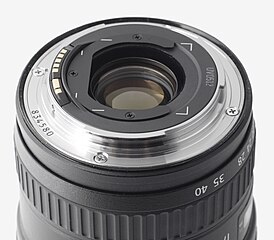
The EF-S 18-55 on the left has a 'plastic mount', the EF 17-40L on the right has a 'metal mount'. Very few of us disassemble lenses, so we have no idea what's behind that mount surface. Roger is talking about how the screws that that attach that visible surface piece to the lens are connected - do those screws go into metal screw-holes that are attached to the frame of the lens, or are the screw-holes plastic?
'Plastic' can be quite strong, so for a 'light' lens (most lenses under 100mm, with the exception of the 'magic cannonball' 85L), I agree with Roger that I wouldn't expect any issues, and 'professional' could apply. However, for the bayonet 'teeth' of the mount, plastic wears down more easily than metal (vs. the screw-holes, which aren't subjected to routine 'wear'). That means a lens with a plastic mount (as I'd say is the common definition pictured above, not Rogers's use of the term), would be able to tolerate fewer mount/unmount cycles than a lens with metal bayonet teeth. Since a professional lens would be expected to last years and most 'pros' own several lenses and change them frequently, it makes sense to associate a metal mount (as pictured above, regardless of how it's screwed in) with 'professional' build.
Weather proofing is another area where I have rolled my eyes for years. The most vulnerable part of the photographic assembly is the front element and other than using a Nikonos I see no protection of consequence offered by the claims of weather resistance.
Upvote
0

And this is one reason why I don't like how most reviewers evaluate "build quality." They evaluate the feel of the materials of the parts they can see, which is a mistake. Think of cheap faucets with nice finishes but plastic gears. The same thing happens with lenses. Having a metal outer barrel is not indicative of the materials used for the inner assemblies that often matter more...
Upvote
0
Lee Jay said:neuroanatomist said:I think Rogers's definition of a plastic vs. a metal mount differs from how most people think about those terms. For most of us, we're talking about the bayonet parts - the 'teeth' that lock into the mount on the camera.
Correct.
I second that. I think Roger Cicala is surely someone who know a lot about lenses, but in this case I think he got the crowd wrong. I would never think of something the screw mounts in, when I hear of "plastic mounts". I guess they were all talking about the plastic rear-element which fits into the bayonett. Sorry, Roger, lot of verbiage for nothing... you thought too loud.
Upvote
0
It's all about sample size. My experience, with a lens that I use maybe 4 times times a year, even 20 busy pros experience with that lens using it every day, are statistically meaningless compared to a huge rental organization's repair data on that lens.
Upvote
0

neuroanatomist said:I think Rogers's definition of a plastic vs. a metal mount differs from how most people think about those terms. For most of us, we're talking about the bayonet parts - the 'teeth' that lock into the mount on the camera.
The EF-S 18-55 on the left has a 'plastic mount', the EF 17-40L on the right has a 'metal mount'. Very few of us disassemble lenses, so we have no idea what's behind that mount surface. Roger is talking about how the screws that that attach that visible surface piece to the lens are connected - do those screws go into metal screw-holes that are attached to the frame of the lens, or are the screw-holes plastic?
'Plastic' can be quite strong, so for a 'light' lens (most lenses under 100mm, with the exception of the 'magic cannonball' 85L), I agree with Roger that I wouldn't expect any issues, and 'professional' could apply. However, for the bayonet 'teeth' of the mount, plastic wears down more easily than metal (vs. the screw-holes, which aren't subjected to routine 'wear'). That means a lens with a plastic mount (as I'd say is the common definition pictured above, not Rogers's use of the term), would be able to tolerate fewer mount/unmount cycles than a lens with metal bayonet teeth. Since a professional lens would be expected to last years and most 'pros' own several lenses and change them frequently, it makes sense to associate a metal mount (as pictured above, regardless of how it's screwed in) with 'professional' build.
Exactly! It's the wear and tear over time mounting and dismounting that I was thinking of also. I have seen lenses tried mounted a bit tilted and a piece of plastic has broken off. I also seen a few 50mm f1.8 and the Nikon 18-105 split apart on the middle of the barrel. I have also tried to kill a lightweight 17-85 with brutal force without success, if it was a heavy lens it would have exploded.
Weather sealing is always a funny term, but I have used my gear in VERY heavy rain without issue and once took my 85 L, which isn't sealed, into light rain and it fogged up right away, so there is something to it.
The truth hurts and I love these mythbusting articles from Roger, great read!
Upvote
0
Not surprised by any of it at all. (although I think he uses the term metal mount differently than most people, that said, he does bring up anchoring which many probably don't think to think of)
Upvote
0
Random Orbits said:And this is one reason why I don't like how most reviewers evaluate "build quality." They evaluate the feel of the materials of the parts they can see, which is a mistake. Think of cheap faucets with nice finishes but plastic gears. The same thing happens with lenses. Having a metal outer barrel is not indicative of the materials used for the inner assemblies that often matter more...
OTOH, you seem to have missed the part where the materials for the inner anchors being metal actually might be worse than from plastic.
Upvote
0

Great article. I worry about 3 things with my lenses.
1. fungus. I live in a very humid environment
2. Will the IS element fail?
3. Will he AF element fail?
1. fungus. I live in a very humid environment
2. Will the IS element fail?
3. Will he AF element fail?
Upvote
0

mrsfotografie said:'Carbon fibre' is in fact a composite; there are carbon fibers in an epoxy resin-type matrix. The Epoxy is a 'plastic' so it is in fact reinforced plastic. The principle is the same as reinforced concrete, where the concrete carries the compression, and the steel the tension.
The devil is in the details. those fibers don't always lineup so that they reinforce the part in the right axis. It takes a lot of experience with making molds, superb process control, and frequent checking to make sure the fibers are doing any good. I had a plastic bayonet lens from Canon where the bayonet flanges broke away.
Canon, like many other companies is out sourcing more and more parts, and having problems as a result.
Upvote
0

Obviously there is glass in the lenses, plastic-coated wires, rubber on the focus rings, etc...DUUUUUH...but like Roger says..Zeiss uses metal throughout the Lens. Zeiss could make that claim in their literature..in this instance, it is dishonest for Olympus to make that claim.fugu82 said:Wouldn't "all metallic construction" be kinda hard to see through? And those all metallic circuit boards would be tricky to engineer.
Upvote
0

Daniel Flather said:Look at the mount on the body, it's metal, but what is it attached to?
Umm, I think you have supplied your own awnser. The Body. ;D
On my 1Dx that's made of magnesium BTW. But of course its weather sealed and Profesional quality. ;D
I think your making a perfectly valid point, just couldn't resist the silly reply.
Upvote
0

The fibers in carbon fiber components are usually from a cloth so alignment is easy.... It's sort of like with fiberglass.you could lay up fiberglass cloth in a mold or you could use "chop glass", where short fibers were blown in place.... The chop layup is faster and cheaper, but the laid up cloth is both lighter and stronger.Mt Spokane Photography said:mrsfotografie said:'Carbon fibre' is in fact a composite; there are carbon fibers in an epoxy resin-type matrix. The Epoxy is a 'plastic' so it is in fact reinforced plastic. The principle is the same as reinforced concrete, where the concrete carries the compression, and the steel the tension.
The devil is in the details. those fibers don't always lineup so that they reinforce the part in the right axis. It takes a lot of experience with making molds, superb process control, and frequent checking to make sure the fibers are doing any good. I had a plastic bayonet lens from Canon where the bayonet flanges broke away.
Canon, like many other companies is out sourcing more and more parts, and having problems as a result.
BTW, we use carbon-fibre dishes in aircraft and on the satellites..... They are far better than metal dishes, particularly with thermal stability and weight.
Upvote
0
I think that most people will mean the bayonets when they refer to "mounts". It may be that Roger knows better. Maybe people complain when the "mounts" break and from Rogers experience it's what he calls the mount that breaks rather than the bayonet.
On the subject of plastic mounts. Be they bayonets or what the bayonet mounts on. Many will be made of a filled plastic. That filler may be glass, carbon, ceamic or inert filler as there are several options. It can be in the form of fibers, beads or powder as well as the obvious options of woven material that you probably wouldn't expect in a bayonet, but might well find in a mount as defined by Roger.
There are also several options for the matrix as well. Epoxy is not the most likely for this type of application.
The obvious problem with bayonet mounts for lenses is wear. As the lens is mounted and removed it may well be subject to abrasion. If it wears and the filler is exposed it can create a very abrasive paste or dust that may wear even more, and get in the camera. Thus causing even more wear.
Please don't think I don't like plastic, I'd quite happily buy a lens with "plastic" bayonets. But I wouldn't expect to see them on my 200-400 when I get it. (in my dreams)
On the subject of plastic mounts. Be they bayonets or what the bayonet mounts on. Many will be made of a filled plastic. That filler may be glass, carbon, ceamic or inert filler as there are several options. It can be in the form of fibers, beads or powder as well as the obvious options of woven material that you probably wouldn't expect in a bayonet, but might well find in a mount as defined by Roger.
There are also several options for the matrix as well. Epoxy is not the most likely for this type of application.
The obvious problem with bayonet mounts for lenses is wear. As the lens is mounted and removed it may well be subject to abrasion. If it wears and the filler is exposed it can create a very abrasive paste or dust that may wear even more, and get in the camera. Thus causing even more wear.
Please don't think I don't like plastic, I'd quite happily buy a lens with "plastic" bayonets. But I wouldn't expect to see them on my 200-400 when I get it. (in my dreams)
Upvote
0
Don Haines said:The fibers in carbon fiber components are usually from a cloth so alignment is easy.... It's sort of like with fiberglass.you could lay up fiberglass cloth in a mold or you could use "chop glass", where short fibers were blown in place.... The chop layup is faster and cheaper, but the laid up cloth is both lighter and stronger.
BTW, we use carbon-fibre dishes in aircraft and on the satellites..... They are far better than metal dishes, particularly with thermal stability and weight.
You won't find may bits in a mass production lens made that way.
Edited to correct typo.
Upvote
0
Eagle Eye said:I previously owned the 24-70 f/2.8L. I could have sworn it had a metal mount. Am I crazy?
nope your thinking of the bayonet part Roger is referring to the internal mount which you cannot see unless you take the bayonet off
Upvote
0

infared said:Three of the four screws sheared.
Doesn't sound like a plastics issue, interesting that the weakest link would seem to be the screws under a shearing force. You could argue that's good design!
Upvote
0
Similar threads


- Replies
- 3
- Views
- 6K


- Replies
- 21
- Views
- 13K

- Replies
- 37
- Views
- 22K