Are These The EOS 7D Mark II Specifications?

Lee Jay said:
I have many, actually, it's just that they were controlled tests, rather than uncontrolled tests. You see, to science folks like myself, uncontrolled tests are useless.

More detail, yes. Just not as much extra detail as you'd expect from the difference in pixel density, even in controlled testing.

http://www.canonrumors.com/forum/index.php?topic=22399.0
 
Upvote 0
xps said:
Woody said:
whothafunk said:
all you people see is that it supposedly has 20MP.

People are disappointed if it's the same 20 MP sensor from 70D.

If it's a 20 MP sensor based on EXMOR or better technology, I am sure you won't find so many pages of rant.

Sometimes it is impossible to rise the MP count without changing the Layout of your chips. So, IMO, I could believe the rumors, that a rise in MPs to 24MP or more would afford an change in the manufacturing process - as we know from the computerindustry, where each 1-2 years an new manufacturing process needs to renew nearly the whole fabrication hardware.
The rumor was, that Canon is retaining to change their manufacturing hardware to maximise their profit.
Actually....
To maximize their profit they would shift all FF and APS-C sensors over to the 180nM line and completely shut down the 500nM line... I suspect the 70D is already there.... I suspect 7D2 and the rest of the APC-C line to soon follow....
 
Upvote 0
Don Haines said:
neuroanatomist said:
Lee Jay said:
Most everything I shoot is moving - fast. How would you suggest I shoot identical shots with two cameras of the same subject?

Auto racing, standing at a turn with cars coming toward you. 500 chances to shoot the same car going around the track... ;)
duct tape a stuffed animal to a ceiling fan?

Just had my wisdom teeth out and you made me laugh. I'll get you for that.. ::) And LOL at "big whites" for socks.
 
Upvote 0
Lawliet said:
privatebydesign said:
If you have shots that make it "crazy clear" you are not testing what I am asking.

To get the results you want you have to approach the issue in about the most ham-fisted way possible. That's not evaluating the gear, but manhandling it - not exactly the best way to find out if one could get better results using proper, or at least reasonable, technique.

Sure, you could use a filter made from ground glass and declare that as standard to proof that a smaller pixel pitch makes no sense...but anyone interested in results will take it off and invalidate your conclusion.

If you believe that you can't understand what I am saying. All I am asking for is actual real world comparisons using cameras as we actually do, handheld with AF, that demonstrate a "crazy clear" resolution advantage to the crop camera in focal length limited situations.

I want the best techniques possible within the limits of what we actually do, why say stupid things like use a ground glass filter, when my request is completely fair and reasonable?
 
Upvote 0
privatebydesign said:
Lee Jay said:
I have many, actually, it's just that they were controlled tests, rather than uncontrolled tests. You see, to science folks like myself, uncontrolled tests are useless.
So lets see some your many "controlled tests"...

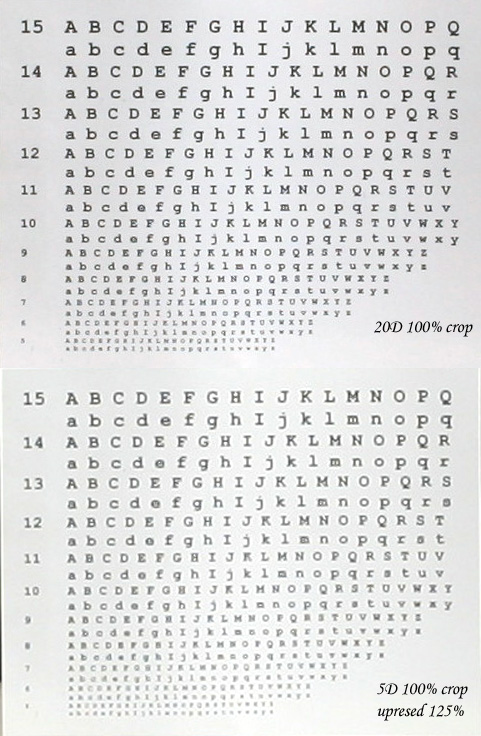
Same focal length, f-stop, ISO, shutter speed, shooting position, subject, lighting, and processing.

Smaller pixels on top:
20D%20versus%205D%20upres%20pixel%20density%20test.jpg


Smaller pixels on the left:
Pixel%20density%20test%202%20detail%20filtered.jpg
 
Upvote 0
Lee Jay said:
privatebydesign said:
Lee Jay said:
I have many, actually, it's just that they were controlled tests, rather than uncontrolled tests. You see, to science folks like myself, uncontrolled tests are useless.
So lets see some your many "controlled tests"...

Same focal length, f-stop, ISO, shutter speed, shooting position, subject, lighting, and processing.

Smaller pixels on top:
20D%20versus%205D%20upres%20pixel%20density%20test.jpg


Smaller pixels on the left:
Pixel%20density%20test%202%20detail%20filtered.jpg

They are not controlled tests of the metrics I asked for, are they? I said hand held and with AF, show me some controlled tests that demonstrate a clear advantage in resolution to the 7D against a 5D MkII or MkIII cropped that used AF and was hand held.
 
Upvote 0
privatebydesign said:
They are not controlled tests of the metrics I asked for, are they? I said hand held and with AF, show me some controlled tests that demonstrate a clear advantage in resolution to the 7D against a 5D MkII or MkIII cropped that used AF and was hand held.

Hand held with AF is not controlled (though, both of these were with AF). However, I could have done these handheld as I could have frozen them with flash.
 
Upvote 0
Lee Jay said:
privatebydesign said:
They are not controlled tests of the metrics I asked for, are they? I said hand held and with AF, show me some controlled tests that demonstrate a clear advantage in resolution to the 7D against a 5D MkII or MkIII cropped that used AF and was hand held.

Hand held with AF is not controlled (though, both of these were with AF). However, I could have done these handheld as I could have frozen them with flash.

PBD's point is clear... There are theoretical/potential advantages, and there are empirical/practical advantages. A car with a top speed of 160 mph has an advantage over a car with a top speed of 90 mph...now, demonstrate the utility of that advantage to a driver commuting to and from work in an urban setting.

The supposed 'reach advantage' of a crop sensor applies in focal length limited situations. That generally means long lenses and (relatively) distant subjects. 'Controlled testing' with standard lenses at close distances, at base ISO, and/or with flash as the primary illumination isn't as relevant.

In real world, practical usage most of the 'reach advantage' evaporates, and at high ISO there no advantage at all.
 
Upvote 0
neuroanatomist said:
In real world, practical usage most of the 'reach advantage' evaporates, and at high ISO there no advantage at all.

And that's total baloney as well.

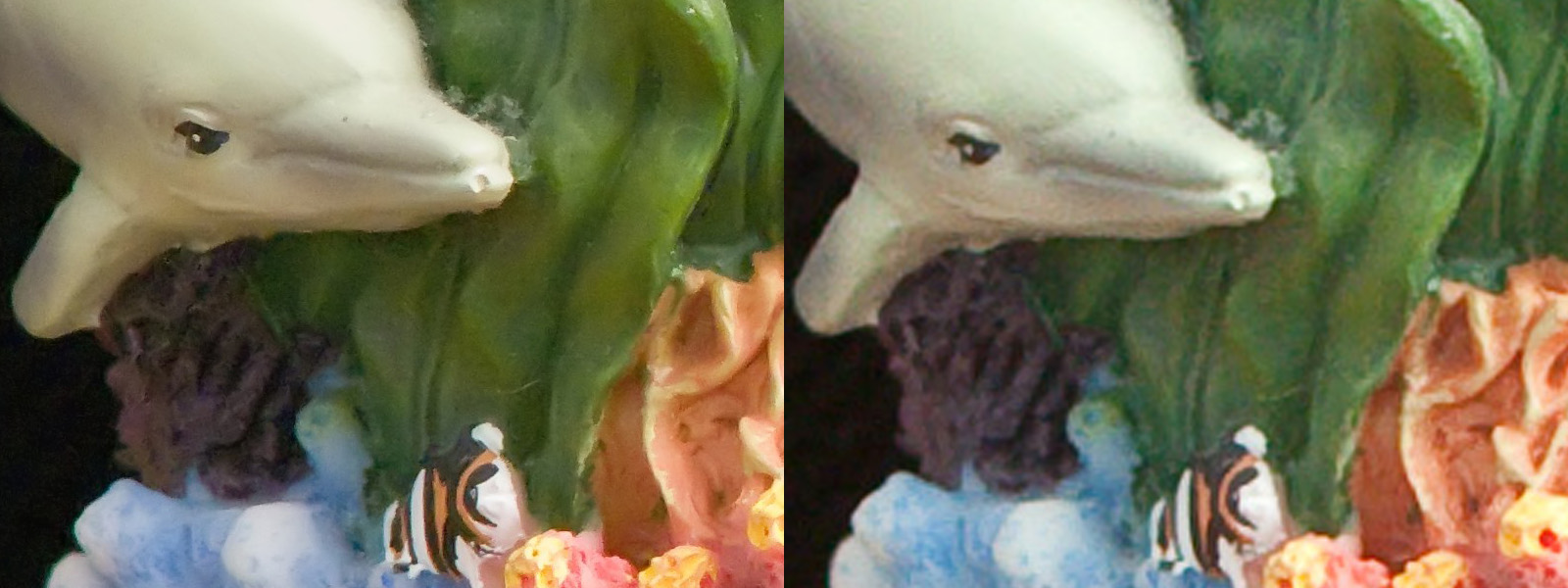
Do you think that teleconverters are useless? Do you think a 100-400L has no "reach" advantage over a 70-200/2.8? All those keep aperture the same, and just change the effective size of the image. Longer focal lengths at the same aperture (not f-stop) and smaller pixels do exactly the same thing.

Do you see a detail difference between these two? They were shot with the same aperture diameter.

20D_5699%20cropped%20enhanced.jpg

T2i__3574%20edited.jpg
 
Upvote 0
Surely up sampling to beyond 100% isn't an accurate comparison is it ? Unless you were going to enlarge the final image beyond 100%. I'd rather see the 20D reduced 37% to match. Also what happened with sharpening ? The 5D required a fair amount, more than the 20D if memory serves me, but it was a long time ago now.
 
Upvote 0
Sporgon said:
Surely up sampling to beyond 100% isn't an accurate comparison is it ? Unless you were going to enlarge the final image beyond 100%. I'd rather see the 20D reduced 37% to match. Also what happened with sharpening ? The 5D required a fair amount, more than the 20D if memory serves me, but it was a long time ago now.

The 5D image is smaller, therefore it has fewer pixels, therefore it has less resolution. This is a fair comparison as both images were shot in raw and both images were processed using the same tools and settings and are shown at the same final size from the same area of the sensor.
 
Upvote 0
3kramd5 said:
Lee Jay said:
both images were ... from the same area of the sensor.

Which is the reach-limited scenario, no?

Yes...and that's the scenario where smaller pixels help.

Look, given the same aperture, reducing pixel size and increasing focal length do the same thing. That's why in the astro community, people usually talk about image scale (arc seconds per pixel) rather than focal length. Want a smaller image scale? Use smaller pixels or use a Barlow (teleconverter). Same thing except the Barlow might be less than perfect optically.
 
Upvote 0
Lee Jay said:
3kramd5 said:
Lee Jay said:
both images were ... from the same area of the sensor.

Which is the reach-limited scenario, no?

Yes...and that's the scenario where smaller pixels help.

I agree.

More pixels on subject is better for detail.

More area on subject is better for light.

More pixels on subject with more area on subject (high resolution, large format) is best. And naturally, you pay for it.
 
Upvote 0
Don Haines said:
Marauder said:
Don Haines said:
Happy Birthday!
I hit 55 next weekend... I asked for a 600F4 for my birthday.... I will probably get a pair of socks :)

Hopefully they are "Canon" socks! :o
With size 13 1/2 feet I am almost guaranteed "Big Whites"...

Maybe they can put a red stripe around them for some "L" series comfort, or a pair that's "weather sealed" for those long canoe trips. :D


* This thread is growing faster than I can keep up, so sorry to reply to something several pages ago...
 
Upvote 0
raptor3x said:
Don Haines said:
Lee Jay said:
Do you see a detail difference between these two? They were shot with the same aperture diameter.

What did you shoot the second image with... and what settings?

First image is with a 20D @ 280mm, f/6.3, 1/200s, ISO400
Second image is with a T2i @ 560mm, f/11, 1/20s, ISO200

I wouldn't count on the EXIF data as the teleconverter stacks were different and only the first one reports.
 
Upvote 0