Are These The EOS 7D Mark II Specifications?

Don Haines said:
Lee Jay said:
privatebydesign said:
Stop trying to break down a simple system test to a series of theoretical concepts you think you can prove, system tests don't work like that and you can't supply "evidence" to support your position.

Yes, I did. You just didn't like it because it was shot on a tripod.

The tripod/handheld argument is a bit of a red herring. How good is the tripod? how well does it control vibrations? And shooting without a tripod depends a lot on the person, how stable their stance is, and are they leaning up against a tree/rock/building/??? for extra stability. I can hand-hold steadier than the typical tripod, but a good tripod is steadier than me.....

and yes, I can shoot the moon at 600mm, handheld, with nothing to lean against and still get a sharp picture...

The point is, that "handheld" is a nebulous standard that can never be defined, so therefore it can never be a controlled variable in tests...

Fair point Don, but mine is that you can't handhold without some impact in resolution and that impact, even though it is to both systems, will make any small resolution differences even smaller.
 
Upvote 0
privatebydesign said:
Don Haines said:
Lee Jay said:
privatebydesign said:
Stop trying to break down a simple system test to a series of theoretical concepts you think you can prove, system tests don't work like that and you can't supply "evidence" to support your position.

Yes, I did. You just didn't like it because it was shot on a tripod.

The tripod/handheld argument is a bit of a red herring. How good is the tripod? how well does it control vibrations? And shooting without a tripod depends a lot on the person, how stable their stance is, and are they leaning up against a tree/rock/building/??? for extra stability. I can hand-hold steadier than the typical tripod, but a good tripod is steadier than me.....

and yes, I can shoot the moon at 600mm, handheld, with nothing to lean against and still get a sharp picture...

The point is, that "handheld" is a nebulous standard that can never be defined, so therefore it can never be a controlled variable in tests...

Fair point Don, but mine is that you can't handhold without some impact in resolution and that impact, even though it is to both systems, will make any small resolution differences even smaller.

also a fair point.....

May I suggest that we let this discussion drop for a while and over the weekend go take some pictures of the moon and carry this on in a new thread?

I propose that those interested get their hands on a FF camera and a crop camera of approximately the same vintage.. (6D and 70D would make a good pair, 5D2 and 7D/60D would make a good pair) and go out and take some moon pictures with the same lens/ISO/aperture/shutter speed and scale them up to the same size... Get 4 pictures and post the results... FF tripod, FF handheld, crop on tripod, and crop on handheld.... and for entertainment's sake, add in any other camera you wish to try.....
 
Upvote 0
Don Haines said:
privatebydesign said:
Don Haines said:
Lee Jay said:
privatebydesign said:
Stop trying to break down a simple system test to a series of theoretical concepts you think you can prove, system tests don't work like that and you can't supply "evidence" to support your position.

Yes, I did. You just didn't like it because it was shot on a tripod.

The tripod/handheld argument is a bit of a red herring. How good is the tripod? how well does it control vibrations? And shooting without a tripod depends a lot on the person, how stable their stance is, and are they leaning up against a tree/rock/building/??? for extra stability. I can hand-hold steadier than the typical tripod, but a good tripod is steadier than me.....

and yes, I can shoot the moon at 600mm, handheld, with nothing to lean against and still get a sharp picture...

The point is, that "handheld" is a nebulous standard that can never be defined, so therefore it can never be a controlled variable in tests...

Fair point Don, but mine is that you can't handhold without some impact in resolution and that impact, even though it is to both systems, will make any small resolution differences even smaller.

also a fair point.....

May I suggest that we let this discussion drop for a while and over the weekend go take some pictures of the moon and carry this on in a new thread?

I propose that those interested get their hands on a FF camera and a crop camera of approximately the same vintage.. (6D and 70D would make a good pair, 5D2 and 7D/60D would make a good pair) and go out and take some moon pictures with the same lens/ISO/aperture/shutter speed and scale them up to the same size... Get 4 pictures and post the results... FF tripod, FF handheld, crop on tripod, and crop on handheld.... and for entertainment's sake, add in any other camera you wish to try.....


Great idea, though I'd suggest anything but the moon unless your main normal focal length limited subject is the moon. I was thinking soft toys or birds feathers.
 
Upvote 0
privatebydesign said:
Lee Jay said:
Yes, I did. You just didn't like it because it was shot on a tripod.

Lee Jay said:
privatebydesign said:
I don't understand what you think you are demonstrating here. Neither is with a FF camera, neither is handheld, and neither is with AF.

The 20D pixels are the same size as those in the 5DII. Both were handheld, both were with AF.

Lee Jay,

This is my last comment to you unless you can actually supply the images you said you could.


You have now said the same images were shot both on a tripod, and handheld, you have no credibility.

Idiot.

The moon shots were handheld, the letters were on a tripod. Both were focused with regular AF.
 
Upvote 0
privatebydesign said:
Lee Jay said:
Yes, I did. You just didn't like it because it was shot on a tripod.

Lee Jay said:
privatebydesign said:
I don't understand what you think you are demonstrating here. Neither is with a FF camera, neither is handheld, and neither is with AF.

The 20D pixels are the same size as those in the 5DII. Both were handheld, both were with AF.

Lee Jay,

This is my last comment to you unless you can actually supply the images you said you could.


You have now said the same images were shot both on a tripod, and handheld, you have no credibility.

I presume he's referencing the images from reply 765 as shot from a tripod and those from reply 769 as being handheld.
 
Upvote 0
privatebydesign said:
Don Haines said:
privatebydesign said:
Don Haines said:
Lee Jay said:
privatebydesign said:
Stop trying to break down a simple system test to a series of theoretical concepts you think you can prove, system tests don't work like that and you can't supply "evidence" to support your position.

Yes, I did. You just didn't like it because it was shot on a tripod.

The tripod/handheld argument is a bit of a red herring. How good is the tripod? how well does it control vibrations? And shooting without a tripod depends a lot on the person, how stable their stance is, and are they leaning up against a tree/rock/building/??? for extra stability. I can hand-hold steadier than the typical tripod, but a good tripod is steadier than me.....

and yes, I can shoot the moon at 600mm, handheld, with nothing to lean against and still get a sharp picture...

The point is, that "handheld" is a nebulous standard that can never be defined, so therefore it can never be a controlled variable in tests...

Fair point Don, but mine is that you can't handhold without some impact in resolution and that impact, even though it is to both systems, will make any small resolution differences even smaller.

also a fair point.....

May I suggest that we let this discussion drop for a while and over the weekend go take some pictures of the moon and carry this on in a new thread?

I propose that those interested get their hands on a FF camera and a crop camera of approximately the same vintage.. (6D and 70D would make a good pair, 5D2 and 7D/60D would make a good pair) and go out and take some moon pictures with the same lens/ISO/aperture/shutter speed and scale them up to the same size... Get 4 pictures and post the results... FF tripod, FF handheld, crop on tripod, and crop on handheld.... and for entertainment's sake, add in any other camera you wish to try.....


Great idea, though I'd suggest anything but the moon unless your main normal focal length limited subject is the moon. I was thinking soft toys or birds feathers.
I was thinking moon because everyone will be at the same distance and shooting the same subject with the same light levels.... the hallmark of all successful experiments is to control the variables...
 
Upvote 0
jrista said:
Were debating reach-limited situations, where a tripod is highly likely, and if you know what your doing, with the ability to use an optimal ISO for either camera....

Shooting birds/wildlife/(sports) is arguably one of the most common, if not the most common, 'reach-limited' scenario. When you were shooting birds and wildlife before getting a 600/4L IS II and 5DIII, IIRC you primarily used a 7D + 100-400L. That's an eminently hand-holdable combo (I know, because it's what I used for birds/wildlife before getting a 1D X and 600 II). What percentage of your reach limited 7D + 100-400L bird/wildlife shots were from a tripod? (Note: if you cropped the image more than a small reframing in post, you were reach limited.)

The 'optimal ISO' for any camera is as low as possible. What percentage of your 7D + 100-400L bird/wildlife shots were at ISO 100?

You seem to be suggesting that most 'reach limited' shooters are using a tripod and base ISO, and I seriously doubt that's the case. You're also implying that anyone not using a tripod and shooting at base ISO when reach limited doesn't know what they're doing, meaning you might not like the obvious implication if you can't honestly answer the above two questions as 100%.
 
Upvote 0
Don Haines said:
What you shoot with depends on what your needs are and what your budget is.

For example, if I have $2500 and want to take pictures of distant birds.... I'm going to grab a 70D and the Tamron 150-600.... If my budget is $25,000 I am going to grab a 1DX, a 600F4, and a 2X teleconverter.

Right, yes, but the point is that FF is clearly better in many more common shooting situations than crop is, which is why the 1-series and the Dx-series are full frame. If pixel density was king for wildlife/sports, M43 would be ruling that realm but it doesn't. Its not even a consideration for anyone even somewhat serious about that kind of shooting. Pro wildlife and sports shooters overwhelmingly prefer full frame cameras and Canon and Nikon both agree that FF is the preferred size for action/sports/wildlife. There is no real technical reason to prefer a crop over a full frame, all other specs being equal, and the only real life reason to go with a crop is cost. If the technical advantage really existed, pros would be putting their $12,000 600mm f/4 IS II's + 1.4x TC's on 7D's all day long and throwing their 1DX's back in the bag. They almost never do, though.
 
Upvote 0
Lee Jay said:
privatebydesign said:
Lee Jay said:
Yes, I did. You just didn't like it because it was shot on a tripod.

Lee Jay said:
privatebydesign said:
I don't understand what you think you are demonstrating here. Neither is with a FF camera, neither is handheld, and neither is with AF.

The 20D pixels are the same size as those in the 5DII. Both were handheld, both were with AF.

Lee Jay,

This is my last comment to you unless you can actually supply the images you said you could.


You have now said the same images were shot both on a tripod, and handheld, you have no credibility.

Idiot.

The moon shots were handheld, the letters were on a tripod. Both were focused with regular AF.

Thanks Lee Jay, I did misread your different quotes and for that I am sorry.

Meanwhile you seem content to try to compare a crop and ff sensor without actually having a FF sensor. I'll go stand back in the corner again now. :)
 
Upvote 0
neuroanatomist said:
jrista said:
Were debating reach-limited situations, where a tripod is highly likely, and if you know what your doing, with the ability to use an optimal ISO for either camera....

Shooting birds/wildlife/(sports) is arguably one of the most common, if not the most common, 'reach-limited' scenario. When you were shooting birds and wildlife before getting a 600/4L IS II and 5DIII, IIRC you primarily used a 7D + 100-400L. That's an eminently hand-holdable combo (I know, because it's what I used for birds/wildlife before getting a 1D X and 600 II). What percentage of your reach limited 7D + 100-400L bird/wildlife shots were from a tripod? (Note: if you cropped the image more than a small reframing in post, you were reach limited.)

The 'optimal ISO' for any camera is as low as possible. What percentage of your 7D + 100-400L bird/wildlife shots were at ISO 100?

You seem to be suggesting that most 'reach limited' shooters are using a tripod and base ISO, and I seriously doubt that's the case. You're also implying that anyone not using a tripod and shooting at base ISO when reach limited doesn't know what they're doing, meaning you might not like the obvious implication if you can't honestly answer the above two questions as 100%.

The vast majority of my bird photos were shot from a tripod, 100-400 and 600 alike. I've hand-held both, and for BIF I hand-hold, but for the most part, my bird photography is from a tripod. I'd say the majority of my wildlife is from a tripod as well, although I hand-hold for that more often. I've cropped to as little as 10% of the frame before, however as my skill improved, crops were usually 50% or so of the frame, which is still definitely reach limited.

I also NEVER said base ISO. I don't know why I have to keep saying this, but please don't put words in my mouth. I explicitly said ISO 400 and 800, as in decent light or better, that's usually where I am (and ISO 1600)...and decent light or better is what you want! :P It is only in post-sunset light that I've shot at ISO 3200 and up, however the 7D has done very well at ISO 3200 in the past...but again, from a tripod. I very rarely shoot anything at base ISO, but that isn't the point here. The point is that the primary target group for the 7D II is the same target group for the 7D...bird and wildlife shooters.

Hand-holding throws a massive amount of uncertainty into the mix. It doesn't matter if you are hand-holding a crop camera or a full frame camera...hand-holding completely removes any consistency, even for the same photographer. You could just as easily have someone with very steady hands and excellent skill with a 7D and someone with unsteady hands with a 5D III or 1D X. We want a fair comparison between the resolution of a crop camera and a full frame camera. Hand-holdability eliminates any possibility of a reasonable comparison. As Don said, this whole hand-holdability vs. tripod argument is a red herring. It UNNECESSARILY complicates things, for absolutely no gain whatsoever.

We can compare the sensors of crop and FF cameras. We HAVE compared them, on many occasions. PBD himself has often shared his own comparison, which says the same thing as everyone elses, that crop cameras (even the 7D, with it's stronger AA filter) is still resolving more detail than a FF sensor. I disagree with the assertion that the resolution difference is completely and blatantly obvious between say the 7D and 5D III, however it is a visible difference. The difference between a 1D X and 7D is larger. The difference between a 5D III or 1D X and 70D is even larger. Throw in a Nikon 24mp APS-C camera, and the difference is even larger.

This isn't rocket science, and we don't need to convolute the whole issue to favor one side of the argument or another. Smaller pixels == better. I don't think anyone would argue that the D800 has more resolution than the 5D III...the D800's pixels are 4.9µm, where as the 7D's pixels are 4.3µm, the 70D's are 4.15µm, and the D5300 has 3.9µm pixels. If no one denies that the D800 has more resolving power than a 5D III, then why are we debating whether a 7D, 70D, 7D II, D5300, or any other sensor with SMALLER pixels has more resolving power than a 5D III? ::)
 
Upvote 0
jrista said:
If no one denies that the D800 has more resolving power than a 5D III, then why are we debating whether a 7D, 70D, 7D II, D5300, or any other sensor with SMALLER pixels has more resolving power than a 5D III? ::)

We're not, we are asking for a demonstration of the actual achievable resolution differences when handheld and when using AF.

Why is that considered so antagonistic?
 
Upvote 0
privatebydesign said:
jrista said:
If no one denies that the D800 has more resolving power than a 5D III, then why are we debating whether a 7D, 70D, 7D II, D5300, or any other sensor with SMALLER pixels has more resolving power than a 5D III? ::)

We're not, we are asking for a demonstration of the actual achievable resolution differences when handheld and when using AF.

Why is that considered so antagonistic?

I never said it was antagonistic...just convoluted. I also think it's a useless comparison. As I said before...hand-holdability is dependent as much on the photographer, and as much on the photographers physiological state. There are days when I can hand hold my 600mm with nearly perfect stability...and other days when I have a hard time keeping it stable (even with IS, it can be difficult to get the shot.) Your asking for a highly subjective "comparison" that demonstrates "achievable resolution differences"...but, that could go either way. It could depend on which camera is used first, when the tester's arms are strong, and which camera is used second, after they have been weakened a bit from shooting test shots with the first.

There is no objective comparison to be had there. We could all run that test, and we could all get different results. And then, we would still be having this debate, because then we wouldn't be able to agree on the outcome of the results. :P Maybe if someone built an apparatus to "hand-hold" a camera for us, and perform the same kind of shake for each camera tested, then we might be able to get some useful results. Otherwise...I think what your asking for is rather pointless...I don't think there is a consistent answer.
 
Upvote 0
Steve said:
Don Haines said:
What you shoot with depends on what your needs are and what your budget is.

For example, if I have $2500 and want to take pictures of distant birds.... I'm going to grab a 70D and the Tamron 150-600.... If my budget is $25,000 I am going to grab a 1DX, a 600F4, and a 2X teleconverter.

Right, yes, but the point is that FF is clearly better in many more common shooting situations than crop is, which is why the 1-series and the Dx-series are full frame. If pixel density was king for wildlife/sports, M43 would be ruling that realm but it doesn't. Its not even a consideration for anyone even somewhat serious about that kind of shooting. Pro wildlife and sports shooters overwhelmingly prefer full frame cameras and Canon and Nikon both agree that FF is the preferred size for action/sports/wildlife. There is no real technical reason to prefer a crop over a full frame, all other specs being equal, and the only real life reason to go with a crop is cost. If the technical advantage really existed, pros would be putting their $12,000 600mm f/4 IS II's + 1.4x TC's on 7D's all day long and throwing their 1DX's back in the bag. They almost never do, though.
I would go one further.... I would say that technically, FF is clearly better in MOST common situations. I doubt that there is a single person on this forum who would argue otherwise.... the only case, where in technical terms, crop beats FF is for reach limited scenarios under good lighting.

The thing is, there is more than just the technical aspects of sensor size to consider. For the vast majority of people it comes down to what they can afford to spend. It does not matter what the technical specs of a camera are if you can not afford it.

You can't leave glass out of the equation. If I was going out to take bird pictures (tiny birds) and had to pick between a 1DX and the Tamron 150-600 or a T3i with a 600F4, I'd grab the T3i. Too many FF against crop anecdotes involve great glass on the FF and kit lenses on the crop camera.... not a fair comparison but an accurate comparison because if you have the money for a great FF camera, then you usually have L glass hanging off of it, while many with crop cameras do not.

For many people it comes down to size... a SL1 is a heck of a lot easier to carry on a hike than a 1DX, but even here it comes down to personal preference. In my opinion, for going on a week long hike, the best Canon gear you can bring is a 70D, an 17-55, and a 70-200F4. There are better cameras and better lenses.... but they weigh too much!

Of course if I was hiking in the mountains I would quickly change my mind to a 6D with a 24-70F4 and the 70-200F4.... Your subject matter greatly influences the choice of kit too.....

In the end it comes down to what you as an individual want to do and the balance of factors that influences your decision. There is no easy answer.
 
Upvote 0
jrista said:
neuroanatomist said:
jrista said:
Were debating reach-limited situations, where a tripod is highly likely, and if you know what your doing, with the ability to use an optimal ISO for either camera....

Shooting birds/wildlife/(sports) is arguably one of the most common, if not the most common, 'reach-limited' scenario. When you were shooting birds and wildlife before getting a 600/4L IS II and 5DIII, IIRC you primarily used a 7D + 100-400L. That's an eminently hand-holdable combo (I know, because it's what I used for birds/wildlife before getting a 1D X and 600 II). What percentage of your reach limited 7D + 100-400L bird/wildlife shots were from a tripod? (Note: if you cropped the image more than a small reframing in post, you were reach limited.)

The 'optimal ISO' for any camera is as low as possible. What percentage of your 7D + 100-400L bird/wildlife shots were at ISO 100?

You seem to be suggesting that most 'reach limited' shooters are using a tripod and base ISO, and I seriously doubt that's the case. You're also implying that anyone not using a tripod and shooting at base ISO when reach limited doesn't know what they're doing, meaning you might not like the obvious implication if you can't honestly answer the above two questions as 100%.

The vast majority of my bird photos were shot from a tripod, 100-400 and 600 alike. I've hand-held both, and for BIF I hand-hold, but for the most part, my bird photography is from a tripod. I'd say the majority of my wildlife is from a tripod as well, although I hand-hold for that more often. I've cropped to as little as 10% of the frame before, however as my skill improved, crops were usually 50% or so of the frame, which is still definitely reach limited.

I also NEVER said base ISO. I don't know why I have to keep saying this, but please don't put words in my mouth. I explicitly said ISO 400 and 800, as in decent light or better, that's usually where I am (and ISO 1600)...and decent light or better is what you want! :P It is only in post-sunset light that I've shot at ISO 3200 and up, however the 7D has done very well at ISO 3200 in the past...but again, from a tripod. I very rarely shoot anything at base ISO, but that isn't the point here. The point is that the primary target group for the 7D II is the same target group for the 7D...bird and wildlife shooters.

Hand-holding throws a massive amount of uncertainty into the mix. It doesn't matter if you are hand-holding a crop camera or a full frame camera...hand-holding completely removes any consistency, even for the same photographer. You could just as easily have someone with very steady hands and excellent skill with a 7D and someone with unsteady hands with a 5D III or 1D X. We want a fair comparison between the resolution of a crop camera and a full frame camera. Hand-holdability eliminates any possibility of a reasonable comparison. As Don said, this whole hand-holdability vs. tripod argument is a red herring. It UNNECESSARILY complicates things, for absolutely no gain whatsoever.

We can compare the sensors of crop and FF cameras. We HAVE compared them, on many occasions. PBD himself has often shared his own comparison, which says the same thing as everyone elses, that crop cameras (even the 7D, with it's stronger AA filter) is still resolving more detail than a FF sensor. I disagree with the assertion that the resolution difference is completely and blatantly obvious between say the 7D and 5D III, however it is a visible difference. The difference between a 1D X and 7D is larger. The difference between a 5D III or 1D X and 70D is even larger. Throw in a Nikon 24mp APS-C camera, and the difference is even larger.

This isn't rocket science, and we don't need to convolute the whole issue to favor one side of the argument or another. Smaller pixels == better. I don't think anyone would argue that the D800 has more resolution than the 5D III...the D800's pixels are 4.9µm, where as the 7D's pixels are 4.3µm, the 70D's are 4.15µm, and the D5300 has 3.9µm pixels. If no one denies that the D800 has more resolving power than a 5D III, then why are we debating whether a 7D, 70D, 7D II, D5300, or any other sensor with SMALLER pixels has more resolving power than a 5D III? ::)

Sorry, I misinterpreted your use of the word 'optimal'.

Interesting that you shot the 100-400 mostly from a tripod, except for BIF (if you don't have a gimbal head for your 600 II, get one!). I think the fraction of 100-400L shooters who shoot birds/wildlife with a tripod is very small.

I stand by the statement that the main advantage to APS-C is lower cost. 7D + 100-400 vs. 5DIII + 600 II is an apt example. As AlanF pointed out, the 'extra reach' with smaller pixels doesn't deliver even the theoretical advantage most people seem to think it does, and the practical advantage is even less.
 
Upvote 0
neuroanatomist said:
Interesting that you shot the 100-400 mostly from a tripod, except for BIF (if you don't have a gimbal head for your 600 II, get one!). I think the fraction of 100-400L shooters who shoot birds/wildlife with a tripod is very small.

Most of the people that I know who have gotten into shooting birds, got there through bird watching. Among serious birders, you see an awful lot of tripods holding the binoculars. It is a small step to go from binoculars on a tripod to cameras on a tripod.... so you see a lot of bird photographers (around here anyway) shooting from tripods.

As to wildlife photographers.... I haven't a clue...
 
Upvote 0
Don Haines said:
neuroanatomist said:
Interesting that you shot the 100-400 mostly from a tripod, except for BIF (if you don't have a gimbal head for your 600 II, get one!). I think the fraction of 100-400L shooters who shoot birds/wildlife with a tripod is very small.

Most of the people that I know who have gotten into shooting birds, got there through bird watching. Among serious birders, you see an awful lot of tripods holding the binoculars. It is a small step to go from binoculars on a tripod to cameras on a tripod.... so you see a lot of bird photographers (around here anyway) shooting from tripods.

As to wildlife photographers.... I haven't a clue...

Interesting. I've gone on many Audubon outings, and while there are usually a couple of tripod-mounted spitting scopes, the binoculars and 100-400's (of which there are many) are generally handheld. It's mostly those of us with 500mm and longer lenses using tripods.
 
Upvote 0
neuroanatomist said:
Sorry, I misinterpreted your use of the word 'optimal'.

Sorry. The 7D doesn't really gain much of an advantage at ISO settings lower than that, thanks to the read noise problem. It's still around 11 stops of DR, however the lower ISO setting hurts my shutter speed. For a Canon camera, I believe ISO 400 is at the lower end of optimal for Birds/BIF/Wildlife. You still get more light per ADU at lower ISO (for that sufficiently longer exposure...actually ZERO gain at the same exposure, plus the increased read noise), so more dynamic range (in the REAL sense of the word, not in the editing latitude sense), but the cost to shutter speed is too high. So, I consider optimal, on the 7D at least, to be ISO 400-1600 really. On the 5D III, ISO 400 through 3200, maybe even a little higher, could be considered optimal, IMO.

neuroanatomist said:
Interesting that you shot the 100-400 mostly from a tripod, except for BIF (if you don't have a gimbal head for your 600 II, get one!). I think the fraction of 100-400L shooters who shoot birds/wildlife with a tripod is very small.

I have the Jobu Pro 2 gimbal. I've never had any luck using it for BIF, though. I've tried on many occasions, however I have to stoop to use it for BIF, as the tripod only goes so high...and that just makes it a worse experience. The camera quick releases well enough, though, so pulling the lens off the tripod for BIF is quick, then I have a full six degrees of freedom and the ability to stand upright. :P

That said...I am selling the 100-400, and the 600 is a bit much for hand-held BIF. It's longer and heavier, and sometimes, especially when birds are flying towards me, too narrow an FOV to have much luck. I haven't had many BIF shots that I care much for in the last year, and I don't try all that often anymore. I am hoping once I get the 300/2.8 II that things on the BIF front will change considerably. I think 300/2.8 and 420/4 will be pretty optimal for hand-held BIF.

neuroanatomist said:
I stand by the statement that the main advantage to APS-C is lower cost. 7D + 100-400 vs. 5DIII + 600 II is an apt example. As AlanF pointed out, the 'extra reach' with smaller pixels doesn't deliver even the theoretical advantae most people seem to think it does, and the practical advantage is even less.

Oh, I don't disagree. The main advantage of APS-C is indeed the lower cost. I just think it's a bit much to claim there is no advantage in terms of resolving power. I don't think one single person here would think they could legitimately claim that the D800 does not have a resolution advantage over the 5D III...and yet the D800 has LARGER pixels than the 7D, 70D, pretty much every Canon crop camera released in the past several years. The 7D is the example I think we've seen most used here over the years, including PBD's own 1Ds III/7D comparison done years ago (which, IMO, still shows a visible resolution advantage to the 7D, despite it's shortcomings and stronger AA filter.)

I strongly believe that if someone had the ability to compare a D5300 and a 1D X and/or 5D III in a reach-limited situation, the D5300 would do extremely well, showing a greater advantage in resolving power than any Canon crop camera. If Canon releases a 7D II with a 24mp sensor, I believe that same advantage will come to Canon crop cameras.

I also don't believe there is a difference between a cropped sensor and a full frame sensor (or, for that matter, an MFD sensor) if they all have the same pixel size...in a reach-limited situation, they are all going to resolve the subject the same. I don't think anyone would deny that either...and yet...were debating whether cropped cameras with smaller pixels have a real-world resolution advantage over full-frame cameras. It's kind of inane... :o
 
Upvote 0
privatebydesign said:
jrista said:
If no one denies that the D800 has more resolving power than a 5D III, then why are we debating whether a 7D, 70D, 7D II, D5300, or any other sensor with SMALLER pixels has more resolving power than a 5D III? ::)

We're not, we are asking for a demonstration of the actual achievable resolution differences when handheld and when using AF.

Why is that considered so antagonistic?

Over 90% of my shots are handheld. I am not steady like Don. Some days I have trouble drinking soup with a spoon.

I understand what you are asking for but I can't afford either the 5D3 or a big white.

If someone wishes to donate same I can spend the next couple of years running tests ;D ;D ;D
 
Upvote 0
I know you guys here are photographers but remember that, on the other side of the universe, there's a huge group of people using Canon DSLRs as video cameras. It's quite a substantial market (bigger than you think) and I hope Canon addresses our needs too.

I, as a video professional, don't care that much about the high frame rate, or better AF system, or anything photography-related as I find that the current performance of photographic cameras like the 7D is way more than enough for practically any need. The raw photographs produced by all Canon cameras right now (down to the rebels) are absolutely stunning, with tons of detail, dynamic range, clean high ISOs, and beautiful 14 bit colour. And the conpetetion is not very far ahead in terms of IQ.

Where we have a problem is the video quality really. It's been 5 years into the DSLR video revolution and Canon still has not improved the image quality in any way. The video resolution in 1080p is less than 720p, with tons of aliasing and moire due to the poor downsampling through line-skipping. The images are crushed by a very poor H.264 algorithm and colour is saved into very thin 8 bit 4:2:0 containers, this produces heavy banding and noise that looks atrocious conpared the uncompressed photographs.

I have absolutely no problem with the sensor in the 70D, or the current 7D for that matter, because I know from the photographs that these sensor are of extremely high quality. What I have a problem with is how that image produced from that sensor is being downscaled and stored into a video file. This is where Canon needs to improve IMO and this is what I am waiting for in the next Canon cameras.

The competetion is getting fierce, Nikon D3300/5200/5300/D7100s are producing extremely detailed video with no aliasing or moire, and have low-light performance comparable to Canon's 5D mk III. Sony A7s, A6000 and A5100 are also doing the same. Panasonic is taking it even further and producing 4K images that can then be downscaled to stunningly clear 1080p video. These 600$-2000$ cameras are producing video quality closer to the Canon C100/300 than it is to the Canon DSLRs.

While the C line cameras are producing stunning image quality, it's simply a different market and that high image quality needs to trickle down to the lower-end DSLRs in order to stay competitive with this incredibly fierce market. And by the way you can't be afraid of cannablizing the C line, technology is moving very fast and you'll have to keep up, for example Sony's 600$ A6000 is producing a better image than Sony's professional 5000$ FS100. You will have to do it too, otherwise it will be a huge loss. Also remember that the C line cameras are professional camcorders that have many advantages other than image quality over a DSLR, they have proper audio (XLR inputs, proper monitoring, meters), built-in ND filters, EVF and articualting screen, waveform monitor, focus peaking and zebras, proper HDSDI output, Timecode, genlock, proper video-camera form factor, proper 50mbps 4:2:2 codec, and many many other factors that will always make them appealing to the professional videographer, so there're no reason to cripple the lower-end DSLRs for video.


I've been a Canon DSLR video shooter for 5 years, and am invested heavily in the Canon system, yet Canon still has not provided me an upgrade path in quality for less than the 6000$ C100, while the other companies are providing that for their customers for much less.

This situation needs to change as soon as possible with the 7D successor otherwise Canon will be losing a huge share of the market (video shooters) shifting to Panasonic, Sony, and Nikon.

I want a Canon DSLR (hopefully the next 7D) with an image closer to the C100/C300, i.e,

-1080p resolution
-No aliasing or moire
-Low light performance similar to the competetion
 
Upvote 0
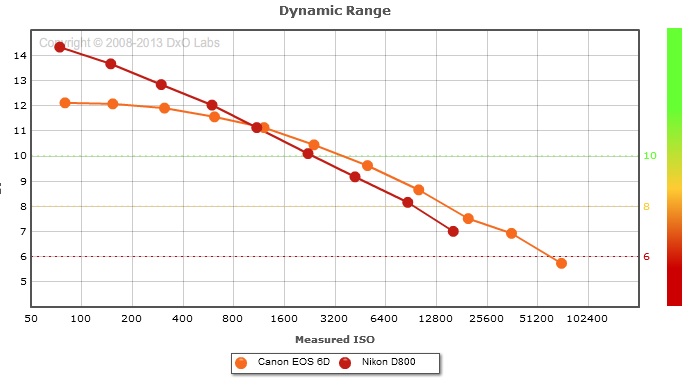
To the Dynamic Range hunters just a small hint... the advantage of Nikon is only on the lower ISOs. If you need high ISO for sportsphotography or birds, the Canon is equal around ISO 800 with even better results on the higher ones.

dr.jpg


Most people forget this, blame Canon but shoot with ISO1600 on a wedding.
 
Upvote 0