• The Canon Rumors Forum has officially been shut down as of July 10, 2026.

    All data will be deleted on September 16, 2026.

    the ad free experience will return by July 17, 2026.

Autofocus Problem / Question

Status
Not open for further replies.
This is for those of you who have deeper tech understanding of what goes on inside the camera:

Question that is bothering me:

I have a rebel 550d (t2i) + canon 50mm 1.4 prime. Even when I try to carefully focus using the center focusing point only (which is supposed to be most sensitive) the prime often "just" misses and the picture is slightly / moderately blurry - depending on how wide I opened the lens. 1.4 - 2.5 are almost always slightly off. It does not seem to be a back/forward focus problem - just lack of capability to achieve sharp focus.

If I focus using the sensor in live view mode - the focus is almost always tack sharp - or at least much better, even wide open at 1.4 - and beyond 2 tack sharp.

1) Can someone explain this phenomenon?
2) Would a more advanced body (say a 60d ) have better autofocus results ? Is there a difference even using the CENTER focusing point between the 550d and the 60d ?

Thank you all
 
bycostello said:
the first thing is discount the obvious, are you shooting at a fast shutter speed?

You can get camera and lens calibrated to give better focusing.

Yes, I am shooting at a high speed and leaning on a table to further steady myself.

I live abroad and giving in my gear is problematic. Secondly, canon often will match the body with this particular lens, but create issues with other body-lens combo's.
 
Upvote 0
koolman said:
It does not seem to be a back/forward focus problem - just lack of capability to achieve sharp focus.

If I focus using the sensor in live view mode - the focus is almost always tack sharp - or at least much better, even wide open at 1.4 - and beyond 2 tack sharp.

1) Can someone explain this phenomenon?

Why do you think it isn't a back/front focus problem? I ask, because what you describe sounds like a classic case of a need to adjust your AF - the phase detect AF is off a bit, whereas the contrast detect AF (Live View) is spot on. Phase detect uses a separate AF sensor, which may be slightly misaligned relative to the image sensor (that misalignment can affect different lenses in different ways). Contrast detect uses the imaging sensor, so there's nothing to be aligned/adjusted.

Granted, the 50/1.4 has some halation wide open, and that results in a slight softening of the resulting images - but if they're sharper using live view, that really points to an AF issue.

AF issues (front/back focus) are most evident in shots with a shallow depth of field (like you get with the 50/1.4 at a wide aperture). A similar issue on a typical consumer zoom (f/3.5-5.6) would likely never be noticed. That's also why you aren't noticing an issue at f/2.8 and narrower - the deeper DoF masks focus errors.

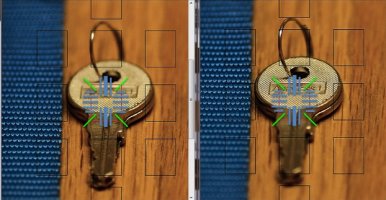
Is this reproducible, e.g. does it happen with different subjects? That's important, because one thing many people don't realize is that the actual AF point on the AF sensor is larger than the little box in the viewfinder. That means that your chosen focus point may have features that cause your camera's AF system to lock onto something you didn't intend, even within one AF point. See the attached image below - a member of another forum was compaining that two successive shots with a 135mm f/2L had different focus, but when I superimposed the center AF point of the 7D (the camera used by that person), you can see that the AF system was merely locking onto different features of the key each time. You can also see how the actual AF point sensor is alrger than the representative box in the viewfinder.

The ideal way to test AF performance is with a commercial tool like a LensAlign or SpyderLensCal - those have a focus target that is parallel to the camera (and aligned properly), and a readout 'ruler' at an angle to the camera. Since buying one just for this seems unwise, try printing this starburst target, then tape it to a box on a table, and line up a row of somethings (batteries work well) next to the box, extending toward and away from the camera. Focus on the target straight on, and see which battery is in focus (the one adjacent to the target, or forward/backward of that). Compare phase AF and Live View. A tripod would work best, assuming you have one.

koolman said:
2) Would a more advanced body (say a 60d ) have better autofocus results ? Is there a difference even using the CENTER focusing point between the 550d and the 60d ?

There might difference between the center AF point in your camera and a more advanced body. The 60D (and 40D/50D) as well as the 7D have a more complex center AF point. Yours has two lines, one sensitive to f/5.6 and the other sensitive to f/2.8 (the 'high-precision' part). The xxD and 7D bodies have a +-shaped f/5.6 sensor with an X-shaped f/2.8 sensor superimposed on that, so you're getting the f/2.8 presicion in two orientations instead of just one. But as stated above, I don't think that's the problem in your case.

If the problem is a misadjusted AF, a more advanced body would help. But not the 60D. The feature that allows a user to correct AF issues on their own is called autofocus microadjustment (AMFA), and the 60D doesn't have it. The current xD bodies have it (1-series, 5DII, 7D), as does the 50D (but Canon dropped AMFA from the 60D, for no apparent reason other than to differentiate the lines, as it's a no-cost feature). Personally, I'll never by a body without AFMA - all of my AF lenses have some amount of adjustment applied, but it's most important with the fast primes.

Hope that helps...

 

Attachments

  • AF-key-example.jpg
    AF-key-example.jpg
    261.2 KB · Views: 2,636
Upvote 0
to me it also looks like a problem that would be solved with microadjustment

any problems due to lens sharpness, field curvature, etc., would be the same in phase-detect-AF and contrast-detect-AF

unless you're using the central focus point for your phase-detect-AF tests, and a side of the sensor for your contrast-detect-AF tests: then field curvature could be an issue too

but if the problem appears in tests such as the one proposed by neuroanatomist, it's 99% sure a microadjustment issue

the cheapest canon with microadjustment right now is the 7D
if you don't mind going for an older body, the 50D also had microadjustment and is a pretty good camera
the 60D doesn't have it

also, you may be interested in this article:
http://www.lensrentals.com/blog/2010/07/how-autofocus-often-works
 
Upvote 0
neuroanatomist said:
koolman said:
It does not seem to be a back/forward focus problem - just lack of capability to achieve sharp focus.

If I focus using the sensor in live view mode - the focus is almost always tack sharp - or at least much better, even wide open at 1.4 - and beyond 2 tack sharp.

1) Can someone explain this phenomenon?

Why do you think it isn't a back/front focus problem? I ask, because what you describe sounds like a classic case of a need to adjust your AF - the phase detect AF is off a bit, whereas the contrast detect AF (Live View) is spot on. Phase detect uses a separate AF sensor, which may be slightly misaligned relative to the image sensor (that misalignment can affect different lenses in different ways). Contrast detect uses the imaging sensor, so there's nothing to be aligned/adjusted.

Granted, the 50/1.4 has some halation wide open, and that results in a slight softening of the resulting images - but if they're sharper using live view, that really points to an AF issue.

AF issues (front/back focus) are most evident in shots with a shallow depth of field (like you get with the 50/1.4 at a wide aperture). A similar issue on a typical consumer zoom (f/3.5-5.6) would likely never be noticed. That's also why you aren't noticing an issue at f/2.8 and narrower - the deeper DoF masks focus errors.

Is this reproducible, e.g. does it happen with different subjects? That's important, because one thing many people don't realize is that the actual AF point on the AF sensor is larger than the little box in the viewfinder. That means that your chosen focus point may have features that cause your camera's AF system to lock onto something you didn't intend, even within one AF point. See the attached image below - a member of another forum was compaining that two successive shots with a 135mm f/2L had different focus, but when I superimposed the center AF point of the 7D (the camera used by that person), you can see that the AF system was merely locking onto different features of the key each time. You can also see how the actual AF point sensor is alrger than the representative box in the viewfinder.

The ideal way to test AF performance is with a commercial tool like a LensAlign or SpyderLensCal - those have a focus target that is parallel to the camera (and aligned properly), and a readout 'ruler' at an angle to the camera. Since buying one just for this seems unwise, try printing this starburst target, then tape it to a box on a table, and line up a row of somethings (batteries work well) next to the box, extending toward and away from the camera. Focus on the target straight on, and see which battery is in focus (the one adjacent to the target, or forward/backward of that). Compare phase AF and Live View. A tripod would work best, assuming you have one.

koolman said:
2) Would a more advanced body (say a 60d ) have better autofocus results ? Is there a difference even using the CENTER focusing point between the 550d and the 60d ?

There might difference between the center AF point in your camera and a more advanced body. The 60D (and 40D/50D) as well as the 7D have a more complex center AF point. Yours has two lines, one sensitive to f/5.6 and the other sensitive to f/2.8 (the 'high-precision' part). The xxD and 7D bodies have a +-shaped f/5.6 sensor with an X-shaped f/2.8 sensor superimposed on that, so you're getting the f/2.8 presicion in two orientations instead of just one. But as stated above, I don't think that's the problem in your case.

If the problem is a misadjusted AF, a more advanced body would help. But not the 60D. The feature that allows a user to correct AF issues on their own is called autofocus microadjustment (AMFA), and the 60D doesn't have it. The current xD bodies have it (1-series, 5DII, 7D), as does the 50D (but Canon dropped AMFA from the 60D, for no apparent reason other than to differentiate the lines, as it's a no-cost feature). Personally, I'll never by a body without AFMA - all of my AF lenses have some amount of adjustment applied, but it's most important with the fast primes.

Hope that helps...

neuroanatomist: Thanks for all the info and explanations. I just did some more test shots - and you may be right! It seems that there is a slight front focus issue - noticeable only at very wide f stops and "masked" on consumer lenses.

I will try and compensate for this meanwhile by focusing on a spot slightly farther away from the spot I want the focus on. I can also just use live view if needed.

I would like to upgrade the body - however at this point in time I would wait to see what new bodies appear then purchase the 7d - a 2 year old camera - which is fundamentally my 550d in a fancier package. I'm not a pro and I need to watch the budget.
 
Upvote 0
What's the normal tolerance on phase-detection AF? I just bought a refurb 24-105 that I've been trying to test. It might be slightly off focus -- maybe 2-3 mm at f4. I'm still trying to improve my test technique, though, so it's possible it's experimental error.
 
Upvote 0
koolman said:
neuroanatomist: Thanks for all the info and explanations. I just did some more test shots - and you may be right! It seems that there is a slight front focus issue - noticeable only at very wide f stops and "masked" on consumer lenses.

I would like to upgrade the body - however at this point in time I would wait to see what new bodies appear then purchase the 7d - a 2 year old camera - which is fundamentally my 550d in a fancier package. I'm not a pro and I need to watch the budget.

Makes sense. Actually, AFMA was one driver for me when I went from a T1i/500D to the 7D (mainly I was looking for better AF, but I had recently gotten a 100mm f/2.8L Macro IS and it was backfocusing a bit on my T1i - I lived with it for a while, but for macro it's not a big deal as that's usually shot with manual focus/10x Live View).

Orangutan said:
What's the normal tolerance on phase-detection AF? I just bought a refurb 24-105 that I've been trying to test. It might be slightly off focus -- maybe 2-3 mm at f4. I'm still trying to improve my test technique, though, so it's possible it's experimental error.

The tolerance is not stated in terms of depth of field. It's stated in terms of depth of focus, which is analogous to depth of field, but on the image side (i.e. focus in front of or behind the image sensor in the camera, usually measured in µm). The tolerance is 'within one depth of focus for the lens at max aperture' for standard precision sensors, and within 1/3 of the depth of focus at max aperture' for the high-precision center AF point when activated by an lens of f/2.8 or faster (or f/4 on 1-series bodies). If your body has AFMA, each 'unit' of AMFA equates to 1/8 of the depth of focus at max aperture.

For normal subjects (i.e. not macro), depth of focus is dependent primarily on aperture, and relatively independent of subject distance. However, depth of field is affected by subject distance, so with close subjects, slight focus errors become more apparent (because depth of field is getting relatively shallower, whereas the specified tolerance for depth of focus is not).

Honestly, the best way to test AF is with one of the commercial tools that I mentioned above. Personally, I use a LensAlign Pro.
 
Upvote 0
Harley said:
I have been wondering about the very same thing and will try the home test for my lenses, too.

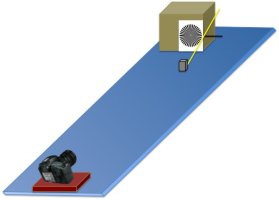
If you're looking for something maybe a little better than batteries on a table, but close to free, attached below is a mockup I made of a home-built LensAlign. It would require a cardboard box, a book, a tape measure, a chopstick, and a printout of this focus target.

It could be set up on a table, or even the floor if necessary. If you have a good tripod, you would use that instead setting the camera on a book. The camera-to-target distance should be ~25x the focal length of the lens (regardless of sensor size), so for an 85mm lens that's about 7 feet. The focus target gets taped to the box, down low, and chopstick gets stuck in at the edge of the box, vertically centered on the target. The chopstick supports a tape measure at an angle. Note the measurement on the tape measure where it passes next to the target - that's your 'zero point' against which you can judge front or back focusing (when you review your images at 100% on your computer). Pick a book of a thickness that centers the lens at approximately the same height as the center of the focus target.
 

Attachments

  • AFtesting.jpg
    AFtesting.jpg
    22.4 KB · Views: 2,392
Upvote 0
neuroanatomist said:
Harley said:
I have been wondering about the very same thing and will try the home test for my lenses, too.

If you're looking for something maybe a little better than batteries on a table, but close to free, attached below is a mockup I made of a home-built LensAlign. It would require a cardboard box, a book, a tape measure, a chopstick, and a printout of this focus target.

It could be set up on a table, or even the floor if necessary. If you have a good tripod, you would use that instead setting the camera on a book. The camera-to-target distance should be ~25x the focal length of the lens (regardless of sensor size), so for an 85mm lens that's about 7 feet. The focus target gets taped to the box, down low, and chopstick gets stuck in at the edge of the box, vertically centered on the target. The chopstick supports a tape measure at an angle. Note the measurement on the tape measure where it passes next to the target - that's your 'zero point' against which you can judge front or back focusing (when you review your images at 100% on your computer). Pick a book of a thickness that centers the lens at approximately the same height as the center of the focus target.

This is pretty neat. But, I'm wondering: why 25x the focal length of the lens? Seems kind of tricky to accomplish that with a 300mm lens. Wouldn't that be something like 25 feet or more? My house isn't that big. Why does the distance from lens to target matter?
 
Upvote 0
unfocused said:
This is pretty neat. But, I'm wondering: why 25x the focal length of the lens? Seems kind of tricky to accomplish that with a 300mm lens. Wouldn't that be something like 25 feet or more? My house isn't that big. Why does the distance from lens to target matter?

LensAlign recommends 25x the focal length; SpyderLensCal recommends 5-10x the focal length, but Canon's Chuck Westfall actually recommends 50x the focal length. I'm not sure about the rationale behind any of those suggestions, to be honest. Given that depth of focus does not depend on subject distance at non-macro distances, it shouldn't matter all that much, but I'm not 100% sure that it doesn't.

I should point out that the above distance recommendations are qualified by a statement to the effect of 'calibrate at the subject distance you most often shoot at,' and that is what makes the most sense to me. In the example of the 85L, 7 feet is a pretty reasonable distance for portraits I shoot with that lens, and for my 100-400mm, ~32 feet is pretty reasonable for the birds I usually shoot (calibrate zooms at the longest focal length). With the markings on the LensAlign ruler, the DoF at 25x focal length yields enough separation between markings to make it easy to determine front/back focus. YMMV...
 
Upvote 0
koolman said:
neuroanatomist: Thanks for all the info and explanations. I just did some more test shots - and you may be right! It seems that there is a slight front focus issue - noticeable only at very wide f stops and "masked" on consumer lenses.

I will try and compensate for this meanwhile by focusing on a spot slightly farther away from the spot I want the focus on. I can also just use live view if needed.

I would like to upgrade the body - however at this point in time I would wait to see what new bodies appear then purchase the 7d - a 2 year old camera - which is fundamentally my 550d in a fancier package. I'm not a pro and I need to watch the budget.

There is a very good writeup and chart here.

It is basically the starting point for the commercial lens align product and works well.

I find that I get excellent focus adjust accuracy at relatively short distances where the shallow depth of field becomes apparent. not macro, but say 5-7 ft for a 35mm L.

Canon will adjust your 50mm f/1.4 lens at no cost if its in warranty.
Otherwise they have a flat $95 fee for repairs. Its also possibly a combination of tolerance stackup where the camera and / or the lens needs adjustment.

I'd get it fixed, its worth it to have it right-on. Send in camera and lens so they make sure the right one is fixed.

I had a XTi bpdy that was off, and it had a simple screw adjustment to adjust the stop screw for the sub mirror. Two clicks of the screw and everything was perfect.
 
Upvote 0
Mt Spokane Photography said:
koolman said:
neuroanatomist: Thanks for all the info and explanations. I just did some more test shots - and you may be right! It seems that there is a slight front focus issue - noticeable only at very wide f stops and "masked" on consumer lenses.

I will try and compensate for this meanwhile by focusing on a spot slightly farther away from the spot I want the focus on. I can also just use live view if needed.

I would like to upgrade the body - however at this point in time I would wait to see what new bodies appear then purchase the 7d - a 2 year old camera - which is fundamentally my 550d in a fancier package. I'm not a pro and I need to watch the budget.

There is a very good writeup and chart here.

It is basically the starting point for the commercial lens align product and works well.

I find that I get excellent focus adjust accuracy at relatively short distances where the shallow depth of field becomes apparent. not macro, but say 5-7 ft for a 35mm L.

Canon will adjust your 50mm f/1.4 lens at no cost if its in warranty.
Otherwise they have a flat $95 fee for repairs. Its also possibly a combination of tolerance stackup where the camera and / or the lens needs adjustment.

I'd get it fixed, its worth it to have it right-on. Send in camera and lens so they make sure the right one is fixed.

I had a XTi bpdy that was off, and it had a simple screw adjustment to adjust the stop screw for the sub mirror. Two clicks of the screw and everything was perfect.

Hi, I live in Israel - and sending the camera abroad for this is a bit much. Local canon representative will charge allot and I'm afraid that messing with the body could cause more harm then help - as it could mess up other lenses.

We are talking about a "slight" front focus issue - noticeable only at f stops < 2.5 . I can compensate meanwhile manually - and eventually I'll upgrade the body for something with MF adjustments.
 
Upvote 0
I guess this opportunity is as good as any to throw out a question for speculation.

Why can't Canon (or any manufacturer) implement automatic MFA for any camera that has Live View? The user would:

[list type=decimal]
[*]Mount the camera on a tripod or other sturdy surface
[*]Point it at a standard target at some reasonable distance
[*]Choose the function from the menu
[*]Step back and let it go.
[/list]

So how does it do its magic? Simple: it compares Live View focus to phase detect focus, then automatically adjusts PD focus until they are the same.

Yes, there's still room for misuse by n00bs, but much less than with manual MFA.

Thoughts?
 
Upvote 0
Orangutan said:
Why can't Canon (or any manufacturer) implement automatic MFA for any camera that has Live View?

Certainly possible, and something I'd really like to see implemented. It's been discussed before here, and IIRC, I even suggested the possibility of a nice Canon-branded focus target. I'm sure Canon could price a piece of plastic like that appropriately, after all, look at the reasonable prices on their lens hoods... :o
 
Upvote 0
Status
Not open for further replies.