Basic Information on Lenses Coming in 2016 [CR2]

JonAustin said:
scyrene said:
Dalantech said:
JonAustin said:
Dalantech said:
IMHO a 50mm 1:2 lens is worthless -you'd be better off with a true 1:1 lens even if you only wanted to shoot at 1:2...

Oh, I don't know about that. I've had my 50/2.5CM for nearly 13 years now. It's the lens with the oldest design in my kit -- and also the lens I've owned the longest -- but I still find it very useful. Still today (as back in 2003 when I bought it), I find it to be the best compromise between price and quality among Canon's non-L 50mm primes. I have used it on numerous paid product photography shoots ... sharp, sharp, sharp! And fast enough for these applications.

Disclaimers:

I am eagerly awaiting the 50/1.4 quasi-USM's replacement.
I also have the 100/2.8L IS macro.

Worthless in the sense that you really can't shoot macro with it unless you add the life size converter. I'd bet that a lot of the images that you've taken with it could have been done with a normal 50mm lens, or the EF-S 60mm (can use one even on a non crop factor camera if you add at least 12mm of extension). To me a 50mm 1:2 lens makes as much sense as drinking near beer, or decaffeinated coffee. But when I shoot macro it's usually at life size of higher mag.

Some of us like decaffeinated coffee! I like the taste of coffee, but if I drink it in the evening, I can't get to sleep at night. So it's a good compromise... :P

I don't like the taste of coffee, decaffeinated or otherwise, but I have found that the magnification provided by the 50/2.5CM was more than sufficient for many of my macro shots. Sure, a lot of the images I've captured with it could have been accomplished with a normal 50, but many more could not. My only point being that, just because it's worthless to you doesn't necessarily mean its useless to everyone else.

I agree that there are some people that are perfectly happy with a 50mm macro. I had one but I found I only really liked it for product photography. The working distance and slow focus made it next to impossible to chase insects, I dont find the 24-70 f4 IS much better. I also dont like the image compression/perspective of these lenses which is why I havent bothered even trying the 100L yet. I greatly preferred the 70-300L and now the 300f4L for flower photography and large/fast insects.
 
Upvote 0
Canon Rumors said:
We’ve been trying to get more information on lenses coming in 2016 and things are been relatively hard to come by. We’re now being told that the non-L 200-600 super zoom

Canon may be on a two year cycle.
as a matter of fact for the last 10 years, only one "odd" year released anything other than 4 lenses, the even years launched more the last 3 times (2010, 2012,2014)

if so, we should expect a slew of lenses coming out

2010 - 5 lenses
2011 - 4 lenses
2012 - 9 lenses
2013 - 4 lenses
2014 - 7 lenses
2015 - 4 lenses
2016 - ?

Maybe instead of blowing all their load on EF lenses, they will work on EF-S and EF-M this time around. both could use some lenses for sure.

CR is predicting 3-5 EF-M lenses and a super zoom for EF mount and a 16-35/2.8

that would take us up to 8 lenses this year. pretty much what you'd expect if the pattern is accurate.
 
Upvote 0
j-nord said:
I agree that there are some people that are perfectly happy with a 50mm macro. I had one but I found I only really liked it for product photography. The working distance and slow focus made it next to impossible to chase insects, I dont find the 24-70 f4 IS much better. I also dont like the image compression/perspective of these lenses which is why I havent bothered even trying the 100L yet. I greatly preferred the 70-300L and now the 300f4L for flower photography and large/fast insects.

I don't chase insects, so that was never an issue for me. I'm probably outing myself as weird, but I actually get a little grin listening to the 50CM buzz as the lens extends in and out in macro mode. I'm still signed up for ahsanford's 50mm f/whatever non-L IS (true ring) USM, if and when it is ever released, but I doubt that I'll ever part with my little 50CM, as long as it continues to work.
 
Upvote 0
JonAustin said:
rrcphoto said:
Canon may be on a two year cycle. as a matter of fact for the last 10 years, only one "odd" year released anything other than 4 lenses, the even years launched more the last 3 times (2010, 2012,2014)

Interesting observation ... hope it pans out this year!

That would be wishful thinking, can you imagine the board meeting where they discuss how it's an odd numbered year and they have to ramp up production, R&D and prototypes to make the quota?
 
Upvote 0
slclick said:
JonAustin said:
rrcphoto said:
Canon may be on a two year cycle. as a matter of fact for the last 10 years, only one "odd" year released anything other than 4 lenses, the even years launched more the last 3 times (2010, 2012,2014)

Interesting observation ... hope it pans out this year!

That would be wishful thinking, can you imagine the board meeting where they discuss how it's an odd numbered year and they have to ramp up production, R&D and prototypes to make the quota?

right because they develop all that in a year.

or it could be manufacturing is on a two year cycle for the creation of lenses, and it's easier to inject new lenses in certain parts of the manufacturing year.
 
Upvote 0
rrcphoto said:
slclick said:
JonAustin said:
rrcphoto said:
Canon may be on a two year cycle. as a matter of fact for the last 10 years, only one "odd" year released anything other than 4 lenses, the even years launched more the last 3 times (2010, 2012,2014)

Interesting observation ... hope it pans out this year!

That would be wishful thinking, can you imagine the board meeting where they discuss how it's an odd numbered year and they have to ramp up production, R&D and prototypes to make the quota?

right because they develop all that in a year.

or it could be manufacturing is on a two year cycle for the creation of lenses, and it's easier to inject new lenses in certain parts of the manufacturing year.
There could definitely a reason for the cycle. And cycles are pretty common for big companies. Intel, for example, has an explicitly stated tick-tock model which is a roughly 2 year cycle.
 
Upvote 0
scyrene said:
Dalantech said:
scyrene said:
PS your butterfly shot is great, but not what I have in mind for the 180 macro lens. I want whole insects in their environment - just what those long macro lenses were designed for.

But a long focal length macro lens won't give you the subject in its environment if you're shooting above 1/3 life size -and even that might be too much magnification. A 180mm macro is gonna give you some great, smooth bokeh, that will completely obliterate the subjects surroundings -and that's not a bad thing. Getting too much detail in the background will probably just distract the viewer from the subject.

True, it's a fine balance. I'll see how it works out over the summer, and if it's not what I'm hoping for, I'll sell it. I had toyed with a standard 200mm (or 70-200mm) lens, and maybe adding an extension tube, but I imagine that will not be as optically good. The main problem with standard telephoto lenses (like my 500) is their maximum magnification is generally very low, less than 0.2x - so I can photograph a butterfly from a few metres away, but not that middle ground, say 0.5-1.5m which is the distance I encounter many flying insects. I may not be using the 180mm at 1:1 all of the time, but there aren't many (or any?) lenses that fall in the middle - that 0.3-0.5x range. So for me, the 180 is the sensible choice (I use the 100L macro at present for these shots, and it just doesn't have enough reach for things like bees that I can't easily get close to). But we'll see :)

A couple of ideas:

1) Add a 500D diopter to that 500mm. It will reduce the working distance down to roughly half a meter and give you some more magnification.

2) Use a syringe and inject 1:1 sugar syrup into the flowers to give the bees a reason to let you get close...

It's your skill, and the willingness of the subject, and not the lens that lets you take the shot that you want. You create the images -the equipment is just a tool...
 
Upvote 0
JonAustin said:
I don't like the taste of coffee, decaffeinated or otherwise, but I have found that the magnification provided by the 50/2.5CM was more than sufficient for many of my macro shots. Sure, a lot of the images I've captured with it could have been accomplished with a normal 50, but many more could not. My only point being that, just because it's worthless to you doesn't necessarily mean its useless to everyone else.

You could use that same 50mm macro to take a scenic, or a portrait, but the same could be said for any focal length. But is that 50mm useful for macro? No, because it's not really a macro lens at 1:2...
 
Upvote 0
Dalantech said:
scyrene said:
Dalantech said:
scyrene said:
PS your butterfly shot is great, but not what I have in mind for the 180 macro lens. I want whole insects in their environment - just what those long macro lenses were designed for.

But a long focal length macro lens won't give you the subject in its environment if you're shooting above 1/3 life size -and even that might be too much magnification. A 180mm macro is gonna give you some great, smooth bokeh, that will completely obliterate the subjects surroundings -and that's not a bad thing. Getting too much detail in the background will probably just distract the viewer from the subject.

True, it's a fine balance. I'll see how it works out over the summer, and if it's not what I'm hoping for, I'll sell it. I had toyed with a standard 200mm (or 70-200mm) lens, and maybe adding an extension tube, but I imagine that will not be as optically good. The main problem with standard telephoto lenses (like my 500) is their maximum magnification is generally very low, less than 0.2x - so I can photograph a butterfly from a few metres away, but not that middle ground, say 0.5-1.5m which is the distance I encounter many flying insects. I may not be using the 180mm at 1:1 all of the time, but there aren't many (or any?) lenses that fall in the middle - that 0.3-0.5x range. So for me, the 180 is the sensible choice (I use the 100L macro at present for these shots, and it just doesn't have enough reach for things like bees that I can't easily get close to). But we'll see :)

A couple of ideas:

1) Add a 500D diopter to that 500mm. It will reduce the working distance down to roughly half a meter and give you some more magnification.

2) Use a syringe and inject 1:1 sugar syrup into the flowers to give the bees a reason to let you get close...

It's your skill, and the willingness of the subject, and not the lens that lets you take the shot that you want. You create the images -the equipment is just a tool...

Constructive ideas are always welcome. However...

You can't put the 500D closeup lens on a 500mm supertele lens - the lens doesn't accept front filters. Also, I have tried using it with extension tubes to reduce minimum focus distance, but 500mm is just a bit *too* much, and unwieldy (it's a big heavy object, and tracking subjects that small is not easy - the lens really wasn't designed for this).

Using sugar syrup is a good method for attracting some insects, but not all - I don't just want to photograph nectarivorous bees, but also the many small wasps, and other invertebrates. Nonetheless, it's a method I will be using this summer.

No offence, but the 'it's not the equipment' cliché is patently false (but you're by no means the only person to repeat it). Otherwise let's go and photograph insect macros with a pinhole camera. Unless you're saying long lenses only exist for people with no skill? Obviously both the equipment's capabilities *and* the user's skill and knowledge are important. I dunno why you're so against the 180mm macro lens option...
 
Upvote 0
Dalantech said:
JonAustin said:
I don't like the taste of coffee, decaffeinated or otherwise, but I have found that the magnification provided by the 50/2.5CM was more than sufficient for many of my macro shots. Sure, a lot of the images I've captured with it could have been accomplished with a normal 50, but many more could not. My only point being that, just because it's worthless to you doesn't necessarily mean its useless to everyone else.

You could use that same 50mm macro to take a scenic, or a portrait, but the same could be said for any focal length. But is that 50mm useful for macro? No, because it's not really a macro lens at 1:2...

{sigh}
 

Attachments

  • Bored.jpg
    Bored.jpg
    12.8 KB · Views: 582
Upvote 0
kphoto99 said:
neuroanatomist said:
Dalantech said:
1) Add a 500D diopter to that 500mm. It will reduce the working distance down to roughly half a meter and give you some more magnification.

Got any 500D diopters laying around that are 125mm in diameter and can attach to a lens with no front filter?

Duct tape maybe ;-)

I've actually mounted a 77mm ND filter on the front of the 500L for photographing the sun (usual warnings apply). I made a cardboard structure that fitted over the lens hood, and taped the filter into the middle of it. It worked fine, but of course the distance to the front element wasn't critical, as it would be with a close up filter I imagine...
 
Upvote 0
scyrene said:
I've actually mounted a 77mm ND filter on the front of the 500L for photographing the sun (usual warnings apply). I made a cardboard structure that fitted over the lens hood, and taped the filter into the middle of it. It worked fine, but of course the distance to the front element wasn't critical, as it would be with a close up filter I imagine...

Get much vignetting? :o
 
Upvote 0
neuroanatomist said:
scyrene said:
I've actually mounted a 77mm ND filter on the front of the 500L for photographing the sun (usual warnings apply). I made a cardboard structure that fitted over the lens hood, and taped the filter into the middle of it. It worked fine, but of course the distance to the front element wasn't critical, as it would be with a close up filter I imagine...

Get much vignetting? :o

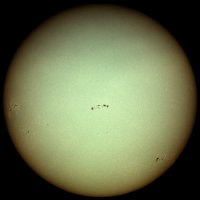
None visible - but then the sky is black in shots exposed for the sun's surface, and there is darkening towards the limb, so vignetting probably wouldn't be noticeable. Here's one (also lots of extenders and stopping down - 2800mm, f/22).
 

Attachments

  • 7907944344_10401de274_k.jpg
    7907944344_10401de274_k.jpg
    2.2 MB · Views: 169
Upvote 0
scyrene said:
No offence, but the 'it's not the equipment' cliché is patently false (but you're by no means the only person to repeat it). Otherwise let's go and photograph insect macros with a pinhole camera. Unless you're saying long lenses only exist for people with no skill? Obviously both the equipment's capabilities *and* the user's skill and knowledge are important. I dunno why you're so against the 180mm macro lens option...

No, I'm saying that just having a specific piece of equipment isn't a guarantee that you'll get the shot. The more you know about the habits and quirks of the subjects you want to photograph the easier it is to create the images that you want.

I have a Canon 180mm macro because I bought into the "long focal length lenses are bug lenses" myth. It sits in my closet collecting dust while I take images like this one at 65mm. Check out the technique section under the photo, I explain how I was able to make that image.
 
Upvote 0
neuroanatomist said:
Dalantech said:
1) Add a 500D diopter to that 500mm. It will reduce the working distance down to roughly half a meter and give you some more magnification.

Got any 500D diopters laying around that are 125mm in diameter and can attach to a lens with no front filter?

Sorry, wasn't aware that the lens was such a monster.
 
Upvote 0
kphoto99 said:
neuroanatomist said:
Dalantech said:
1) Add a 500D diopter to that 500mm. It will reduce the working distance down to roughly half a meter and give you some more magnification.

Got any 500D diopters laying around that are 125mm in diameter and can attach to a lens with no front filter?

Duct tape maybe ;-)

Gaffers tape -won't leave any residue behind...
 
Upvote 0