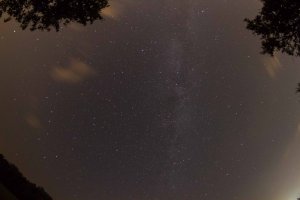
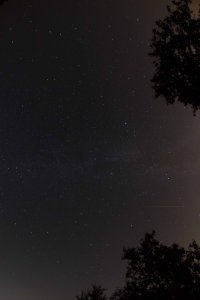
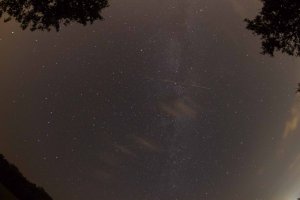
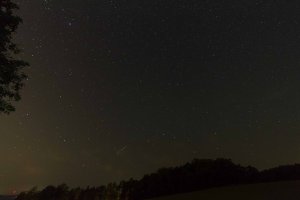
Congratulations on your catches! Though in the images you posted only
20130813-0132 and
20130812-0129 look like meteors. All of your second set are definitely satellites. Meteors can be tricky to capture, but I have a good recipe and I'm sorry I wasn't able to share it with you before this year's Perseids. Well, there are other showers (e.g. the Leonids) , and perhaps you will have the opportunity for a repeat with good weather next year, or for the moonless 2015 Perseids.
A few relevant things about meteors:
[list type=decimal]
[*]There are more fainter meteors than brighter
[*]They flash in a fraction of a second (longer for brighter ones)
[*]Showers appear to originate from a point, called the radiant
[*]Meteors (even for showers) are as likely to happen anywhere in the sky, and are unpredictable
[/list]
1 & 2 implies that in order to catch as many meteors as possible, you should aim for maximum practical sensitivity while limiting the background as much as possible for the best contrast.
[list type=decimal]
[*]Maximum aperture for your lens
[*]As high ISO as you find acceptable
[*]The shorter the exposure (longer than the expected duration of the meteor), the better the contrast, i.e. the brighter the meteor looks like relative to the background/foreground. There is a trade-off to be made, of course. In practice, using the longest exposure that maintain dark skies does not significantly worsen the contrast, so go with that. This is where you realise you need dark skies, as city skies easily can saturate in less than a second, while you can go on for minutes before that happens in truly dark locations.
[*]Keep shooting repeatedly for as long as you can.
[*]With dropping temperatures, watch out for dew on the front lens. Lens hoods help a bit, but for wide-angle lenses they are not very constraining.
[*]Watch your focus, use live view on a bright star. For a slow lens (as the EF-S 10-22), use some other, bright faraway light, or focus during daytime and lock it.
[/list]
What about focal length? With a wider lens, you cover more sky, so are more likely to get a meteor in the field. On the other hand, its image will be smaller and less impressive than if you were lucky to catch it at a longer focal length. Again, it's a trade-off.
For your alternative, I think the lens choices you made are the best given your selection, but as you've already concluded, it would be better to reduce the exposure time of the 5D3, perhaps using 10s with ISO 1600 or 3200. That would improve your contrast by a factor of 3. For the 7D. it's hard to improve your strategy, since going beyond ISO 1600 gives pretty noisy results.
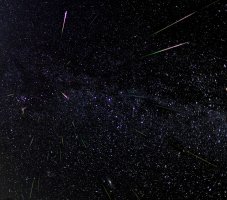
I also photographed the Perseids this year, but I did it in a very lazy way. I happened to visit my parents-in-law house on the countryside, where they have dark skies, so I just went out at midnight and set up the camera to shoot repeatedly (using a remote and locking the shutter button). Went to bed, and came back to empty the net after two hours. My settings:
5D3+24/1.4L @ 1.4, 15s, ISO 1600. Since I wanted to capture the perspective effect of the radiant, I included Perseus in the field (but no interesting foreground object... I save that for 2015!). In ~500 frames, I identified ~50 meteors, out of which I produced a mosaic from the brightest half (seen below). The mosaic took some time to produce in photoshop, since I had to match the rotating background of stars. Next time I'll perhaps use a mount with drive, to simplify the process.
I think 24/1.4 is pretty much ideal for meteors. Unfortunately the 24/1.4L has awful coma, so next time I will probably try the Samyang 24/1.4, which is supposed to show less (see
this thread)
I also found hundreds of satellite tracks in my images. The easy way to identify them is:
[list type=decimal]
[*]hey are generally white (reflected sunlight). Meteors are colourful!
[*]They last for more than a fraction of a second (typically minutes and can almost always be seen in consecutive frames)
[*]Their streak don't generally show the same light distribution as meteors (though a few do).
[/list]