I am asking for a common question but I truly need the exact answers from the experience photographers. What is the best way to set lighting up for portraits and table-top product shots?

jannatul18 said:I am asking for a common question but I truly need the exact answers from the experience photographers.


jannatul18 said:I am asking for a common question but I truly need the exact answers from the experience photographers. What is the best way to set lighting up for portraits and table-top product shots?
AcutancePhotography said:When I use multiple lights, I like to set each one up separately to make sure that each light is doing what I need it...
Each light needs to have a purpose and can, usually, be evaluated for that purpose individually. Of course you also have to look at how all the lights working together at the same time make or break the scene.


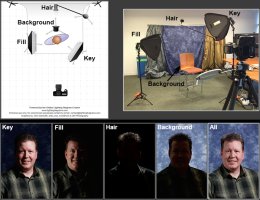
neuroanatomist said:Here's an example from a 4-light 'corporate headshot' setup. Key and fill are each a 600EX-RT in a Lastolite 24" Ezybox, both on Manfrotto 1051BAC stands. The key has a round mask diffuser panel (for catchlight shape), and the fill is gridded. The hair light is a 600EX-RT with a Honl 1/8" Speed Grid on a Manfrotto 420B Combi Boom. Background light is an Buff Einstein 640 with a white shovel background reflector, on a Manfrotto 012B backlight stand. The backdrops are Backdrop Alley muslin on a Manfrotto 1314B background support system. Speedlites were radio triggered with an ST-E3-RT and the monolight was optically slaved.
neuroanatomist said:+1
Here's an example from a 4-light 'corporate headshot' setup. Key and fill are each a 600EX-RT in a Lastolite 24" Ezybox, both on Manfrotto 1051BAC stands. The key has a round mask diffuser panel (for catchlight shape), and the fill is gridded. The hair light is a 600EX-RT with a Honl 1/8" Speed Grid on a Manfrotto 420B Combi Boom. Background light is an Buff Einstein 640 with a white shovel background reflector, on a Manfrotto 012B backlight stand. The backdrops are Backdrop Alley muslin on a Manfrotto 1314B background support system. Speedlites were radio triggered with an ST-E3-RT and the monolight was optically slaved.
neuroanatomist said:AcutancePhotography said:When I use multiple lights, I like to set each one up separately to make sure that each light is doing what I need it...
Each light needs to have a purpose and can, usually, be evaluated for that purpose individually. Of course you also have to look at how all the lights working together at the same time make or break the scene.
+1
Here's an example from a 4-light 'corporate headshot' setup. Key and fill are each a 600EX-RT in a Lastolite 24" Ezybox, both on Manfrotto 1051BAC stands. The key has a round mask diffuser panel (for catchlight shape), and the fill is gridded. The hair light is a 600EX-RT with a Honl 1/8" Speed Grid on a Manfrotto 420B Combi Boom. Background light is an Buff Einstein 640 with a white shovel background reflector, on a Manfrotto 012B backlight stand. The backdrops are Backdrop Alley muslin on a Manfrotto 1314B background support system. Speedlites were radio triggered with an ST-E3-RT and the monolight was optically slaved.


neuroanatomist said:AcutancePhotography said:When I use multiple lights, I like to set each one up separately to make sure that each light is doing what I need it...
Each light needs to have a purpose and can, usually, be evaluated for that purpose individually. Of course you also have to look at how all the lights working together at the same time make or break the scene.
+1
Here's an example from a 4-light 'corporate headshot' setup. Key and fill are each a 600EX-RT in a Lastolite 24" Ezybox, both on Manfrotto 1051BAC stands. The key has a round mask diffuser panel (for catchlight shape), and the fill is gridded. The hair light is a 600EX-RT with a Honl 1/8" Speed Grid on a Manfrotto 420B Combi Boom. Background light is an Buff Einstein 640 with a white shovel background reflector, on a Manfrotto 012B backlight stand. The backdrops are Backdrop Alley muslin on a Manfrotto 1314B background support system. Speedlites were radio triggered with an ST-E3-RT and the monolight was optically slaved.