
Best way of setting up the lighting

jannatul18 said:
I am asking for a common question but I truly need the exact answers from the experience photographers.

The reason for it being such a "common question" probably is that it's a contradiction in itself.

You can hardly expect "exact" answers from such a generalized question, giving away nothing at all about the specifics. Other people cannot do your work for you, even if there's plenty of helpful members around.
 
Upvote 0
This question is sort of like asking, "What is the exact way to paint a painting?"

A better way to ask this question would be to show a photo that is lit in the manner you want to light your subject, and then ask how to set up your lighting similarly.
 
Upvote 0
The best way is to ensure that type of light you want (soft vs. hard, feathered, etc.) falls on the subject and background where you want the light to fall, and that light does not spill where you want shadow.

If you want more details than that, you need to provide specifics about lights you have or budget to buy them, space you'll have, subjects you'll shoot, etc.

Honestly, it sounds like you need to do more research to figure out what questions you need to ask.
 
Upvote 0
jannatul18 said:
I am asking for a common question but I truly need the exact answers from the experience photographers. What is the best way to set lighting up for portraits and table-top product shots?

As mentioned, it is impossible to answer that in one way only. It depends on the mood you want, on the subject, how many lights/flashes do you have and so on.
Here's a few, perhaps, useful links to give you some ideas:
http://digital-photography-school.com/studio-lighting-unravelling-the-complexity-of-multiple-lights/
http://digital-photography-school.com/6-portrait-lighting-patterns-every-photographer-should-know/
http://digital-photography-school.com/lighting-ratios-to-make-or-break-your-portrait/

A few searches on YouTube might also give you some. (I think there should be some with Joe McNally...)
If you have a smartphone, there used to be apps for setting up the lights - I had one (for iPhone) that did let me experiment with the number of lights and their positions, strengths and types. Like a virtual studio in which you could move things around and get a rough idea on how the model would be lit from those lights.

Edit: Did a quick search in Google Play and got this example application -> https://play.google.com/store/apps/details?id=com.pixvision.studiobuddy
 
Upvote 0
I echo the other comments about we need more information. But since a general question was asked, we can, at least, give general answers.

When I use multiple lights, I like to set each one up separately to make sure that each light is doing what I need it. I just find it far too difficult to turn on 3-4 constant lights or fire off 3-4 strobes and then, if the lighting is not right try to find out which is the offending light. Maybe other photographers are better at that then I am.

Each light needs to have a purpose and can, usually, be evaluated for that purpose individually. Of course you also have to look at how all the lights working together at the same time make or break the scene.

I can highly recommend the following book


Light Science and Magic: An Introduction to Photographic Lighting
by Fil Hunter and Steven Biver

It is a text book on photographic lighting.
 
Upvote 0
AcutancePhotography said:
When I use multiple lights, I like to set each one up separately to make sure that each light is doing what I need it...

Each light needs to have a purpose and can, usually, be evaluated for that purpose individually. Of course you also have to look at how all the lights working together at the same time make or break the scene.

+1

Here's an example from a 4-light 'corporate headshot' setup. Key and fill are each a 600EX-RT in a Lastolite 24" Ezybox, both on Manfrotto 1051BAC stands. The key has a round mask diffuser panel (for catchlight shape), and the fill is gridded. The hair light is a 600EX-RT with a Honl 1/8" Speed Grid on a Manfrotto 420B Combi Boom. Background light is an Buff Einstein 640 with a white shovel background reflector, on a Manfrotto 012B backlight stand. The backdrops are Backdrop Alley muslin on a Manfrotto 1314B background support system. Speedlites were radio triggered with an ST-E3-RT and the monolight was optically slaved.
 

Attachments

  • Portrait Setup.jpg
    Portrait Setup.jpg
    282 KB · Views: 4,377
Upvote 0
I experimented with different lighting set ups at home to figure out which look I liked and was easy to work with. I recommend doing a lot of different set ups. My go to portrait is a simple two umbrella set up. One key one fill. You could even just have one key and one reflector. All depends on the look you want. I like to keep it simple as possible. When I start thinking about multiple lights I know something will go wrong!

Table top can be done various ways. Easy way is to place the object on white seamless paper and hit it with a large enough light from above and to the side. Stick a reflector on the opposite side to bounce light back. Foam core is really good for that. You can create a little foam core enclosure so light bounces around and wraps the subject nicely. You could do it with just one light.
 
Upvote 0
neuroanatomist said:
Here's an example from a 4-light 'corporate headshot' setup. Key and fill are each a 600EX-RT in a Lastolite 24" Ezybox, both on Manfrotto 1051BAC stands. The key has a round mask diffuser panel (for catchlight shape), and the fill is gridded. The hair light is a 600EX-RT with a Honl 1/8" Speed Grid on a Manfrotto 420B Combi Boom. Background light is an Buff Einstein 640 with a white shovel background reflector, on a Manfrotto 012B backlight stand. The backdrops are Backdrop Alley muslin on a Manfrotto 1314B background support system. Speedlites were radio triggered with an ST-E3-RT and the monolight was optically slaved.

The setup in your diagram is virtually identical to what I use, except I shoot the key and fill lights into umbrellas, I light the background with a third 600 Speedlite diffused with a Spinlight 360, and I don't typically use a hair light. (Thanks to your post, I may now have to buy another 600 and stand!)

Like Chauncey, I run the camera from EOS Utility on a tethered laptop. I love the ability to tweak and tune the output of each of the 600s from the Utility!
 
Upvote 0
neuroanatomist said:
+1

Here's an example from a 4-light 'corporate headshot' setup. Key and fill are each a 600EX-RT in a Lastolite 24" Ezybox, both on Manfrotto 1051BAC stands. The key has a round mask diffuser panel (for catchlight shape), and the fill is gridded. The hair light is a 600EX-RT with a Honl 1/8" Speed Grid on a Manfrotto 420B Combi Boom. Background light is an Buff Einstein 640 with a white shovel background reflector, on a Manfrotto 012B backlight stand. The backdrops are Backdrop Alley muslin on a Manfrotto 1314B background support system. Speedlites were radio triggered with an ST-E3-RT and the monolight was optically slaved.
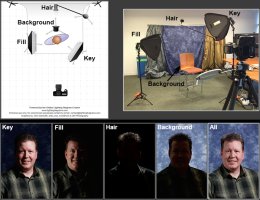
awesome, thanks for sharing. this sequence explains the idea perfectly.
 
Upvote 0
neuroanatomist said:
AcutancePhotography said:
When I use multiple lights, I like to set each one up separately to make sure that each light is doing what I need it...

Each light needs to have a purpose and can, usually, be evaluated for that purpose individually. Of course you also have to look at how all the lights working together at the same time make or break the scene.

+1

Here's an example from a 4-light 'corporate headshot' setup. Key and fill are each a 600EX-RT in a Lastolite 24" Ezybox, both on Manfrotto 1051BAC stands. The key has a round mask diffuser panel (for catchlight shape), and the fill is gridded. The hair light is a 600EX-RT with a Honl 1/8" Speed Grid on a Manfrotto 420B Combi Boom. Background light is an Buff Einstein 640 with a white shovel background reflector, on a Manfrotto 012B backlight stand. The backdrops are Backdrop Alley muslin on a Manfrotto 1314B background support system. Speedlites were radio triggered with an ST-E3-RT and the monolight was optically slaved.

Very good and instructive way of showing the effects of all parts! But did you have to use such an expensive model for this example? ;)
 
Upvote 0
neuroanatomist said:
AcutancePhotography said:
When I use multiple lights, I like to set each one up separately to make sure that each light is doing what I need it...

Each light needs to have a purpose and can, usually, be evaluated for that purpose individually. Of course you also have to look at how all the lights working together at the same time make or break the scene.

+1

Here's an example from a 4-light 'corporate headshot' setup. Key and fill are each a 600EX-RT in a Lastolite 24" Ezybox, both on Manfrotto 1051BAC stands. The key has a round mask diffuser panel (for catchlight shape), and the fill is gridded. The hair light is a 600EX-RT with a Honl 1/8" Speed Grid on a Manfrotto 420B Combi Boom. Background light is an Buff Einstein 640 with a white shovel background reflector, on a Manfrotto 012B backlight stand. The backdrops are Backdrop Alley muslin on a Manfrotto 1314B background support system. Speedlites were radio triggered with an ST-E3-RT and the monolight was optically slaved.

Awesome example, Neuro! Definitely highlights the importance of each light in a 4-light setup! I am a big believer in lighting the background separately - and I use the exact setup you have! Also, the hair-light just adds so much "pop" to a portrait - and I like how it also spills over his shoulders and creates even more separation from the background! Well done!
 
Upvote 0