Camera focusing

BPO

Oct 14, 2012
4
0
4,611
I am currently using a 5d mark iii and I love it. I have AFMA all of my lenses. I use mostly the 24-70 2.8ii and the 70-200 2.8i and every once in a while the 85 1.2 ii. My issue is that when post processing my pictures the ones shot in landscape orientation look considerably better and are in focus better than the ones shot in portrait orientation. Is there something that could be causing this in the camera or is this most likely operator error? It wouldn't be a big deal if it was only occassionally but looking back at my past shoots the best pictures are always taken in landscape orientation. Thanks for all replies and insights.
 
Operator error most likely. Not everyone is comfortable with the hand positioning in portrait orientation.

If things don't work out, try using a grip and see if it makes a difference (it should).
 
Upvote 0
Try shooting the same exact object after putting your camera on a tripod and taking a few shots (3 or 5) in each orientation. That should tell you something.

Also post the pictures and point out the issues in order to get better inputs. :)
 
Upvote 0
J.R. said:
If things don't work out, try using a grip and see if it makes a difference (it should).

After the test mentioned by rpt, totally try that. Grips arent that expensive and my portraits oriented pics really improved once I got a grip. Comfort helps to focus on composition and what not. But this might require the large hands and use to weight that some don't have/want.
 
Upvote 0
Hi BPO.
I know the 5D III has lots of focus points, not all equal, and the ability to change focus points dependant on orientation, is this perhaps the cause of your issue or do you use the same point in both orientations?

Cheers Graham.

BPO said:
I am currently using a 5d mark iii and I love it. I have AFMA all of my lenses. I use mostly the 24-70 2.8ii and the 70-200 2.8i and every once in a while the 85 1.2 ii. My issue is that when post processing my pictures the ones shot in landscape orientation look considerably better and are in focus better than the ones shot in portrait orientation. Is there something that could be causing this in the camera or is this most likely operator error? It wouldn't be a big deal if it was only occassionally but looking back at my past shoots the best pictures are always taken in landscape orientation. Thanks for all replies and insights.
 
Upvote 0
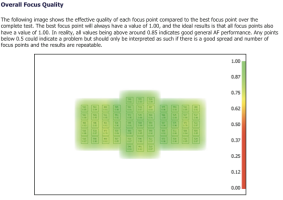
+1 to the suggestions above, particularly Graham's. If you have FoCal, run a multipoint test which checks all 61 AF points and gives you a 'heat map' of accuracy. I know of one 5DIII user who sent his camera for repair based on those data.

Here's one of mine, 1D X with the 100L:
 

Attachments

  • AF Quality.png
    AF Quality.png
    78.8 KB · Views: 604
Upvote 0
neuroanatomist said:
+1 to the suggestions above, particularly Graham's. If you have FoCal, run a multipoint test which checks all 61 AF points and gives you a 'heat map' of accuracy. I know of one 5DIII user who sent his camera for repair based on those data.

Here's one of mine, 1D X with the 100L:

Yes, my 5D MK III definitely has some of the points that are not perfect when I ran the focal test, but I've never bothered to have it adjusted.
 
Upvote 0
The 61 focus points on the 5DIII are a mixed bag of different double cross, single cross, and non-cross types. This is an important distinction. A focus point is actually a small line, or group of lines. And best focus is achieved when whatever you are focusing on crosses one of those lines at or near a right angle. So if a non-cross-type focus point you are using is oriented horizontally and you are trying to focus on something that has primarily a horizontal orientation in the frame, there is very little intersecting cross section for the AF point to latch on to.

Like wise if the AF point is vertical and you are trying to focus on something that is standing straight up and down.

Again, best results are achieved when the AF point orientation is at or near 90-degrees to whatever you are focusing on.

A cross-type AF point combines AF lines in two directions perpendicular to each other - usually horizontal and vertical. In the 5DIII, there are also dual-cross points that use diagonal crossing lines.

Of the 61 AF points in the 5DIII (and 1DX) system, only 41 are cross-type sensors. The remaining 20 are single-line AF points.

I have mine configured to disable the non-cross-type AF points. That's one of the settings in the AF configuration system. Trying turning off the non-cross-type points and see what you get when you know you are always using a cross-type AF point regardless of camera orientation.

There's a fabulous guide to the 1DX AF system and the only difference between it and the 5DIII system is the AF-point linked metering on the 1DX. Otherwise they are identical so this guide is equally valuable and pertinent to 5DIII users.

http://www.learn.usa.canon.com/resources/articles/2012/1dx_guidebook.shtml
 
Upvote 0
gbchriste said:
There's a fabulous guide to the 1DX AF system and the only difference between it and the 5DIII system is the AF-point linked metering on the 1DX. Otherwise they are identical so this guide is equally valuable and pertinent to 5DIII users.

It sounds like you're referring to Spot Metering linked to any AF point, which is available on the 1-series bodies but not on other Canon bodies, where spot metering is limited to the center of the frame. I'd call that more of a difference in metering rather than AF systems.

The difference in the AF systems is iTR - face/subject recognition and tracking in AI Servo. As Canon puts it, on the page you linked:

" The only major AF-related difference between the two involves their metering systems. With the EOS-1D X, the new 100,000-pixel RGB metering system not only measures exposure, but can be used along with Automatic AF point selection to assist the AF system in following subjects around the AF area. This is Canon's Intelligent Tracking and Recognition system, EOS iTR. Backing up this sophisticated 100,000-pixel metering system is a separate, independent DIGIC 4 processor, dedicated strictly to metering tasks."
 
Upvote 0