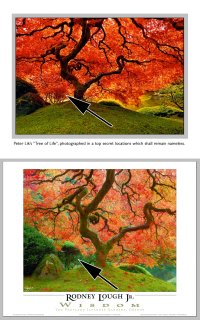
Can someone debunk this Peter Lik picture... PLEASE!!!

  • Thread starter Thread starter arussarts
  • Start date Start date
Status
Not open for further replies.
wickidwombat said:
moreorless said:
Can't say I care too much whether its "real" or not but I do care that its garish rubbish. ;)
But hes sold 200 million in limited edition prints and is a master of photography! and has memberships to all the exclusive clubs ::)

But on a more serious note i do feel like saying "put down the mouse and step away from the saturation slider!" with a loud horn

As a wise man once said "Nobody ever went broke underestimating the taste of the American public"
 
Upvote 0
Just catching up on this, I can't comment on the detail of the image, but I have seen the moon appear that big before. Happened to me about a decade ago driving up to Maine for a Columbus Day weekend. Think it was the Harvest Moon and coming up over Rte 128... Basically the moon was bigger than 8 lanes of divided highway and was also a gorgeous deep red. Don't think it was nearly that sharp, but looks like something from another world.
 
Upvote 0
Maui5150 said:
Just catching up on this, I can't comment on the detail of the image, but I have seen the moon appear that big before. Happened to me about a decade ago driving up to Maine for a Columbus Day weekend. Think it was the Harvest Moon and coming up over Rte 128... Basically the moon was bigger than 8 lanes of divided highway and was also a gorgeous deep red. Don't think it was nearly that sharp, but looks like something from another world.

Yeah you get extreme atmospheric distortion at a low level, especially with a 600mm lens or longer.
 
Upvote 0
Both the moon and the fore/background images are quite nice, but it's disappointing that the photoshoping was so poorly done. I can't see the advantage of going through the trouble to shoot on location when the result anyway doesn't resemble reality, in particular with the two widely different focal lengths used in the composite.

The stellar background also looks fake to me (not merely wrong scale/exposure) - the brightness distribution of the stars is too small for a real sky image but typical for imaginary ones produced by artists. It could perhaps be a detail of the milky way, or part of an Hubble Space Telescope image of another galaxy, but nothing you capture without a dedicated telescope compensating for the Earth rotation. The obvious gradient of the sky is not apparent in the star brightness distribution - if you look at real images of the night sky, stars fade quickly as you get close to the horizon, in particular if there's haze.

Too bad a date wasn't given, we could have found out the precise location and phase of the moon at moonrise.
 
Upvote 0
5D Freak said:
-the moon has been taken at 1/500s (ISO200) at probably the native focal length of a reflector (not refractor) telescope at F11 (Celestron C14 or equivalent Meade). Larger the diameter, the less effect atmospheric abberations have.

In general I agree with what you write, with the exception of this. The opposite is actually true. Larger diameter telescopes are more affected by atmospheric turbulence. The simple reason is that more air is sampled by the larger parallel beam. The diffraction limit, on the other hand, goes down with telescope diameter. Unless you have adaptive optics or are imaging in the infrared, however, a diameter larger than 10 cm is not going to help your resolution much (and may actually be detrimental), because the airmass itself will limit your resolution to about 1 arcsecond. Lens telescopes are preferred to mirror telescopes when observing bright targets like the moon and the planets, because they usually have a cleaner aperture (i.e. no obstructing secondary mirror) that produces better contrast.
 
Upvote 0
Maui5150 said:
Just catching up on this, I can't comment on the detail of the image, but I have seen the moon appear that big before. Happened to me about a decade ago driving up to Maine for a Columbus Day weekend. Think it was the Harvest Moon and coming up over Rte 128... Basically the moon was bigger than 8 lanes of divided highway and was also a gorgeous deep red. Don't think it was nearly that sharp, but looks like something from another world.

Ok the moon can appear bigger, especially when it first rises in a dark sky. But it is not bigger, it's just the way your brain works. It does not change it's distance earth, or it's size, so to get a photograph of it like Peter your going to have to use a loooong lens/telescope, or crop the image. I have been out at sea, and seen people terrified by the rising moon. I recall a friend screaming "a huge sailboat is coming right at us!" Nope, just the moon dude.

I did some math one time and found that if you want to fill the frame with the moon, actually get the edges of the moon to touch the edges of the horizontal edges of frame, you'd need a 2350mm lens on FF and about 1450 on a 1.6 crop.
 
Upvote 0
TexPhoto said:
Maui5150 said:
Just catching up on this, I can't comment on the detail of the image, but I have seen the moon appear that big before. Happened to me about a decade ago driving up to Maine for a Columbus Day weekend. Think it was the Harvest Moon and coming up over Rte 128... Basically the moon was bigger than 8 lanes of divided highway and was also a gorgeous deep red. Don't think it was nearly that sharp, but looks like something from another world.

Ok the moon can appear bigger, especially when it first rises in a dark sky. But it is not bigger, it's just the way your brain works. It does not change it's distance earth, or it's size, so to get a photograph of it like Peter your going to have to use a loooong lens/telescope, or crop the image. I have been out at sea, and seen people terrified by the rising moon. I recall a friend screaming "a huge sailboat is coming right at us!" Nope, just the moon dude.

I did some math one time and found that if you want to fill the frame with the moon, actually get the edges of the moon to touch the edges of the horizontal edges of frame, you'd need a 2350mm lens on FF and about 1450 on a 1.6 crop.

Actually what I was referring to is atmospheric refraction, which is what I was seeing, which is also why the moon was freakishly red.

Whether it was from high levels of CO2 or water vapor in the atmosphere at the time, the size difference I was noticing was not a mind trick / illusion, but was an optical magnification of the reflected light do to the quality of air at the horizon combined with the curvature of the earth.

So while I have personally experienced cases where the appearance of the moon was much larger, and do to magnification of the atmosphere, and not a perspective illusion, I also recall that the features were softened / blurred, and not as crystal clear and sharp as through air. This is further amplified as when the moon is coming just over the horizon, the light is passing through more atmosphere.
 
Upvote 0
"Next time you're stunned by large moon on horizon, bend over and view it between your legs. The effect goes away entirely." - Neil deGrasse Tyson

Neil deGrasse Tyson (born October 5, 1958) is an American astrophysicist, a science communicator, the Frederick P. Rose Director of the Hayden Planetarium at the Rose Center for Earth and Space, and a Research Associate in the Department of Astrophysics at the American Museum of Natural History. Since 2006 he has hosted the educational science television show NOVA scienceNOW on PBS.

Or check here: http://en.wikipedia.org/wiki/Moon_illusion
 
Upvote 0
I think it's entirely possible, however I'd hate to look for that perfect spot where it becomes possible.

Also I think his colors are rubbish... I would have touched those. Looks like something from the 80s.

Check out the Koyanisqatsi film. At some point within the first 20 min or so, he films the moon as a backdrop to some highrisers and also here the size looks daunting. It is possible with a long enough lens and far enough away from the foreground objects.
Best of luck getting it :D
 
Upvote 0
TexPhoto said:
"Next time you're stunned by large moon on horizon, bend over and view it between your legs. The effect goes away entirely." - Neil deGrasse Tyson

Neil deGrasse Tyson (born October 5, 1958) is an American astrophysicist, a science communicator, the Frederick P. Rose Director of the Hayden Planetarium at the Rose Center for Earth and Space, and a Research Associate in the Department of Astrophysics at the American Museum of Natural History. Since 2006 he has hosted the educational science television show NOVA scienceNOW on PBS.

Next time you're stunned by a large moon on the horizon, tell your friend to pull his pants back up.
 
Upvote 0
Aren't we already brain washed to accept all kind of funny creatures to make fortunes based on lies, hoaxes, stolen intellectual properties?
Just today someone have reached 28 billion of personal worth, apparently as the legend says, on not entirely honest manipulations.
All we bread eaters, sheep, ****, can do is go and occupy Wall St. I guess...
 
Upvote 0
The moon is bigger on the horizon thing (Atmospheric magnification) is a myth. Long since proven false.

Peter's images never looked very real to me. The dime store romance novel language of how he felt connected to the moon is the part than makes me feel sick.
 
Upvote 0
TexPhoto said:
I did some math one time and found that if you want to fill the frame with the moon, actually get the edges of the moon to touch the edges of the horizontal edges of frame, you'd need a 2350mm lens on FF and about 1450 on a 1.6 crop.
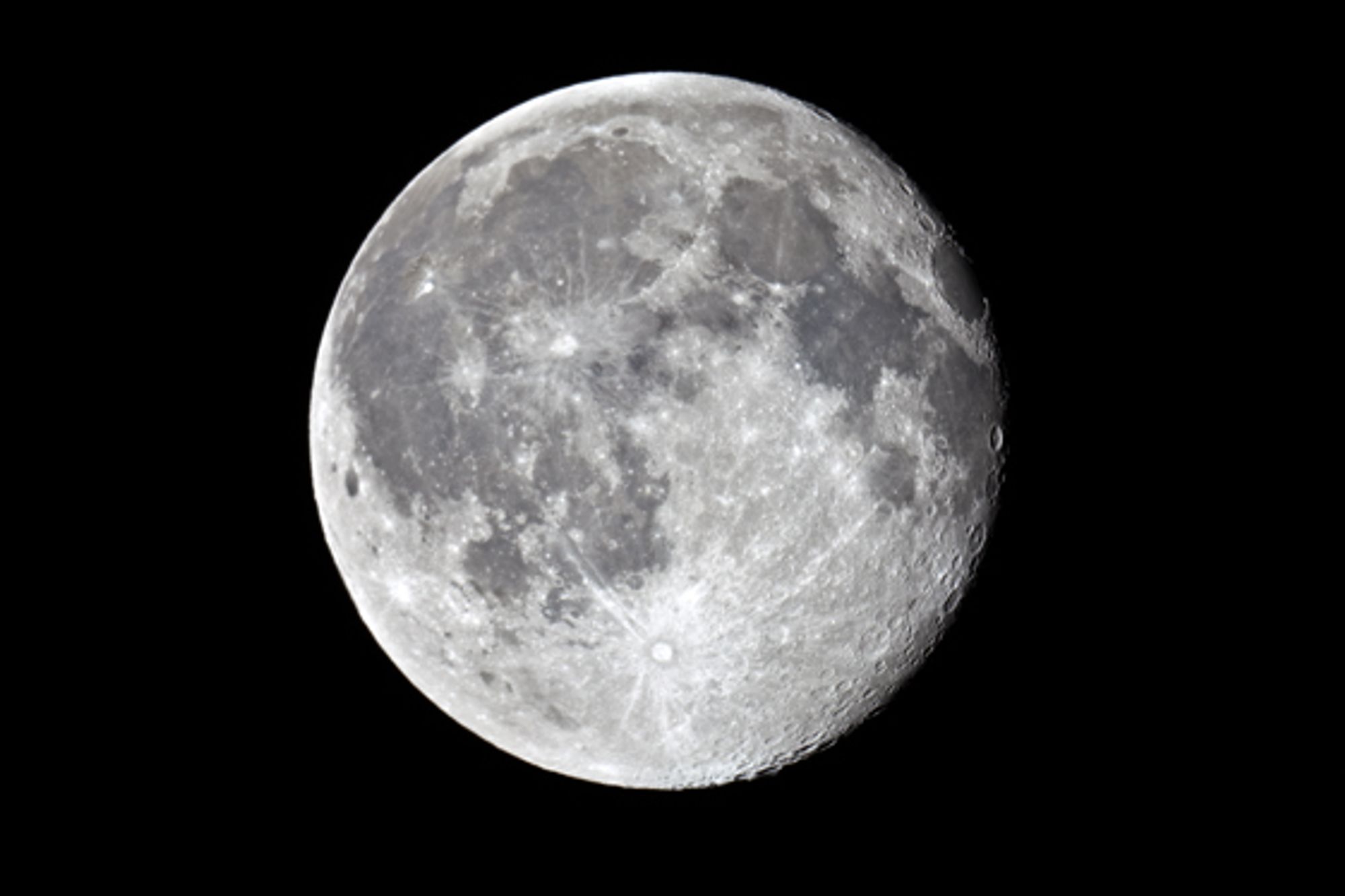
Sounds about right. This image is a fullframe image of the moon, shot through a Celestron CPC 800 of 2032 mm focal length.

luna_sm.jpg


Full size image here.
 
Upvote 0
I'm just am amateur/advanced amateur, but do have some questions: (1) How can the haze or clouds that create the lavender tones in the photo be behind, and nowhere in front of, any portion of the moon? Wouldn't the haze or clouds have to be more than 340,000 miles from the earth in order for that to be the case? (2) Is there a lens that would allow both the moon and the foreground tree to both be in sharp focus? What focal length would be required for that to work? (3) Did the photographer survive the absolute nail-biting, nerve wracking experience? If this is what one goes through to get an exceptional photo, I can only guess how Moses' post-climb writeup would have read, after he had seen the burning bush and heard the voice of God.
 
Upvote 0
Status
Not open for further replies.