Canon’s Image Stablization Innovation

Richard CR

Canon Rumors Premium
Dec 27, 2017
2,339
3,625
17,629
Canada
www.canonnews.com
This article looks through Canon's history and innovation in the realm of image stabilization. So sit down, grab a coffee, because this is a long article. Canon’s image stabilization (IS) systems have transformed photography and videography, delivering sharp images and smooth footage despite camera shake or motion. From optical to digital solutions, Canon has crafted […]

See full article...
 
  • Like
Reactions: 1 users
Great, comprehensive post – thanks!

Anyone out there has IS issues when mounted on a tripod?

Way back, the white L telephoto lenses with IS, when mounted on a tripod with IS enabled, ‘oscillated’ as the IS sensor would be in a ‘dead zone’ with no movement detected. This was fixed in latter versions of these lenses.

Recently, on an indoor existing light tripod setup, I had an issue with IS on with my EF 100mm f/2.8 L Macro lens. I used mirror lock and self-timer on my 1DX II. Stopping down several stops from wide open (with correspondingly longer exposure times) yielded decidedly increased blur – way more than diffraction effects. I thought perhaps some minor vibration in my floor was causing the increased blur with longer exposure times. I always walk away from the tripod during the 10-second self-timer countdown. Experimenting with turning off the mirror lock, self-timer and IS determined IS was the culprit.

Perhaps the EF L Macro lens’ ‘hybrid’ IS does not like to be mounted on a tripod?
 
Upvote 0
Perhaps the EF L Macro lens’ ‘hybrid’ IS does not like to be mounted on a tripod?
Most lenses with IS should have it turned off when using a tripod. Newer lenses detect tripod mounting (based on a lack of motion) and disable IS. I don’t know how that works with adapted lenses on R bodies, and I don’t think the IS system on the EF 100L Macro is tripod-sensing anyway.

As a general rule, IS should be turned off when on a tripod. The exception is with Canon’s supertele lenses depending on the model, e.g. the IS system of the 300/400/500/600 MkII and the MkIIIs of the 400/600 lenses can mitigate mirror slap on a DSLR.
 
  • Like
Reactions: 4 users
Upvote 0
Anyone out there has IS issues when mounted on a tripod?
I located my images with the IS on when using a tripod issue.

I recently purchased a new car and wanted to archive its window sticker. It was too large for my flatbed scanner, so I decided to take a photo of it taped to a wall with my macro lens.
 

Attachments

  • image_stabilizer_OFF.JPG
    image_stabilizer_OFF.JPG
    1.6 MB · Views: 6
  • image_stabilizer_ON.JPG
    image_stabilizer_ON.JPG
    1.1 MB · Views: 5
Upvote 0
I feel like the RF 100-400mm stabilizes more effectively on the R10 compared to the R8. Perhaps the 'wiggle room' provided by the smaller sensor allows for better stabilization efficiency. Even at the long end, where APS-C usually has the disadvantage of requiring more precision, I was repeatedly able to achieve sharp images at extreme shutter speeds at a 640mm equivalent. This seems to apply to the RF 24mm IS STM as well, its lens-based IS also performed better on the smaller sensor.
 
Upvote 0
Sorry, folks, for monopolizing this message thread…

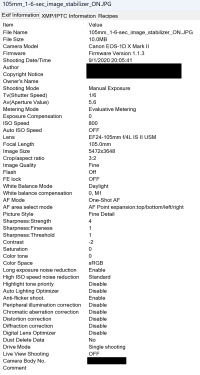
I want to state that 4-stops IS improvement is real. I am a senior citizen, don’t have Parkinson’s, but my hand-holding is not as steady as in my younger years.

The attached image is handheld 1/6 second at 105mm (full frame.) This is 4 stops down from the old general 1/focal length (35mm) rule for minimum hand-held shutter speed: 1/100, 50, 25, 12, 6.
 

Attachments

  • 105mm_1-6-sec_image_stabilizer_ON.JPG
    105mm_1-6-sec_image_stabilizer_ON.JPG
    3.2 MB · Views: 4
  • EXIF.png
    EXIF.png
    76.2 KB · Views: 4
Upvote 0
I located my images with the IS on when using a tripod issue.

I recently purchased a new car and wanted to archive its window sticker. It was too large for my flatbed scanner, so I decided to take a photo of it taped to a wall with my macro lens.
I recorded some video with the EF 100-400 ii & APS-C in windy conditions with a medium heavy tripod: Much much mure stability than without IS. Maybe it is a good idea to leave it on except you cannot accept battery drain (longer time lapses). More recent lenses have - as far as I know - a detection mechanism if they are mounted on a tripod or not.
 
Upvote 0
Most lenses with IS should have it turned off when using a tripod. Newer lenses detect tripod mounting (based on a lack of motion) and disable IS. I don’t know how that works with adapted lenses on R bodies, and I don’t think the IS system on the EF 100L Macro is tripod-sensing anyway.

As a general rule, IS should be turned off when on a tripod. The exception is with Canon’s supertele lenses depending on the model, e.g. the IS system of the 300/400/500/600 MkII and the MkIIIs of the 400/600 lenses can mitigate mirror slap on a DSLR.
My experience with the EF 100-400 ii is that IS can help in windy conditions to stabilize the image - seen at 400mm with APS-C sensor, I switched it off for some shots and seen afterwards that IS works here on tripod at least for video.
My general rule getting more and more important with these complex (and great) camera-lens systems is trying out different things to understand the interwoven functions of these systems.
 
Upvote 0
I feel like the RF 100-400mm stabilizes more effectively on the R10 compared to the R8. Perhaps the 'wiggle room' provided by the smaller sensor allows for better stabilization efficiency.
Correct. If the image circle is larger than needed, that helps (to a point). It’s why the 28-70/2 gets the full 8 stops from IBIS. It’s why the R7 gets at most 7-stops with RF-S lenses, but can get 8-stops with some RF lenses (including the 28-70/2 that doesn’t have IS).
 
Upvote 0
My experience with the EF 100-400 ii is that IS can help in windy conditions to stabilize the image - seen at 400mm with APS-C sensor, I switched it off for some shots and seen afterwards that IS works here on tripod at least for video.
My general rule getting more and more important with these complex (and great) camera-lens systems is trying out different things to understand the interwoven functions of these systems.
Continuous IS on these lenses is immensely helpful with video in general: smooths out pans and softens ground vibrations or camera adjustments. I replaced my EF 100-400ii with the RF 100-500 (for the R7) and the on the newer lens the IS auto-shuts off when it detects a stable surface, so now the slightest touch of the camera at 500 causes an "earthquake". Can't count how much footage this "feature" has wrecked. See below for an example (albeit with different scenes).

https://youtu.be/B6HW8nKz5P8?si=njnTx6_eFlnY8uEW
 
Upvote 0