
Canon 5D Mark III - Resolution Review

  • Thread starter Thread starter jcs
  • Start date Start date
Status
Not open for further replies.
psolberg said:
JasonATL said:
I'm with peederj on this on. This is simply illogical. If the optical low pass filter is, indeed, optical, then it is in hardware. In live view, zoom in as peederj suggests. The resolution is there on the sensor AFTER the optics of the camera. So, any softening would logically come from the downconversion AFTER the sensor and the optics.

Having said that, if you provide an even sharper (dare I say even aliased) image to the same downscaling algorithm, it seems plausible to me that the result might appear sharper. But, that won't necessarily make a better image overall.

I won't be running out to mod my 5D3 any time soon, assuming this is even serious.

just curious, did you watch the video? phillip bloom had his own take
http://philipbloom.net/2012/04/01/a-drastic-solution-to-increasing-sharpness-with-the-5dmkiii/

To my eyes, it looks better, but as I said, I'm sure we'll find out more in time.

It still doesn't look at all as sharp as the C300 though. It's hard to see how it could help more than a modest little bit. I mean take an unmodded 5D3 22MP still and downsample to 2MP and it looks way sharper than the video a stock 5D3 produces AND simply look at a 100% view of a 22MP still and it still looks way sharper, so if the AA is so strong as to blur up 2MP off the sensor then how can a 22MP look at the sensor look so much vastly crisper?

I still think they need to add a 2x2 1.6x cropped true 1920x1080p mode on the 5D3. A crop mode would be useful at times anyway. Nikon and the others offer cropped modes. But Canon and their stupid protectionism are shooting themselves in teh foot. They could've had raves beyond raves for this had they just added zebra strips, zoom focusing while shooting, a true 1920x1080 mode even if it perhaps could only happen at 1.6x crop due to technical limitations (3x3 may be too large block for the internal AA filter to help enough so maybe they had to blend things, or perhaps, as some suggest 3x3 doesn't work well and they are doing 4x4 but at reduced resolution then).

I wonder if they didn't cripple the 5D3 to save the Cinema line.... and yet it was the 5 series video were they actually were the revolution, with their new cinema line they will just be one among many.
 
Upvote 0
It still doesn't look at all as sharp as the C300 though. It's hard to see how it could help more than a modest little bit. I mean take an unmodded 5D3 22MP still and downsample to 2MP and it looks way sharper than the video a stock 5D3 produces AND simply look at a 100% view of a 22MP still and it still looks way sharper, so if the AA is so strong as to blur up 2MP off the sensor then how can a 22MP look at the sensor look so much vastly crisper?

I don't know the details of the sampling canon does for video versus stills, but the quality without the OLP is undeniably better which means that at least part of the issue is hardware related and not firmware. If the OLP filter played no part in the final output, then the video footage would look nearly identical with the exception of slightly more aliasing. However I'm seeing a noticeable increase in detail and it has yet to be explained away by those that don't think the OLP makes any difference. I agree it is no C300, but that's besides the point, it is better than the stock 5DIII and that's our reference point. Until I see otherwise, I can only believe what I see, and what I see is a noticeable impact of the OLP sensor based on empirical evidence.
 
Upvote 0
Has the guy who removed the OLPF posted the absolute most dead obvious first step of a resolution chart shot with modded and unmodded bodies with downloadable direct from camera files and enough information to 100% reproduce the results? If not, he's hiding something, and I think his inducing people to damage their $3500 cameras is seriously outrageous if he is.
 
Upvote 0
peederj said:
Has the guy who removed the OLPF posted the absolute most dead obvious first step of a resolution chart shot with modded and unmodded bodies with downloadable direct from camera files and enough information to 100% reproduce the results? If not, he's hiding something, and I think his inducing people to damage their $3500 cameras is seriously outrageous if he is.

I agree with the idea that a resolution chart (comparison) would be useful here. As much as I like resolution charts, it is picture quality in the real world that matters most. A resolution chart would tell us if resolution is really improved, but it wouldn't necessarily answer how much aliasing shows up on certain objects (though it should show some aliasing, if it exists).

I don't think James Miller is really trying to pull one over on people, nor is he necessarily encouraging anyone to damage their own cameras. Anyone who does so based only on his two videos might deserve a $3500 paper weight.

What he has indicated will be forthcoming this week is a side-by-side comparison with an unmodded 5D3 and his modded 5D3.
 
Upvote 0
I'm hoping that someone more knowledgeable than myself can help us interpret this.

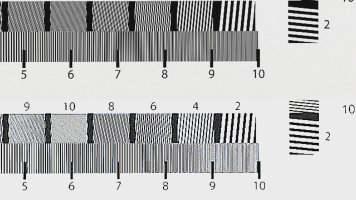
Here is capture from the same source video as in the resolution chart tests that I did (video linked above in this thread). In this capture, the video is on the bottom and the still (scaled to 1920x1080p) is on the top. I applied an EXTREME amount of sharpening to the video (more than anyone in their right mind would even dream of applying to real shots) and some to the still.

Under the theory (as I understand it) that sharpening cannot create resolution, I wonder what is going on in this chart? There are distinguishable groups of lines near the "10" (1000 lines) mark.

Does this mean that the 5D3 might have more true resolution than we think?

I don't think the actual resolution makes or breaks this camera. Though I want to get more real-world footage, I'm happy with what I'm seeing so far. I'm downright amazed at how much sharpening I can apply to real shots and it still look very nice. I'm just curious about this and had already shot the charts (a bit of a painstaking process - and it probably still wasn't done perfectly).

I'm just hoping someone can improve my understanding of how to read and interpret what we see in these charts.

Thanks!
 

Attachments

  • ResHyperSharpened.jpg
    ResHyperSharpened.jpg
    569.1 KB · Views: 1,895
Upvote 0
Under the theory (as I understand it) that sharpening cannot create resolution, I wonder what is going on in this chart? There are distinguishable groups of lines near the "10" (1000 lines) mark.

you're just enhancing whatever is there and introducing artifacting in the process. garbage in garbage out per se. black and white lines are as ideal to the algorithm as it gets, and not really representative of what you'll actually achieve in the field where less dramatic contrast and irregular edges will make sharpening fall appart. you simply can't extrapolate this result to what you'll capture in the field.
 
Upvote 0
JasonATL said:
I'm hoping that someone more knowledgeable than myself can help us interpret this.

Here is capture from the same source video as in the resolution chart tests that I did (video linked above in this thread). In this capture, the video is on the bottom and the still (scaled to 1920x1080p) is on the top. I applied an EXTREME amount of sharpening to the video (more than anyone in their right mind would even dream of applying to real shots) and some to the still.

Under the theory (as I understand it) that sharpening cannot create resolution, I wonder what is going on in this chart? There are distinguishable groups of lines near the "10" (1000 lines) mark.

Does this mean that the 5D3 might have more true resolution than we think?

Hey Jason- as the lines approach the resolution limit of the camera, the information begins to alias. As we move farther right, the aliasing becomes so strong that we can no longer see clear black-white line pairs. The limit in your chart example is around 850 lines, which is consistent with every other line chart test I have seen (including my own). The lines you are seeing past 850 are aliased and so-called 'false detail'. At one point based on your vimeo test I estimated 890 lines, however 850 is probably more fair. 1000+ would be nice but 850 is good enough for now.

I too have asked to see a line chart with the NO-OLPF mod. My guess is that it will show 900+ lines. I estimate that removing the OLPF might not alias too badly for video based on the low-pass filtering effect of pixel binning (2x2 or 3x3, etc.). Also requested pan shots on high detail image- sounds like they are coming.

It's possible to have the OPLF mod done for $450 by maxmax.com. They'll also put an optical glass in place to keep the optics correct. Ideally they'll find a way to also make the dust cleaning system work (or perhaps Canon will provide the parts, including optical glass, to make this work: another way to make a buck).
 
Upvote 0
No, those lines don't count at all.
You are supposed to stop counting as soon as you first hit a pair where you don't have a clear and normal looking separation. You can always get some here and there that pop up later on if they hit the right aliasing alignment or something. And there is more than resolution, the MTF can be really weak at higher frequencies. Without sharpening, black bars on the 5D3 already start fading out contrast even above just 400. Sharpening is absolutely required for 5D3 video otherwise the micro-contrast at all but really lo res scales is terrible.


JasonATL said:
I'm hoping that someone more knowledgeable than myself can help us interpret this.

Here is capture from the same source video as in the resolution chart tests that I did (video linked above in this thread). In this capture, the video is on the bottom and the still (scaled to 1920x1080p) is on the top. I applied an EXTREME amount of sharpening to the video (more than anyone in their right mind would even dream of applying to real shots) and some to the still.

Under the theory (as I understand it) that sharpening cannot create resolution, I wonder what is going on in this chart? There are distinguishable groups of lines near the "10" (1000 lines) mark.

Does this mean that the 5D3 might have more true resolution than we think?

I don't think the actual resolution makes or breaks this camera. Though I want to get more real-world footage, I'm happy with what I'm seeing so far. I'm downright amazed at how much sharpening I can apply to real shots and it still look very nice. I'm just curious about this and had already shot the charts (a bit of a painstaking process - and it probably still wasn't done perfectly).

I'm just hoping someone can improve my understanding of how to read and interpret what we see in these charts.

Thanks!
 
Upvote 0
Thanks all for the explanations! I suspected that the lines at the higher frequencies "didn't count" or thought that they probably shouldn't count, even if they might count on some technicality.

In my tests, my Sony EX1 looks "clean" in this regard -- without having to sharpen it. But, as I've said elsewhere, I often prefer the end result of the real world footage from the 5D3 (even my 600D in many cases) to my EX1.
 
Upvote 0
JasonATL said:
Thanks all for the explanations! I suspected that the lines at the higher frequencies "didn't count" or thought that they probably shouldn't count, even if they might count on some technicality.

In my tests, my Sony EX1 looks "clean" in this regard -- without having to sharpen it. But, as I've said elsewhere, I often prefer the end result of the real world footage from the 5D3 (even my 600D in many cases) to my EX1.

your tests did hint that the EX1 might be prone to aliasing
 
Upvote 0
has anybody found a comparison of the 5DIII vs the HDMI 4:2:2 of the D800? I think the internal codec of the D800 easily wins in detail to even the "all I" mkIII one. But I'm really curious if the detail will improve using the HDMI out because both the D800 and 5DMKIII are still VERY SOFT compared to a still downscaled to 1080.
 
Upvote 0
psolberg said:
has anybody found a comparison of the 5DIII vs the HDMI 4:2:2 of the D800? I think the internal codec of the D800 easily wins in detail to even the "all I" mkIII one. But I'm really curious if the detail will improve using the HDMI out because both the D800 and 5DMKIII are still VERY SOFT compared to a still downscaled to 1080.

ALL-I stores less detail than IPB (ALL-I stores more noise & artifacts, which can look sharper/more detailed before post processing. PPro CS5.5's decoder exacerbates the ALL-I quality problem (macroblocking), whereas FCP7/Compressor's decoder does a better job). Post sharpening works great on IPB (and to a lesser extent on ALL-I due to noise & artifacts; it can become chunky/granular if sharpened too much).

Tested static shots, moving shots, low & high detail- haven't yet been able to get ALL-I to exceed IPB in detail stored. If anyone has an example showing ALL-I exceeding IPB, please post it (+100% still frame crops) along with camera settings (http://carousel.hu/c300/?page_id=395 shows ALL-I not looking worse than IPB, however the scene is not detailed).
 
Upvote 0
jcs said:
ALL-I stores less detail than IPB (ALL-I stores more noise & artifacts, which can look sharper/more detailed before post processing. PPro CS5.5's decoder exacerbates the ALL-I quality problem (macroblocking), whereas FCP7/Compressor's decoder does a better job). Post sharpening works great on IPB (and to a lesser extent on ALL-I due to noise & artifacts; it can become chunky/granular if sharpened too much).

Tested static shots, moving shots, low & high detail- haven't yet been able to get ALL-I to exceed IPB in detail stored. If anyone has an example showing ALL-I exceeding IPB, please post it (+100% still frame crops) along with camera settings (http://carousel.hu/c300/?page_id=395 shows ALL-I not looking worse than IPB, however the scene is not detailed).

And would Canon kindly provide us an IPB that runs at ALL-I's max of 90mbps? The camera can handle streaming that much data; ALL-I is virtually worthless in practice...and so...why not let us use everything we paid for... :-\
 
Upvote 0
peederj said:
Interesting analysis of D800 resolution, with commentary on 5D3:

http://falklumo.blogspot.de/2012/04/lumolabs-nikon-d800-video-function.html

Wish I'd said that. ;)

Stephen Melvin said:
It appears that the D800 is line skipping, only using one row out of three. This would explain its noise performance compared to the Mk III. It also appears that the Mk III is binning, using the entire sensor.

http://falklumo.blogspot.de/2012/04/lumolabs-nikon-d800-video-function.html
 
Upvote 0
Stephen Melvin said:
It appears that the D800 is line skipping, only using one row out of three. This would explain its noise performance compared to the Mk III. It also appears that the Mk III is binning, using the entire sensor.

http://falklumo.blogspot.de/2012/04/lumolabs-nikon-d800-video-function.html

interesting but, I don't care much for moire from my experience with the 5DII. Detail, as close as true 1080p is what I'm after and so far the D800 delivers more than either the 5DII or III. I'm still looking for that HDMI 4:2:2 footage comparison, but apparently external recorders are having trouble doing the handshake with the D800 for full 1080p and OEMs have not yet provided firmware updates. namely the atomos ninja.
 
Upvote 0
With the advent of large sensor interchangeable lens video-specific cameras that are affordable (fs-100, fs-700, etc.) I think the days of DSLR video are more or less coming to an end anyway. It will fall back to being what it was intended for: a convenience facility for photojournalists that primarily shoot stills and don't want to carry two cameras. I shoot both stills and video roughly equally and would like to be able to have my 5d3 as a B-cam and even an A-cam for narrow DOF shots, but Canon has, sadly, crippled the resolution. :'(

The D800 is of no interest to me; my next stills camera move will probably be to medium format. Medium format video would be truly awesome.

Canon is going to try to wring some money out of people (via the overpriced C300) as they ramp up their cinema division, something they can only do because of the runaway success of the 5d2 and the subsequent vestment of all that EF glass. But with the fs-700 easily adaptable to EF or any other glass, and the Zeiss CP primes having interchangeable mounts, those margins will not be sustainable for Canon. I think they have made a big mistake here with the 5d3 resolution: they could have sustained that branding and that franchise, undercutting Sony and Panasonic, but they've had internal interference with their own opportunity. Positioning a 1080p cam against RED's 4K cam for a similar TCO was a blunder they shouldn't be protecting.

The 5d3 does beat the D800 in video, soundly. But who cares? Nikon is a non-player in video, even though it had the first DSLR video, and Canon has far bigger threats on its horizon.

We will check back after NAB.
 
Upvote 0
I'm shooting my movie, now with 2 5D3s. I've got Canon lenses, and I am familiar with Canon's software (custom profiles), menu systems, and can get pro audio out of in-camera recording when necessary (using a preamp).

I can sharpen and add custom noise to IPB in post that looks crisp, clean and detailed enough for my needs at this time.

If the D800 were all around better, would you sell all of your Canon glasses and switch?

The FS700 is more than twice as much as the 5D3, requires an expensive adapter for Canon lenses (Metabones), requires a full support rig and a lot more gear to make into a useful tool. Granted the results will be excellent, however run & gun and discrete shooting options go away.

Hopefully the release of the FS700 will bring down the price of the C300, which I would prefer over the FS700 (the FS700 won't do 4k at release).

For the manufacturers, yes, it is a contest of sorts. However for us consumers, the release of new cameras doesn't prevent our current cameras from working. Nothing stopping us from completing our projects.

Also note that a $450 maxmax.com OLPF removal mod may bring the 5D3 up closer to 1000 lines of resolution. If they can make the dust cleaning system operational, I might consider this option (after more examples have been posted showing no major issues with aliasing and moire (at least similar to C300 performance)).
 
Upvote 0
if this is soft then I'm ok with soft. to me this is so sharp that i can read all the little tiny wording on all the billboards. also this look super clean to me, shot at night at 640iso f4 on the 24-105mm kit lens, in I-mode!
i also had to compress this for vimeo to a mp4, seems as clean and sharp as i would ever need out of DSLR.
fyi i also shot in times square last year too, but with a 5DMK2 and its was moire all over the place, none here!
ps, just noticed if you look at it on this page then its not playing in HD, so it probably does look soft, so press the vimeo button in the corner and make sure you watch in HD. the native file is even sharper.
5DMKIII night time video test
 
Upvote 0
Status
Not open for further replies.