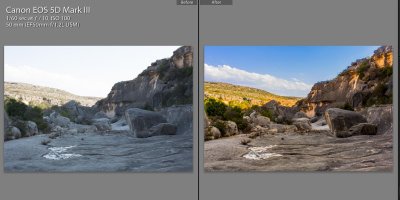
Canon 5d Mark III Shadow recovery

Status
Not open for further replies.
Marsu42 said:
Cgdillan said:
"5D MkIII or 6D??? | EF 35f1.4 | EF 50f1.4 | EF 70-200f2.8L MkII | TC 1.4x III | TC 2x III"
Unless all you do is video.. Definitely the 5D mkIII. My opinion...

... and if you do video: definitely 5d3, too, unless it's proven Magic Lantern will also run on the 6d. And the 6d hasn't even got the swivel screen, doh.

I agree mostly. If all you do is video and don't use magic lantern I would probably say 6D just for the price. unless of course you also need the headphone jack and silent controls. But IQ and ergonomics for video other than that is about the same.at $1,300 cheaper.

If you have the money then 5D mkIII will be the one that will last you without finding yourself wanting more. The 6D has it's limitations that you could easily outgrow.
 
Upvote 0
dswatson83 said:
This video compares the D600 & 7D for shadow recovery and they also show a 5dIII file. It's clear to me that there is banding and grain in both the Canon shots more than the Nikon but only when viewed at 100% or more and only when pushing it all the way.
Nikon D600 Review Part 4 - Dynamic Range Testing...WOW!

I disagreed with a huge portion of this video. I understand where he was coming from but still I disagree with his approach. and the 5D mmiii scene was so different than the sunset scene there was no way to actually compare the difference. Although yes a huge difference between the D600 and 7D. I wonder what the difference is between the 7D and D7000 in this area.
 
Upvote 0
Cgdillan said:
dswatson83 said:
This video compares the D600 & 7D for shadow recovery and they also show a 5dIII file. It's clear to me that there is banding and grain in both the Canon shots more than the Nikon but only when viewed at 100% or more and only when pushing it all the way.
Nikon D600 Review Part 4 - Dynamic Range Testing...WOW!

I disagreed with a huge portion of this video. I understand where he was coming from but still I disagree with his approach. and the 5D mmiii scene was so different than the sunset scene there was no way to actually compare the difference. Although yes a huge difference between the D600 and 7D. I wonder what the difference is between the 7D and D7000 in this area.

I agree about the D600 vs. 7D comparison. He kept saying that there was "so much detail" in the D600 shadows, but not in the 7D shadows. As far as I could tell, the following is actually what occurred:

1. The 7D photo was over-exposed, which blew out the highlights of the sky, and captured full detail in the shadows.
2. The 7D shadows appeared to be fully recoverable, I did not see any LOSS of detail, even if it was a bit noisy detail. The 7D shadow detail in the 100% crop simply looked brighter and a bit noiser than the D600 100% crop, but I wouldn't have said there was LESS detail.
3. The D600 shot was a tiny bit under-exposed (or possibly just "properly" exposed), which preserved the highlights of the sky better.
4. The D600 DOES preserve additional detail in the shadows, so they were able to be recovered despite the lower exposure than the 7D.
5. The 7D shadows looked dull and muddy because a 100% shadow recovery resulted in a higher shadow exposure overall than in the D600 recovery.
6. The D600 appeared to have the same general DETAIL in the shadows, however since it was not over-exposed with a 100% shadow push, it appeared to have much richer color.
7. The D600 was shot second, after the sun had sunk a little lower into the horizon, which would have reduced the dynamic range of the scene a bit. Combined with the D600's additional DR to start, the odds were overly stacked in favor of the D600.

I would offer that one of two things could be done with the 7D image. First, he could have exposed it properly. He just popped out the camera and snapped a shot, without any concern in-camera for preserving those highlights. That is NOT a fault of the camera, that was operator error. A proper 7D exposure would have resulted in much the same kind of sky and midtines as the D600. Probably would have REALLY lost some detail in the shadows if that was done, however with a bit of NR much of it could have been recovered. Wouldn't be as good as real DR, but it would have been better than a botched exposure.

Alternatively, the Blacks of the 7D could have been pulled down a bit, which would have had the effect of increasing shadow contrast, and enriched the shadow colors to look as good as the D600 from a color fidelity standpoint. Nothing can be done about the blown sky, however I would be willing to bet LR4 could do some wondrous things with it regardless, and produce a final image that looked a lot closer to what the D600 produced.

I really wish I could get my hands on a D600 to compare with my 7D. It wouldn't take much more than a LITTLE bit of extra care with the 7D to capture a similar scene with much better results. Again, nothing is an alternative for additional real-world sensor DR, but I think the video above was far too ad-hoc and careless to be a viable test. That blown sky was the result of crappy camera use by a hapless camera user. :P
 
Upvote 0
jrista said:
Cgdillan said:
dswatson83 said:
This video compares the D600 & 7D for shadow recovery and they also show a 5dIII file. It's clear to me that there is banding and grain in both the Canon shots more than the Nikon but only when viewed at 100% or more and only when pushing it all the way.
Nikon D600 Review Part 4 - Dynamic Range Testing...WOW!

I disagreed with a huge portion of this video. I understand where he was coming from but still I disagree with his approach. and the 5D mmiii scene was so different than the sunset scene there was no way to actually compare the difference. Although yes a huge difference between the D600 and 7D. I wonder what the difference is between the 7D and D7000 in this area.

I agree about the D600 vs. 7D comparison. He kept saying that there was "so much detail" in the D600 shadows, but not in the 7D shadows. As far as I could tell, the following is actually what occurred:

1. The 7D photo was over-exposed, which blew out the highlights of the sky, and captured full detail in the shadows.
2. The 7D shadows appeared to be fully recoverable, I did not see any LOSS of detail, even if it was a bit noisy detail. The 7D shadow detail in the 100% crop simply looked brighter and a bit noiser than the D600 100% crop, but I wouldn't have said there was LESS detail.
3. The D600 shot was a tiny bit under-exposed (or possibly just "properly" exposed), which preserved the highlights of the sky better.
4. The D600 DOES preserve additional detail in the shadows, so they were able to be recovered despite the lower exposure than the 7D.
5. The 7D shadows looked dull and muddy because a 100% shadow recovery resulted in a higher shadow exposure overall than in the D600 recovery.
6. The D600 appeared to have the same general DETAIL in the shadows, however since it was not over-exposed with a 100% shadow push, it appeared to have much richer color.
7. The D600 was shot second, after the sun had sunk a little lower into the horizon, which would have reduced the dynamic range of the scene a bit. Combined with the D600's additional DR to start, the odds were overly stacked in favor of the D600.

I would offer that one of two things could be done with the 7D image. First, he could have exposed it properly. He just popped out the camera and snapped a shot, without any concern in-camera for preserving those highlights. That is NOT a fault of the camera, that was operator error. A proper 7D exposure would have resulted in much the same kind of sky and midtines as the D600. Probably would have REALLY lost some detail in the shadows if that was done, however with a bit of NR much of it could have been recovered. Wouldn't be as good as real DR, but it would have been better than a botched exposure.

Alternatively, the Blacks of the 7D could have been pulled down a bit, which would have had the effect of increasing shadow contrast, and enriched the shadow colors to look as good as the D600 from a color fidelity standpoint. Nothing can be done about the blown sky, however I would be willing to bet LR4 could do some wondrous things with it regardless, and produce a final image that looked a lot closer to what the D600 produced.

I really wish I could get my hands on a D600 to compare with my 7D. It wouldn't take much more than a LITTLE bit of extra care with the 7D to capture a similar scene with much better results. Again, nothing is an alternative for additional real-world sensor DR, but I think the video above was far too ad-hoc and careless to be a viable test. That blown sky was the result of crappy camera use by a hapless camera user. :P

I understand that the D600 is better IQ. I meant that I disagree with the fact that he even compared the two cameras. It's a comparison that makes no sense since the two cameras would be used for two totally difference purposes. Neither one replaces the other.
 
Upvote 0
Cgdillan said:
Off topic but..
"5D MkIII or 6D??? | EF 35f1.4 | EF 50f1.4 | EF 70-200f2.8L MkII | TC 1.4x III | TC 2x III"
Unless all you do is video.. Definitely the 5D mkIII. My opinion...

From my experience in using 5d3 - it won't disappoint you at all. The video tends to be mushy with respect to fine details (outdoor - on grass for example) as other tests have shown but i don't know if 6d will be any better.

Whether 5d3 is worth the difference in price versus still untested 6D? well its not an easy call until you can test both the bodies.
 
Upvote 0
If the 5DIII has insufficient dynamic range for whatever you're doing, whatever you're doing is extreme. Basically, you're either trying to salvage a severely underexposed image, or you're trying to turn deep shadows into midtones (or even highlights -- I've actually seen people try that).

Here's an example of light that's as bad as one might reasonably want to shoot in -- midafternoon Arizona direct desert sunlight from the bottom of a steep ravine half-and-half lit and shadowed. And there's no dynamic range problems. No clipped highlights, no noisy or blocked shadows; just the expected image quality awesomeness from Canon's ultimate jack-of-all-trades camera.

http://www.canonrumors.com/forum/index.php?topic=13771.msg249243#msg249243

It's not a particularly beautiful image, though...but that's in no small part because the light itself is ugly.

Cheers,

b&
 
Upvote 0
.
This looks like Salt Lake City.


sach100 said:
This shot was taken while i was adjusting for correct exposure. The sky looked okay but the bottom half is obviously underexposed. I wanted to see how much i can push the shadows in post. I increased the shadow recovery slider to +100 in camera raw keeping everything else unaltered. If i can do this in post then this is plenty of available DR in shadows for me.
 
Upvote 0
TrumpetPower! said:
If the 5DIII has insufficient dynamic range for whatever you're doing, whatever you're doing is extreme. Basically, you're either trying to salvage a severely underexposed image, or you're trying to turn deep shadows into midtones (or even highlights -- I've actually seen people try that).
Not true. There are circumstances where you cannot properly expose all parts of the image due dyanmic range variations in the shooting conditions. You can expose properly for one part or the other and either blow out the highlights or block up the shadows. The lesser of two evils is to expose so the highlights don't get blown and if you still need to you can lift the shadows...this works ok in a lot of circumstances, but not all. In particular, scenarios where you have larger areas of smooth shadows, pattern noise can become a very real problem that will be visible even on moderate prints sizes.
 
Upvote 0
art_d said:
TrumpetPower! said:
If the 5DIII has insufficient dynamic range for whatever you're doing, whatever you're doing is extreme. Basically, you're either trying to salvage a severely underexposed image, or you're trying to turn deep shadows into midtones (or even highlights -- I've actually seen people try that).
Not true. There are circumstances where you cannot properly expose all parts of the image due dyanmic range variations in the shooting conditions. You can expose properly for one part or the other and either blow out the highlights or block up the shadows. The lesser of two evils is to expose so the highlights don't get blown and if you still need to you can lift the shadows...this works ok in a lot of circumstances, but not all. In particular, scenarios where you have larger areas of smooth shadows, pattern noise can become a very real problem that will be visible even on moderate prints sizes.

You know, I keep coming across these complaints, very much like the one you just made, but I've yet to experience anything remotely like this problem in my shooting. Perhaps you could post an example of a properly-exposed image shot with a 5DIII with excessive shadow noise? And, please, not Fred Miranda's infamous page two example. That shot is at least a stop or two underexposed, in harsh noonday Sun, and he's lifting deep Zone II shade almost to midtones. That's the textbook definition of "extreme." And of "bad light." And, too, "poor technique."

Cheers,

b&
 
Upvote 0
TrumpetPower! said:
art_d said:
TrumpetPower! said:
If the 5DIII has insufficient dynamic range for whatever you're doing, whatever you're doing is extreme. Basically, you're either trying to salvage a severely underexposed image, or you're trying to turn deep shadows into midtones (or even highlights -- I've actually seen people try that).
Not true. There are circumstances where you cannot properly expose all parts of the image due dyanmic range variations in the shooting conditions. You can expose properly for one part or the other and either blow out the highlights or block up the shadows. The lesser of two evils is to expose so the highlights don't get blown and if you still need to you can lift the shadows...this works ok in a lot of circumstances, but not all. In particular, scenarios where you have larger areas of smooth shadows, pattern noise can become a very real problem that will be visible even on moderate prints sizes.

You know, I keep coming across these complaints, very much like the one you just made, but I've yet to experience anything remotely like this problem in my shooting. Perhaps you could post an example of a properly-exposed image shot with a 5DIII with excessive shadow noise? And, please, not Fred Miranda's infamous page two example. That shot is at least a stop or two underexposed, in harsh noonday Sun, and he's lifting deep Zone II shade almost to midtones. That's the textbook definition of "extreme." And of "bad light." And, too, "poor technique."

Cheers,

b&
I wouldn't call it a "complaint." Just a statement of fact. In my shooting I've come across circumstances where it is a legitimate issue. (And thanks, privatebydesign, for posting a link to our previous discussion on that with my examples.)

My intent is to provide honest feedback on where I've found the limits of the equipment to be. I have no interest in exaggerating the impact of the issue. It's obviously not a deal breaker for me, since I still am shooting Canon. But, that doesn't mean it doesn't exist, and I do feel there's a bit of a rush to judgement to dismiss anyone who mentions pattern noise as not knowing how to expose properly or such things.

So while the Canon system suits my needs very well for the most part, this is an area where I do think there is room for improvement. I find it unfortunate when opinions are expressed to the effect that everything is fine, there's no need for improvement. Why do we need to rationalize away shortcomings? "Hey Canon, stop worrying about R&D, your sensors as good as they need to be and if someone thinks the competition is better it's just becasue they don't know how to shoot." :P Why should we send a message to a manufacturer that their product is perfect, we the consumers don't expect anything more?
 
Upvote 0
art_d said:
TrumpetPower! said:
art_d said:
TrumpetPower! said:
If the 5DIII has insufficient dynamic range for whatever you're doing, whatever you're doing is extreme. Basically, you're either trying to salvage a severely underexposed image, or you're trying to turn deep shadows into midtones (or even highlights -- I've actually seen people try that).
Not true. There are circumstances where you cannot properly expose all parts of the image due dyanmic range variations in the shooting conditions. You can expose properly for one part or the other and either blow out the highlights or block up the shadows. The lesser of two evils is to expose so the highlights don't get blown and if you still need to you can lift the shadows...this works ok in a lot of circumstances, but not all. In particular, scenarios where you have larger areas of smooth shadows, pattern noise can become a very real problem that will be visible even on moderate prints sizes.

You know, I keep coming across these complaints, very much like the one you just made, but I've yet to experience anything remotely like this problem in my shooting. Perhaps you could post an example of a properly-exposed image shot with a 5DIII with excessive shadow noise? And, please, not Fred Miranda's infamous page two example. That shot is at least a stop or two underexposed, in harsh noonday Sun, and he's lifting deep Zone II shade almost to midtones. That's the textbook definition of "extreme." And of "bad light." And, too, "poor technique."

Cheers,

b&
I wouldn't call it a "complaint." Just a statement of fact. In my shooting I've come across circumstances where it is a legitimate issue. (And thanks, privatebydesign, for posting a link to our previous discussion on that with my examples.)

My intent is to provide honest feedback on where I've found the limits of the equipment to be. I have no interest in exaggerating the impact of the issue. It's obviously not a deal breaker for me, since I still am shooting Canon. But, that doesn't mean it doesn't exist, and I do feel there's a bit of a rush to judgement to dismiss anyone who mentions pattern noise as not knowing how to expose properly or such things.

So while the Canon system suits my needs very well for the most part, this is an area where I do think there is room for improvement. I find it unfortunate when opinions are expressed to the effect that everything is fine, there's no need for improvement. Why do we need to rationalize away shortcomings? "Hey Canon, stop worrying about R&D, your sensors as good as they need to be and if someone thinks the competition is better it's just becasue they don't know how to shoot." :P Why should we send a message to a manufacturer that their product is perfect, we the consumers don't expect anything more?

You have a solid portfolio sir, My hat's tipped through the internet.

I don't do alot of HDR, but they're is another canon user here called A!ex or something like that. He does alot of it and it looks sublime. He once mentioned that the merging program has alot to with how good the final DR is and it seem's your shooting DR scene's excess of what possible with either platform.

I usually use flash for indoor property photography, but I can't say I do it enough to give an opinion.
 
Upvote 0
art_d said:
TrumpetPower! said:
art_d said:
TrumpetPower! said:
If the 5DIII has insufficient dynamic range for whatever you're doing, whatever you're doing is extreme. Basically, you're either trying to salvage a severely underexposed image, or you're trying to turn deep shadows into midtones (or even highlights -- I've actually seen people try that).
Not true. There are circumstances where you cannot properly expose all parts of the image due dyanmic range variations in the shooting conditions. You can expose properly for one part or the other and either blow out the highlights or block up the shadows. The lesser of two evils is to expose so the highlights don't get blown and if you still need to you can lift the shadows...this works ok in a lot of circumstances, but not all. In particular, scenarios where you have larger areas of smooth shadows, pattern noise can become a very real problem that will be visible even on moderate prints sizes.

You know, I keep coming across these complaints, very much like the one you just made, but I've yet to experience anything remotely like this problem in my shooting. Perhaps you could post an example of a properly-exposed image shot with a 5DIII with excessive shadow noise? And, please, not Fred Miranda's infamous page two example. That shot is at least a stop or two underexposed, in harsh noonday Sun, and he's lifting deep Zone II shade almost to midtones. That's the textbook definition of "extreme." And of "bad light." And, too, "poor technique."

Cheers,

b&
I wouldn't call it a "complaint." Just a statement of fact. In my shooting I've come across circumstances where it is a legitimate issue. (And thanks, privatebydesign, for posting a link to our previous discussion on that with my examples.)

My intent is to provide honest feedback on where I've found the limits of the equipment to be. I have no interest in exaggerating the impact of the issue. It's obviously not a deal breaker for me, since I still am shooting Canon. But, that doesn't mean it doesn't exist, and I do feel there's a bit of a rush to judgement to dismiss anyone who mentions pattern noise as not knowing how to expose properly or such things.

So while the Canon system suits my needs very well for the most part, this is an area where I do think there is room for improvement. I find it unfortunate when opinions are expressed to the effect that everything is fine, there's no need for improvement. Why do we need to rationalize away shortcomings? "Hey Canon, stop worrying about R&D, your sensors as good as they need to be and if someone thinks the competition is better it's just becasue they don't know how to shoot." :P Why should we send a message to a manufacturer that their product is perfect, we the consumers don't expect anything more?

I agree with everything you have said. That said, I don't think that everyone who argues these points is arguing that we should tell Canon "Stop worrying about R&D, we thing your product is fine." There have been a number of members here who have been on a determined crusade to purposely put Canon cameras in an exceptionally bad light, making it seem as though they are terrible cameras not capable of even the most minimal image quality.

I don't know of anyone who honestly believes Canon DR is as good as the DR from a D800, D600, or D3200. It quite clearly is not. Canon definitely needs to improve in this area. Even if they don't really improve DR much, even more critical is improving the quality of their noise, such that if we do need to lift shadows, they don't look nasty, and the noise can be cleaned up with better results.

My problem is that we have had individuals like Mikael and some of his pals who have purposely tried to make Canon cameras sound like the worst cameras on earth, who have blatantly claimed Canon is completely incapable of innovating new products or improving their current technology, etc. All based on one single thing: A DXOMark score. I've argued very heavily against that kind of thing...I think it is ludicrous to demonize Canon that way, and obfuscate and twist the truth to make people switch brands...for what? Some kind of ridiculous vendetta (I honestly don't know...I could never figure Mikael out.)

Anyway...Canon most assuredly has areas where they need to improve. They need to move off of their ancient 500nm sensor fabrication process, and onto a more advanced and modern 180nm process. They need to figure out how to reduce or eliminate the banding noise introduced by their off-die ADCs. They need to figure out how to improve DR and improve the quality of their noise. Sony changed the game with Exmor...and Canon customers, even those such as myself who have argued heavily against using the inappropriately scalar DXO score as the sole means of determining the quality of a camera, most definitely have the right to expect Canon to rise to that competition and at least meet it head on, if not surpass the quality of their competitors offerings.
 
Upvote 0
art_d said:
Not true. There are circumstances where you cannot properly expose all parts of the image due dyanmic range variations in the shooting conditions. You can expose properly for one part or the other and either blow out the highlights or block up the shadows. The lesser of two evils is to expose so the highlights don't get blown and if you still need to you can lift the shadows...this works ok in a lot of circumstances, but not all. In particular, scenarios where you have larger areas of smooth shadows, pattern noise can become a very real problem that will be visible even on moderate prints sizes.

Nikon shooters never encounter such situations? Doubt so. Anyway i think this happens so rarely its not a real problem.
 
Upvote 0
RLPhoto said:
You have a solid portfolio sir, My hat's tipped through the internet.

I don't do alot of HDR, but they're is another canon user here called A!ex or something like that. He does alot of it and it looks sublime. He once mentioned that the merging program has alot to with how good the final DR is and it seem's your shooting DR scene's excess of what possible with either platform.

I usually use flash for indoor property photography, but I can't say I do it enough to give an opinion.
First off thank you.

As far as HDR, it can be a good solution but there are circumstances where it's not practical at (such as when stuff is moving or when you're not on a tripod). If I have unlimited time I would normally opt for fill flash instead. But, how often is that, right ? ;) The problem with fill flash is there's usually more than one spot that needs it, and it takes time to set up and balance the lighting on all those strobes. So I find that I tend to only bother with flash if there's a person acting as a model in the scene, and otherwise if DR is an issue I'll be doing multiple exposures and blending in post.
 
Upvote 0
jrista said:
I agree with everything you have said. That said, I don't think that everyone who argues these points is arguing that we should tell Canon "Stop worrying about R&D, we thing your product is fine." There have been a number of members here who have been on a determined crusade to purposely put Canon cameras in an exceptionally bad light, making it seem as though they are terrible cameras not capable of even the most minimal image quality.

I don't know of anyone who honestly believes Canon DR is as good as the DR from a D800, D600, or D3200. It quite clearly is not. Canon definitely needs to improve in this area. Even if they don't really improve DR much, even more critical is improving the quality of their noise, such that if we do need to lift shadows, they don't look nasty, and the noise can be cleaned up with better results.

My problem is that we have had individuals like Mikael and some of his pals who have purposely tried to make Canon cameras sound like the worst cameras on earth, who have blatantly claimed Canon is completely incapable of innovating new products or improving their current technology, etc. All based on one single thing: A DXOMark score. I've argued very heavily against that kind of thing...I think it is ludicrous to demonize Canon that way, and obfuscate and twist the truth to make people switch brands...for what? Some kind of ridiculous vendetta (I honestly don't know...I could never figure Mikael out.)

Anyway...Canon most assuredly has areas where they need to improve. They need to move off of their ancient 500nm sensor fabrication process, and onto a more advanced and modern 180nm process. They need to figure out how to reduce or eliminate the banding noise introduced by their off-die ADCs. They need to figure out how to improve DR and improve the quality of their noise. Sony changed the game with Exmor...and Canon customers, even those such as myself who have argued heavily against using the inappropriately scalar DXO score as the sole means of determining the quality of a camera, most definitely have the right to expect Canon to rise to that competition and at least meet it head on, if not surpass the quality of their competitors offerings.
Yeah, the discussions tend to get overrun by the loudest shouters. But I think we're showing reasonable voices can prevail :)
 
Upvote 0
sandymandy said:
art_d said:
Not true. There are circumstances where you cannot properly expose all parts of the image due dyanmic range variations in the shooting conditions. You can expose properly for one part or the other and either blow out the highlights or block up the shadows. The lesser of two evils is to expose so the highlights don't get blown and if you still need to you can lift the shadows...this works ok in a lot of circumstances, but not all. In particular, scenarios where you have larger areas of smooth shadows, pattern noise can become a very real problem that will be visible even on moderate prints sizes.

Nikon shooters never encounter such situations? Doubt so. Anyway i think this happens so rarely its not a real problem.
The point is that if you encounter such a scenario with an Exmor sensor, you can lift the shadows with no pattern noise resulting.

As far as it being so rare that it is not a real problem....on architectural shoots I'd say I run across it at least one time on every shoot. Compared to the total number of photos I make across a bunch of shoots, yes, that's a very small number. But since it's not zero, on those occasions when it does happen, then it is a problem which requires extra work to deal with.

Is it a huge problem? No. But a real one? Yes.
 
Upvote 0
Art,

I think you might agree with me that the examples you posted in the other thread qualify as "extreme," which was the word I've been using to describe the situations where the 5DIII lacks sufficient dynamic range.

I'd also suggest that the set of such situations where the 5DIII lacks the dynamic range but it's still within the D800's dynamic range is very small. In most such cases, you're only going to get less-bad, not good, results from the D800 unless you do what you should be doing with the 5DIII -- fixing the light or blending multiple exposures. And even in those very few situations where the extra stop or two you can get from the D800 will make the shot, you'll still get a very respectable image from the 5DIII.

And that's my point. Does the D800 have better dynamic range than the 5DIII? Yes, of course. Does it matter? About as much as the difference between two family sedans, one with a top speed of 95 MPH and the other with a top speed of 110 MPH. Most people wouldn't even notice said specification, and would be much more impressed with the one with the more practical and comfortable interior and a smoother and quieter ride at legal freeway speeds.

One last artistic point...in the prison, I think it would have made for a much more compelling (and true-to-life) story to have left the prison doors as dark as they appeared to the eye. Lifting the shadows like that makes the room seem bright, well-lit, and almost comfortable. That's not at all what you described it really being like....

Cheers,

b&
 
Upvote 0
TrumpetPower! said:
Art,

I think you might agree with me that the examples you posted in the other thread qualify as "extreme," which was the word I've been using to describe the situations where the 5DIII lacks sufficient dynamic range.
Your definition of extreme seemed to be (from your previous post) :
“Basically, you're either trying to salvage a severely underexposed image, or you're trying to turn deep shadows into midtones.”
Neither was the case in the examples I presented.

I'd also suggest that the set of such situations where the 5DIII lacks the dynamic range but it's still within the D800's dynamic range is very small. In most such cases, you're only going to get less-bad, not good, results from the D800 unless you do what you should be doing with the 5DIII -- fixing the light or blending multiple exposures.
I disagree. The biggest asset of the D800 is being able to lift blocked up shadows in an otherwise properly exposed shot. You can do that on a 5DIII or 5DII as well and. And in fact a lot of times I do so. I don’t get a “less bad shot” from doing this. The problem is doing so when you have a large smooth area, because that’s when the pattern noise is noticable. On a D800 the shadows will stay clean. And while this only happens on a small number of shots, the benefit of being able to do this is very nice.

And even in those very few situations where the extra stop or two you can get from the D800 will make the shot, you'll still get a very respectable image from the 5DIII.
That is debatable. It depends on the scenario. And it depends on who you ask and what their expectations are. Maybe some of my clients might not notice the little bit of pattern noise in the shot. Maybe some would. But I don’t want to try and find out. People hire typically hire a photographer to shoot a job because they want the photos to be better than “respectable.”

And that's my point. Does the D800 have better dynamic range than the 5DIII? Yes, of course. Does it matter? About as much as the difference between two family sedans, one with a top speed of 95 MPH and the other with a top speed of 110 MPH. Most people wouldn't even notice said specification, and would be much more impressed with the one with the more practical and comfortable interior and a smoother and quieter ride at legal freeway speeds.
I think your metaphor is off base. Because you’re assuming that both cars are being used in the same way. What if instead of comparing two sedans with different top speeds, we compare a sedan to a four-wheel drive SUV. Both behave pretty much the same driving down the freeway. But the SUV has the ability to perform better in an offroad environment where fewer people are driving, or it will perform better in the snow when the sedan might not be able to move. (I myself happen to own a 4x4 truck. I would say I use the four-wheel drive “rarely.” But I will tell you, when I have used it, it’s been damn handy to have.)

And again, I’m not understanding the need to try and rationalize away the spots where a certain product comes up short. Does the more dynamic range matter? The answer is that, to certain photographers, in certain situations, yes, it does. If it doesn’t matter to you, in your shooting situations, that’s fine. But that doesn’t mean we should marginalize what matters to other photographers because it doesn’t matter to you.

One last artistic point...in the prison, I think it would have made for a much more compelling (and true-to-life) story to have left the prison doors as dark as they appeared to the eye. Lifting the shadows like that makes the room seem bright, well-lit, and almost comfortable. That's not at all what you described it really being like....
To the eye, the prison doors do not appear darker than how I have presented them in that photo. The camera does not record things “true-to-life” (nor for that matter does your brain but that’s a different discussion.) The cell block was well lit. But the lighting was not uniform. The eye adjusts to the brightness levels as its looking around the room so it does look uniform. Standing there looking at those doors, they are that shade of gray. But to the camera, exposing for the highlights in the courtyard below where the majority of the light in the room is falling, it doesn’t come across that way. Without blending exposures and lifting the shadows, the doors come across as almost black, that entire side of the scene is way too murky. They do not look like that to the eye. If that catwalk was really as dark in the “true to life” scenario as the camera recorded it to be, it would be too dark to walk along that catwalk without a flashlight.
 
Upvote 0
Status
Not open for further replies.