Canon 5d Mark III Shadow recovery

Status
Not open for further replies.
TrumpetPower! said:
I think, if I had to offer a concise and all-encompassing definition...good light is light which needs no modification to be rendered as you desire for the image you wish to create. Bad light is light which requires you to manipulate the image to represent your vision.
So by that definition a huge number of photographers are unwittingly taking photos in bad light. Anyone who has ever used a fill flash, a reflector, a graduated neutral density filter. Not only does that include myself and pretty much every interior photography job I've ever shot, but wedding photographers and photojournalists who use flash guns. And fashion photographers working in studios with strobes. And landsape photographers using graduated filters, and all those National Geographic photographers you imply would never do something so as to modify the light in their images.

Photography is at its very core about the manipulation of light.
 
Upvote 0
art_d said:
TrumpetPower! said:
I think, if I had to offer a concise and all-encompassing definition...good light is light which needs no modification to be rendered as you desire for the image you wish to create. Bad light is light which requires you to manipulate the image to represent your vision.
So by that definition a huge number of photographers are unwittingly taking photos in bad light.

Well, yes, actually.

Anyone who has ever used a fill flash, a reflector, a graduated neutral density filter.

*sigh*

You seem intentionally doing your hardest to miss the point spectacularly.

What, pray tell, do you think light modifiers do to light?

Nothing says that the only good light is that which happens without human intervention. Most emphatically the opposite.

And I know that I've indicated that the solution to shooting in bad light is to fix the light, either with artificial lighting or by waiting for the right time of day or whatever.

And, really. This is all like Photography 101 stuff. Do you really not know any of this, or are you just arguing for the sake of arguing?

b&
 
Upvote 0
TrumpetPower! said:
art_d said:
Looking outside a window, you can still see stuff in the room.

Actually, you can't. I do believe it's a common undergraduate psychology lab experiment to have a subject close her eyes, have the experimenter re-arrange the scene, have the subject open her eyes and look straight ahead at a well-lit scene, and be utterly unable to even vaguely describe what's off to the sides and not directly lit (but by no means in the dark) without directly looking at them.
Now we are getting somewhere. Because this gets to the core of the issue: percpetion. It's the brain which constructs a cohesive scene for us. It's what allows us to perceive a scenario with widely varying illumination as being more evenly illuminated. It's why we don't perceive a room as turning black whenever we look out a window.

This is the message I am trying to get across. The prison photo example, that is how a person standing there actually perceives the scene. To be a good photographer, you have to understand how human perception is different from what is actually recorded by a camera, when it is necessary to reconcile those differences, and how to do so when necessary.
 
Upvote 0
TrumpetPower! said:
And I know that I've indicated that the solution to shooting in bad light is to fix the light, either with artificial lighting or by waiting for the right time of day or whatever.
So those are the only ways to "fix" the light? We were talking about evening out illumination in an interior scene, were we not? And as I recall, you were telling me it would be more appropriate to leave the scene as it appeared in a single exposure, with the murky shadows on one side, and not modify the lighting?

Let me repeat your definition:
good light is light which needs no modification to be rendered as you desire for the image you wish to create.

And in the next post you say:
Nothing says that the only good light is that which happens without human intervention.
So I apologize if you think I'm being argumentative, but it may come across that way to you because I'm confused by what your're trying to say. First you say that good light needs no modification. Then you say good light can indeed result from modification. This seems to be a contradiction.
 
Upvote 0
Sporgon said:
art_d said:
TrumpetPower! said:
The scene is irrelevant; it's all about the light. Great light in a junkyard will make for awesome art. Bad light in formal gardens will generally make for bad art, unless you work with it to paint a picture of contrasts. And trying to shoot anything in bad light but make it look like good light?
Ok. Define "bad light" then.

Why do people put diffusers on flash guns ? After all it's just light.

So, are you claiming that without a diffuser on a flash, the light is "bad"? No! Light is light...again, HOW YOU USE that light is what matters. You may want diffuse light, you may want hard light. Most of the time how you control your continuous or flash light only matters when you have control over it. If you are intentionally working with NATURAL light...well, diffusers or snoots don't come into play at all. Light is light when your talking about entirely natural lighting...you shoot what's there.

You and Trumpet are really starting to mince words. That's not necessary. If we look at the facts of the discussion, the scene in question here was lit naturally by a skylight in the ceiling. The room was gray. A lot of naturally diffused bounced light. That light was neutral in color cast. Every large surface was some kind of middle-toned gray, so that diffuse bounce would have GREATLY increased the average ambient light level in the entire room. Flash was not involved, so questioning whether "light is light", and why someone might use a diffuser on their flash, is moot and irrelevant to the discussion at hand.
 
Upvote 0
art_d said:
TrumpetPower! said:
And I know that I've indicated that the solution to shooting in bad light is to fix the light, either with artificial lighting or by waiting for the right time of day or whatever.
So those are the only ways to "fix" the light? We were talking about evening out illumination in an interior scene, were we not? And as I recall, you were telling me it would be more appropriate to leave the scene as it appeared in a single exposure, with the murky shadows on one side, and not modify the lighting?

Let me repeat your definition:
good light is light which needs no modification to be rendered as you desire for the image you wish to create.

And in the next post you say:
Nothing says that the only good light is that which happens without human intervention.
So I apologize if you think I'm being argumentative, but it may come across that way to you because I'm confused by what your're trying to say. First you say that good light needs no modification. Then you say good light can indeed result from modification. This seems to be a contradiction.

His statements are not contradictory. Your taking them out of context. In the original context, "good light" referred to natural light. It may not have been explicitly qualified, but from the context of the discussion, "good light" obviously means good *natural* light.

The second statement, which came from a DIFFERENT context of a tangent of discussion that is largely irrelevant, adds the qualification that "good light", in the context of ALL LIGHTING, need not only be "natural"...good light can happen with human intervention, or without.

Again, mincing words here guys. You've derailed the conversation and taken it so far off topic that it is irrelevant to the original discussion. Lets stop taking things out of context, stop mincing words, and stop playing games.

Let's set the context of the discussion: The setting of Art_d's prison photo, and whether it was rendered "realistically", whether the shadow lift was "extreme". A stark, colorless, gray, room with a single primary light source (a skylight), and a small number of artificial light sources. The original as rendered by art_d was lower contrast, middle toned, without any deep shadows. The argument against was that Art_d's rendition required an "extreme" shadow lift, and thus invalid, and therefor not a mark against the 5D III. The argument for was that the rendition was accurate as far as replicating what human vision would have seen, and therefor a prime example of why the greater DR of the D800 is meaningful. The focal point of the debate is dynamic range, and whether a camera like the D800, which offers two more stops of DR over what the 5D III is capable of, has value when it comes to tuning the rendition of a RAW photo.

If we get back to the original discussion, the question is not whether light is light, or whether only natural light is real light, or why people might use a diffuser on their flash. Moot discussions. The question is whether Art_d rendered his scene accurately, and if so, does that mean more DR is a good thing. The question is NOT, or at least SHOULD NOT, be whether the increased DR of a camera like the D800 invalidates the 5D III, or means the 5D III is not a good camera, or that it does not offer good DR. Those, again, are all moot points.

Not everyone needs more DR, but some do. Not everyone who needs more DR always needs it. Even when someone HAS more DR, they may not necessarily be able to reduce the complexity of their workflow.

If the goal of the ARTIST, who in this case was Art_d, was to replicate in the final output image how a human would have seen that prison cell block, and it required a multi-shot HDR image to do so with the 5D III...then YES, the D800 offers something very valuable! If the artistic intend, which Trumpet you have said yourself is a subjective matter, was to lift deep shadows by four stops, then that is the artistic intent. If the intent was based on the memory of a room that was much brighter, with little shadows below a middle-toned gray, and the only person in this forum who actually HAS that memory says it is so, then it is so, and the rendition is accurate.

Assuming you, a party who was not present at the time the photo was hot, who has no information to go by other than the original photo itself as uploaded by Art_d, know better...well, rather arrogant...wouldn't you say? All these tangents about lighting (a factor which Art could not control without bringing in flash, and bringing in flash would not have solved his problem in a way that allowed him to achieve his artistic goals), customer expectations, screen resolution, print resolution or print size, sharpness, etc. are entirely based on assumption, and simply diversionary tactics. None of them have anything to do with the question:

Is more DR valuable? Is the 5D III incapable of getting the shot, in a single shot, as Art_d ENVISIONED IT, given that his vision was to replicate what he SAW while standing there? Does the use of HDR complicate a workflow, thus making a camera with more DR an exceptionally valuable tool when faced with a high dynamic range scene and a specific artistic vision?
 
Upvote 0
art_d said:
First you say that good light needs no modification. Then you say good light can indeed result from modification. This seems to be a contradiction.

If you're modifying the light itself, the light after modification -- if you've done your job right -- is now good light.

But if you're doing your modifications to the art, the light is still bad. That could be an artist painting a high-contrast scene as a low-contrast scene, or a photographer digitally (or in the darkroom or whatever) reducing contrast, or whatever.

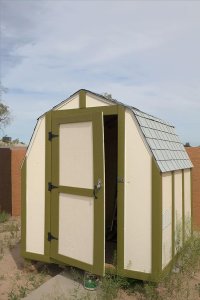
First, a digression. I'm attaching three pictures to this post. The first two are the digression; the third I'll discuss later.

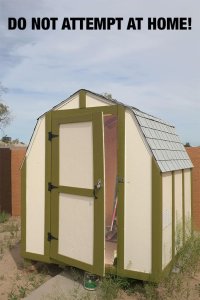
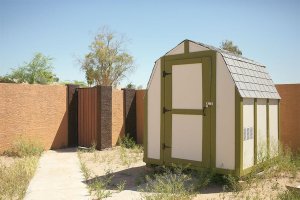
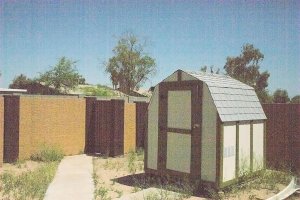
The first attachment is perhaps the archetypal cheesy Internet dynamic range test -- shooting into a garden shed on a bright day. I used a 5DIII and a Shorty McForty. 1/250 @ f/8 @ ISO 100 -- less than a stop dimmer than Sunny f/16.

You'll notice that the inside of the shed is very dark. And, indeed, it's basically exactly as dark as it appeared from my position. That's because this is a colorimetric rendering of the scene...which is different from the way most RAW developers tend to render scenes.

You see, film has a characteristic S-shaped curve to it -- a curve that's not natively present in RAW digital exposures but that almost every RAW developer since the dawn of time has intentionally and painstakingly mimicked. That is, film always stretches the contrast in the midtones but compresses the contrast in the shadows and the highlights. That's just the chemistry and physics of how film works.

Photographers have generally liked that rendition, because it creates images with more "pop." But they've also, perhaps unknowingly, fought against it, because it's exactly that S-shaped curve that causes loss of shadow and highlight detail both. There's no such thing as a free lunch, after all; if you increase contrast in one part of the image, it can only come at the expense of contrast in some other part of the image. Since it's generally the midtones that most people care about and don't mind a loss of detail in shadows and / or highlights, the default S-curve is often a good thing. But it's a real bitch to recover that shadow and highlight detail, especially after the S-curve has been applied, and doubly especially if you don't know that it exists. It can only be done by reducing the contrast in the midtones -- or, of course, by treating different parts of the image differently...and then you're left with an even bigger mess with the transition areas between those parts of the image. Adobe has worked some true magic with their RAW processors, but it's all done by hiding a lot of stuff under the rug. (Did I mention that there's no such thing as a free lunch?)

Anyway, with this colorimetric rendition of the shed, you can just barely pick out some texture in the interior, enough to guess at what's in there. And, from where I was standing, that's exactly what I was able to do: see just enough texture to guess at what I was seeing.

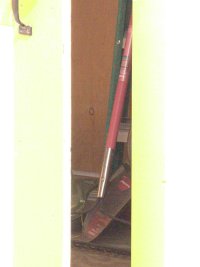
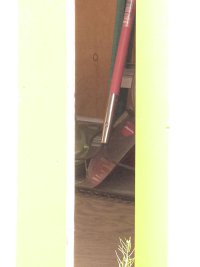
That brings us to the second picture. It's a 100% crop of the exact same RAW file, still a colorimetric rendition, but with four stops of digital push applied. And, surprise surprise! You can now easily see what those contents are -- just as if you were standing inside the shed itself. But, of course, the exterior is now vastly overblown.

I'll also note that I've here taken a four-stops-underexposed image and digitally pushed it. And not applied any noise reduction at all. If you've got any experience with these sorts of things, you should know that the noise that's there would clean up very easily and very well. Even if you didn't do anything to it, it wouldn't even be visible at anything less than a 12" x 18" print -- and even then, you'd have to look closely to see it and it wouldn't at all be objectionable.

Holy Cow! A Nikonista might exclaim. I must have used a D800! So little noise in shadows pushed four stops to a normalized exposure! No...I just exposed properly and I started with a colorimetric rendition.

That's where a lot of these problems come from. Photographers start doing whatever they do with the S-curve already applied, and the contrast in the shadows already flattened into mud. The detail was there...you're just trying to recover it after it's already been thrown away.

Enough of the diversion. Back to light.

There are, of course, times -- lots of times -- where you have no choice in the matter of the light. Sometimes, even, the extreme contrast is the whole point of the exercise and you've got no choice but to bracket and combine exposures to capture everything. I have an example of that here:

http://www.canonrumors.com/forum/index.php?topic=12617.0

That's as extreme an example as I can possibly imagine: a single image that includes the disk of the new moon silhouetting the Sun itself, plus a fully-lit (and backlit) near foreground of the Grand Canyon, plus the deep shadows at the bottom of the Canyon. And it's a fair representation of the scene as I perceived it -- but not in a single glance! The Sun looks very much as it did when I looked at it through solar viewing glasses, and the rest looks very much as it did without the glasses. (With the glasses, of course, everything but the Sun was black.) The foreground was very contrasty and a bit too bright to look at, and it was very hard to pick detail out of the Canyon. And the layers of the Canyon very definitely did fade into intolerably bright glare in the distance, becoming practically indistinguishable at the horizon.

I'd call that bad light, but it was such a spectacle as I'll never forget -- and that rendering of the scene is very faithful to what I remember, even though I had to blend together a half-dozen exposures in order to create it. But, again, it includes detail all the way from the deep shadows of the Grand Canyon to the very Sun itself.

Here's another example of bad light, one that I've repeatedly discussed in this thread and therefore won't keep beating up on:

http://www.canonrumors.com/forum/index.php?topic=13771.msg249243#msg249243

I mainly mention that bad light in order to segue into what good light actually is and what it looks like.

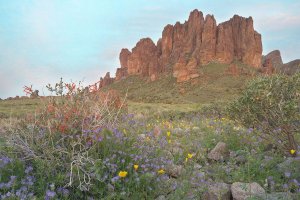
Here's what I actually went to the Lost Dutchman State Park on the day when I made that fisheye shot above -- the third attached photo.

With one minor and one insignificant caveat, this is, once again, a colorimetric rendering of the scene. As in, this looks almost exactly like what I saw, and it's almost exactly what the camera recorded. Again, the 5DIII, this time with the TS-E 24 II...and 1/6s @ f/16 * ISO 1600. Just a smidgen of chroma noise reduction and my typical capture and output sharpening.

The insignificant caveat is that the yellow of the the poppies is actually outside of the Lab gamut -- let alone Adobe RGB or even Pro Photo -- so that yellow got compressed / clipped to the perimeter of the Beta RGB gamut and then perceptually mapped into sRGB.

The minor caveat is that I had to darken the sky by about a stop to bring back the color and texture of the sky.

Perfect light would have resulted in a straight-out-of-the-camera colorimetric rendition that didn't need to be touched. This was as close to perfect as you're going to get in landscape photography.

It still took me a fair bit of fiddling with the sky to bring back the detail. Not because it was clipped in the raw exposure; I still had about a stop of headroom there. But the sky was a bit brighter than the foreground; the two never did quite perfectly equalize. I used a variety of methods to get this end result, but it's equivalent to about one stop of underexposure -- certainly less than two stops.

You can see a hint of haloing around the horizon, especially if you know it's there and you take a step back / reduce the image size. That is, the sky near the ground is a touch lighter than the sky a bit higher, and the tops of the ground are a bit darker than the ground below the horizon. That is an example of the lack of free lunches in action.

However, i like to think that I did a good job on this one. I don't think the transition is very noticeable, and it's certainly a lot less noticeable than if I had used a graduated filter (or waved a lens cap in front of the top half of the lens or whatever).

This is what good light looks like. Again, perfect light would have been with the sky about a stop darker and / or the foreground with about a stop brighter, but there wasn't any color left in the clouds when the light did equalize a few minutes later.

This post is already way too long, so I'll just end it here. Hope it helps.

Cheers,

b&

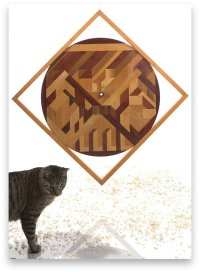
P.S. I lied. I can attach a fourth picture, so I will. It's perfect light, in a studio (with flash). This is a straight-out-of-the-camera colorimetric rendering, and absolutely zero post-processing. The feline photobomb was a fortuitous incursion that helps indicate scale...he's not perfectly lit, of course, but I like the way it makes him look like he's sneaking in from the wings of the stage. b&

 

Attachments

  • _06C2339 - standard.jpg
    _06C2339 - standard.jpg
    82.3 KB · Views: 596
  • _06C2339 - overexposed.jpg
    _06C2339 - overexposed.jpg
    63.7 KB · Views: 610
  • Superstitious Boquet.jpg
    Superstitious Boquet.jpg
    163.6 KB · Views: 556
  • Why Knot?.jpg
    Why Knot?.jpg
    84.7 KB · Views: 577
Upvote 0
@Trumpet: There is a lot more noise in _06C2339 - overexposed.jpg than you would have if you shot that with a D800. You are again assuming that is "clean". If you take that same shot with an actual D800 and push the same, you'll realize that it is most definitely not "clean". It's noisy...and it HAS chroma noise. The D800 might exhibit significantly less luma noise, probably wouldn't exhibit any chroma noise at all, and the detail would be much higher.

It would be nice if someone who actually has both a D800 and a 5D III could take a shot like that, and lift both by the same amount. It's not that the 5D III is "bad"...its most definitely not, its quite good, relative to the last decade of digital photography, and even to a lot of film photography. However it is not as good as a D800.
 
Upvote 0
TrumpetPower! said:
art_d said:
First you say that good light needs no modification. Then you say good light can indeed result from modification. This seems to be a contradiction.

If you're modifying the light itself, the light after modification -- if you've done your job right -- is now good light.

But if you're doing your modifications to the art, the light is still bad. That could be an artist painting a high-contrast scene as a low-contrast scene, or a photographer digitally (or in the darkroom or whatever) reducing contrast, or whatever.
I think jrista is right in that we are both now just mincing words, so I will concede this point on "good light vs. bad light." As I said in another post, it's just a philosophical perspective of mine that it is up to the photographer to work with the light. Or put another way, any light can be good light if you know what to do with it or how to manipulate it. Which I think is what you are saying anyway when you talk about "modifying the light itself."

However--since it does relate to the prison photograph we were discussing--I would like to offer the point for discussion that the exposure blending technique I used is not in principle different from the use of a graduated neutral density filter (or for that matter the black card technique mentioned previously in this thread, which too is a way of modifying the light itself prior to it reaching the camera). With a GND you are manipulating the light before it passes through the lens so that less light is transmitted in a portion of the scene. Exposure blending does essentially the same thing. The only difference is that instead of modifying the amount of light passing through one portion of the scene, you modify the amount of light in a separate exposure and then combine the desired portions of those exposures to get the desired result.

So exposure blending in this manner achieves the same net effect as a GND, although there are several advantages, such as not having to put another optical surface in front of your camera, and being able to be far more careful and selective in how the portions of the scene are blended. So it seems to me that if you accept GND filters as a valid technique for modifying light, then exposure blending should be acceptable as well.

So now let's bring it around full circle. The reason why we must use GND filters or exposure blending in the first place is because of dynamic range limitation. And so, if we accept that GND filters and exposure blending are useful to address dynamic range limitations, then we come to the inevitable conclusion that sensors that natively posses more dynamic range are useful.
 
Upvote 0
jrista said:
@Trumpet: There is a lot more noise in _06C2339 - overexposed.jpg than you would have if you shot that with a D800. You are again assuming that is "clean". If you take that same shot with an actual D800 and push the same, you'll realize that it is most definitely not "clean". It's noisy...and it HAS chroma noise. The D800 might exhibit significantly less luma noise, probably wouldn't exhibit any chroma noise at all, and the detail would be much higher.

<sigh />

Did I claim that it was clean? No. I noted that there's damned little noise in there -- there is -- and that is is totally without noise reduction -- it is -- and that it would clean up very nicely with a bit of noise reduction. And, sure enough, it does. See attached.

Frankly, if I can lift Zone I shadows four freakin' stops to midtones like this and get results like this, I really couldn't give a damn that Nikon can do more. It's like comparing the pickup truck that has a top speed of 105 mph with the one that has a top speed of 115 mph. Who gives a damn, really? Neither is going to get that load of gravel to the job site any quicker.

I mean, honestly. In what sane and rational world would one ever want -- let alone actually need -- to do what I just did here with the archetypal cheesy Internet measurebator snapshot of a garden shed? And in what truly messed-up world would it not be enough?

I mean, you do realize that I could make a 3' x 5' print of this as sharp as what you see on your display, as free of grain as you see here, no?

Pushed four stops! Four stops! From 135 format!

Cheers,

b&
 

Attachments

  • _06C2339.jpg
    _06C2339.jpg
    85.7 KB · Views: 1,357
  • _06C2339 as Smart Object-1.jpg
    _06C2339 as Smart Object-1.jpg
    48.6 KB · Views: 1,403
Upvote 0
art_d said:
So now let's bring it around full circle. The reason why we must use GND filters or exposure blending in the first place is because of dynamic range limitation. And so, if we accept that GND filters and exposure blending are useful to address dynamic range limitations, then we come to the inevitable conclusion that sensors that natively posses more dynamic range are useful.

I think we're almost there.

First, I imagine that the exposure blending you do is much the same as what I did on that shot of the Grand Canyon with multiple exposures, and what I also did with the wildflowers at the base of the Superstition Mountains but with two developments of a single exposure. Even if the actual technique isn't the same, they're logically equivalent.

But the fact that I had to blend two different developments of the same RAW file to get the exposure I needed of the wildflowers brings us to the analogy I used in my response to jrista's needling about D800 dynamic range.

Yes, there is a huge limitation with respect to dynamic range and photography. Absolutely monstrous.

But the cameras aren't the problem.

Just as it's been a loooooong time since the limiting factor in travel times in urban settings has been the maximum speed of the vehicle, it's also been a loooooong time since the limiting factor in photographic dynamic range has been the film and / or electronics used to record the image.

The elephant in the room, the one that nobody ever seems to want to talk about, is the print.

There hasn't been a film / sensor made in decades that can't cleanly produce significantly more dynamic range than a print.

So, sure. Go ahead and capture all you twenty Brazilian stops in a single exposure with your ExSonMorCon sensor.

Now what?

What have you gained, really?

You've still first got to compress that down to the ten stops of the ICC PCS that your RGB image gets run through every time it goes from one color space to another (including from the camera's native space to whatever your favorite working space to your monitor's space to your printer's space).

To those who poo-pooh the Zone System...take any image you can find on the computer. In Photoshop, change to Lab mode. Looks the same, no? Now, compare the L* values of anything you like in the image. Divide by 10, and there's your Zone. And, no, that's not a coincidence. It's a direct and very, very well-informed evolution based on hard science and a hell of a lot of experience.

All of this put together means that means that, if you want the best results, you're either going to wind up blending multiple developments of a single exposure (which is really all that the sliders in Camera Raw / Lightroom do) or blending multiple different exposures...so what's the difference, really? A bit of wear and tear on your camera's shutter that's going to last you a half million exposures and cost $300 to replace when it finally dies?

So maybe every now and again there's an extreme dynamic range shot of a moving subject where you can't fix the light and you need to produce monstrous enlargements meant to be viewed from a short distance (the very definition of pixel peeping) and you can't stand even a hint of grain in the shadows of said shots and you can't let the shadows remain shadows and it's in that narrow two-stop window of additional dynamic range that the D800 has over the 5DIII.

If that's not the setup line for some bad joke about a DeLorean getting electrocuted at the stroke of midnight as it gets blown up with a supersonic missile on Highway 88, I don't know what is.

Cheers,

b&
 
Upvote 0
TrumpetPower! said:
jrista said:
@Trumpet: There is a lot more noise in _06C2339 - overexposed.jpg than you would have if you shot that with a D800. You are again assuming that is "clean". If you take that same shot with an actual D800 and push the same, you'll realize that it is most definitely not "clean". It's noisy...and it HAS chroma noise. The D800 might exhibit significantly less luma noise, probably wouldn't exhibit any chroma noise at all, and the detail would be much higher.

<sigh />

Did I claim that it was clean? No. I noted that there's damned little noise in there -- there is -- and that is is totally without noise reduction -- it is -- and that it would clean up very nicely with a bit of noise reduction. And, sure enough, it does. See attached.

Frankly, if I can lift Zone I shadows four freakin' stops to midtones like this and get results like this, I really couldn't give a damn that Nikon can do more. It's like comparing the pickup truck that has a top speed of 105 mph with the one that has a top speed of 115 mph. Who gives a damn, really? Neither is going to get that load of gravel to the job site any quicker.

I mean, honestly. In what sane and rational world would one ever want -- let alone actually need -- to do what I just did here with the archetypal cheesy Internet measurebator snapshot of a garden shed? And in what truly messed-up world would it not be enough?

I mean, you do realize that I could make a 3' x 5' print of this as sharp as what you see on your display, as free of grain as you see here, no?

Pushed four stops! Four stops! From 135 format!

Cheers,

b&

I think you are still missing the point. You've lifted that 4 stops...that is amazing, no doubt about it! I am an advocate for both brands, as both brands achieve some amazing things, regardless of whether they are 12 stops or 14 stops of DR.

The point, here, is that the D800 can still do better. There are some sample images and the accompanying RAW files on Flickr that are so completely underexposed, the images look almost entirely black without any post processing. You can lift those nearly black photos at least SIX stops, and still have an image with richer contrast, deeper and more detailed shadows, richer color, stronger highlights, and LESS NOISE than the photo you have posted here.

I've posted my own images from my Canon 7D where I've pushed exposure around by about four stops. That's about what you get with a Canon sensor. Four stops. That's particularly evident when you use an 8-bit computer screen...your screen is limited to only displaying eight stops at once, so you have to push and pull the shadows to get a photo looking correct on an 8-bit display. You need to push shadows around even more in order to compress that information into the 5-7 stops you get in a print, especially for fine art matte papers where you might barely have five stops of DR.

It's not a perfect four stops either, you usually start losing a LOT of color fidelity once you've pushed over two stops. Four stops is really pushing the boundaries, and like your examples, you lose contrast and color fidelity (richness of detail) where things are supposed to be deeper shadows. They end up looking muddy, dull, lifeless. You could push less, but that may not accurately represent what the scene looked like to human eyes. You could push less, and end up with just that much less detail in the shadows, or too much global contrast.

The same things can be done with the D800, D600, or D3200, WITHOUT those limitations. That's the point. Four stops is great. Six stops is better! And six stops is exactly what you would expect the difference to be between a camera capable of capturing ~12 stops of DR in a single shot vs. a camera capable of capturing ~14 stops of DR in a single shot. Noise reduction can improve your gains a bit. Assuming the noise is evenly distributed, or if you have a debanding NR tool, you might be able to gain another stop, and the gains might be a little better in terms of magnitude for a Canon...which starts out with more noise than a Nikon w/ Exmor, but the Nikon will still benefit from NR as well. So it will maintain its lead even if it is a smaller lead.

Again, as this seems to be a common misunderstanding. This doesn't make the 5D III a "bad" camera. Some people seem to think that because the D800 does better, well then the 5D III must just suck, right? I've argued AGAINST that kind of sentiment for over a year. The 5D III is an excellent camera. That is more than evident in the kind of photos people take with it. That's not the point. The point is, many photographers do the kind of work that can and will benefit from more native dynamic range. The point is that more dynamic range, be it in a D800, or in some future camera Canon releases six months, a year, or four years from now, is a useful thing. It leads to better IQ. It supports a simpler workflow. It expands the boundaries of what we can do with a camera.

It's VALUABLE. It's USEFUL.

It would allow Art_d to do less work with more information and get better results in less time.

Just because you can lift a 5D III's "Zone I" shadows by four stops, make them look rather dull, muddy, lacking in fine detail and color fidelity, and a little noisy...doesn't mean the buck stops there. The D800 can STILL do BETTER! That's the point!


TrumpetPower! said:
<sigh />

Did I claim that it was clean? No. I noted that there's damned little noise in there -- there is -- and that is is totally without noise reduction -- it is -- and that it would clean up very nicely with a bit of noise reduction. And, sure enough, it does. See attached.

BTW, and I quote:

TrumpetPower! said:
Holy Cow! A Nikonista might exclaim. I must have used a D800! So little noise in shadows pushed four stops to a normalized exposure! No...I just exposed properly and I started with a colorimetric rendition.

I don't think you've seen very many D800 ISO 100 photos. If you really think the noise in either the original that has no NR, or even the second one you posted that does have NR, is anywhere close to the shadow IQ of a D800, you are mistaken.

Take that same photo of the shed with the D800, lift it four stops, and you STILL have two more stops of DEEPER SHADOWS that will be richer, less noisy, and more detailed than either of the two shots you posted. You are trying to make a comparison to something it seems you have either never really seen, or not investigated deeply enough, to really understand now ludicrous it sounds to read the quote above. NO, I did not think:

"Holy Cow! He must have used a D800! So little noise in shadows pushed four stops to a normalized exposure!"

I thought:

"Is this guy serious? Has he ever even seen a D800 lifted by four to six stops?"

I really encourage you to look more into the shadow recovery capabilities of the D800. It's not a 5D III killer, it doesn't make Canon cameras worthless or useless or moot, or in any other way incapable of taking excellent photographs. But it IS a game changer for some types of photography, in a very meaningful and extremely valuable way.
 
Upvote 0
TrumpetPower! said:
The elephant in the room, the one that nobody ever seems to want to talk about, is the print.

There hasn't been a film / sensor made in decades that can't cleanly produce significantly more dynamic range than a print.
TrumptPower, I've been making exhibition prints for a number of years now so I can speak with some experience in this area. I'm sorry, but with all due respect I have to say you are off base here. In fact I presented an example of one such case along with the prision photo where the dynamic range limitations of the camera were problematic and created an issue in the print.

http://www.arthurdomagala.com/blog/2012/04/dynamic-range-canon-dslrs-and-shadow-noise-dealing-with-it/

And it's not just me. What about all those National Geographic photographers who've been using GND filters for these past decades, where you claim that there should be no dynamic range limitations for print? What about all those landscape photographers using them who make prints?

So maybe every now and again there's an extreme dynamic range shot of a moving subject where you can't fix the light and you need to produce monstrous enlargements meant to be viewed from a short distance (the very definition of pixel peeping) and you can't stand even a hint of grain in the shadows of said shots and you can't let the shadows remain shadows and it's in that narrow two-stop window of additional dynamic range that the D800 has over the 5DIII.
From my experience (again, I am talking real world work I am actually producing, not contrived scenarios), there are situations where the fixed pattern noise present in Canon sensors will be obtrusive even in moderate sized prints.

You've made several exagerrations in your post which I do not think are helpful to the conversation.

First, I do not know what constitutes "monstrous enlargements" to you, but as far as the implication that viewing prints from a short distance is "pixel peeping"... the whole viewing distance argument is a red herring. Because viewing distance has more to do with context than with print size. For instance, I printed a series of 24x36 enlargements of project photos for a company's conference room. I didn't stress out about smudgy details or noise in those photos because of the context. They look fine from across the room, and that is the context they are meant to be viewed in. But, in a gallery setting, they would not be acceptable (to me at least). When prints are exhibited in a gallery, we don't rope off a perimeter in front of the print so that a viewer can't get close to the print and examine its details!

Another problem with your statement above is the "hint of grain" remark. We are not talking about grain. We are talking about fixed pattern noise.

And finally, you imply there is only a problem if you don't let "shadows remain shadows." This too has been demonstrated as false.
 
Upvote 0
art_d said:
First, I do not know what constitutes "monstrous enlargements" to you, but as far as the implication that viewing prints from a short distance is "pixel peeping"... the whole viewing distance argument is a red herring.

First, you've got that bass-ackwards, and you're dead worng.

You've indicated that you deliver full-size full-resolution files to your clients with the expectation that they will be pixel peeping them and that you and they expect your files to look good when viewed at 100% pixel magnification on the screen.

There is no difference at all between pixel peeping a 5DIII file and standing a foot away from a 38" x 57" print of said file. No difference at all.

Another problem with your statement above is the "hint of grain" remark. We are not talking about grain. We are talking about fixed pattern noise.

And finally, you imply there is only a problem if you don't let "shadows remain shadows." This too has been demonstrated as false.

So take a look at the cheesy shed pictures I posted above. I'd suggest that's the very definition of extreme. Would you agree? And I'd also suggest that the cleaned-up results are more than acceptable for printing even at 24" x 36". Would you agree? And I'd further suggest that only boosting those shadows three stops instead of four stops would make the few hints of objectionable noise remaining invisible even in a 44" x 66" print. Would you agree?

If you would agree with me on all those points...then what's the problem? If I can get results like that with a hasty shot of the shed in my back yard, what real-world photographic situation is there, actually, that's even more demanding? (Short, of course, of crazy things like when I shot the annular eclipse and the bottom of the Grand Canyon at the same time.)

Do I just have amazing intuitive technique and not realize it? Am I the only one who actually knows how to expose properly and develop a raw file to its full potential?

Or are there some even more extreme, more demanding situations out there that I'm simply unaware of?

Once again: is this a case of bragging about the speed at which the rev limiter kicks in on the minivan, or are there actual real-world situations where that minivan actually isn't fast enough?

Cheers,

b&
 
Upvote 0
TrumpetPower! said:
art_d said:
First, I do not know what constitutes "monstrous enlargements" to you, but as far as the implication that viewing prints from a short distance is "pixel peeping"... the whole viewing distance argument is a red herring.

First, you've got that bass-ackwards, and you're dead worng.
The discussion might proceed better without the snarkiness. (Just my opinion.)

Ok. So, please explain how I am wrong.

You've indicated that you deliver full-size full-resolution files to your clients with the expectation that they will be pixel peeping them and that you and they expect your files to look good when viewed at 100% pixel magnification on the screen.
Please recall that what I said was I deliver files to my clients at native resolution with a uniformity in quality.

In addition to delivering files to clients I sometimes make prints for them. And in addition to that, I also exhibit my own work.

There is no difference at all between pixel peeping a 5DIII file and standing a foot away from a 38" x 57" print of said file. No difference at all.
What is the point of injecting this straw man argument? I made no mention of printing this size. I made reference to a 20x30 inch print. (Though I’ve seen pattern noise occur in prints smaller than that too.)

And I'd also suggest that the cleaned-up results are more than acceptable for printing even at 24" x 36". Would you agree?
No I would not. Because you have not defined “acceptable” in a context. What is acceptable in one context is not acceptable for another. For a billboard, sure. For a gallery print, certainly not. And you are ignoring that the content of the photo itself also has a huge impact as to whether or not pattern noise is noticeable enough to be objectionable.

And I'd further suggest that only boosting those shadows three stops instead of four stops would make the few hints of objectionable noise remaining invisible even in a 44" x 66" print. Would you agree?
No. See above.

And in all honesty, I am not really concerned about shadow noise in prints at such sizes. Because once you get to a point where you’re interpolating the image by that much, the context of the work is different. It’s in the more moderate print sizes where it can be a problem (as I’ve tried to demonstrate).

If I can get results like that with a hasty shot of the shed in my back yard, what real-world photographic situation is there, actually, that's even more demanding?
I’ve already shown two real-world photographic situations.
 
Upvote 0
Okay, enough already.

If these shots don't lay the entire matter to rest, absolutely nothing will.

One more exposure of the same classic cheesy Internet measurebator shot: my backyard shed.

I shot this six stops underexposed. As in, I moved the metering bug from where it said it was supposed to be three stops to the left until it disappeared and then another three stops farther.

And I only stopped there because I ran out of shutter speed -- though, of course, I had plenty of room to stop down the aperture.

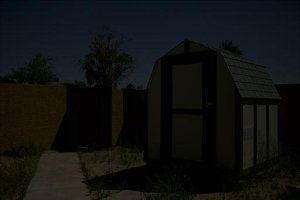
The first attachment is just with white balancing.

The second is after applying six stops of digital push. That makes it the digital equivalent of an ISO 6400 shot.

The third is a 100% crop of a representative portion which includes the noisiest part of the resulting image.

Yes, of course -- I applied noise reduction.

I really don't think there's anything further that needs to be written about the 5DIII's ability to recover shadows.

Once again, and for the last time if I can control my SIWOTI:

The 5DIII has far more dynamic range than 90% of photographers need for 90% of photographic situations. The set of real-world photographic situations where the 5DIII has insufficient dynamic range but the D800 does is almost, but perhaps not quite, perfectly empty. If you find that the 5DIII lacks sufficient dynamic range for your needs, either you're doing some truly extreme photography (such as making an image of an annular eclipse at the Grand Canyon) or your technique isn't up to getting everything from the camera that it's capable of giving.

Cheers,

b&
 

Attachments

  • _06C2344 as shot.jpg
    _06C2344 as shot.jpg
    13.3 KB · Views: 833
  • _06C2344 normalized.jpg
    _06C2344 normalized.jpg
    129.9 KB · Views: 817
  • _06C2344 normalized crop.jpg
    _06C2344 normalized crop.jpg
    183.9 KB · Views: 832
Upvote 0
Okay, so maybe my SIWOTI is a bit worse than I thought -- or maybe I'm just dragging my feet a bit before I get back to trying to figure out how I'm going to light this giclee shoot of a beetle that's mostly a solid block of gold leaf the size of a soup bowl.

But here's one more -- perhaps the ultimate -- variation on the theme.

This is the darkest exposure i could get without resorting to filters: 1/8000 @ f/22 @ ISO 100. As far as the back-of-the-LCD preview goes, i might as well have left my lens cap on -- which, I know, is another favorite activity of Internet measurebators. It worked out to nearly ten stops of digital push; that's the digital equivalent of ISO 51,200. As in, take all of the analog gain that the camera does on the sensor at its native maximum ISO of 25,600, do that digitally instead, and then add yet another stop of digital gain.

I'd show you the as-is shot, but it's as solid black as the LCD preview was.

But I am including a 100% crop of the highlights. Yes, the shadows (and midtones) in this shot are junk. Duh! It's a digitally-pushed ISO 51,200 equivalent exposure. But these highlights are what you get from the 5DIII when you push your below Zone I solid featureless black ink blobs to Zone VIII (edit: forgot an "I") and IX near-paper-white highlights.

And if any of all y'all really want -- or think you need -- more out of a camera...well, sorry, but I ain't got no sympathy for you. None whatsoever.

Cheers,

b&
 

Attachments

  • _06C2347 crop.jpg
    _06C2347 crop.jpg
    200.5 KB · Views: 718
  • _06C2347.jpg
    _06C2347.jpg
    197.9 KB · Views: 676
Upvote 0
TrumpetPower! said:
Okay, enough already.

If these shots don't lay the entire matter to rest, absolutely nothing will.

One more exposure of the same classic cheesy Internet measurebator shot: my backyard shed.

I shot this six stops underexposed. As in, I moved the metering bug from where it said it was supposed to be three stops to the left until it disappeared and then another three stops farther.

And I only stopped there because I ran out of shutter speed -- though, of course, I had plenty of room to stop down the aperture.

The first attachment is just with white balancing.

The second is after applying six stops of digital push. That makes it the digital equivalent of an ISO 6400 shot.

The third is a 100% crop of a representative portion which includes the noisiest part of the resulting image.

Yes, of course -- I applied noise reduction.

I really don't think there's anything further that needs to be written about the 5DIII's ability to recover shadows.

Once again, and for the last time if I can control my SIWOTI:

The 5DIII has far more dynamic range than 90% of photographers need for 90% of photographic situations. The set of real-world photographic situations where the 5DIII has insufficient dynamic range but the D800 does is almost, but perhaps not quite, perfectly empty. If you find that the 5DIII lacks sufficient dynamic range for your needs, either you're doing some truly extreme photography (such as making an image of an annular eclipse at the Grand Canyon) or your technique isn't up to getting everything from the camera that it's capable of giving.

Cheers,

b&

Could you post some original images with full EXIF? The original "dark" image looks a little odd...too flat, such that it makes me wonder if it really is a natively under-exposed shot.

Additionally, the noise in those shadows is not clean. It looks nothing like the kind of deep NOISELESS or NEAR-NOISELESS shadows you get out of a D800 when it is lifted 6 stops. You might see that kind of noise if you lifted a D800 eight stops, however you still wouldn't have the banding, which is the real problem Canon sensors have. I'm ok with noise...but I can clearly see the banding in those shadows.

Again, you should really play with a few D800 NEF's yourself. I think you don't fully understand what those extra 2 stop of DR offer, or what it means to have ZERO BANDING NOISE. It's the banding noise that is the real killer for Canon sensors. Their native sensor DR is actually probably just as good as Nikons, but when the off-die ADC's in the DIGIC DSP's process the signal, they ADD the hideous shadow noise that Canon sensors are now infamous for. If it wasn't for the ADC noise, I think Canon sensors are actually quite stellar.
 
Upvote 0
art_d said:
TrumpetPower! said:
The elephant in the room, the one that nobody ever seems to want to talk about, is the print.

There hasn't been a film / sensor made in decades that can't cleanly produce significantly more dynamic range than a print.
TrumptPower, I've been making exhibition prints for a number of years now so I can speak with some experience in this area. I'm sorry, but with all due respect I have to say you are off base here. In fact I presented an example of one such case along with the prision photo where the dynamic range limitations of the camera were problematic and created an issue in the print.

http://www.arthurdomagala.com/blog/2012/04/dynamic-range-canon-dslrs-and-shadow-noise-dealing-with-it/

And it's not just me. What about all those National Geographic photographers who've been using GND filters for these past decades, where you claim that there should be no dynamic range limitations for print? What about all those landscape photographers using them who make prints?

Your article touches on some points that Ctein, a well-known printer who has decades of experience in film and digital, has mentioned a number of times in his writings. Very interesting stuff.
 
Upvote 0
Status
Not open for further replies.